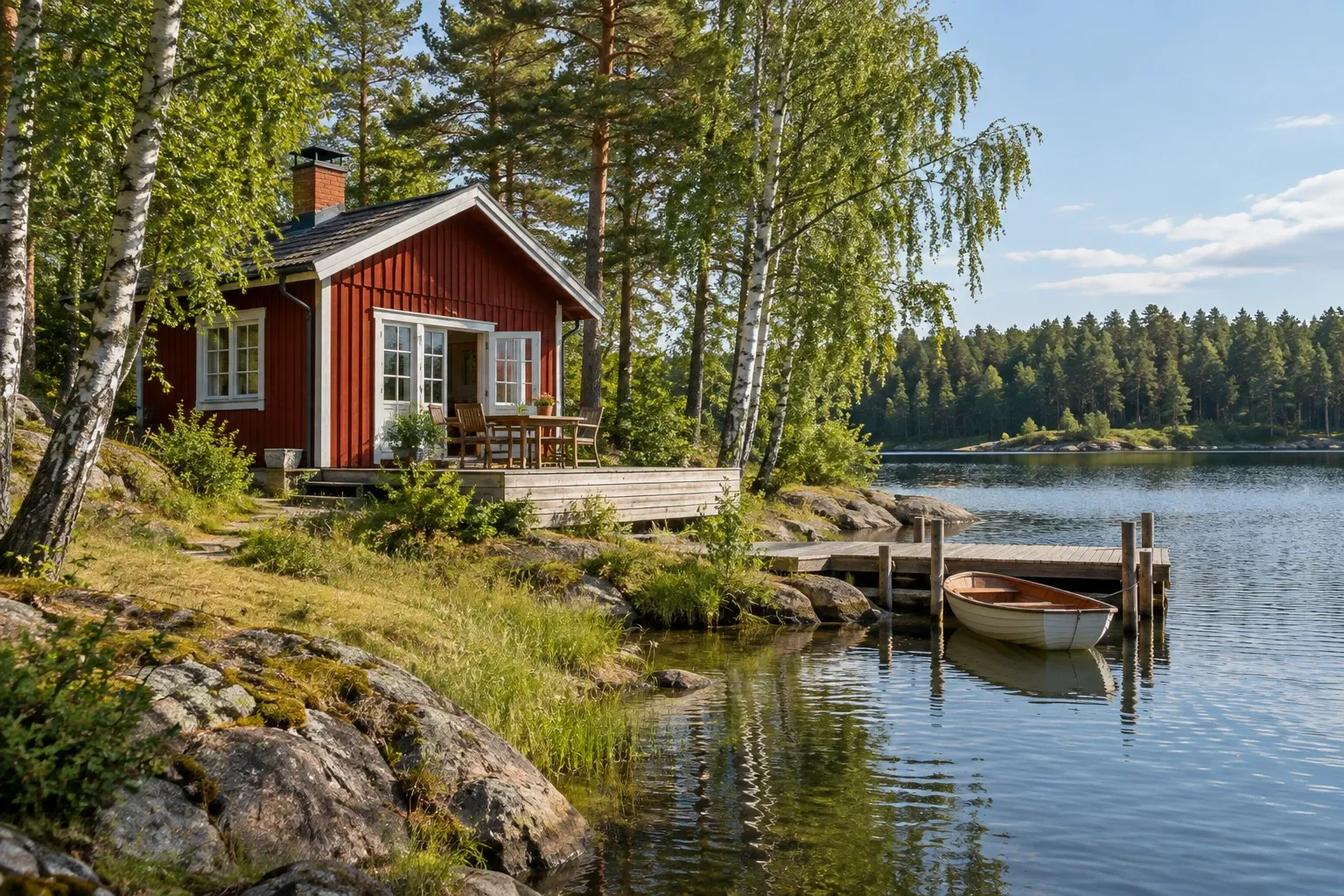
The gap between the photograph and the week is where cabin disappointment lives. Almost every gap is a feature — cheaper, quieter, on a lake no hotel could reach — as long as nobody has to discover it at 22:00 on arrival night.
When you need this
You have booked a stuga and the listing is thin. You are choosing between a cabin, a hotel and a campsite cabin for a family week. The listing says egen brunn and you do not know whether that matters. Or it is departure morning and there is a cleaning checklist on the fridge.
A stuga is a house, not a hotel
What you are renting is a private house that somebody lends you for a week. It has whatever systems that house happens to have — which is exactly why it costs a fraction of a hotel and sits somewhere a hotel never could.
Three of those systems account for most of the surprise: water, sewage and the toilet. Everything else is house rules Swedes absorb in childhood and never think to write down.
Water: municipal supply or a private well
Many rural cabins do not draw from a municipal main. They draw from a private well (egen brunn) on the property, which is the owner’s responsibility rather than a utility’s.
For a rented cabin, Swedish law splits at a surprisingly precise line:
| The cabin | What applies to its well |
|---|---|
| Rented holiday accommodation for up to 8 guests | Outside the drinking-water regulations entirely — quality is the owner’s responsibility |
| Larger lets, or supply of 10 m³/day or 50+ people | A commercial drinking-water facility: registered with the municipality, with a hazard analysis and sampling programme the municipality approves |
So the honest answer to “is the cabin water tested?” depends on how many beds the cabin has. Below the line, the Swedish Food Agency’s values are guideline values, not binding limits — the agency advises testing at least every three years, and every year if small children drink it.
One question settles it: municipal water or egen brunn, and when was it last tested? Any good host answers immediately. For whether it is safe to drink — almost always yes — see can you drink tap water in Sweden, which owns that ground.
New for 2026: the fluoride guideline value for private wells was lowered to 1.5 mg/l on 1 February 2026, matching the municipal limit, after the European Food Safety Authority reassessed fluoride and named the fetus — and therefore pregnant women — the most sensitive group. Older Swedish advice named small children instead.
Toilets: flush, incinerate, or walk outside
Sweden has roughly 700,000 small sewage systems with a water closet connected, and around a million properties on their own or a shared small system. A cabin toilet is therefore rarely connected to a public sewer, and it may not be a flush toilet at all.
| Type | What it means for you |
|---|---|
| Flush toilet on a septic system | Works normally — but see the flushing rules below |
| Incinerating toilet (förbränningstoalett) | Burns the waste at around 600 °C. Needs a fresh bowl liner at every visit and runs for roughly an hour afterwards |
| Composting or urine-separating dry toilet | No water, no smell when correctly vented, a bin rather than a bowl |
| Outhouse (utedass) | A separate hut, dry, with a composting arrangement. Torch recommended |
None of these are unhygienic. A well-ventilated utedass is odourless and, once you have used it in daylight, entirely unremarkable. The listing should say which you are getting — if it does not, ask.
What you must not flush
A private sewage system is a small piece of living biology, not a municipal treatment plant that can absorb your mistakes.
Only faeces and toilet paper go down the toilet. Everything below disturbs the biological processes that clean the water and can damage the system outright:
- Wet wipes — including anything sold as “flushable”. They are the commonest cause of blockages
- Cooking fats and oils
- Household chemicals, paint, solvents
- Leftover medicines — these go back to a pharmacy
Installing such a system requires a municipal permit in the first place, and sludge emptying (slamtömning) happens at least once a year. If a tanker turns up in the drive during your week, that is routine.
Winter: the water may simply be turned off
Rather than heat an empty house all winter, owners of summer cabins shut off the supply and drain the pipes and water heater so nothing freezes and bursts. A cabin let outside its season may therefore have no running water at all.
Cabins built for year-round use do not have this problem — but their rental terms commonly require you to leave the heating on at around 10 °C through the cold half of the year, for exactly the same reason. Confirm water availability for your specific dates rather than for the season.
What the cabin probably will not have
Not faults. Just absences worth knowing before you arrive:
- A dishwasher. Common in Swedish homes, uncommon in cabins
- A tumble dryer. There may well be a washing machine, and there will be a drying rack
- Reliable wifi. Agencies specifically advise against streaming and heavy downloads on cabin connections
- Strong mobile signal. Thin in forest, mountain and archipelago terrain — see mobile coverage in Sweden’s wilderness
- Tea towels, dish cloths and bin bags. Bring them
- Included electricity. It is frequently metered, read at arrival and departure, and settled when you return the key
One safety note attached to that last cluster: Telenor, Tele2 and Tre switched off their 2G and 3G networks in December 2025, so an older handset without VoLTE may not connect a call at all — including to 112. Check before you go somewhere remote.
Cleaning on departure is your job
This is the item that costs money to get wrong. Guest-performed final cleaning (slutstädning) is the Swedish norm, and agencies publish a checklist for it.
You usually have three options, and only two of them are good ideas:
- Buy final cleaning when you book. Priced per cabin by size. The sane choice if you have a morning ferry
- Clean it yourself to the published standard, allowing real time on departure day
- Leave it and hope — the owner is entitled to invoice you for cleaning afterwards, at their rate
Note the trap in option 1: even when cleaning is included or bought, the dishes and the oven are usually still yours. Departure is typically 10:00.
Bed linen, towels and what to pack
Pillows and duvets are supplied. Sheets, pillowcases, duvet covers and towels are not — the guest brings them, and that is standard across the Swedish letting market.
Most owners will rent you linen if you ask when booking, paid on site. Assume “bring your own” unless the listing says otherwise in writing, because discovering this on a rural Saturday evening means a long drive or a week under bare duvets.
Add to the bag: tea towels, dish cloths, bin bags, a torch, insect repellent and a power bank.
Firewood, the wood stove and the sauna
Most cabins have a wood stove, many have a sauna, and both are among the best reasons to be there.
Firewood is usually your purchase — from the owner, a filling station or a shop. And never burn driftwood or beach-collected wood: the salt in it damages the firebox, and that damage is yours.
The stove itself you can trust. Swedish municipalities are responsible by law for the sweeping and fire-safety inspection of fixed combustion appliances, at intervals set by the civil contingencies agency. Locate the smoke alarm and the water stopcock when you arrive, before you unpack.
Running the sauna and underfloor heating all week on a metered supply is how people meet a surprising bill at key return.
The boat, the jetty and the lake
If a boat comes with the cabin, it is normally a bare boat: let by the week, used at your own risk, fuel at your cost, approved life jackets required and under-16s supervised by an adult.
You do not need a licence. Sweden requires a certificate only for craft over 12 metres long and 4 metres wide, which no cabin rowing boat approaches — jet skis are the one exception and do need a förarbevis. Check bailer, oars, fuel and life jackets before you push off, and bring children’s life jackets from home: cabin stocks run adult-heavy.
The jetty is part of the property. Swimming from your own brygga needs no permission; landing on a neighbour’s does.
Mosquitoes and ticks
Northern Sweden in high summer has the mosquitoes the rest of the country jokes about. Repellent, long sleeves in the evening, mesh over any open window.
The joke misplaces the worst of it, though. Sweden’s two officially recognised mosquito emergencies are in the central lake belt, not Lapland: the Nedre Dalälven floodplain and Klarälven at Forshaga both hold Naturvårdsverket permits for helicopter larvae control, granted because the mass occurrence makes it close to unbearable to be outdoors. A cabin on the Dalälven floodplain in a wet July is a harder proposition than one in Jämtland — and it is ninety minutes from Stockholm.
Ticks are the more serious item. Lakeside and archipelago cabins in southern and central Sweden sit in exactly the right habitat. Sweden’s public health agency issued revised TBE vaccination recommendations on 5 May 2026, recommending vaccination for adults and children from age three at risk of tick bites in risk area 1; cases are reported from Skåne up to southern Dalarna and further north along the Baltic coast. Build a daily tick check into the week — see ticks in Sweden and mosquitoes in Sweden.
Rubbish, recycling and pant
Here is the one nobody warns you about: at many Swedish holiday houses rubbish collection is not organized at all, and removing it is explicitly the guest’s job. Ask the host where the nearest bins or recycling station (återvinningsstation) are on arrival, not on departure morning.
It also has to be sorted. Separating food waste has been a legal requirement across Sweden since 1 January 2024, and packaging collection is mid-transition — municipalities have had to collect all packaging materials at certain squares and parks since 1 January 2026, with collection at the property required from 1 January 2027. Arrangements genuinely differ between municipalities right now.
And save the empties: a week’s cans and PET bottles are worth real money at any supermarket machine. See how pant works.
Five questions to ask before you book
Send these in one message. A good host answers all five in one reply.
- Is the water municipal or egen brunn — and when was the well last tested?
- What kind of toilet is it?
- Will the water be turned on during my dates?
- Is bed linen included, or can I rent it?
- Is final cleaning included, and can I buy it?
Practical information
| Item | Detail |
|---|---|
| Water | Municipal or private well; wells for lets of up to 8 guests sit outside the drinking-water regulations |
| Well testing | Owner’s responsibility; agency advice is at least every 3 years, yearly with small children |
| Fluoride guideline (private wells) | 1.5 mg/l since 1 February 2026 |
| Toilet | Flush on septic, incinerating, dry/composting, or an outhouse |
| Down the toilet | Faeces and toilet paper only — no wipes, fats, chemicals or medicines |
| Winter water | Often drained and off; year-round lets usually require ~10 °C background heat |
| Bed linen and towels | Bring your own; pillows and duvets supplied; linen often rentable on site |
| Final cleaning | Usually an optional add-on priced per cabin; otherwise yours, or invoiced afterwards |
| Electricity | Often metered — read at arrival and departure, settled at key return |
| Firewood | Usually bought by the guest; never burn driftwood |
| Boat | Weekly, own risk, own fuel, life jackets required; no licence under 12 × 4 m |
| Rubbish | Often no collection — you remove it, sorted; food waste separation mandatory since 2024 |
| Typical times | Arrival from 16:00, departure by 10:00 |
| Deposit | Common, covering electricity, water and damage |
FAQ
Can you drink the water in a Swedish holiday cabin?
Usually yes, but ask one question: municipal supply or a private well (egen brunn)? Municipal water is food-grade by law. A well below the regulated thresholds is the owner’s responsibility, tested on advice rather than obligation — Livsmedelsverket suggests every three years, yearly with small children. A good host knows the answer immediately.
Do Swedish holiday cabins have proper toilets?
Many do, but not all. You may find an ordinary flush toilet on a private septic system, an incinerating toilet that burns the waste, a composting or urine-separating dry toilet, or a genuine outhouse (utedass) behind the cabin. The listing should say which. None of them are unhygienic; they simply work differently from a hotel bathroom.
Do I have to clean the cabin before I leave?
Yes, unless you have bought final cleaning (slutstädning). Guest-cleaned departure is the Swedish norm and agencies publish a checklist. Even when cleaning is included, the dishes and the oven are usually still yours. If you leave it unclean without paying for cleaning, the owner is entitled to invoice you afterwards.
Do I need to bring my own bed linen to a Swedish cabin?
Normally yes. Pillows and duvets are supplied; sheets, pillowcases, duvet covers and towels are brought by the guest, along with tea towels and cloths. Most owners will rent you linen if you ask when booking, paid on site. Assume “bring your own” unless the listing states otherwise in writing.
Is there wifi and mobile coverage at a Swedish cabin?
Often some of both, rarely enough for remote work. Agencies specifically advise against streaming and heavy downloads on cabin connections, and coverage thins in forest, mountain and archipelago terrain. Note also that Telenor, Tele2 and Tre switched off 2G and 3G in December 2025, so older handsets may fail entirely. Download maps in advance.
Why is there no water at the cabin in winter?
Because summer cabins are drained. Rather than heat an empty house all winter, owners shut the supply and empty the pipes and water heater so nothing freezes and bursts. Cabins let year-round avoid this, but their rental terms often require you to leave background heating at around 10 °C. Confirm water availability for your exact dates.
What do I do with the rubbish when I leave a Swedish cabin?
Often, take it with you. At many Swedish holiday houses collection is not organized and disposal is explicitly the guest’s job — sorted, since separating food waste has been a legal requirement since January 2024. Cans and PET bottles go to a supermarket deposit machine for a refund. Ask the host where the nearest bins or recycling station are.
Related guides
- Can you drink tap water in Sweden? — the safety answer behind the well question on this page
- Renting a stuga — how the Swedish cabin letting market actually works
- Where to book Swedish cabins — the platforms compared, before you commit
- Swedish campsites — campsite cabins are a different, cheaper, more serviced product
- How pant works — turning the week’s empties back into money
- Wild camping in Sweden — if the cabin is a base for wider trips
Facts verified 2026-07-26. Sources: Livsmedelsverket, Havs- och vattenmyndigheten, Naturvårdsverket, Folkhälsomyndigheten, Transportstyrelsen, PTS, Sveriges Riksdag and Swedish cabin letting agencies — full register in this topic’s source file. Cleaning fees, linen charges and electricity rates vary by owner and are deliberately not published here; check your listing. Found something outdated? Tell us and we’ll fix it.