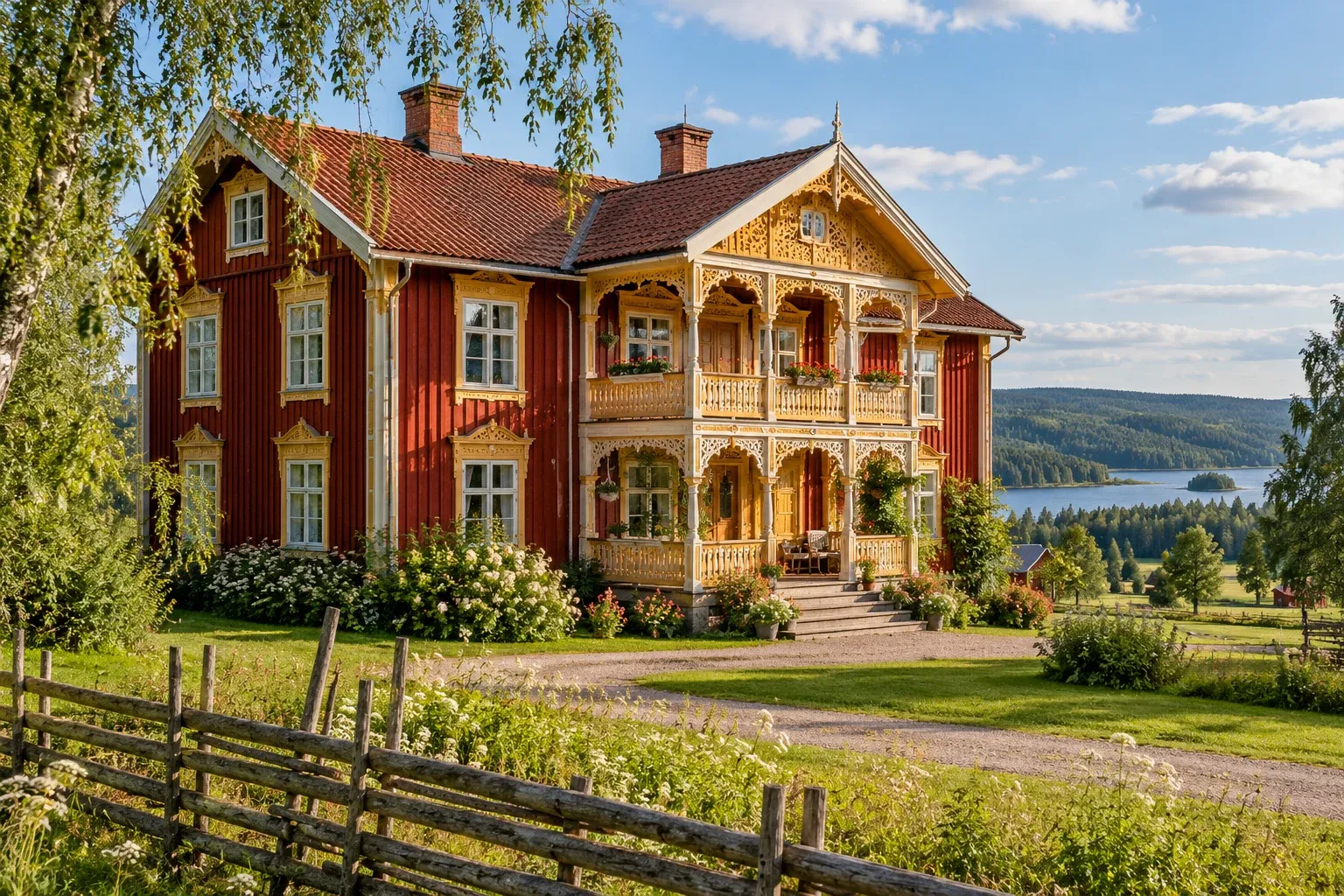
Hälsingland’s farmers built timber “castles” with whole floors just for weddings and hired painters to cover the walls. Here’s which of the seven World Heritage farms you can walk into, when, how far apart they are, and how to behave at the private ones.
When you need this
- You saw “Decorated Farmhouses of Hälsingland” on a list of Sweden’s UNESCO World Heritage sites and want to know if you can actually go inside
- You are driving between Stockholm and the north and want to stop at one or two farms
- You need to know which farms are walk-in, which need booking, and what is open outside summer
- You are standing near an old painted farm and wonder whether you may walk up to it
The seven farms and how to get in
The hälsingegårdar (Hälsingland farms) were inscribed as a UNESCO World Heritage site on 1 July 2012 — Sweden’s 15th and still its newest. They stand for a tradition of about 1,000 well-preserved farms in 36 parishes; the seven are the chosen best examples. Hälsingland is a province, not a county — all seven lie in Gävleborg county (provinces vs counties explains the difference).
The key fact for a visitor: six of the seven are privately owned, according to the county board, Länsstyrelsen Gävleborg. Only Bortom Åa belongs to the municipality.
| Farm | Where | Ownership | How you get in (2026 season) |
|---|---|---|---|
| Gästgivars | Vallsta, Arbrå (Bollnäs) | Private | Walk-in, daily in summer; visitor center |
| Erik-Anders | Asta, Söderala (Söderhamn) | Private | Walk-in, weekends in spring and September, daily in summer; visitor center |
| Bortom Åa | Fågelsjö, Los (Ljusdal) | Municipality | Daily in summer; houses by guided tour only; can be shown all year |
| Kristofers | Stene, Järvsö (Ljusdal) | Same family for 14 generations, still farmed | Summer, advance booking only |
| Pallars | Långhed, Alfta (Ovanåker) | Same family since the 1600s | Summer, advance booking only |
| Jon-Lars | Långhed, Alfta (Ovanåker) | Private | Summer, advance booking only |
| Bommars | Letsbo (Ljusdal) | Private | Summer guided tours; every visit booked |
Four visitor centers help you plan, and the region asks you to contact them in advance: at Erik-Anders (Söderhamn), Ol Anders (Alfta), Gästgivars (Vallsta) and Stenegård (Järvsö). Beyond the seven, the county board says some 40 other hälsingegårdar open to visitors in summer.
Season by season
The walk-in season is short. These are the 2026 dates; the farms publish new ones each spring, and the region warns that hours and prices vary.
| Period | What was open in 2026 |
|---|---|
| May – mid-June | Erik-Anders at weekends (2 May – 14 June, 12:00–15:00) |
| 1 June – 13 September | Bortom Åa daily 10:00–17:00 (closed Midsummer Eve); tours at 10:00, 12:00, 14:00, 16:00 |
| 13 June – 16 August | Gästgivars daily 11:00–17:00 |
| 20 June – 30 August | Erik-Anders daily 11:00–17:00 |
| “Summer” | Kristofers, Pallars, Jon-Lars and Bommars by advance booking |
| 5–27 September | Erik-Anders at weekends, 12:00–15:00 |
| October – April | No regular opening; Bortom Åa by arrangement; ask a visitor center |
Best window: mid-June to mid-August, when all three walk-in farms are open. If you drive in winter, winter tires are compulsory from 1 December to 31 March whenever there are winter road conditions — see winter driving in Sweden.
Planning a route
The seven farms spread across an area about 100 km east–west and 50 km north–south, with Fågelsjö far out in the west. Seeing them all takes at least two days. Our own measured driving times:
| Route | Distance | Driving time |
|---|---|---|
| Stockholm – Vallsta | 287 km | about 3 h 40 min |
| Stockholm – Järvsö | 315 km | about 4 h |
| Gävle – Asta (Erik-Anders) | 76 km | about 1 h |
| Asta – Vallsta | 49 km | about 55 min |
| Vallsta – Långhed | 33 km | about 40 min |
| Vallsta – Järvsö | 28 km | about 30 min |
| Järvsö – Letsbo | 33 km | about 35 min |
| Letsbo – Fågelsjö | 98 km | about 1 h 50 min |
| Stockholm – Fågelsjö | 400 km | about 5.5 h |
- One-day cluster: Gästgivars in Vallsta (walk-in), then the two Långhed farms and Kristofers in Järvsö (both booked).
- On the coast road: Erik-Anders is 8 km from Söderhamn, about an hour north of Gävle.
- Bortom Åa is a destination in itself, about 3 km from road E45. It is the one farm with a public-transport option we could verify: Inlandsbanan, the summer tourist train, stops at Fågelsjö about 3 km away. For the rest, plan on a car — see driving in Sweden.
What you are looking at
Each farm has its own story:
- Gästgivars — the party house was built for a wedding in 1840. Painter Jonas Wallström imitated fine English porcelain and developed stencil painting (schablonmålning) in a style copied across Sweden. The name comes from a coaching inn (gästgiveri) on the farm in the 1600s–1700s.
- Erik-Anders — built in the 1820s, manor-like, with a grand party hall upstairs and restrained marbling. One son followed the preacher Erik Jansson to Bishop Hill in America.
- Kristofers — many well-preserved rooms on two floors show how rooms were used for parties; free-hand flower painting by Anders Ädel.
- Pallars — one of Hälsingland’s very largest farms. “Blåmålarn” (“the blue painter”, probably a couple from Bingsjö in Dalarna) used costly ultramarine where most farms used cheaper Prussian blue, and painted named places such as Stockholm and Gävle.
- Jon-Lars — the largest building of all, built in two identical halves for two brothers after a fire. Upstairs, one half has landscapes by the Dala painter Svärdes Hans Ersson, the other French arabesque wallpaper.
- Bommars — original interiors from 1848 and a clothes room papered with Stockholm newspapers from the mid-1850s.
- Bortom Åa — a Forest Finn farm from the 1600s in Orsa Finnmark, with a gunsmith’s forge and a storehouse with seven locks.
UNESCO describes the decoration as canvas or textile paintings fixed to the walls, or paint applied straight onto wooden walls and ceilings. Subjects were often biblical, but the figures wear the fashions of the painter’s day, in a blend of folk art with Baroque, Rococo and Gustavian taste. Many paintings came from itinerant dalmålare, painters from neighboring Dalarna. Strikingly often the painters were soldiers or soldiers’ sons, and their wives and children sometimes helped.
UNESCO’s key point is the party rooms themselves. Each farm has between four and ten rooms or a separate house (herrstuga) used only for festivities, above all weddings, and hardly used the rest of the year. These rooms are the most richly decorated on each farm.
Why farmers here were rich
| Source of wealth | What happened |
|---|---|
| Flax | Linen made the big money in the 1600s–1800s, with a heyday around 1750–1850; the cloth sold across Sweden |
| Forest | The most profitable income; when cotton pushed linen out in the mid-1800s, farmers sold forest land and felling rights |
| Freedom | No nobility owned the land; farmers ran their own villages and traded as far as Norway |
| Peace | No war since the Great Northern War ended in the early 1700s, so the farms survived |
The county board dates the big building boom to about 1800–1870, though the habit of building large party rooms began in the 1600s.
Private farms: the etiquette
Region Gävleborg is blunt: most hälsingegårdar are privately owned and run no tourism at all. Kristofers is still a working farm, and the booked farms are family homes.
- Don’t walk into a lived-in farmyard. Allemansrätten, the right of public access, stops at the hemfridszon — the privacy zone around a home, which has no fixed size. Entering someone’s home without permission is hemfridsbrott, punishable by fines or up to a year in prison.
- Book, then turn up on time. Without a booking at Kristofers, Pallars, Jon-Lars or Bommars you won’t get in.
- Ask about access first. The region warns that access for people with disabilities may be limited at these private settings.
- Your ticket matters. In May 2026 a member of parliament pointed out that much of the preservation rests on owners working unpaid hours. The culture minister answered that the government follows the issue.
Practical information
| Item | Detail |
|---|---|
| UNESCO name | Decorated Farmhouses of Hälsingland (2012) |
| Walk-in farms | Gästgivars, Erik-Anders, Bortom Åa (houses by guided tour) |
| Booking-only farms | Kristofers, Pallars, Jon-Lars, Bommars |
| Main season | Mid-June – mid-August (2026 dates above) |
| Year-round | Bortom Åa by arrangement; visitor centers |
| Bommars tour price | 300 SEK per person, coffee included; free under 16 (no year on the page; checked 2026-10-06) |
| Other prices | Set by each farm and season — check the farm |
| Free preview | Länsstyrelsen Gävleborg’s online films of all seven farms with building conservator Erika Åberg |
| Off the list | Delsbo Forngård, a local heritage open-air museum with three Hälsingland farmhouses and 18th-century wall paintings |
FAQ
What are the Decorated Farmhouses of Hälsingland?
They are seven large 19th-century timber farms in Hälsingland, north of Stockholm, inscribed as a UNESCO World Heritage site in 2012 — Sweden’s newest. Rich, independent farmers built whole houses or suites of rooms used only for parties such as weddings, and hired local and traveling painters, many from Dalarna, to decorate them. They represent about 1,000 such farms in the province.
Can you visit the Hälsingland World Heritage farms?
Yes, but mostly in summer. Gästgivars in Vallsta, Erik-Anders near Söderhamn and Bortom Åa in Fågelsjö keep daily summer opening hours; Bortom Åa’s houses are entered on guided tours. Kristofers, Pallars, Jon-Lars and Bommars are private and shown in summer only by advance booking. Six of the seven are privately owned homes, so check hours and book ahead.
Which farms can I see in one day?
Base the day around Vallsta. Gästgivars is walk-in in summer; the Långhed farms Pallars and Jon-Lars are 33 km away and Kristofers in Järvsö 28 km away, both by advance booking. Erik-Anders, 8 km from Söderhamn, fits a day on the coast road instead. Bortom Åa in Fågelsjö is too remote to combine easily — about 1 h 50 min beyond Letsbo.
Can you visit the Hälsingland farms in winter?
Hardly. In 2026 Gästgivars was open from 13 June to 16 August and Erik-Anders’ last weekend ended on 27 September. Bortom Åa, owned by the municipality, can be shown all year by arrangement, and the four visitor centers can advise. Otherwise, Länsstyrelsen Gävleborg’s free online films with a building conservator show all seven farms inside.
Why were the farmers in Hälsingland so rich?
Flax and forest. Linen made in Hälsingland sold across Sweden, with a heyday around 1750–1850, and when cotton pushed linen out in the mid-1800s, farmers sold forest land and felling rights. They owned their land with no nobility above them, traded widely, and the province has seen no war since the early 1700s, so the farms survived.
Can I walk up to any old farm in Hälsingland?
No. Most of Hälsingland’s roughly 1,000 historic farms are private homes that run no tourism. Allemansrätten does not cover the privacy zone around a dwelling, and entering someone’s home without permission is a crime. Visit the World Heritage farms in their opening hours, book the private ones, or ask a visitor center about the 40 or so other farms open in summer.
How do I get to the farms without a car?
With difficulty. The farms are rural and up to 100 km apart, and we could verify only one public-transport link: Inlandsbanan, the summer tourist train, has a halt in Fågelsjö about 3 km from Bortom Åa. For the other six, plan on a car, or ask a visitor center about local options before you travel.
Related guides
- Sweden’s UNESCO World Heritage sites — the other 14 sites and how to reach them.
- Dalarna — the home province of the traveling painters and its folk art.
- Allemansrätten — exactly where the right of public access stops at a home.
- Spelmansstämmor — Delsbostämman, the fiddlers’ gathering at Delsbo Forngård.
- Provinces vs counties — why you won’t find Hälsingland on the county map.
Facts verified 2026-10-06. Sources: UNESCO World Heritage Centre, Riksantikvarieämbetet, Länsstyrelsen Gävleborg, Region Gävleborg, Sveriges Riksdag, Naturvårdsverket, Transportstyrelsen, Gästgivars, Erik-Anders, Fågelsjö Gammelgård, Bommars, Delsbo hembygdsförening, OSRM route measurements — full register in this topic’s source file. Found something outdated? Tell us and we’ll fix it.