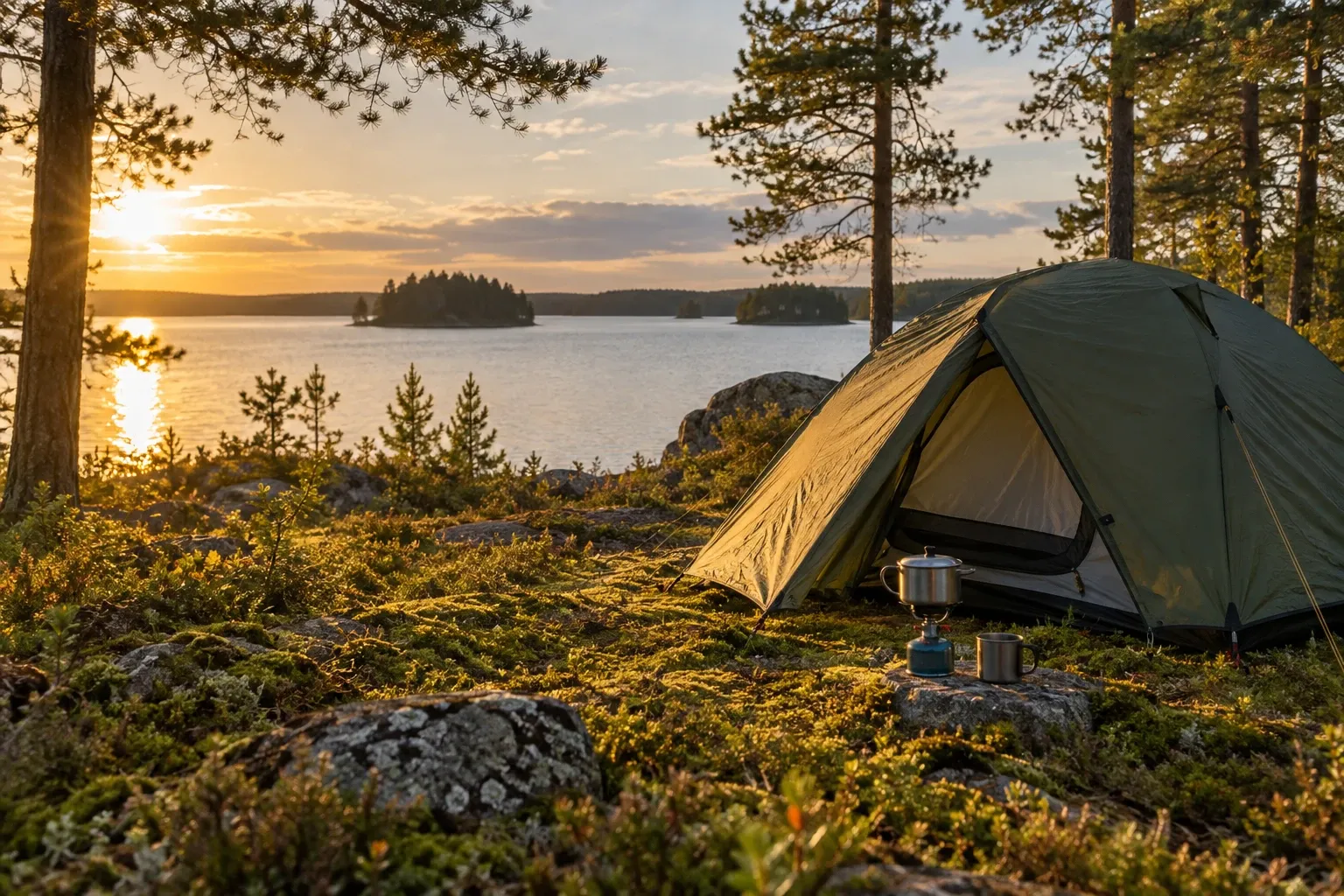
Sweden is one of the best camping countries in Europe, but “camping” here means three different things with three different rule sets. Know which one you’re doing each night and almost everything else falls into place.
When you need this
You’re planning a first camping trip and deciding between a tent, campsites and a motorhome. Or you’ve read that you “can camp anywhere in Sweden” and want to know where that stops. Or a guide has told you to buy a camping card before you arrive. This page sorts you into the right system and sends you to the page with the detail.
Three ways to camp, three rule sets
| Wild camping in a tent | Campsite | Motorhome or car | |
|---|---|---|---|
| What governs it | Allemansrätten (the right of public access) | The campsite’s own terms | Parking law |
| Cost | Free | Pitch fee; check-in with a free Camping ID | Free to modest at ställplatser (stopovers) |
| How long | A night or two | As booked | 24 hours on public streets on weekdays |
| Services | None | Showers, toilets, often cabins | Water and waste at stopovers |
Most visitor mistakes come from carrying one column’s rules into another — above all, assuming the tent’s freedom applies to the van.
Wild camping in a tent
Under allemansrätten you may pitch a tent on land that isn’t farmed and isn’t near a home, free and without asking anyone. Naturvårdsverket, the Swedish Environmental Protection Agency, calls one or two nights “a good rule of thumb” and says two or three tents are within the right; a big group with many tents needs the landowner’s permission.
The duty behind the right is written into the Environmental Code: show consideration and care in nature — inte störa, inte förstöra, don’t disturb, don’t destroy. In practice:
- Stay well away from homes. The privacy zone around a house, the hemfridszon, has no fixed size in meters. It’s judged case by case, and tenting needs more distance than walking past. The more secluded, the better.
- Stay off fields with crops and pasture with animals. Pitch on ground that can take it.
- Read the board at nature reserves and national parks. They usually allow tenting only at designated places, and some ban it entirely.
- Watch for town rules. Municipal ordinances can ban tenting in parks, sports grounds and some recreation areas.
- Leave nothing. Pee far from water; dig a hole for feces away from paths and campsites and cover it; bury, burn (only when there’s no fire risk) or carry out the paper. Take all food waste with you — Naturvårdsverket links leftovers in nature to the spread of African swine fever among wild boar.
Landowner permission unlocks what the right doesn’t: longer stays, bigger groups, pitching closer to buildings. The full rules, including the myths, are in the wild camping rules.
Campsites and the camping card
You don’t need to buy a camping card. SCR Svensk Camping, the campsite industry association, dropped the purchase requirement at the start of 2019. At its affiliated campsites you check in with a free Camping ID or, if you already own one, a Camping Key Europe card. The card is an optional paid product, valid 12 months from purchase, that buys discounts and accident and liability insurance. Campsites outside SCR set their own check-in arrangements.
A campsite is private land, so allemansrätten doesn’t apply inside it. Most sites open roughly May to September and also rent cabins (stugor) — often the cheapest roof in the area when the weather turns. More in Swedish campsites and the Camping ID.
Motorhomes, campervans and cars
Allemansrätten doesn’t cover motorhomes, caravans with a towing vehicle, or cars with a roof tent. Driving onto snow-free open ground — a meadow, a beach, a forest clearing — is banned by the Off-Road Driving Act except for farming and forestry.
What you can do is sleep where the vehicle is legally parked. On municipal streets in built-up areas and on public roads, that means at most 24 hours in a row on weekdays; weekdays before a Sunday or public holiday don’t count. The practical network is ställplatser, rest areas and campsites. A tent pitched beside the vehicle is covered by allemansrätten, as long as the vehicle itself is legally parked.
Depth: wild camping with a motorhome, touring Sweden by motorhome and sleeping in your car.
Fires and fire bans
A fire ban (eldningsförbud) is a local regulation made by a county administrative board or a municipality, and breaching one — intentionally or through carelessness — is punishable by fines. Bans can appear overnight, so check the national fire-ban map at krisinformation.se for the municipality you’re standing in, on the day.
Gas and liquid-fuel camping stoves normally stay legal under both tiers of ban, but the ban decision itself is the text that counts — read it. And never run a stove inside a shelter or a tent you sleep in: Sweden’s mountain safety council says stoves are for outdoor use only, because of carbon monoxide and fire. Details: campfire rules and checking the fire ban where you are.
Mosquitoes, ticks and the mountains
- Mosquitoes peak from mid-June to early August and fall away clearly in August. Forest and bog are the worst terrain; the open fell above the birch forest is much milder. Pack a head net, repellent and a tent with a fine inner mesh. See mosquitoes in Sweden.
- Ticks are densest in the south and center but reported from every Swedish municipality. Check yourself every evening wherever you camp. See ticks in Sweden.
- Mountains: the rest shelters (rastskydd) on mountain trails are for breaks, and for nights only in an emergency — not as planned accommodation. See mountain safety.
Camping with a dog
From 1 March to 20 August Swedish law requires dogs to be kept from running loose wherever wildlife lives — in practice, on a lead. In reindeer herding areas the dog must be on a lead or shut in whenever reindeer are near, in any month. Campsites set their own dog rules on their grounds. See Sweden’s leash law.
Mistakes to avoid
- Buying Camping Key Europe because an old guide says it’s compulsory. Ask for the free Camping ID.
- Treating wild camping as a motorhome right. The vehicle stays on legal parking.
- Believing a fixed “70 meters from houses” rule. There’s no fixed distance; out of sight and earshot is the working test.
- Pitching in a nature reserve without reading the entrance board.
- Staying a week at the perfect lake. One or two nights, then move or ask.
- Heading into July forest and bog with no mosquito plan.
Good to know: Many trips work best mixing all three — wild nights on the trail, a campsite every few days for showers and laundry, ställplatser in between for a motorhome. Sort your trash at the campsite’s recycling point and return cans and bottles for deposit; see recycling in Sweden.
Practical information
| Item | What it costs or requires |
|---|---|
| Wild camping in a tent | Free, by right; a night or two, two or three tents |
| Camping ID (campsite check-in) | Free |
| Camping Key Europe | Optional annual fee, valid 12 months — check the current price before buying |
| Campsite pitch | Per pitch, commonly plus per person; electricity usually extra |
| Ställplats night | Free at some; a modest fee at most — check the sign or app |
| Vehicle parking, public streets and roads | Up to 24 hours in a row on weekdays |
| Littering outdoors, minor case | 800 kr on-the-spot fine |
| Breaching a fire ban | Fines, plus liability if a fire spreads |
| Campsite season | Roughly May to September for most sites |
| Dog-control period in nature | 1 March – 20 August |
FAQ
Can you camp anywhere in Sweden?
In a tent, almost — for a night or two, on ground that can take it, away from homes and off crops and grazed pasture. National parks and nature reserves usually restrict tenting to designated sites, and towns may ban it in parks. In a motorhome or car, no: the vehicle is not covered by allemansrätten and must stay on legal parking.
Do I need a camping card in Sweden?
No. The requirement to buy a camping card at Swedish campsites ended at the start of 2019. At SCR-affiliated campsites you check in with a Camping ID, or with a Camping Key Europe card if you already have one. The card is an optional paid product, valid 12 months, that buys discounts and accident and liability insurance.
Is wild camping free in Sweden?
Yes. Pitching a tent under allemansrätten costs nothing and needs no permit, for a night or two with two or three tents. What it asks in return is behavior: stay well away from homes, leave no trash or food, and damage nothing. A bigger group or a longer stay needs the landowner’s permission, which is also free to ask for.
Can I wild camp in a campervan or motorhome in Sweden?
Not under allemansrätten, which covers tents but not motorhomes, caravans or roof-tent cars. Driving onto open ground is prohibited. You may sleep where the vehicle is legally parked — on municipal streets and public roads for up to 24 hours in a row on weekdays — and most travelers use ställplatser, rest areas and campsites.
Can I have a campfire when camping in Sweden?
Only when no fire ban applies where you are, and even then you are responsible if it spreads. Bans are set by county boards and municipalities and can change overnight, so check the fire-ban map for your municipality on the day. Gas and liquid-fuel camping stoves normally stay legal during bans, but the ban text decides.
When is the best time to go camping in Sweden?
Late May to September covers the campsite season. July is the Swedish holiday peak, with full sites and the most people. Mosquitoes peak from mid-June to early August in forest and bog country, and fire bans are most likely in dry summer spells. Late August and early September combine quiet pitches with far fewer insects.
Can I bring my dog camping in Sweden?
Yes, with rules. From 1 March to 20 August Swedish law requires dogs to be kept from running loose where wildlife lives, which in practice means a lead. In reindeer herding areas the dog must be on a lead whenever reindeer are near, in any month. Campsites set their own dog rules on their grounds.
Related guides
- The wild camping rules — where a tent may go, the myths, and the decision procedure.
- Swedish campsites and the Camping ID — check-in, cabins and whether the card pays off.
- Wild camping with a motorhome — what the vehicle may and may not do overnight.
- Checking the fire ban where you are — the map, the tiers and the app, step by step.
- Mosquitoes in Sweden — where and when they’re bad enough to change your plans.
Facts verified 2026-09-24. Sources: Naturvårdsverket, Sveriges Riksdag (statute texts), Krisinformation.se and the county boards, SCR Svensk Camping, Fjällsäkerhetsrådet, SVA — full register in this topic’s source file. We never publish current fire-ban status or campsite prices; check them live. Found something outdated? Tell us and we’ll fix it.