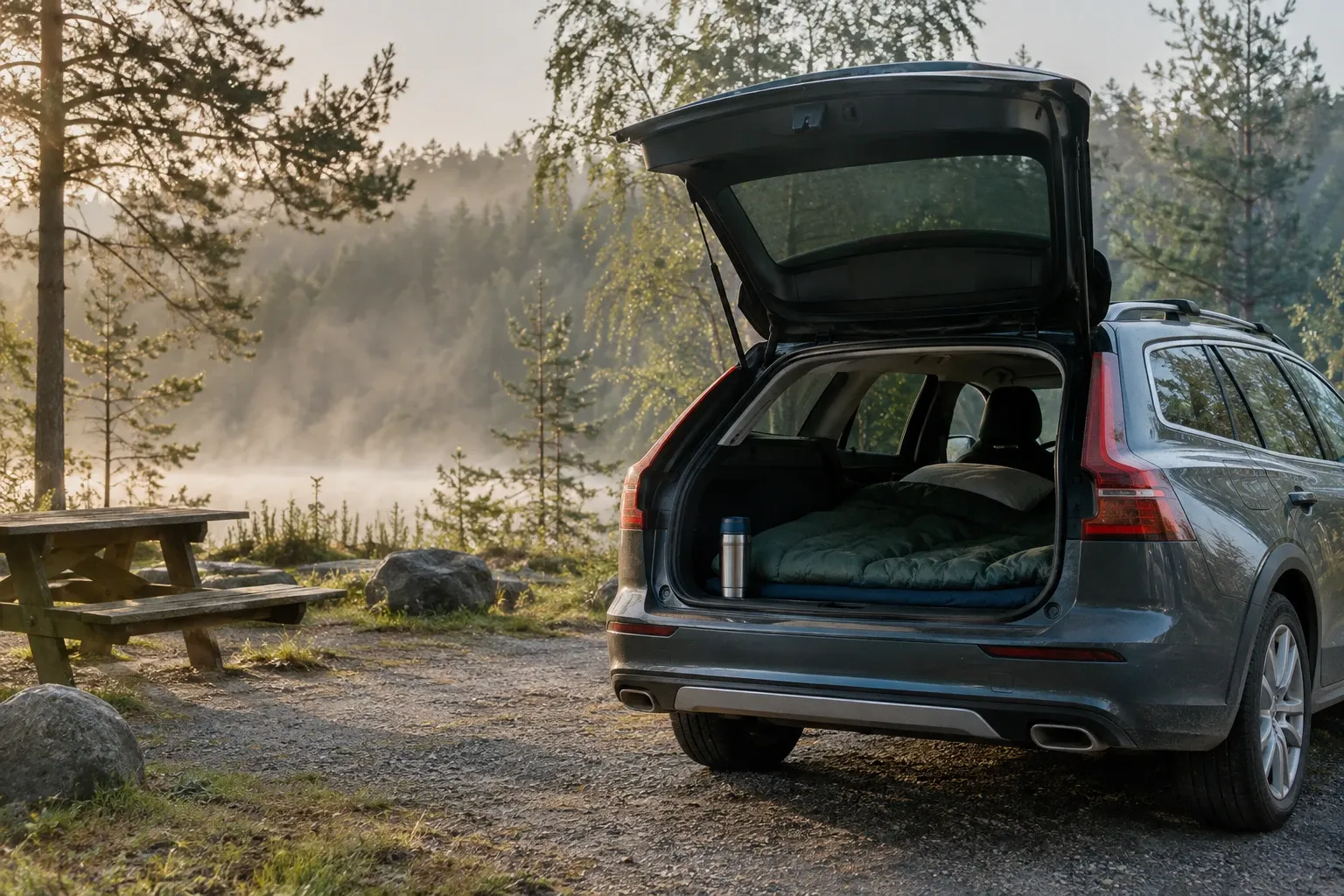
Search this question and you’ll find confident yeses and confident noes, mostly unsourced. Both are half right, because the internet keeps arguing about the wrong law.
When you need this
A long drive and a choice between a hotel and the back seat. A rest area at 11pm and a question about whether staying is allowed. Or a general assumption that Sweden’s famous freedom-to-roam covers your car.
The short answer, and the reframe
Sleeping in a parked vehicle is not prohibited in Sweden. There’s no general rule against it, and — this is the useful bit — a vehicle is legally considered parked whether or not someone is inside it.
That single fact reframes everything. Your sleeping is not the regulated activity. Parking is.
So the question is never “may I sleep here?” It’s “may I park here, and for how long?” Once you see it that way, every situation becomes readable from the signs in front of you.
Allemansrätten stops at the vehicle
Here’s where most people go wrong.
Sweden’s right of public access, allemansrätten, covers being in nature and pitching a tent for a night or two. It does not cover:
- Parking a motorhome
- A caravan with its towing vehicle
- A car with a roof tent
That last one surprises people. A roof tent doesn’t convert your car into a tent — legally it remains a vehicle, and vehicles are governed by parking law, not by the right of public access.
So the reasoning “I could legally camp here, so I can legally sleep in my car here” is wrong. You’ve crossed from one legal regime into another without noticing. Details on what allemansrätten really covers in wild camping in Sweden.
And you can’t drive off the road to find somewhere quieter: the Off-Road Driving Act prohibits driving on bare ground.
The 24-hour rule
On a street or public road, a vehicle may generally be parked for a maximum of 24 consecutive hours on weekdays.
One exception worth knowing: the limit does not apply on the day before a Sunday or public holiday. So a Saturday-night stop has more latitude than a Tuesday one.
At rest areas and marked parking places, 24 hours is likewise the normal default unless the signage says otherwise.
The practical takeaway is simple: one night is fine, two nights in the same spot is where you run into trouble. Move on in the morning.
Local bans override everything
Municipalities and landowners can restrict or prohibit overnight stays through local traffic and public-order regulations, and those rules are enforceable.
They cluster exactly where you’d want to stop: scenic viewpoints, beaches, trailheads, popular car parks. The demand is why the ban exists.
This is why no general answer — including this article — beats the sign in front of you. Read the signage at every stop, before you settle in. Look for övernattning förbjuden (overnight stay prohibited) and any time limits.
Where it is reliably fine: rest areas
The obvious answer that most visitors never consider: the national rest-area network.
Around 270 rest areas on Sweden’s national road network are free, open around the clock all year, and have toilets. They’re maintained by the national road authority, and the standard maximum stay is 24 hours unless posted otherwise.
For a night in the car, that’s the most reliable legal option in the country. More on the network in public toilets in Sweden.
Mistakes to avoid
- Believing allemansrätten permits sleeping in a vehicle anywhere.
- Driving off the road onto ground to find a quieter spot.
- Ignoring signage at a scenic car park.
- Staying more than 24 hours in one spot.
- Using a campsite’s car park without checking in — that’s private property.
- Assuming a roof tent changes the legal category of your vehicle.
Good to know
- Ask, if you’re on a farm or private plot. Permission is often given freely, and asking turns a grey area into a clear yes.
- Don’t obstruct. Parking that impedes traffic, access or emergency routes is an offence regardless of the 24-hour rule.
- Winter has a hazard the law doesn’t cover: running an engine or fuel heater for warmth carries a real carbon-monoxide risk. Snow-clearing rules may also require you to move.
- If you want a shower, a campsite is often inexpensive and changes the trip — see Swedish campsites.
- If it’s the wild-camping experience you’re after, take a tent. That’s what allemansrätten actually protects, and it’s free.
- Cooking outside the car? Check the fire rules first — see campfires and fire bans.
Practical information
| Item | Detail |
|---|---|
| Sleeping in a parked vehicle | Not prohibited |
| Legal framing | Parking rules, not allemansrätten |
| Allemansrätten covers | Tents — not cars, caravans, motorhomes or roof tents |
| Street / public road limit | 24 consecutive hours on weekdays |
| Exception | Limit doesn’t apply the day before a Sunday or public holiday |
| Rest areas | ~270 nationally · free · open 24/7 · toilets · usually 24h max |
| Local overnight bans | Enforceable; common at scenic spots and trailheads |
| Private land | Landowner permission required |
| Driving off-road | Prohibited on bare ground |
FAQ
Is it legal to sleep in your car in Sweden?
Yes. No Swedish law prohibits sleeping in a legally parked vehicle, and a vehicle counts as parked whether or not someone is inside. The question is therefore always about parking rather than sleeping: may you park in that spot, and for how long? Signs and local municipal rules decide, and they override any general answer.
Does allemansrätten let me sleep in my car anywhere?
No, and this is the most common misunderstanding. The right of public access covers being in nature and pitching a tent for a night or two. It does not cover parking a motorhome, a caravan with its towing vehicle, or a car with a roof tent. A roof tent does not change the vehicle’s legal category. Vehicles are governed by parking rules.
How long can I park overnight in Sweden?
On a street or public road the general limit is 24 consecutive hours on weekdays, and that limit does not apply on the day before a Sunday or public holiday. Rest areas and marked parking places usually apply the same 24-hour default unless the signage says otherwise. Local rules can be stricter.
Can I sleep in my car at a Swedish rest area?
Usually yes, and it is the most reliable legal option. Around 270 rest areas on the national road network are free, open around the clock all year and have toilets. The normal maximum stay is 24 hours unless signs state otherwise. Always check the signage on arrival, since individual sites can carry restrictions.
Can a Swedish municipality ban sleeping in vehicles?
Yes. Municipalities and landowners can restrict or prohibit overnight stays through local traffic and public-order regulations, and such bans are enforceable. They are most common at popular scenic spots, beaches and trailheads — exactly the places people want to stop. Read the signs at every location rather than relying on a general rule.
Is sleeping in a car different from wild camping in Sweden?
Legally, completely different. Wild camping in a tent is protected by allemansrätten for a night or two on unfenced land away from homes. Sleeping in a vehicle is not covered by that right at all and falls under parking law instead. If you want the freedom allemansrätten offers, the tent is what unlocks it.
Related guides
- Wild camping in Sweden — what allemansrätten actually protects
- Wild camping with a motorhome — the same question, bigger vehicle
- Swedish campsites — the paid alternative with facilities
- Public toilets in Sweden — including the rest-area network
- Campfires and fire bans — if you’re cooking outside the car
Facts verified 2026-07-25. Sources: Naturvårdsverket (the Swedish EPA), Trafikförordningen (1998:1276), specialist motoring press — full register in this topic’s source file. Local overnight bans change; always read the signage. Found something outdated? Tell us and we’ll fix it.