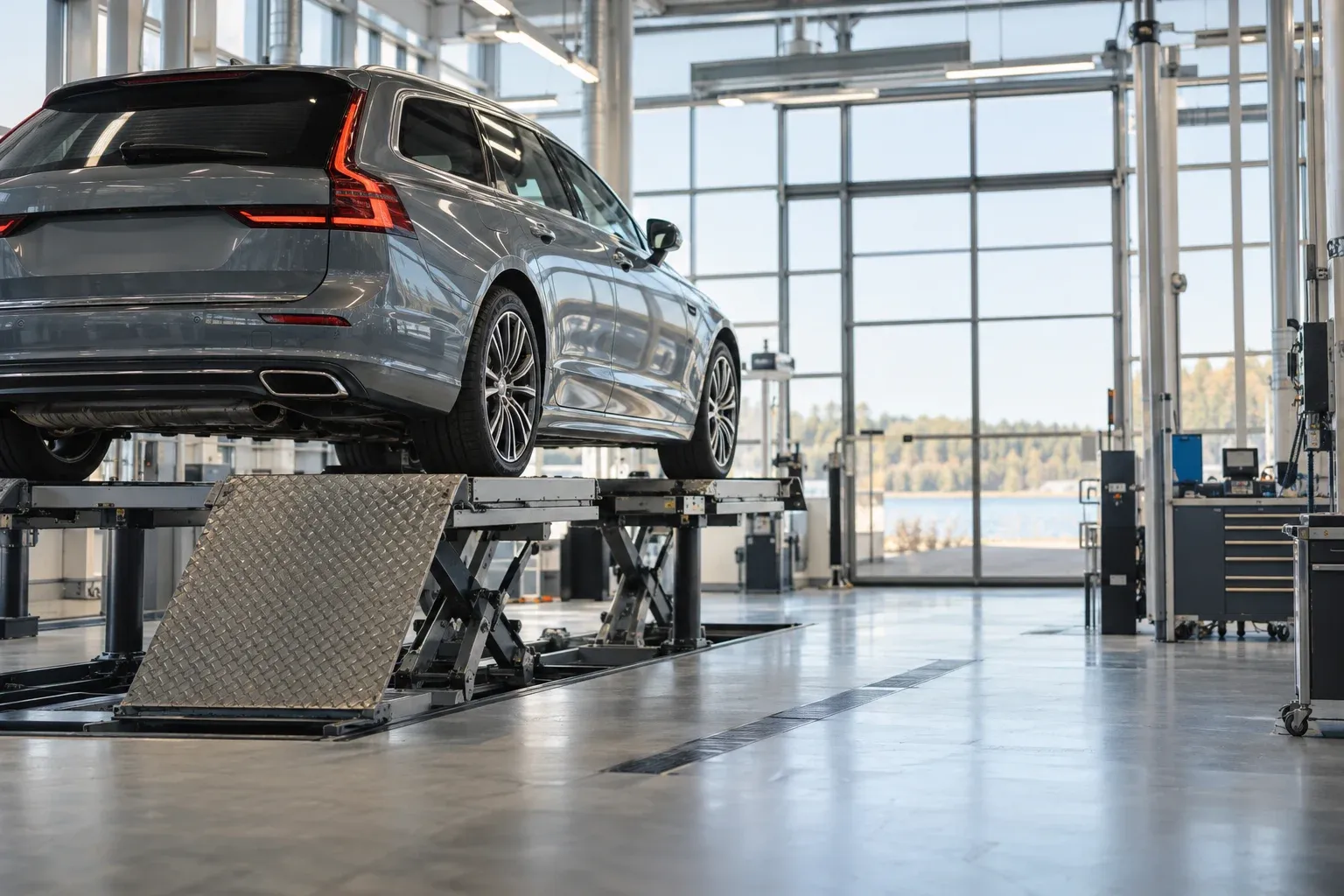
Every Swedish-registered car has its own inspection clock, and nobody from the state will remind you when it runs out. Here is how the schedule works, what happens when you miss it or fail, who actually does the inspections, and which changes are still only proposals.
When you need this
You have moved to Sweden and own or have just bought a Swedish-registered car. You are looking at a used car and want to know whether it is legal to drive. You borrowed a friend’s car and found a körförbud (driving ban) notice. You keep a Swedish car but spend most of the year abroad. Or you read somewhere that inspection rules for old cars are changing and want to know what is actually in force.
If you are only visiting with your own foreign-registered car, Swedish inspection does not apply to you: EU rules have cars tested in the country where they are registered. For a car you plan to move here for good, see driving a foreign-registered car in Sweden long-term.
The schedule: 3 years, 2 years, then 14 months
Bilbesiktning is the everyday word; the legal name for the recurring check is kontrollbesiktning. The Vehicle Ordinance (fordonsförordningen) sets the schedule for cars with a total weight of up to 3.5 tonnes:
| Inspection | Deadline |
|---|---|
| First | Within 3 years (36 months) of the month the car was first used |
| Second | Within 2 years (24 months) of the first |
| Every one after that | Within 14 months of the previous full inspection |
That is the “3-2-1” pattern people talk about, except that the “1” is really fourteen months. Guides that describe a “2-2-1” rule or yearly checks after a set number of years are not describing Swedish law.
You may inspect earlier whenever you like, but the next deadline is then counted from the month you actually inspected. So inspecting two months early moves the whole cycle two months forward.
The old system, where the last digit of the number plate fixed your inspection months (besiktningstermin), was abolished from 20 May 2018. Older guides still describe it.
Some vehicles run on other clocks:
- Every year: rental cars, taxis, driving-school cars, emergency vehicles and cars over 3.5 tonnes.
- Four years, then every two: motorcycles, light trailers and car-based tractors (see EPA and A-tractors).
- Every two years: passenger cars and light trucks from the calendar year 30 years after their model year.
- Exempt at 50: from 1 January of the year a car turns 50 model years, provided it has an approved, valid inspection from the previous two calendar years. A car already under a driving ban keeps it.
Missing the deadline: the automatic driving ban
Transportstyrelsen (the Swedish Transport Agency) sends no summons. The inspection companies send marketing letters, but the responsibility is the owner’s. If the car is not inspected by its deadline, a driving ban starts automatically from the calendar month after the due month, with no letter or police stop needed. It lasts until the car has been through a control inspection.
During the ban you may drive only by the shortest suitable route to an inspection company or to a repair workshop. A car that is avställd (taken off the road in the register) may only be driven by the shortest suitable route to the nearest inspection company.
Warning: Using a car in breach of a driving ban is an offence. The owner can be fined, and so can a driver who knew about the ban. Check before you borrow or buy.
The ban follows the car, not the owner. That is why checking a used car’s status before you pay matters (see buying a used car in Sweden). You can look up any car’s inspection date and ban status free in Transportstyrelsen’s “Fordonsuppgifter” e-service by registration number; Swedish number plates covers the other lookup routes.
Failing the inspection
A car passes if it is roadworthy, meets the emissions and fluorinated-gas rules, and has only defects of minor significance. Otherwise there are three outcomes:
| Result | What happens |
|---|---|
| Minor defects | Fix them; no follow-up order if they are simple and weren’t found last time |
| Fail (underkänd) | A deadline to fix the defects and return for a re-check (efterkontroll), or have an accredited workshop repair and test the car |
| Dangerous defects | A driving ban on the spot, and a ban sticker on the car |
Return within two months of a failed full inspection and the re-check may be limited to the parts that failed. If you use the workshop route instead, the test must be done within one month of a ban starting and within two months of the inspection, and Transportstyrelsen decides whether to accept the workshop’s certificate. Miss the deadline on your report and a driving ban starts.
Failing is common. In 2024, 908,384 of 3,930,177 passenger-car inspections ended in a fail requiring a re-check, roughly one in four. Faulty low-beam headlights and position lights were the most common remarks, so check your bulbs before you go. Failure rates also differ by county: Halland had the lowest share in 2024 and Värmland the highest.
Who does the inspections
Not the state. Until 1 July 2010 the market was a monopoly run by AB Svensk Bilprovning, which the state owned 52 percent of. Since then vehicle inspection has been open to competition. Inspection bodies must be accredited, and Swedac (the Swedish accreditation authority) and Transportstyrelsen supervise them.
In 2025 five companies did almost all inspections: Besikta, Bilprovningen, Opus, Carspect and DEKRA, each with roughly 11 to 26 percent of the market per month. Every other firm had under half a percent. So “Bilprovningen” is now a company name, not the authority, and you can book with whichever company suits you. Prices and opening hours are set by each company and station.
Cars kept abroad, imported cars and rentals
- A Swedish car abroad: it must be inspected in Sweden. A periodic test in another EU country does not count, and Transportstyrelsen no longer grants exemptions. If you live abroad most of the year, the car should be registered and inspected there; otherwise inspect early, before you leave, to move the next deadline.
- A car imported from the EEA: a periodic test it passed while registered in another EEA country counts as a Swedish control inspection when the schedule is applied. The registration inspection on import is a separate step.
- Rental cars: they are inspected every year, and that is the rental company’s duty, not yours (see renting a car in Sweden).
- Modified cars: if an inspection finds changes that need a registration inspection, you get one month to have one before a ban starts.
What is changing, and what isn’t
Good to know: older guides may present some of these proposals as settled. As of October 2026 none of the proposals below is in force.
- Veteran cars: in August 2025 Transportstyrelsen proposed that cars from 1960 onward return to inspection every second year, starting in early 2026. That did not happen. In February 2026 the proposal was being redrafted, possibly keeping the exemption but requiring a special certificate. Until a new rule is decided, the 50-year exemption above applies.
- EU annual tests for older cars: the European Commission proposed annual tests for cars over ten years old. The European Parliament’s transport committee rejected that in May 2026, and negotiations with member states follow. Sweden’s 14-month rhythm is unchanged.
- Diesel particle counting: not part of the Swedish inspection yet. Bilprovningen runs a free, voluntary pilot for Euro 5b and later diesel cars, and a binding requirement may come around 2029.
Practical information
| Item | What to know | Checked |
|---|---|---|
| Control inspection price | Set freely by each company and station; compare when booking | 2026-10-14 |
| Re-check within two months | Limited to failed items; price set by the company | 2026-10-14 |
| Driving in breach of a ban | A fine (penningböter); the amount is not set in the ordinance | 2026-10-14 |
| Checking a car’s inspection status | Free in Transportstyrelsen’s “Fordonsuppgifter” e-service | 2026-10-14 |
| Schedule, cars up to 3.5 tonnes | 36 months, then 24, then every 14 | 2026-10-14 |
FAQ
How often do cars need inspection in Sweden?
A car up to 3.5 tonnes must be inspected within three years of the month it was first used, then within two years, then within fourteen months of each previous full inspection. Cars that turn 30 go to every two years, and from 50 they can be exempt. Rental cars, taxis and driving-school cars are inspected every year.
What happens if I miss my car inspection in Sweden?
A driving ban, körförbud, starts automatically from the month after the month the inspection was due. Transportstyrelsen sends no reminder. You may then drive only by the shortest suitable route to an inspection company or a repair workshop. The owner, and a driver who knew, can be fined for any other use until the car passes.
Is the inspection month still set by the last digit of the number plate?
No. That system of fixed inspection periods ended in May 2018. Today each car’s deadline is counted from the month of its own last inspection, and you may inspect earlier whenever you like. Check the current due month in Transportstyrelsen’s vehicle-information e-service by registration number, rather than trusting older guides or the plate.
Who does car inspections in Sweden?
Private, accredited companies, not the state. The market opened to competition on 1 July 2010. In 2025 Besikta, Bilprovningen, Opus, Carspect and DEKRA did almost all inspections. Transportstyrelsen writes the rules and supervises the market together with Swedac. You can book with any company, and each sets its own prices.
What happens if my car fails the inspection?
For an ordinary fail you get a deadline to fix the defects and return for a re-check, or have an accredited workshop repair and test the car. Return within two months and only the failed parts are rechecked. If the car is dangerous, the inspector issues a driving ban on the spot. Missing the deadline also triggers a ban.
Can I inspect my Swedish car in another EU country?
No. Transportstyrelsen says a Swedish-registered car must be inspected in Sweden, and a periodic test in another EU country does not count. It no longer grants exemptions for cars kept abroad. If you spend most of the year abroad, the car should be registered and inspected there, or inspected early before you leave Sweden.
Related guides
- Buying a used car in Sweden — inspection and ban status are among the first checks
- Insurance and vehicle tax — the other fixed costs of owning a Swedish car
- Driving a foreign-registered car in Sweden long-term — the registration inspection when you import a car
- Swedish number plates — every way to look up a car’s inspection data
- Driving in Sweden — the rules that apply once you’re on the road
Facts verified 2026-10-14. Sources: Sveriges riksdag (Fordonsförordning 2009:211, Fordonslag 2002:574, betänkande 2009/10:NU10), Transportstyrelsen, European Transport Safety Council and named Swedish motoring media — full register in this topic’s source file. This is general information, not legal advice. Found something outdated? Tell us and we’ll fix it.