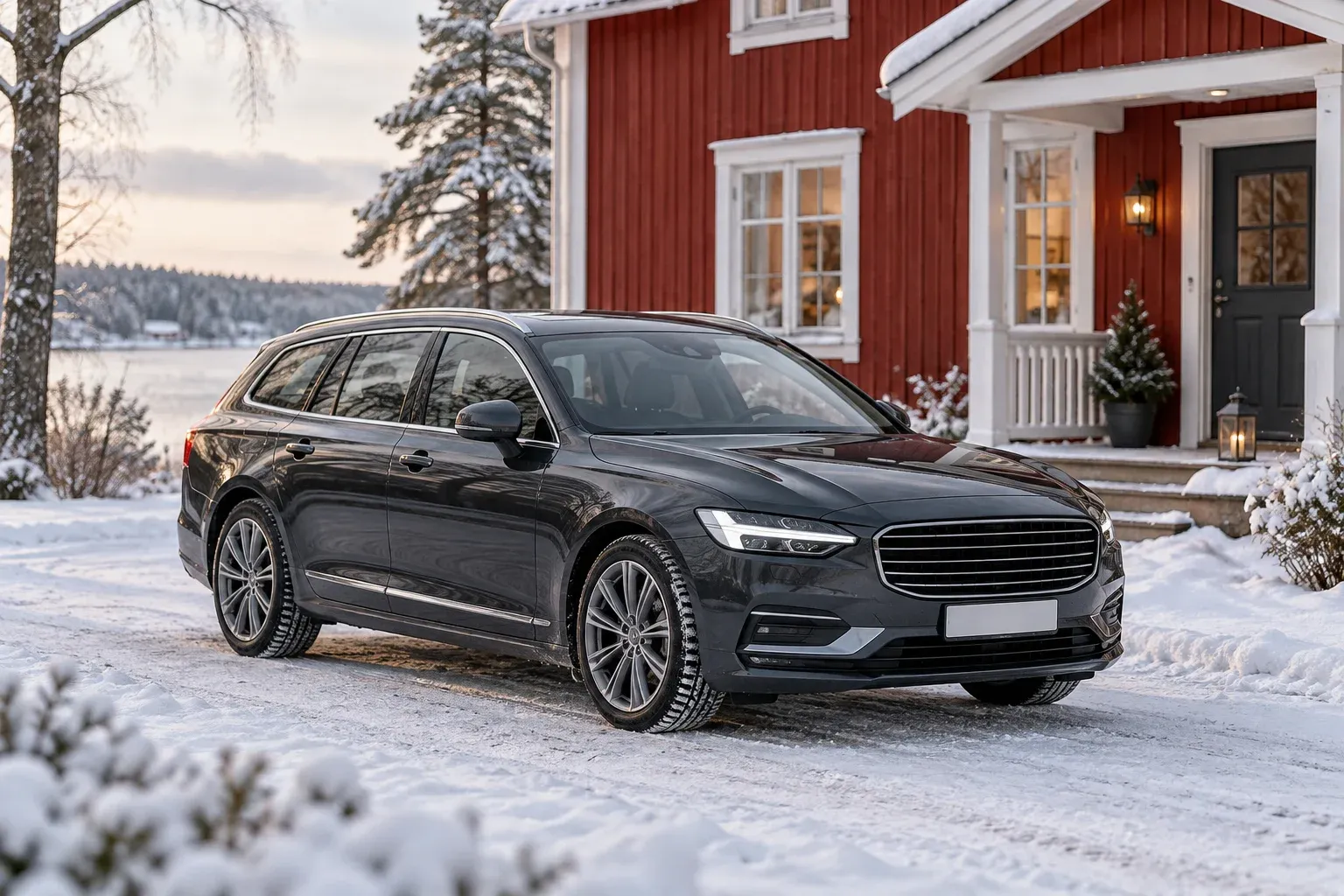
A car on Swedish plates costs money even when it never leaves the driveway. Here is how the two fixed costs work, what the insurance levels mean, why a new petrol car can pay several times the tax of a slightly older one, and how to make both bills stop.
When you need this
You’ve moved to Sweden and bought, imported or leased a car on Swedish plates. An insurer asks whether you want halv or hel cover. A tax bill arrived that looks far higher than your colleague’s. A letter from Trafikförsäkringsföreningen says you owe a fee for every day. Or you’re leaving for the winter and want the bills to stop.
Two costs tied to the register, not the driver
Both costs follow the car’s status in the vehicle register (vägtrafikregistret), not how much you drive. As long as the car is registered and not laid up, it must be insured and taxed every day.
| Cost | Who sets it | Who pays | Can you skip it? |
|---|---|---|---|
| Trafikförsäkring (traffic insurance) | Your insurer; required by law | The owner, or the holder of a lease of a year or more or a credit purchase with retention of title | Only by laying the car up |
| Fordonsskatt (vehicle tax) | Fixed by statute, collected by Transportstyrelsen | The owner recorded in the register | Only by laying the car up |
| Halv- or helförsäkring | Your insurer | You | Yes, it’s voluntary |
The leasing rule surprises people. If you lease a car for a year or more, the duty to insure is yours, not the leasing company’s.
Traffic insurance and the layers on top
Trafikförsäkring is compulsory. It pays for personal injury in a crash, including the driver’s and passengers’, and for damage to other people’s property. It never pays for your own car. Damage to your car is paid by the other side’s traffic insurance only when the other driver caused it (see car accidents in Sweden).
Everything that protects your own car is voluntary, sold in two standard levels:
| Level | What it usually includes | When it fits |
|---|---|---|
| Traffic insurance only | Injuries and other people’s property | Older, low-value cars |
| Halvförsäkring (part cover) | Traffic insurance plus theft, fire, glass, breakdown, rescue and legal-expenses cover | Most cars; new cars with a body-damage warranty |
| Helförsäkring (full cover) | Part cover plus vagnskadeförsäkring, which pays for damage to your own car in a crash or from vandalism | Newer or financed cars without a warranty |
Despite the name, a halvförsäkring is a bundle of covers, not half the price. Most new cars come with a three-year manufacturer’s body-damage warranty (vagnskadegaranti), and with one a halvförsäkring is usually enough. Exact contents differ between insurers, so read the terms. Choosing a higher excess (självrisk) on the own-damage part lowers the premium with many insurers.
Two details from the law matter to newcomers. An insurer licensed to sell traffic insurance must provide it on request, although its licence can limit this to certain groups or areas. And 32 percent of every traffic-insurance premium is tax, built into the price you’re quoted. If you only have a coordination number, ask the insurer directly whether it can quote you (why Swedish forms ask for a personnummer is a story of its own).
You also can’t simply cancel. Traffic insurance on a registered car ends only if the car is laid up, leaves the register, the duty ends for another reason, or another insurer takes over.
Vehicle tax and malus
For a car from 2006 onward, fordonsskatt is a base amount of 360 kr a year plus a CO2 amount. The CO2 amount is normally 22 kr for each gram per kilometer above 111 g in mixed driving, or 11 kr for ethanol and gas cars. Diesel cars from 2018 onward add a fuel surcharge and a 250 kr environmental surcharge.
Then there is malus. Since 1 July 2018, new petrol and diesel cars pay a far higher CO2 rate for their first three years. For cars first taxed from 1 June 2022, that is 107 kr per gram from 75 g up to 125 g, and 132 kr per gram above 125 g. Cars first taxed between July 2018 and May 2022 had lower thresholds and rates for their three years. An electric car pays only the 360 kr base amount.
Here is what that means in practice, calculated from the statutory rates as of October 2026:
| Car | Malus years (first three) | Afterwards |
|---|---|---|
| Electric | 360 kr | 360 kr |
| Petrol, 150 g CO2/km | 9,010 kr | 1,218 kr |
| Diesel, 150 g CO2/km | 11,288 kr | 3,496 kr |
Freshness note: “bonus-malus” now means malus only. The purchase bonus for low-emission cars ended for cars ordered after 8 November 2022. Since 1 February 2025, motorhomes are outside malus, and ethanol cars first in traffic before that date are exempt. Older pages still describe the previous rules.
The import trap: the three malus years count from the car’s first registration anywhere, not from its Swedish registration. A two-year-old petrol car you bring from abroad still has a year of malus left when it gets Swedish plates (registration itself is covered in driving a foreign-registered car long-term).
The northern discount: if your registered address is in one of 36 listed municipalities in the north and inland, among them Kiruna, Gällivare, Jokkmokk, Åre, Härjedalen, Malung-Sälen and Torsby, you pay tax only on the part above 384 kr a year.
Temporarily registered cars pay no vehicle tax at all.
Paying the tax
Tax up to 3,600 kr a year is paid once a year in advance. Above that, it is split into three four-month periods, and you can’t choose another split. The payment month depends on the last digit of the registration number (on plates ending in a letter, the digit before it), and the bill arrives by the 12th of that month.
| Final digit | Payment month |
|---|---|
| 0 | March |
| 1 | April |
| 2 | May |
| 3 | June |
| 4 | August |
| 5 | October |
| 6 | November |
| 7 | December |
| 8 | January |
| 9 | February |
Pay late and you get a late-payment fee and a use ban (användningsförbud): the car may not be driven until the tax is paid. If someone drives it anyway and two months have passed since the due date, police or vehicle inspectors must take the plates. Direct debit (autogiro) or e-invoice prevents most of this, though it covers only the ordinary tax.
Selling has two traps. Whoever is registered as owner at the start of the payment month owes that month’s tax, even if the sale goes through days later. And tax isn’t refunded when ownership changes on a car still in use; it follows the car. Lay the car up before selling if you want overpaid tax back (see buying a used car).
When the car is uninsured
If a registered car that isn’t laid up lacks traffic insurance, Trafikförsäkringsföreningen (TFF), the traffic insurers’ joint body, is entitled by law to a fee for every uninsured day. It’s based on the premiums charged in Sweden and may be up to 10 percent above the highest premium for that kind of vehicle, so it’s meant to cost more than insuring. TFF ignores make, model year, home town and bonus.
The minimum is 200 kr, however short the gap. Since 1 April 2025, the daily fee drops to 50 percent from day 91 and to 25 percent from day 181. Cars 30 years or older pay half.
Worse things can follow. If an uninsured car causes a crash, the insurers pay the victims jointly through TFF and can reclaim up to a tenth of the year’s price base amount from the person who should have insured it. The county administrative board can order you to insure under a conditional fine. And driving an unregistered or laid-up car without insurance is punishable by fines.
Warning: A car parked on the street for months still needs insurance if it isn’t laid up. Cancelling the policy without laying the car up doesn’t work, and a long gap can cost more than a year’s premium.
Laying the car up
Laying up (ställa av) is the only clean way to stop both costs. It’s done online through Transportstyrelsen’s e-service or Mina sidor, or on the registration certificate, not by phoning customer service, and no fee is stated. It counts from the day a complete notice arrives, never backdated.
While laid up, the car needs no traffic insurance and pays no vehicle tax, and overpaid tax is refunded. It may not be driven, except by the shortest route to or from the nearest inspection, insured and with no unpaid tax. The annual register fee (vägtrafikregisteravgift) is still charged. Most cars are taxed by whole months, so the date matters around month ends; a car taxed at 4,800 kr or more a year is taxed per day in the month it is laid up or put back into use.
To drive again, put the car back into use (ställa på), with insurance in place first.
Visitors and foreign plates
None of this applies to a tourist. A rental car’s traffic insurance and tax are the rental company’s costs (see car rental insurance for what you might add). A car registered in the EU, the EEA, Switzerland, the UK and some other listed European countries may be used temporarily in Sweden on its home insurance, and a non-resident’s foreign car pays no Swedish vehicle tax. Once you live in Sweden, the car needs Swedish registration, and both costs begin.
Practical information
| Item | What to know | Checked |
|---|---|---|
| Vehicle tax, base amount | 360 kr a year | 2026-10-14 |
| CO2 amount, normal | 22 kr per g/km above 111 g (11 kr for ethanol and gas) | 2026-10-14 |
| Malus, first three years (first taxed from 1 June 2022) | 107 kr per g/km from 75 to 125 g, 132 kr per g/km above 125 g | 2026-10-14 |
| Diesel surcharges (2018+ cars) | Fuel surcharge 13.52 × g/km, plus 250 kr | 2026-10-14 |
| Rural reduction | Tax paid only above 384 kr in 36 listed municipalities | 2026-10-14 |
| Late tax payment | Fee of at least 100 kr, plus a use ban | 2026-10-14 |
| Premium tax on traffic insurance | 32 percent of the premium | 2026-10-14 |
| TFF uninsured fee, private car | 202 kr per day; minimum 200 kr | 2026-10-14 |
| Insurance premiums | Set by each insurer; compare quotes | 2026-10-14 |
| Laying up | No fee stated by Transportstyrelsen | 2026-10-14 |
FAQ
Is car insurance mandatory in Sweden?
Traffic insurance (trafikförsäkring) is. Every vehicle in the Swedish register that is not laid up must have it, whether or not it is driven, and the owner is responsible. It pays for injuries and other people’s property. Cover for your own car, theft and fire is voluntary, sold as halvförsäkring or helförsäkring. A laid-up car needs no insurance.
What is the difference between halvförsäkring and helförsäkring?
A halvförsäkring (part cover) is traffic insurance plus theft, fire, glass, breakdown, rescue and legal-expenses cover. A helförsäkring (full cover) adds vagnskadeförsäkring, which pays for damage to your own car in a crash or from vandalism. A new car with a three-year body-damage warranty usually needs only a halvförsäkring. Exact contents vary by insurer.
How much is vehicle tax in Sweden?
For a car from 2006 or later: 360 kr a year plus 22 kr per gram of CO2 per kilometer above 111 g. Diesel cars pay surcharges on top. Petrol and diesel cars from 2018 onward pay much higher malus rates for their first three years. An electric car pays 360 kr. Transportstyrelsen shows the exact amount per car.
What is malus in Swedish car tax?
Malus is the higher vehicle tax that new petrol and diesel cars pay for their first three years, introduced on 1 July 2018. For cars first taxed from 1 June 2022 it is 107 kr per gram of CO2 above 75 g, rising to 132 kr above 125 g. The matching bonus for clean cars ended on 8 November 2022.
What happens if my car is uninsured in Sweden?
If the car is registered and not laid up, Trafikförsäkringsföreningen (TFF) charges you a fee for every uninsured day, 202 kr a day for a private car as of October 2026, and at least 200 kr. If the uninsured car causes damage, TFF pays the victims and can reclaim part of it from you.
How do I stop paying insurance and tax on a car I don’t use?
Lay it up (ställa av) through Transportstyrelsen’s e-service, Mina sidor or the registration certificate. From the day a complete notice arrives, you need neither traffic insurance nor vehicle tax, and overpaid tax is refunded. The car may then not be driven except to an inspection. The register fee is still charged.
Do tourists pay Swedish vehicle tax or traffic insurance?
No. A rental car’s traffic insurance and tax are the rental company’s costs. A car registered in the EU, EEA, Switzerland, the UK or some other listed European countries may be used temporarily on its home insurance, and a non-resident’s foreign car pays no Swedish vehicle tax. Once you live here, the car needs Swedish registration.
Related guides
- Driving a foreign-registered car long-term — when your car must get Swedish plates, and the insurance rules until then
- Car accidents in Sweden — what traffic insurance and TFF actually pay after a crash
- Car rental insurance — what a rental already includes and what is worth adding
- Driving in Sweden — the road rules that come with the car
- Bilbesiktning — the inspection that keeps a Swedish car on the road
Facts verified 2026-10-14. Sources: Sveriges riksdag (Trafikskadelag 1975:1410, Trafikförsäkringsförordning 1976:359, Lag 2007:460, Vägtrafikskattelag 2006:227), Transportstyrelsen, Trafikförsäkringsföreningen, Konsumenternas Försäkringsbyrå and Regeringen — full register in this topic’s source file. This is general information, not legal or insurance advice. Found something outdated? Tell us and we’ll fix it.