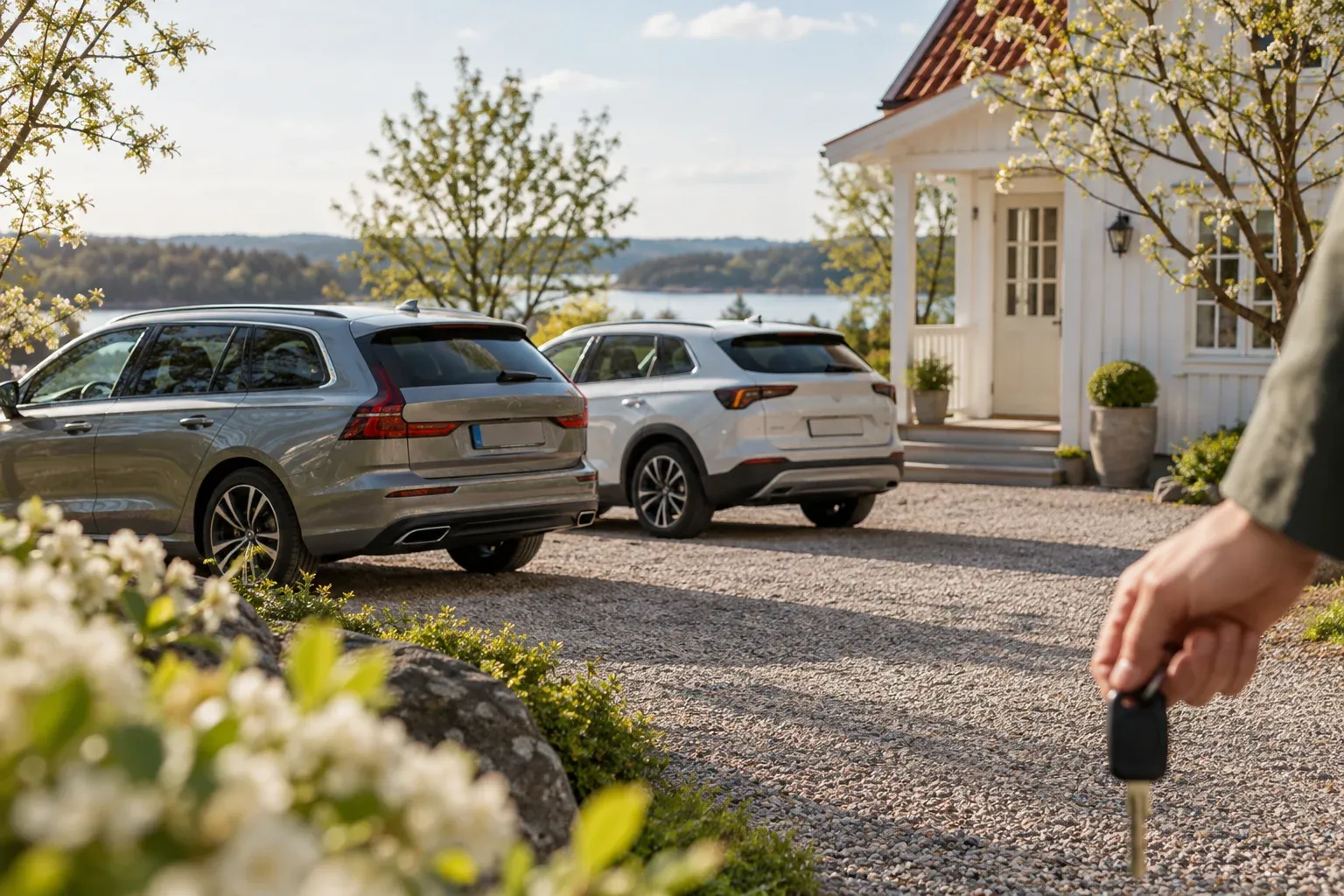
Sweden’s vehicle register is public enough that you can check most of a car’s paperwork before you meet the seller. What you can’t check is the seller, and the transfer itself has a catch for newcomers. Here is the order that keeps you safe.
When you need this
You’ve found a car on Blocket or another marketplace, and want to know it is what the ad says. Maybe you’re a newcomer, exchange student or seasonal worker who needs a car for a year or two. Or the seller has suggested doing the transfer “online, later”, asked for a deposit, or you don’t yet have BankID or a Swedish licence and wonder how you’ll ever be registered as owner.
How the system works
Every car in use in Sweden is in the vehicle register (vägtrafikregistret), kept by Transportstyrelsen, the Swedish Transport Agency. A car changes owner in law when the registered owner and the buyer report it, and the register is updated. Both are required to report it, though one notice can start the process.
Timing matters. If the notice reaches Transportstyrelsen within ten days, you become owner from the date written in it. If it arrives later, the transfer counts from the day it arrives, and any tax, charges or camera invoices in that gap can land on the wrong person.
Check the car before you meet
Four free checks cover most of the risk:
| Check | How | What it tells you |
|---|---|---|
| SMS lookup | Text the plate, no spaces, to 71640 | Make, model, year, status (in traffic, off the road, deregistered), leasing, owner’s name and town |
| Vehicle data | Transportstyrelsen’s vehicle-data e-service | Inspection, tax, technical data; a dealer credit purchase shows in the notes field |
| Debts | Seller logs in to Fordonets skulder and shows you | Unpaid vehicle tax, congestion tax, parking and bridge charges |
| Identity | Seller’s ID against the SMS reply | Whether you’re dealing with the registered owner |
The SMS service is free, though your operator may charge for the message.
Why the debt check matters: the previous owner stays liable for charges decided while they owned the car, but Kronofogden (the Enforcement Authority) can still seize the car to cover them. Unpaid charges can also trigger a use ban (användningsförbud), and police can take the plates off a car driven under one. Transportstyrelsen admits the debt data can lag, so treat a clean result as good, not perfect.
Two more things the register can’t fully tell you. A private loan on the car isn’t recorded; only a dealer’s credit sale with retention of title (kreditköp med återtaganderätt) is. Ask directly whether the car is financed, because a bank may be entitled to take it back. And check the inspection date: a car past its date has an automatic driving ban (körförbud), and Transportstyrelsen sends no reminders.
Dealer or private seller
This is the biggest decision, because it decides which law protects you.
| Dealer | Private seller | |
|---|---|---|
| Law | Konsumentköplagen (Consumer Sales Act, 2022) | Köplagen (Sale of Goods Act) |
| Liability | Faults present at delivery that appear within 3 years | Terms can be agreed away; 2-year outer limit to complain |
| Burden of proof | Faults within 2 years presumed to be the seller’s | On you |
| Complaint deadline | Within 2 months of noticing is always in time | Within reasonable time |
| Withdrawal right | 14 days only for distance sales or online-only auctions | None by law |
Freshness note: Many car-buying pages still say a dealer must prove a fault isn’t its responsibility for only six months. That was the old law. Since the 2022 Consumer Sales Act, the presumption runs for two years.
A dealer can’t contract out of these rules; terms worse for you than the Act are void. Dealers that belong to MRF, the motor trade association, give a vehicle declaration (varudeklaration) and follow the recommendations of ARN, the National Board for Consumer Disputes. A private owner who sells through a company (förmedlingsköp) still gives you consumer protection.
From a private seller, “sold as is” (i befintligt skick) is normal, but it doesn’t remove every right. You can still complain if the car isn’t as described, is much worse than the price suggested, or had a serious fault the seller knew about and hid. You must examine anything the seller invites you to examine.
If you’ll leave Sweden within two years, a dealer car’s two-year presumption is often worth more to you than a lower private price.
Meeting, paying and avoiding scams
Polisen’s advice on ad fraud boils down to a few habits:
- Meet, see the car and pay at handover. Avoid deposits to private sellers.
- Be wary of pressure to close fast, and of prices that look too good.
- Never log in with BankID because someone asks you to. Polisen describes people losing money after following a “payment” link and logging in.
- With Swish, check the recipient is the person you met, and check your bank’s Swish limit before the day.
Konsumentverket, the consumer agency, adds: always write a contract, in two identical copies signed by both of you. Include the parties, the car, mileage, condition, equipment (list the tyres), price and payment terms.
If it goes wrong, call your bank first so it can try to stop the payment, then report it to the police on 114 14 and keep the ad, messages and transfer records.
The ownership transfer
There are two routes:
- Online in Mina sidor. The seller logs in with e-identification such as BankID. Both of you must be over 18 and hold valid Swedish driving licences, and the licence validity and reference number are entered. The transfer registers the same day; no other date can be chosen, and you can’t take the car on or off the road in the same notice.
- On paper. Use the yellow part 2 of the latest original registration certificate (registreringsbevis del 2). Fill in the buyer’s identity number, name, Swedish address, the transfer date and both signatures, and post it to Transportstyrelsen, 701 81 Örebro, within ten days.
Freshness note: Several 2026 Swedish guides say the buyer completes an online transfer by signing with BankID. Transportstyrelsen’s own page describes the seller logging in and requires a Swedish licence for both. If you don’t have one, the paper route is yours.
Do the paperwork while you’re together: complete the online notice, or fill in part 2 on the spot and photograph it. Then check that the register shows you as owner. Transportstyrelsen may refuse to register a car that is reported stolen or seized, and a lease of a year or more blocks the transfer without the lessor’s consent.
Without a personnummer or Swedish licence
To be registered as owner you need an active Swedish personal identity number (personnummer) or a coordination number (samordningsnummer). If you have neither, Transportstyrelsen applies to Skatteverket for you: send a clear colour copy of every page of your valid passport or national ID card with the paper notice. Skatteverket then calls you to a service office to show the original. The paper notice also asks for a Swedish address, so arrange one first.
Insurance, tax and debts
| Item | What applies |
|---|---|
| Traffic insurance | Required from the transfer date if the car is in use; the seller’s ends automatically |
| Off-the-road car (avställd) | No traffic insurance needed, but it may not be driven until put back into use |
| Vehicle tax | Follows the car; a transfer in the month tax is due leaves that payment with the seller |
| Malus | High-CO2 cars pay more tax for 3 years from first becoming taxable |
| Old debts | The previous owner stays liable, but Kronofogden can still seize the car |
Owner-bound exemptions and adaptations lapse at transfer, so check whether the car’s registration depends on one.
Buying abroad instead
If you live in Sweden and buy a car abroad, you may drive it on its foreign plates for one week from entry. After that it needs Swedish registration: an origin check, a registration inspection and plates posted to your Swedish address. A foreign lease blocks registration. The full route is in our guide to driving a foreign-registered car in Sweden.
Practical information
| Item | Detail |
|---|---|
| Owner and status by SMS | Text plate to 71640; free, operator charges may apply |
| Transfer notice deadline | 10 days, or the transfer counts from arrival |
| Online transfer | Seller with e-ID; both over 18 with valid Swedish licences; same day |
| Paper transfer | Registration certificate part 2 to Transportstyrelsen, 701 81 Örebro |
| Dealer fault rights | 3 years; faults within 2 years presumed the seller’s |
| Private-sale fault rights | Köplagen; at the latest 2 years after delivery |
| Transfer fee | None stated by Transportstyrelsen |
| Vehicle tax and malus | Depend on the car; check in the vehicle-data e-service |
| Fraud | Bank first, then police on 114 14 |
FAQ
How do I check a used car before buying it in Sweden?
Text the registration number without spaces to 71640 for the owner, status and any leasing note, free of charge. Then use Transportstyrelsen’s vehicle-data e-service for inspection, tax and credit notes, and ask the seller to show you the debt check in Fordonets skulder. Compare the owner with the seller’s ID before paying.
How does the ownership transfer (ägarbyte) work?
The seller and buyer report it to Transportstyrelsen. Online, the seller logs in to Mina sidor with e-identification, and both must be over 18 with valid Swedish driving licences; it registers the same day. Otherwise you fill in the yellow part 2 of the registration certificate and post it within ten days.
Can I buy a car in Sweden without a personnummer?
Yes, but you need a coordination number. If you have neither, Transportstyrelsen applies to Skatteverket for you, using a colour copy of your passport or national ID card sent with the paper notice, and Skatteverket calls you to an office to show the original. The notice also asks for a Swedish address.
What rights do I have if a used car breaks down?
From a dealer, three years for faults that existed at delivery, and for the first two years the dealer must prove a fault wasn’t there. Complain within two months of noticing it. From a private seller, köplagen applies: terms can be agreed away and you must complain within reasonable time, at the latest two years after delivery.
Does the car’s debt follow the car to me?
The previous owner stays liable for vehicle tax and charges decided while they owned it. But Kronofogden can seize the car to cover them, and unpaid charges can trigger a use ban. That’s why Transportstyrelsen asks buyers to check debts with the seller before the deal, accepting that the data may lag.
How do I avoid scams when buying a car on Blocket?
Meet the seller, see the car and pay at handover, never as a deposit. Be wary of pressure to close fast or a price that looks too good. Never log in with BankID because someone asks you to. If you’re defrauded, call your bank first, then report it to the police and keep the evidence.
Do I need insurance straight away?
Yes, if the car is in use. Traffic insurance must apply from the transfer date you report, and the seller’s insurance ends automatically once the change is registered. An off-the-road car needs no traffic insurance, but it may not be driven until it is put back into use.
Related guides
- Driving a foreign-registered car in Sweden: the import route and the one-week rule in full
- Reklamation: complaining about faulty goods: how to make a fault complaint stick
- ARN consumer disputes: where a dealer dispute goes next
- The personnummer explained: the number the vehicle register is built on
- Scams and pickpockets in Sweden: fraud patterns beyond car ads
Facts verified 2026-10-14. Sources: Transportstyrelsen, Sveriges Riksdag (Förordning 2019:383 and Lag 2019:370 on vehicle registration), Konsumentköplagen, Köplagen, Konsumentverket, Polisen — full register in this topic’s source file. No tax, insurance or inspection amounts are published here. Found something outdated? Tell us and we’ll fix it.