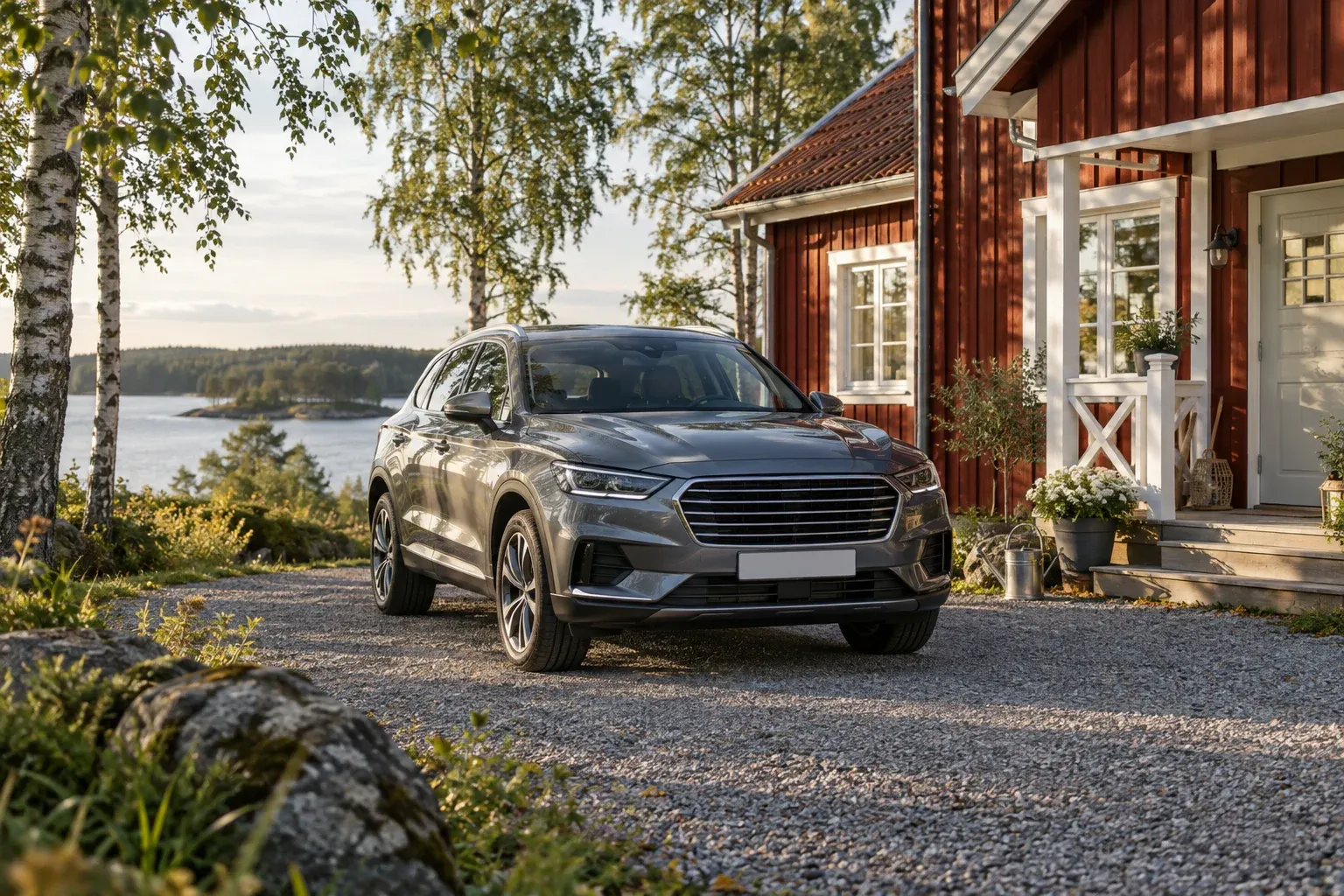
Forget the “one year on foreign plates” rule you’ve read about. Swedish law asks where you live, not how many days you’ve been here. Here is the test, what changes the week you move, and the traps that catch people bringing a car from home.
When you need this
You’re spending a long summer, a sabbatical or a winter season in Sweden with your own car. Or you’ve taken a job here and wonder whether your German, Dutch or UK car can stay on its plates. Maybe you split the year between two countries, or you’ve just become folkbokförd (registered as resident) and the car still wears its home plates.
The rule: residence, not a stay counter
The Act on vehicle registration, Lag (2019:370) om fordons registrering och användning, says every car used in Sweden must be in the Swedish vehicle register. It then exempts cars in internationell vägtrafik (international road traffic). Three conditions must all hold:
| Condition | What it means for you |
|---|---|
| The owner’s main residence is abroad | You live in another country |
| The car is not registered in Sweden | It still has its foreign registration |
| It was brought in to be used temporarily | It is here for a stay and will leave |
The Act sets no day limit for this exemption. The one year written into the law applies only to cars registered in Denmark, Finland or Norway. The other “12 months” you may see is the longest term of a Swedish temporary registration for non-residents, a separate permit with red plates.
So the many web pages promising everyone a year on foreign plates have it wrong in both directions. A non-resident on a long stay has no fixed cut-off. Someone who has moved here gets only a week.
The 185-day test
What if you live in two places? Transportstyrelsen (the Swedish Transport Agency) looks at your egentlig hemvist, your real home. Its rule of thumb: if you live in Sweden for the larger part of the year, at least 185 days in a calendar year, the car must be registered here. If you live abroad most of the year, you may drive it in Sweden on its valid foreign registration while it is here temporarily.
This is agency guidance, not a number in the Act, and it is not the same test as population registration. Folkbokföring asks whether you will sleep here regularly for at least a year. You can meet one test and not the other, so keep evidence of where you really live, such as a lease abroad, a work contract or travel dates.
Transportstyrelsen also answers the common border cases:
- A Danish resident commuting daily to Malmö in a Danish-registered car may do so.
- A Swedish resident with a Danish car must register it in Sweden, even if they work in Denmark.
- A Swedish resident driving a car rented from a foreign company, or a foreign employer’s company car, may do so if the use is temporary.
The Act’s one-year rule for Nordic cars and the agency’s line on residents’ Danish cars don’t sit neatly together. If that’s your situation, ask Transportstyrelsen before relying on the year.
Moving here: the one-week clock
Once you live in Sweden, a car you bring in may be driven on its valid foreign registration for one week from the day it entered the country. After that it needs Swedish registration, or a temporary registration while the process runs. Using it unregistered is an offence punished by fines (penningböter), and the owner can be fined as well as the driver.
Warning: Two traps can make a car impossible to keep. A car on foreign leasing cannot be registered in Sweden; Transportstyrelsen wants proof that the lease is paid off or moved to a Swedish lessor. And plates and certificates are posted only to a Swedish registered address, so the registration can’t be finished before you are folkbokförd.
Leaving the car on foreign plates doesn’t avoid tax either. Swedish vehicle tax covers cars that “are or should be” in the register.
Registering the car
For a used car from another EU country, Transportstyrelsen describes this route:
- Settle tax first if it applies. A car from outside the EU goes through customs, and a new car from another EU country triggers Swedish VAT, reported to Skatteverket.
- Apply for an origin check (ursprungskontroll) once the car is in Sweden, with the original foreign registration certificate and proof of purchase. Pay the fee in advance.
- Add temporary registration if you need to keep driving; it needs a Swedish insurance certificate for temporary registration.
- Book a registration inspection (registreringsbesiktning) with your case number. You may drive there by the shortest route without plates if you have the decision, a booked time and at least one-day insurance.
- Receive Swedish plates with a random number, posted to your Swedish address.
- Insure it and put it into use (ställa på). Vehicle tax is invoiced from then on.
An approved origin check is valid for five years, so start early. A car with a valid roadworthiness test from another EU/EEA country can have it counted at the inspection. Left-hand-traffic cars and British speedometers need more than paperwork, so ask an inspection company first.
Moving from outside the EU? Your car can come in free of duty and VAT as moving goods if you have lived outside the EU for at least a year and owned and used the car there for at least six months. For the first year you may not sell, lend, hire out or pledge it without paying the duty and VAT.
Insurance: is the home policy enough?
Every car used in Sweden must have traffic insurance (trafikförsäkring). For foreign cars, the insurance ordinance decides when the home policy is enough:
| Car registered in | Swedish insurance needed for temporary use? |
|---|---|
| Any other EU country, Norway, Iceland, Switzerland, the UK, Serbia and the other listed countries | No, the home policy counts |
| Elsewhere, arriving from an EEA country, built to carry people or goods | No |
| Elsewhere, arriving straight from outside the EEA | Green card or other EEA-wide proof, or border insurance (gränsförsäkring) through Tullverket |
Check your own contract too: the law accepts the policy, but your insurer may limit how long the car may be abroad. Once the car is Swedish-registered, Swedish insurance is required.
Your licence runs on a different clock
An EU/EEA licence stays valid when you move here. A licence from outside the EU/EEA stops being valid after more than a year as a registered resident, though UK and Faroese licences are exempt. It stays valid while an exchange application is pending, and short fixed-term residents can apply for an exemption. The details, including the exchange rules tightened on 1 May 2026, are in foreign licences and international driving permits.
Charges and winter tyres
A foreign plate changes nothing on the road. Congestion tax in Stockholm and Gothenburg and the three state bridge charges are invoiced to the owner abroad; see congestion charges and paying fines and charges from abroad. From 1 December to 31 March, Swedish winter tyre rules apply to foreign cars in winter road conditions.
Mistakes to avoid
- Assuming a general one-year rule. Only Nordic cars get a statutory year. What decides is where you live.
- Treating folkbokföring and vehicle residence as one test. They ask different questions.
- Bringing a leased car and discovering it can’t be registered.
- Keeping summer tyres because they’re legal at home.
- Ignoring camera invoices because the car is foreign.
Practical information
| Item | What applies |
|---|---|
| Non-resident’s car in temporary use | No Swedish registration or vehicle tax; no fixed day limit |
| Danish, Finnish or Norwegian car | Up to one year without Swedish registration |
| Residence test (Transportstyrelsen) | 185 days a calendar year in Sweden → register here |
| New resident bringing a car | One week on foreign plates from entry |
| Temporary registration for non-residents | 3, 6 or 12 months, not extendable |
| Origin check fee | Fixed, paid in advance; see Transportstyrelsen’s fee page |
| Using a car that should be registered | Fines for driver and owner |
| Non-EU licence after moving | Invalid after more than one year as resident (UK exempt) |
| Moving goods from outside the EU | Duty- and VAT-free on conditions; no sale for a year |
FAQ
How long can I drive a foreign-registered car in Sweden?
As long as you live abroad and the car is here for temporary use, Swedish law sets no fixed day limit; Danish, Finnish and Norwegian cars get a statutory year. What ends the right is moving here. Transportstyrelsen treats you as living in Sweden if you are here at least 185 days a calendar year, and then the car must be registered.
I’ve moved to Sweden. Can I keep my car on its foreign plates?
No. Once you live in Sweden, a car you bring in may be driven on its valid foreign registration for one week from entry. After that it needs Swedish registration, or a temporary registration while the process runs. Using it unregistered is an offence punished by fines for the driver and the owner.
How do I register a foreign car in Sweden?
Apply to Transportstyrelsen for an origin check with the original registration certificate and proof of purchase, and pay the fee. After approval, book a registration inspection. When the car passes, plates and certificate are posted to your Swedish address. Insure it, put it into use, and vehicle tax follows. Customs or VAT come first where they apply.
Is my foreign car insurance valid in Sweden?
For cars registered in the EU and some other European countries, including the UK, Norway and Switzerland, yes: the home policy covers temporary use without Swedish traffic insurance. A car arriving straight from outside the EEA needs proof of EEA-wide insurance, such as a green card, or a border insurance arranged through Tullverket. Once the car is Swedish-registered, Swedish insurance is required.
Does my driving licence stay valid if I move to Sweden?
An EU/EEA licence stays valid. A licence from outside the EU/EEA stops being valid after you have been a registered resident for more than a year, except UK and Faroese licences. It remains valid while an exchange application is pending, and short fixed-term residents can apply for an exemption.
I split my year between Sweden and another country. Which rule applies?
Transportstyrelsen looks at where your real home is. If you live in Sweden for the larger part of the year, at least 185 days in a calendar year, the car must be registered here. If you live abroad most of the year, you may drive it in Sweden on its valid foreign registration while it is here temporarily.
Can I bring my car tax-free when I move from outside the EU?
Yes, as moving goods, if you have lived outside the EU for at least a year and owned and used the car there for at least six months. Tullverket must approve it. For the first year you may not sell, lend, hire out or pledge the car without paying the duty and VAT.
Related guides
- Driving in Sweden: the everyday road rules your car is under from day one
- Foreign licences and international driving permits: the one-year licence rule and exchange in full
- Moving to Sweden for work: folkbokföring, ID and the order of steps the car depends on
- Winter tires in Sweden: what your car needs from 1 December
- Fines and charges from Sweden: handling invoices that reach you abroad
Facts verified 2026-10-06. Sources: Sveriges Riksdag (Lag 2019:370 and Förordning 2019:383 on vehicle registration, Trafikskadelagen, Trafikförsäkringsförordningen, Vägtrafikskattelagen, Körkortslagen), Transportstyrelsen, Tullverket, Polisen — full register in this topic’s source file. Fees are never published here. Found something outdated? Tell us and we’ll fix it.