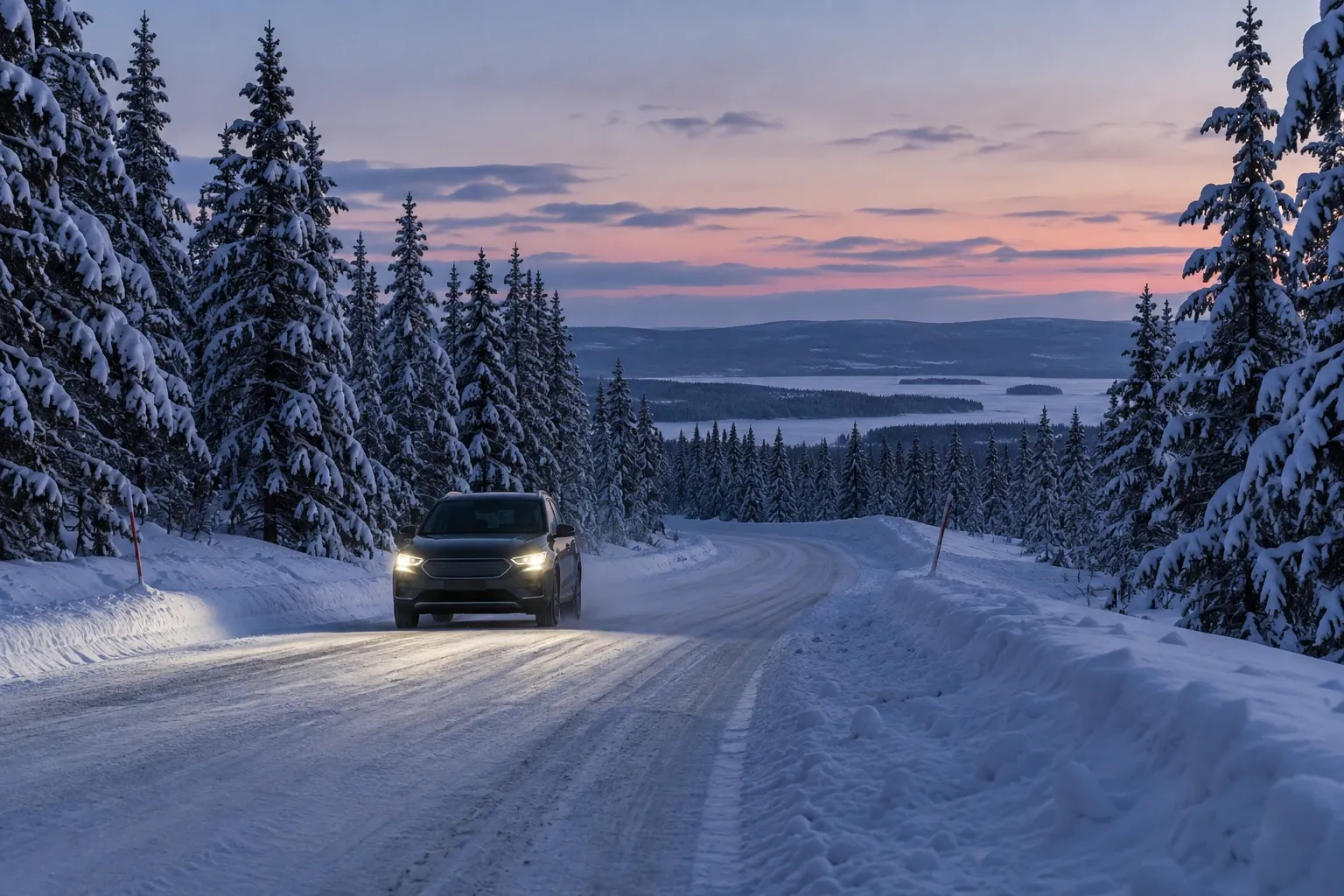
Swedish roads stay open all winter, and most visitors drive them without drama. What catches people is specific: ice you can’t see, days that barely get light, quiet roads that are ploughed last, and mountain passes that close in a storm. Here’s how to handle each one.
When you need this
You’re planning a road trip between November and April, or picking up a rental car for Lapland or a ski resort. Maybe you’re driving your own car up from a country where winter means rain. Or you’ve just seen halka flash up on a road sign, or you’ve parked at a hotel next to a row of electric posts and wondered what they’re for.
Tyres and the winter kit
Start with the one hard rule. From 1 December to 31 March, winter tyres are compulsory whenever there’s snow, ice, slush or frost on the road, and that includes foreign cars. A rental company has to supply them. Everything about markings, studs and dates is in our winter tyres guide.
Then pack the kit. This is Krisinformation’s list, the official Swedish crisis-information service:
| For the car | For you |
|---|---|
| Ice scraper and snow brush | Torch |
| Shovel | Charged mobile phone |
| Extra washer fluid | Reflective vest |
| Jump leads and tow rope | Food and drink |
| Warning triangle (required by law) | Blankets and extra warm clothes |
Save the roadside-assistance number in your phone and on a piece of paper. Buy washer fluid rated for the temperatures ahead, because summer fluid freezes on the glass just when salt spray makes it essential.
Clear the whole car
Here’s something few guides get right: no Swedish statute says how clear your windows must be. We read the Road Traffic Ordinance (trafikförordningen) and the Vehicle Ordinance, and neither has a rule on scraping. That isn’t a loophole. You still have a general duty of care, your speed must suit what you can see, and the car must be safe for traffic.
In practice, according to the road-safety NGO NTF, the windscreen, the front side windows and the mirrors must be clean. Driving without clearing them can bring day-fines and even cost you your licence. So:
- Scrape every window you drive by, plus both mirrors.
- Sweep the lights and number plates.
- Clear the roof. Snow left there counts as an unsecured load: it slides over the windscreen when you brake or blows onto the car behind. It’s a finable offence.
A wiper or washer that “is not effective” is a fixed-fine offence of its own; amounts are in the table below.
Engine heaters and electric cars
Those posts in hotel and apartment car parks power engine block heaters (motorvärmare). Many Swedish cars have one. Plugging in makes cold starts easier and cuts fuel use and emissions. Many modern posts have timers that switch the heater on in time for your departure. Whether a hotel charges for the post varies, so ask at check-in.
You don’t need to plug in overnight. As a rule of thumb, an hour at most around zero and an hour and a half toward −15 °C is enough. Anything longer mostly wastes electricity.
Electric cars lose range in the cold. In a Swedish motorists’ association test at −5 to −8 °C, cars that started warm went 14–26 percent less far than in summer, and cold-started cars did significantly worse. The far north is often much colder than that. Precondition the car while it’s plugged in, and plan shorter legs between chargers (EV charging in Sweden).
The same logic applies to fuel. Trafikverket’s advice is to leave with a full tank, and in the inland north it’s wise to refill well before the gauge gets low.
Black ice and “halka”
Halka means slippery road, and svarthalka is black ice, the kind you can’t see. It forms on bridges, in valleys, along open water and in shaded forest.
The law is simpler than people expect. Your speed must suit the road, the weather and the visibility, and it must never be higher than lets you stop within the distance you can see. The Road Traffic Ordinance specifically requires a low enough speed vid halt väglag, on slippery roads. The speed limit is a maximum for good conditions, not a target. On ice, the lawful speed may be half of it.
On bigger roads, variable signs lower the limit when there’s a risk of ice. A limit shown in a red ring is binding, and one without a ring is advisory. More in our speed limits guide.
Drive for the grip you can’t see. Keep longer gaps, and steer and brake gently. Keep dipped headlights on, because daytime running lights aren’t enough at dusk, in darkness or in snow.
Checking road conditions
Before every leg, check two things:
- Trafikverket’s traffic-information map. It’s free, and it colors roads by condition: no problems, risk of difficult conditions, difficult conditions, and snow- or ice-covered road. It also shows road-weather camera images from a network of roughly 800 stations, plus roadworks, accidents and closures. For the Stockholm and Gothenburg areas, Trafiken.nu adds local detail.
- SMHI’s weather warnings. They come in yellow, orange and red, and ice is among the hazards they cover.
Assume the trip will take much longer than normal. That’s Trafikverket’s own advice.
Which roads are ploughed first
Trafikverket divides state roads into five classes by traffic volume and function, and the busiest roads are ploughed first. Classes 1–3 are cleared fastest and salted. Quiet roads in classes 4–5 are usually sanded and may keep a few centimeters of snow. Municipal streets and private roads follow their own owners’ schedules.
The practical upshot: a trunk road can be black and wet while the side road to your cabin is still white. Plan for the worst road on your route, not the best.
Never overtake a plough, least of all two working in tandem. They work across the road in echelon, about 200 m apart, and one blade reaches into the lane you would overtake in, hidden by snow. Trafikverket calls overtaking them a danger to life. The unploughed road is ahead of them anyway.
Darkness and wildlife
North of the Arctic Circle, at about 66.5° N, there’s polar night. In Kiruna the sun stays below the horizon for about 27 days around the solstice, though twilight gives a few hours of grey light. Further south the days are still short.
Darkness and wildlife go together. Moose and deer are most active at dawn and dusk. In the northern counties reindeer are herded animals, and they walk on the road. Leave earlier and stop earlier, and scan the verges. If you hit one, you have a legal duty to report it. See what to do after a wildlife collision.
Mountain roads: closures and convoys
When a storm hits the mountains, Trafikverket can close a road outright or run it as kolonnkörning, convoy driving. Traffic waits at a barrier until it’s cleared to go, then drives as a group behind a lead vehicle, usually a plough. It happens repeatedly on the E10 between Björkliden and Riksgränsen and on Silvervägen (road 95) toward Junkerdal, both routes into Norway. End times are provisional and can move.
Check closures for the whole route before you set off, not just the start. Crossing into Norway? See our Sweden–Norway border guide.
If you get stuck
Storms strand traffic in the south too. In January 2024, heavy snow and wind stopped the E22 in Skåne for almost two days, and the military used tracked vehicles to get people out. Your kit is what keeps you warm while help comes.
If the car stops on a fast road, Trafikverket’s advice is blunt. About four people a year die after breakdowns and punctures on motorways and 2+1 roads alone:
- Put the hazard lights on.
- Set out the warning triangle at least 100 m back.
- Leave both the car and the road, behind the barrier if there is one.
- Call roadside assistance, or 112 if anyone is in danger.
To report a hazard on a state road that isn’t an emergency, such as a fallen tree, call Trafikverket on 0771-921 921, day or night.
Mistakes to avoid
- Trusting the speed limit on ice. Drive for the grip, not the sign.
- Scraping a porthole. Clear every window you drive by, plus the mirrors, lights, plates and roof.
- Summer washer fluid. It freezes on the glass.
- Overtaking a plough to “get past the snow”. The snow is ahead of it.
- Checking only the first leg. A mountain pass can close while your start point is calm.
- Planning an EV trip on the summer range.
Practical information
| Item | Detail |
|---|---|
| Winter tyres | Compulsory 1 Dec–31 Mar in winter conditions; 2026–27 period starts 1 Dec 2026 |
| No winter tyres when required | 2,000 kr fixed fine for the driver, 2,000 kr for the owner |
| Wiper or washer not effective | 500 kr fixed fine |
| Prescribed lights not switched on | 500 kr fixed fine |
| Roof snow (treated as load) | Fine: 2,000 kr in the schedule; NTF reports 1,500 kr |
| Windows not cleared | Day-fines by income; possible licence revocation |
| Engine-heater post at a hotel | Varies by property; ask at check-in |
| Road conditions | Trafikverket’s traffic-information map, free |
| Weather warnings | SMHI, yellow / orange / red |
| Non-emergency road hazard | Trafikverket 0771-921 921, open 24/7 |
| Emergency | 112 |
FAQ
Is it safe to drive in Sweden in winter as a tourist?
Yes, if you prepare. Main roads are ploughed and salted first, and Swedish drivers are used to snow. The real dangers are black ice you can’t see, short daylight, wildlife at dusk and long gaps between services in the north. Drive well below the limit on ice, carry warm clothes and a winter kit, and check Trafikverket’s road map before each leg.
Do I have to scrape all the car windows in Sweden?
No statute says exactly how clear windows must be, but that is no loophole. In practice the windscreen, the front side windows and the mirrors must be clean, and police can fine you in day-fines or even revoke your licence. Sweep snow off the roof, lights and number plates too: roof snow is treated as an unsecured load.
What is kolonnkörning?
Convoy driving. When a mountain road is too stormy to keep open, Trafikverket stops traffic and lets cars through only in a group behind a lead vehicle, usually a plough. You wait at the barrier for the signal and then drive in the column. It happens several times a winter on the E10 near Riksgränsen and on Silvervägen, road 95.
How do I check road conditions in Sweden?
Use Trafikverket’s traffic-information map. It shows road conditions by color, road-weather camera images, roadworks, accidents and closures, and it’s free. Check SMHI’s weather warnings too: yellow, orange and red, and ice is among the hazards they cover. For the Stockholm and Gothenburg areas, Trafiken.nu adds local detail.
What should I keep in the car in a Swedish winter?
Krisinformation’s list: ice scraper, snow brush, shovel, extra washer fluid, jump leads, tow rope and a warning triangle for the car; a torch, charged phone, reflective vest, food, drink, blankets and warm clothes for you. Save the roadside-assistance number in your phone and on paper, and keep the tank well filled.
How much range does an electric car lose in a Swedish winter?
A lot. In a motorists’ organization test at −5 to −8 °C, cars started warm lost 14–26 percent of their summer range, and a car started cold does significantly worse. Northern Sweden often sees much colder days. Precondition the car while it is plugged in, and plan shorter legs between chargers.
What is a motorvärmare and do I need to plug it in?
An engine block heater. Many Swedish cars have one, and the posts in hotel and apartment car parks are there to power it. It makes cold starts easier and cuts fuel use and emissions. About an hour is enough at around zero, and roughly an hour and a half near −15 °C; longer mostly wastes electricity.
Related guides
- Winter tyres in Sweden: the dates, the alpine symbol and studs, in full
- Driving in Sweden: every general rule this page builds on
- Wildlife collisions: what the law requires after hitting a moose, deer or reindeer
- Renting a car in Sweden: what to check at the desk before a winter trip
- Getting around Sweden: when a winter train beats a winter drive
Facts verified 2026-09-24. Sources: Sveriges Riksdag (trafikförordningen, fordonsförordningen), Åklagarmyndigheten (fixed-fine schedule), Trafikverket, Transportstyrelsen, Krisinformation.se, SMHI, Energimyndigheten, and the road-safety NGO NTF — full register in this topic’s source file. Road status and closures change by the hour and are never published here. Found something outdated? Tell us and we’ll fix it.