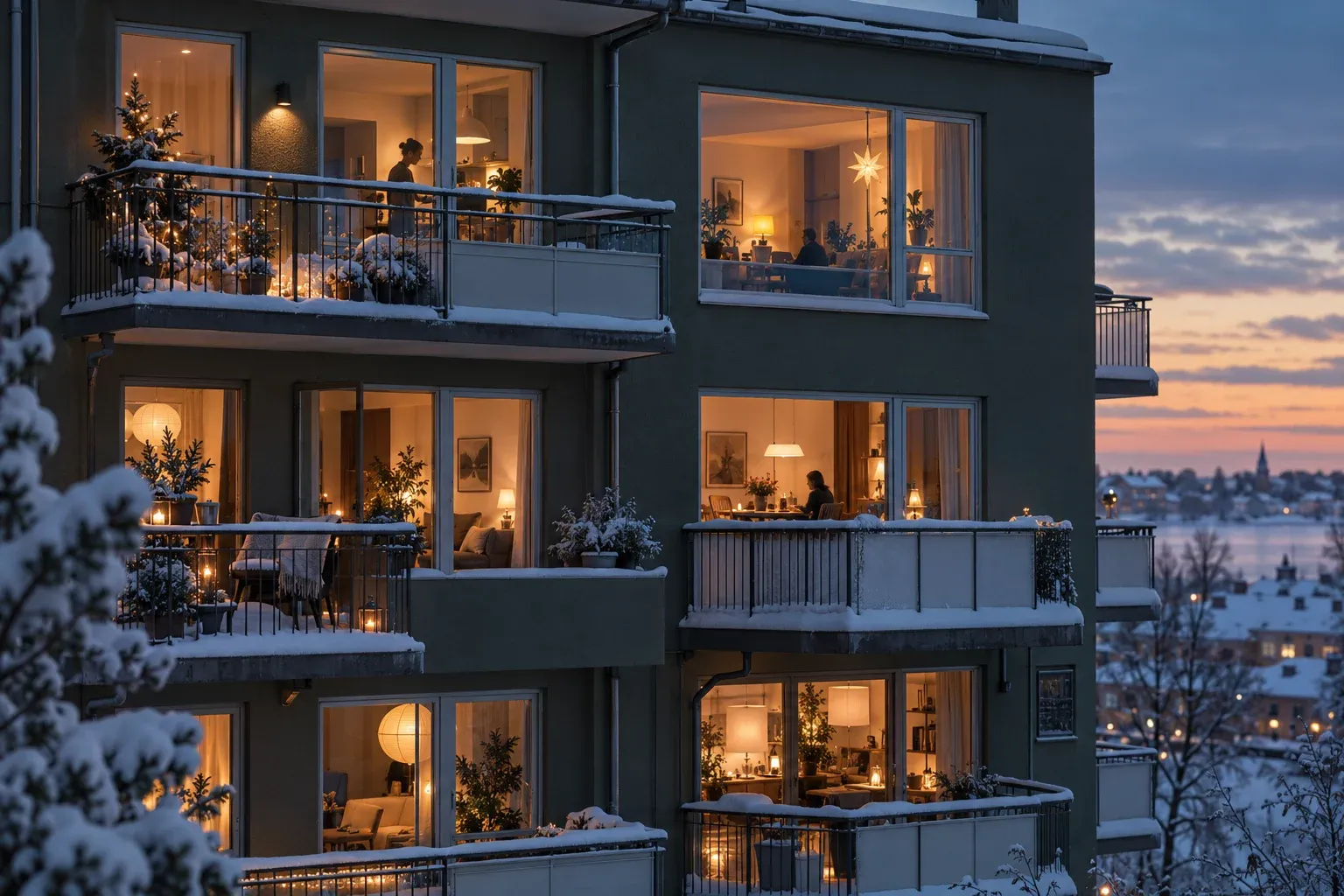
It can be −15 °C outside and warm enough for a T-shirt inside. That is not luck but design, backed by building rules and health guidance. Here is how it works and what it means for your stay.
When you need this
Your hotel room feels too hot in January and there is no obvious switch. You are packing for a winter trip and wondering what to wear indoors. You have rented a flat for a few months and it is cold, or you are booking a July stay and wondering about air conditioning. Or a Swedish host has gently asked you not to leave the window open all day.
Built to keep heat in
Swedish law requires every building to have good energy economy and thermal insulation. Boverket, the National Board of Housing, turns that into detailed requirements for new and renovated buildings. Under the old building code these covered a cap on energy use, a maximum average heat loss through walls, roof, floor and windows, and a limit on electric power for heating.
News from this month: on 1 October 2026 Boverket’s old energy code, BBR, was repealed and replaced by new regulations, BFS 2026:9. Builders may keep using the old rules for projects started or applied for before 1 October 2027 — all of them or none. Five scheduled amendments, from 2027 to 2033, will tighten some requirements further. Many explainers still describe “BBR section 9”; that is now history.
What you notice as a guest is the result. Energimyndigheten, the Swedish Energy Agency, compares twelve typical houses:
| House in the agency’s examples | Windows | Heating | Ventilation |
|---|---|---|---|
| Timber house, 1880 | Single and double glazing | Wood boiler | Natural (självdrag) |
| One-storey house, 1988 | Triple glazing | Waterborne electric | Mechanical exhaust |
| Row house, 2005 | Triple glazing | Exhaust-air heat pump | Mechanical |
| Low-energy villa, 2007 | Triple glazing | District heating | Heat recovery (FTX) |
Building age matters more than region. A 1970s flat and a 2020s flat in the same town can feel very different.
How Swedish homes are heated
In towns and cities the answer is usually fjärrvärme, district heating: hot water made at a central plant and piped to the radiators and taps of connected buildings. According to Energiföretagen, the energy companies’ industry body, it heats more than half of all Swedish homes and premises and around 90% of apartment buildings. The plants mostly burn forestry residues, wood waste from the paper and timber industry and household waste, and also use surplus heat from industry and data centres.
Detached houses and cabins use a mix: heat pumps, electric heating, pellet or wood boilers, and district heating where a network reaches. In the countryside there is no network, so a cabin’s heat almost always depends on electricity or wood.
The official indoor temperatures
There is no statute with a degree figure. The numbers come from Folkhälsomyndigheten, the Public Health Agency, in its general advice HSLF-FS 2024:10. Municipal environmental health inspectors use them when a tenant complains.
| Value | What it means |
|---|---|
| 18 °C | Lowest acceptable operative temperature (20 °C for sensitive people, such as older people and small children) |
| 20–23 °C | What landlords are advised to steer heating towards; most people find it comfortable |
| 24 °C | Highest operative temperature in autumn, winter and spring |
| 26 °C | Highest air temperature in summer; not above 26 °C at night |
The 2024 advice replaced the 2014 version, FoHMFS 2014:17, and added the summer maximum. Older forum posts quoting the 2014 rules are out of date. The same guidance applies in Malmö and in Kiruna.
Living with it: radiators, airing and sleep
In most flats each radiator has a thermostatic knob, often numbered. Turning it down lowers that room; the building’s central heating keeps running, and you normally cannot switch it off. The knob sets a target temperature, not a speed, so turning it to maximum does not heat the room faster.
Swedes air a room in short bursts: windows wide open for a few minutes, then shut. A window left ajar all day in winter just makes the radiator work against it. Keep radiators and ventilation vents uncovered — no drying laundry over them — so heat and air move as designed.
For sleep, 1177, Sweden’s health service, says most people sleep best in a cooler room of around 14–18 °C. That is well below what a Swedish flat is heated to, so turn the bedroom radiator down in the evening. Two more things to know:
- Windows commonly open outward and insect screens are not standard. Lean out carefully and keep children away from open windows.
- Light nights: in summer many bedrooms have blackout or dark roller blinds; ask before booking in the north. See the midnight sun and sleeping in light nights.
Pack lighter clothes for indoors on a winter trip. Trains, shops and museums are heated too — more in packing for a Swedish winter.
Why there is no air conditioning
For most of the year Swedish buildings do not need cooling, and they are not built for it. Folkhälsomyndigheten says most Swedish buildings resist cold well but often cannot cope with heatwave temperatures. Homes generally have no mechanical cooling and ceiling fans are uncommon. Newer hotels may have air conditioning; flats and cabins rarely do.
So in summer the insulation works against you. Look for luftkonditionering (air conditioning) in the listing before booking a July stay, and follow the agencies’ routine: blinds down on the sunny side by day, airing at night or early morning when it is cooler outside. Warnings and cooling advice are in heatwaves and staying cool in Sweden.
Cold flats and power cuts
On a long stay, a cold flat is not just bad luck. Under Swedish law a rented flat must have equipment for continuous heating to meet the lowest acceptable standard. If yours stays cold, file a felanmälan (fault report) with the landlord first. If nothing happens, contact the municipality’s environmental health office, which handles indoor-temperature complaints. House rules for flats are in staying in a Swedish apartment.
In a rural house in winter, a power cut matters. Energimyndigheten calculates that an 1880 timber house falls to about 4 °C within a day without power at −10 °C, and reaches +5 °C in under a day at −20 °C. A modern low-energy house takes about four days to get that cold. The agency’s advice:
- Dress warmly and gather in one room.
- Hang blankets over windows and doors, and lower the blinds.
- Air briefly and regularly.
- Take care with candles, gas or kerosene heaters and any open flame indoors.
Cabin heating, metered electricity and drained winter cabins are covered in what to expect in a Swedish holiday cabin.
Practical information
| Item | What to expect |
|---|---|
| Typical indoor target | 20–23 °C (Folkhälsomyndigheten guidance) |
| Lowest acceptable indoor temperature | 18 °C; 20 °C for sensitive people |
| Highest, autumn to spring / summer | 24 °C operative / 26 °C air, not above 26 °C at night |
| Apartment buildings on district heating | About 90% |
| Energy rules for buildings | BFS 2026:9 since 1 October 2026 (BBR repealed; transition to 1 October 2027) |
| Heating in a hotel room | Included in the room rate |
| Heating in a rented flat | Commonly included in the rent (varmhyra); check the contract |
| Heating in a holiday cabin | Often metered electricity — see the cabin guide |
| Heating and electricity prices | Not published here; they vary by network, supplier and zone — see electricity price zones in Sweden |
FAQ
Why are Swedish homes so warm in winter?
Because they are built to keep heat in and heated all winter. Swedish law requires good energy economy and thermal insulation, so walls are thick and windows double or triple glazed. District heating warms around 90% of apartment buildings, and landlords are advised to aim for 20–23 °C indoors. The result is a warm flat even when it is −15 °C outside.
What temperature do Swedes keep their homes at?
Folkhälsomyndigheten, the Public Health Agency, advises landlords to steer heating towards 20–23 °C, a range most people find comfortable. Its general advice sets 18 °C as the lowest acceptable operative temperature, 20 °C for sensitive groups such as older people, and 24 °C as the highest outside summer. These are guidance values used by municipal inspectors, not a statute with a fixed number.
Why don’t Swedish homes have air conditioning or fans?
For most of the year they do not need it: buildings are designed for long cold winters, not heat. Folkhälsomyndigheten notes that most Swedish buildings resist cold well but often cannot cope with heatwave temperatures, and homes generally lack mechanical cooling. Newer hotels may have air conditioning; flats and cabins rarely do. In summer, blinds down by day and airing at night help.
What is district heating?
District heating, fjärrvärme, is hot water produced at a central plant and piped through a town’s network to the radiators and taps of connected buildings. It heats more than half of Swedish homes and premises and about 90% of apartment buildings. Plants mostly use forestry residues, industrial wood waste and household waste, plus surplus heat from industry and data centres.
Can I turn the heating down in my Swedish room?
Usually yes, room by room. Most radiators have a thermostatic valve, often a numbered knob; turning it down lowers that room’s temperature, while the building’s central heating keeps running. You normally cannot switch the central heating off. For sleeping, 1177 suggests a cooler room of about 14–18 °C, so turning the bedroom radiator down in the evening is sensible.
What can I do if my rented flat in Sweden is too cold?
Report it to your landlord first. A rented flat must have equipment for continuous heating under Swedish law, and Folkhälsomyndigheten’s guidance treats an operative temperature below 18 °C, or 20 °C for sensitive people, as a possible health nuisance. If the landlord does not act, contact the municipality’s environmental health office, which investigates indoor-temperature complaints.
Related guides
- Heatwaves and staying cool in Sweden — why the same warm buildings overheat, and SMHI’s heat warnings.
- Electricity price zones in Sweden — what heating a cabin costs depends on where it is.
- What to expect in a Swedish holiday cabin — wood stoves, meters and drained winter cabins.
- Packing for a Swedish winter — layers that work outdoors and come off indoors.
- Staying in a Swedish apartment — door codes, laundry rooms and house rules.
Facts verified 5 October 2026. Sources: Folkhälsomyndigheten, Boverket, Energimyndigheten, Sveriges Riksdag, 1177 and Energiföretagen — full register in this topic’s source file. Found something outdated? Tell us and we’ll fix it.