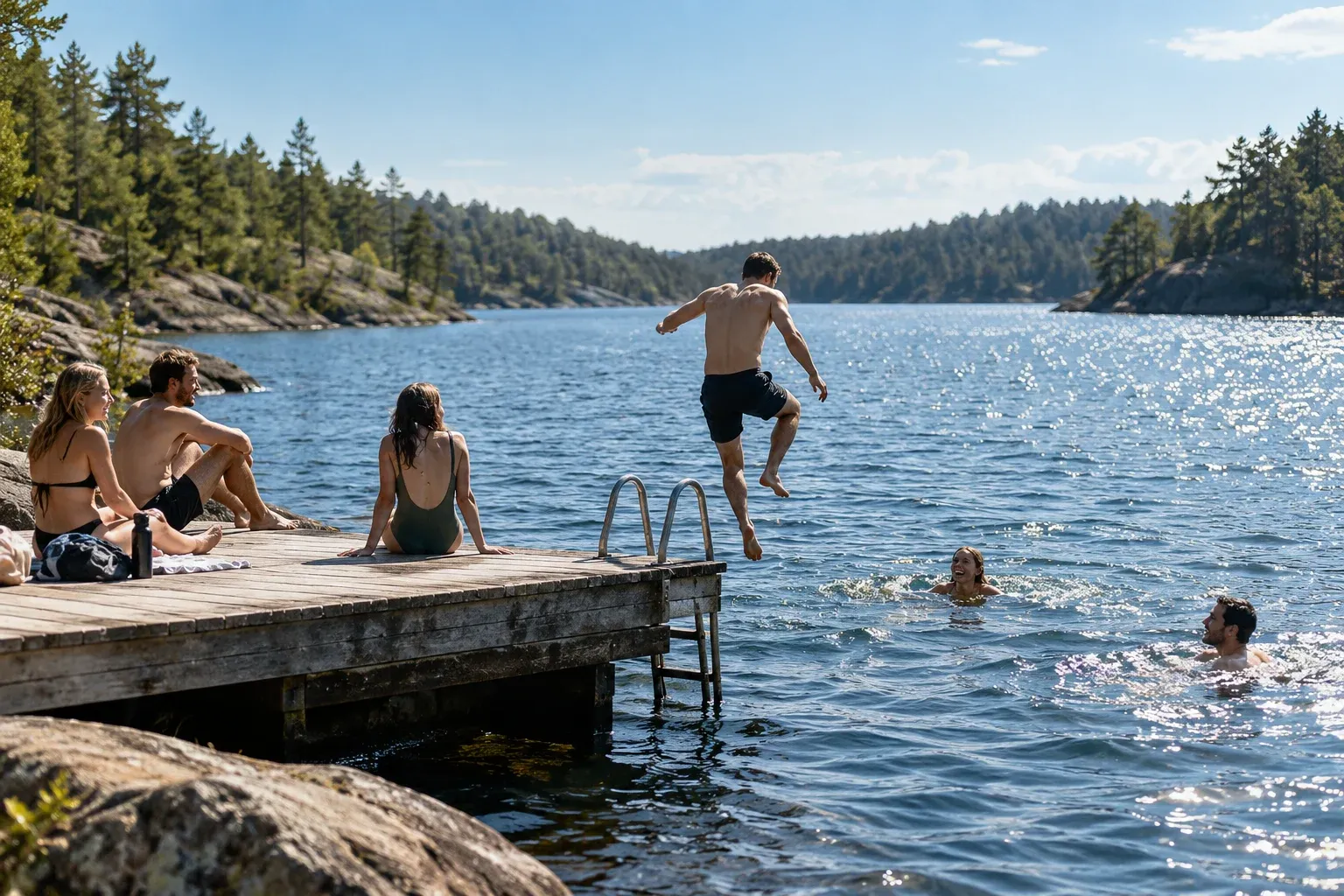
Swedish summers are mostly mild, which is exactly why heat catches people out. Buildings are made to hold warmth, and health effects start at lower temperatures than in southern Europe. Here is how the warnings work and what to do.
When you need this
The forecast shows 28–33 °C for several days. The SMHI app shows meddelande om höga temperaturer or a yellow symbol. Your hotel room or rental flat is still hot at midnight and has no air conditioning. You are travelling with a baby, young children or older relatives. Or someone in your group has a headache and feels sick after a long hot day.
How SMHI warns about heat
SMHI, Sweden’s weather agency, handles heat in two steps. First comes a colourless message for risk groups. If the heat is stronger or lasts longer, it becomes a warning, yellow or orange.
| Level | When SMHI issues it | Aimed at |
|---|---|---|
| High-temperature message (meddelande) | Daily maximum 26–30 °C on three days in a row | Older people, small children, the chronically ill |
| Yellow warning | Daily maximum 30 °C or more on three to four days in a row | Everyone |
| Orange warning | 30 °C on five days in a row, or 33 °C on at least three | Everyone; trains may be delayed or cancelled |
| Red | No red heat level is described | — |
At both warning levels SMHI’s advice is the same: watch for the body’s warning signs in yourself and others, drink water, take it easy, keep an eye on the indoor temperature and find ways to cool down. Messages and warnings appear on smhi.se, in the free SMHI Väder app, on Sveriges Radio P1 and P4, and on krisinformation.se.
Two things often confuse visitors. A värmebölja (heatwave) in SMHI’s statistics means five days in a row at 25 °C or more. That is a climate definition, not a warning. And fire risk is only ever a message, never a warning; a fire ban is a separate local decision. The whole system is covered in SMHI weather warnings explained.
How hot Sweden gets: records and recent heatwaves
Sweden’s national record is 38.0 °C: Ultuna in Uppland on 9 July 1933, and Målilla in Småland on 29 June 1947. Recent summers have come close:
- 21 July 2022: Målilla reached 37.2 °C.
- 26–28 June 2026: SMHI issued an orange heat warning for parts of Blekinge, Kalmar and Kronoberg counties.
- 27 June 2026: Osby set a new Skåne record of 36.8 °C. Lund reached 36.3 °C, almost two degrees above anything measured there since 1881, and five stations passed 35 °C.
- July 2025: northern Norrland had about two weeks of heat. Jokkmokk had 15 days in a row above 25 °C and Haparanda 14, the longest in their records. The peak was only 33.6 °C, at Skellefteå airport. Vidsel had 11 days at 30 °C or more over the summer, equalling the Norrland record.
So the north does get hot, and its heatwaves tend to be long rather than extreme. The Norrland record is 36.9 °C, at Harads in Norrbotten on 17 July 1945. Heat can also come late: Helsingborg and Lund reached 31.1 °C on 4 September 2024.
The human cost is real. The government puts the hot summer of 2018 at around 700 extra deaths.
Why your room stays hot
Swedish buildings are designed to keep heat in through long winters, and research from Chalmers University describes homes as buildings without mechanical cooling. Over a heatwave, flats, cabins and older hotels heat up day by day and cool down slowly at night.
Many newer hotels do have air conditioning. Older hotels, rental flats and summer cabins often do not. If heat is a concern — a baby, an older relative, someone with heart disease — look for “air conditioning” or luftkonditionering in the listing before you book in July.
Staying cool: the official routine
Folkhälsomyndigheten (the Public Health Agency) and 1177 give the same routine:
- Shut out the sun by day. Close curtains and blinds, and close windows and doors where the sun is shining on them.
- Air out at night, in the evening or early morning, when it is cooler outside. Sleep in the coolest room.
- Drink before you are thirsty. Drink more than usual; avoid large amounts of sugary drinks and alcohol.
- Avoid exertion in the hottest hours. Hike, run and cycle in the morning or evening.
- Cool the body. A cool shower is the most effective; a wet towel round the neck helps. Wear loose clothes in natural fibres.
- Protect yourself from the sun. Hat, shade and covering clothes, whatever your age.
- Check on others, especially older relatives.
Where to cool off. Shopping centres, large supermarkets and many newer museums and cinemas are usually air-conditioned. Lakes and the sea are close almost everywhere, but swim at an official bathing place and never alone. Don’t assume a library or an old public building will be cool.
Medicines. Some drugs affect heat and fluid balance, including diuretics, antidepressants and neuroleptics; ask a doctor or pharmacist whether a dose needs adjusting. Temperature-sensitive medicines have storage instructions on the pack, so don’t leave them in a hot car.
Heat stroke: signs and first aid
1177 describes värmeslag (heat stroke) as a body temperature above 40 °C, with weakness, headache, nausea or vomiting, vision problems, dizziness, confusion, a rapid pulse and flushed, dry skin. It can be life-threatening.
Call 112 if you suspect heat stroke and the person is very ill. For advice, call 1177, or +46 771 11 77 00 from a foreign phone.
While you wait:
- Move the person into shade or a cool room.
- Remove excess clothing.
- Give cool drinks if they are conscious and can swallow.
- Fan them, and keep the skin wet with cool water (about 15–18 °C) or a wet towel.
- Do not give fever medicine. Folkhälsomyndigheten warns it can make heat exhaustion and heat stroke worse.
The groups 1177 names as most at risk are children under two, people over 65, people with heart or kidney disease, and people on medicines that affect fluid balance. Small children may not notice that they are thirsty, so offering drinks is up to you.
Hot cars, children and dogs
Jordbruksverket’s animal-welfare rules say an animal may never be left unattended in a car if the temperature inside could rise above +25 °C (or fall below −5 °C). Parking in the shade with a window open is not enough. On a sunny summer day, that line is passed quickly. Trafikverket’s heat advice adds the obvious: don’t leave children or animals in parked vehicles. More on travelling with a dog is in dog-friendly stays and dogs in cars.
Heat brings the other summer hazards
- Drowning. Heat fills lakes and beaches, and July is the worst month: 103 people drowned in Sweden in 2025. Read swimming safety in Sweden before you head for the water, or swimming in Stockholm in the city.
- Fire bans. Hot, dry spells are when local fire bans appear. Check before any barbecue; see how fire bans work.
- Algal blooms. Warm, sunny, calm weather makes Baltic cyanobacteria blooms larger. Keep children and dogs out of green or yellow-green water; see algal blooms in the Baltic.
- Trains. Hot rails expand and can buckle (solkurvor). Trafikverket then lowers speeds, and some departures are cancelled. Check your operator and trafikverket.se on the day.
Practical information
| Item | Detail |
|---|---|
| High-temperature message | 26–30 °C on three days in a row |
| Yellow heat warning | 30 °C or more on three to four days in a row |
| Orange heat warning | 30 °C on five days, or 33 °C on at least three |
| Red heat warning | None described |
| Where to see warnings | smhi.se, SMHI Väder app (free), Sveriges Radio P1/P4, krisinformation.se |
| Emergency | 112 (free) |
| Medical advice | 1177; from a foreign phone +46 771 11 77 00 |
| Animals in cars | Never unattended if it could pass +25 °C inside |
| National record | 38.0 °C (Ultuna 1933, Målilla 1947) |
| Air-conditioned room | Varies by property — check the listing |
FAQ
When does SMHI issue a heat warning?
SMHI issues a yellow warning when the daily maximum is expected to reach 30 °C or more on three to four days in a row, and an orange warning at 30 °C for five days or 33 °C for at least three. Before that, at 26–30 °C over three days, it sends a colourless high-temperature message aimed at risk groups. There is no red heat level.
Do Swedish hotels and homes have air conditioning?
Often not. Swedish buildings are designed to keep heat in through long winters, and homes generally have no mechanical cooling, so rooms heat up over a heatwave. Many newer hotels have it, but older hotels, flats and summer cabins often do not. If heat worries you, look for “air conditioning” or luftkonditionering in the listing before booking.
What are the signs of heat stroke and what should I do?
According to 1177, heat stroke means a body temperature above 40 °C, with weakness, headache, nausea or vomiting, vision problems, dizziness, confusion and a rapid pulse. Call 112 if the person is very ill. Meanwhile move them somewhere cool, remove excess clothing, give cool drinks if they can swallow, fan them and keep the skin wet. Do not give fever medicine.
How hot does it get in Sweden?
Usually not very, but heatwaves happen. The national record is 38.0 °C, at Ultuna in 1933 and Målilla in 1947. Målilla reached 37.2 °C in 2022, and on 27 June 2026 Osby set a Skåne record of 36.8 °C, with five stations at 35 °C or more. In July 2025 parts of Lapland had about two weeks above 25 °C.
Can I leave my dog in the car for a few minutes?
Not when it is warm. Jordbruksverket’s animal-welfare rules say an animal may never be left unattended in a car if the inside temperature could rise above +25 °C, and parking in the shade with a window open is not enough. On a sunny Swedish summer day that threshold is passed quickly. Take the dog with you or leave it with someone.
Where can I cool off during a heatwave in Sweden?
Shopping centres, large supermarkets, many newer museums and cinemas are usually air-conditioned. Lakes and the sea are close almost everywhere — swim at an official bathing place, never alone. Indoors, keep blinds closed in the sun, air out at night and take a cool shower; a wet towel round the neck also helps. Do not assume libraries or old buildings are cool.
Will heat affect my train journey?
It can. When rails heat up they expand and can buckle, and Trafikverket then lowers speeds on affected stretches; some departures may be cancelled. SMHI’s orange heat warning text specifically mentions train delays and cancellations. Check your operator and trafikverket.se on the day, carry water, and allow extra time for connections.
Related guides
- SMHI weather warnings explained — every warning type and what each colour means
- Swimming safety in Sweden — read this before the whole group heads for the lake
- How fire bans work — hot spells are when the bans appear
- Calling 1177 — how to get medical advice in English
- Sweden in summer — the rest of the season’s hazards and calendar
Facts verified 2026-10-03. Sources: SMHI, Folkhälsomyndigheten (Public Health Agency), 1177 Vårdguiden, Trafikverket, Jordbruksverket and the Government Offices of Sweden — full register in this topic’s source file. We never publish current warning status; check SMHI. Found something outdated? Tell us and we’ll fix it.