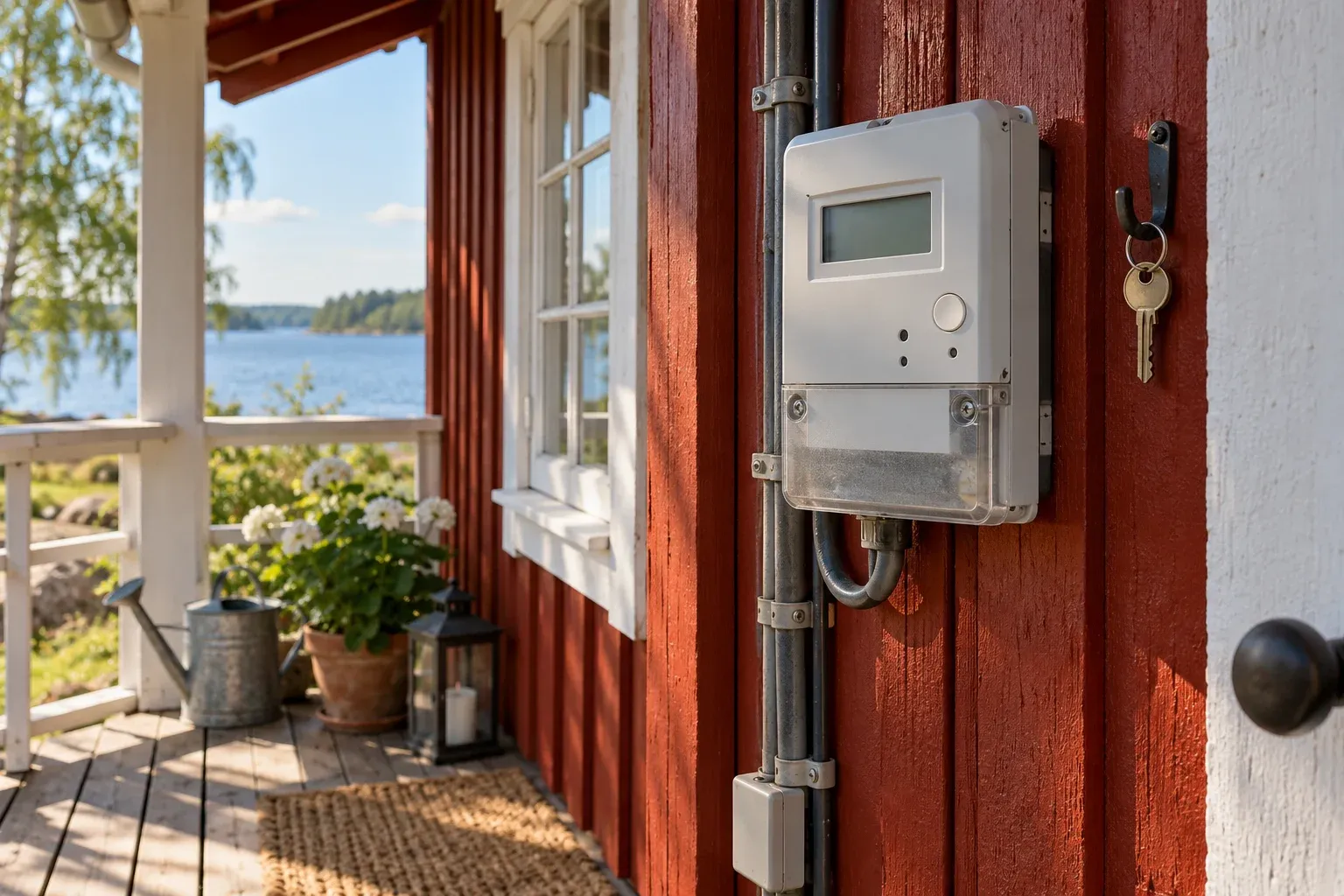
Swedish news talks about “the price in SE4” as if everyone knows what that means. For a visitor the zones are mostly background. What reaches your wallet is the electricity line in a cabin rental, and that’s a number you can ask for in advance.
When you need this
You’re booking a holiday cabin and the terms say “electricity by consumption” (el enligt förbrukning). You’re planning a ski-season week where the heating runs on electricity, or you hope to charge an electric car at the cabin. Or you own a Swedish summer house and the first bill mentions SE3, elnätsavgift and maybe effektavgift. This page explains the system briefly, then what it means for you.
The four zones
Since 2011 Sweden has been split into four elområden (electricity price zones), numbered from north to south:
| Zone | Name | Rough area |
|---|---|---|
| SE1 | Luleå | Far north |
| SE2 | Sundsvall | North-central |
| SE3 | Stockholm | Central Sweden |
| SE4 | Malmö | The far south |
Zone borders follow the grid, not county lines. To find the zone for a specific address, use Svenska kraftnät’s lookup at natomraden.se. Svenska kraftnät is the state grid operator.
The split came from Brussels, in a sense. Before 2011 Svenska kraftnät handled grid shortages by limiting exports to protect southern Sweden. The European Commission objected that this discriminated against customers in other EU countries, so the country was divided into zones instead.
Why prices differ between zones
Northern Sweden produces far more power than it uses, much of it hydro, while most consumption is in the south. The transmission grid has bottlenecks (flaskhalsar) where it can’t carry everything the market wants to move south.
- When the lines are full, prices rise in the southern zones and fall in the north. SE1 and SE2 are usually the cheaper zones, and SE4 the most expensive.
- When they aren’t, neighboring zones share one price. “The north is always cheaper” is a tendency, not a rule.
The wholesale (spot) price is set in a joint European auction at 12:00 the day before, separately for each zone. Next-day prices are published around 13:00 on Nord Pool and on most suppliers’ websites.
Seasons matter too. In winter, cold raises demand and ice on northern rivers can temporarily cut hydro output. In summer, nuclear plants usually take long maintenance breaks. Windy days push prices down; calm, cold days push them up.
What changed in 2025–2026
Many English pages about Swedish electricity are out of date. Four changes to know:
| Change | Since | What it means |
|---|---|---|
| Spot prices per 15 minutes, not per hour | 1 October 2025 | “Hourly prices” are history; a few suppliers still sell hourly contracts |
| Quarter-hour smart meters for every customer | 1 January 2025 | Use is recorded every 15 minutes |
| Flow-based market coupling in the Nordics | 29 October 2024 | A new way of calculating how much power may cross zone borders |
| National capacity-fee requirement scrapped | June 2026 | Grid companies no longer have to add an effektavgift |
On the last point: the regulator Energimarknadsinspektionen (Ei) repealed the rule that would have forced every grid company to introduce a capacity fee. Companies may still charge one if it follows the Electricity Act (ellagen) and EU rules, so check your own grid company. Older pages saying “every bill gets a capacity fee by 2027” are wrong now.
The zone map itself is under review again. The government widened Svenska kraftnät’s assignment in May 2026, and the report is due on 29 January 2027.
What it means in a rental cabin
As a guest, you pay the rate the owner sets, whatever zone the cabin is in. The zone affects the owner’s own costs, which may shape the rate they choose, but it’s the agreed price per kWh that ends up on your bill.
Cabin electricity is handled in one of three ways:
| Model | How it works | What to ask |
|---|---|---|
| Included | Part of the rental price | Nothing, but check the terms say so |
| Flat rate | A fixed charge per stay or per week | The amount |
| Metered | The meter is read at arrival and departure and settled at key return | The price per kWh |
Metered electricity is common at holiday houses: one large agency’s terms read the meter at both ends of the stay and settle at key return. A business letting cabins must state any extra charges separately from the headline price (Prisinformationslagen, the Price Information Act). A private owner letting now and then may not be covered by that law, so get the electricity terms in writing anyway.
“Electricity by consumption” with no rate stated is a blank check. Without a per-kWh figure agreed in advance, you can’t check the bill when you hand back the keys.
Winter is the expensive season. A cabin heated by electricity uses far more power in January than in July, and sauna, underfloor heating and electric radiators are the big consumers. Switch them off when you go out. Photograph the meter on arrival and departure with the timestamp visible; your own photo settles any disagreement.
If the owner has a quarter-hour contract, they may ask you to run the dishwasher, washing or car charging at cheaper times. Spot prices are generally lower at night, early morning, around lunch and late evening.
Charging an EV at a cabin
Only with the owner’s permission and on their terms. Some cabins have a proper charging point; many have only ordinary sockets. Elsäkerhetsverket, the electrical safety authority, warns that charging from an ordinary household socket can overheat it and start a fire, depending on current, duration and the socket’s condition. Use a socket only briefly and with permission, and agree in advance how charging is measured and billed. Networks, cables and public charging are covered in EV charging in Sweden.
If you own a cabin
Every household has two contracts: one with the local grid company (elnätsföretag) and one with a supplier (elhandelsföretag).
- The grid company can’t be changed. It holds a regional monopoly regulated by Ei. Its fee usually has a fixed subscription, based partly on main-fuse size, plus a per-kWh transfer fee, so the fixed part runs while the house is empty.
- The supplier can be changed. Compare contracts on Ei’s Elpriskollen. Contract types are quarter-hour price (follows the spot price), monthly price (set afterwards; may not bind you for more than three months) and fixed price (usually one to three years).
- Energy tax (energiskatt) is charged per kWh on the grid bill. Households in certain municipalities, mainly in the north, get a deduction. The rates are in the table below.
For the full owner’s routine, including winterizing, see owning a Swedish cabin.
Practical information
| Item | Detail |
|---|---|
| Price zones | SE1 Luleå, SE2 Sundsvall, SE3 Stockholm, SE4 Malmö (north to south) |
| Find your zone | natomraden.se (Svenska kraftnät) |
| Spot price | Set per 15 minutes; next day published around 13:00 on Nord Pool and suppliers’ sites |
| Energy tax, 2026 | 36.0 öre/kWh excl. VAT (about 45 öre incl. VAT); 9.6 öre deduction in certain municipalities |
| Energy tax, 2027 | Proposed unchanged at 36.0 öre/kWh — not yet decided |
| Grid fee | Fixed subscription by fuse size plus per-kWh transfer fee; set by the grid company |
| Rental cabin electricity | Owner’s terms: included, flat rate or metered per kWh at key return |
| EV charging at a cabin | Owner’s terms; ask before plugging in |
| Compare supply contracts | Elpriskollen (Ei) |
FAQ
What are the electricity price zones in Sweden?
Sweden is divided into four bidding zones, numbered from north to south: SE1 Luleå, SE2 Sundsvall, SE3 Stockholm and SE4 Malmö. They were introduced in 2011. Each zone gets its own wholesale price, set every quarter-hour in a European auction the day before. When the grid between zones is congested, prices differ; otherwise neighboring zones share one price.
Why is electricity cheaper in northern Sweden?
Northern Sweden produces far more power than it uses, much of it hydro, while most consumption is in the south. The transmission grid cannot always carry all of it south, so when the lines are full, prices rise in the southern zones and fall in the north. In hours without congestion, the price difference disappears.
Do I pay extra for electricity in a Swedish holiday cabin?
Often. Many rental cabins meter electricity, read the meter at arrival and departure and settle the cost at key return; others include it or charge a flat rate. A business must state extra charges separately from the headline price. Ask for the price per kWh before booking, and photograph the meter at both ends of your stay.
Does the price zone affect what I pay as a guest?
Not directly. As a guest you pay the rate the owner sets, whatever zone the cabin is in. The zone affects the owner’s own spot price, which may shape the rate they choose. What matters for you is the agreed price per kWh and how much you use, especially for heating, sauna and EV charging.
Can I charge my electric car at a rental cabin?
Only with the owner’s permission and on their terms. Some cabins have a proper charging point; many have only ordinary sockets. Elsäkerhetsverket warns that charging from an ordinary household socket can overheat it and start a fire, depending on current, duration and the socket’s condition. Agree in advance how charging is measured and billed.
Is the Swedish electricity price hourly or every 15 minutes?
Every 15 minutes. The European day-ahead market switched to quarter-hour prices with first delivery on 1 October 2025, and all Swedish customers have had quarter-hour smart meters since January 2025. Many older articles still describe hourly prices. Next-day prices are published around 13:00, and a few suppliers still sell hourly-price contracts.
What is an effektavgift on a Swedish electricity bill?
A capacity fee that some grid companies charge based on your highest power use, not just total kWh. A national rule requiring all grid companies to introduce one was repealed in June 2026, so it is now each company’s choice, within the rules of ellagen and EU law. Check your grid company’s tariff to see if it applies.
Related guides
- What to expect in a Swedish holiday cabin — meter reading, firewood and the other house rules nobody states
- Plugs and sockets in Sweden — adapters, campsite hook-ups and metered cabin power
- EV charging in Sweden — networks, apps and why not to use a household socket
- Owning a Swedish cabin — the grid fee, supplier and winter routine
- What a Swedish summer house really costs — electricity alongside the property fee and other bills
Facts verified 2026-10-05. Sources: Energimarknadsinspektionen, Svenska kraftnät, Skatteverket, Regeringen, Elsäkerhetsverket, Sveriges riksdag — full register in this topic’s source file. The energy tax changes in January and the zone review reports in January 2027. Found something outdated? Tell us and we’ll fix it.