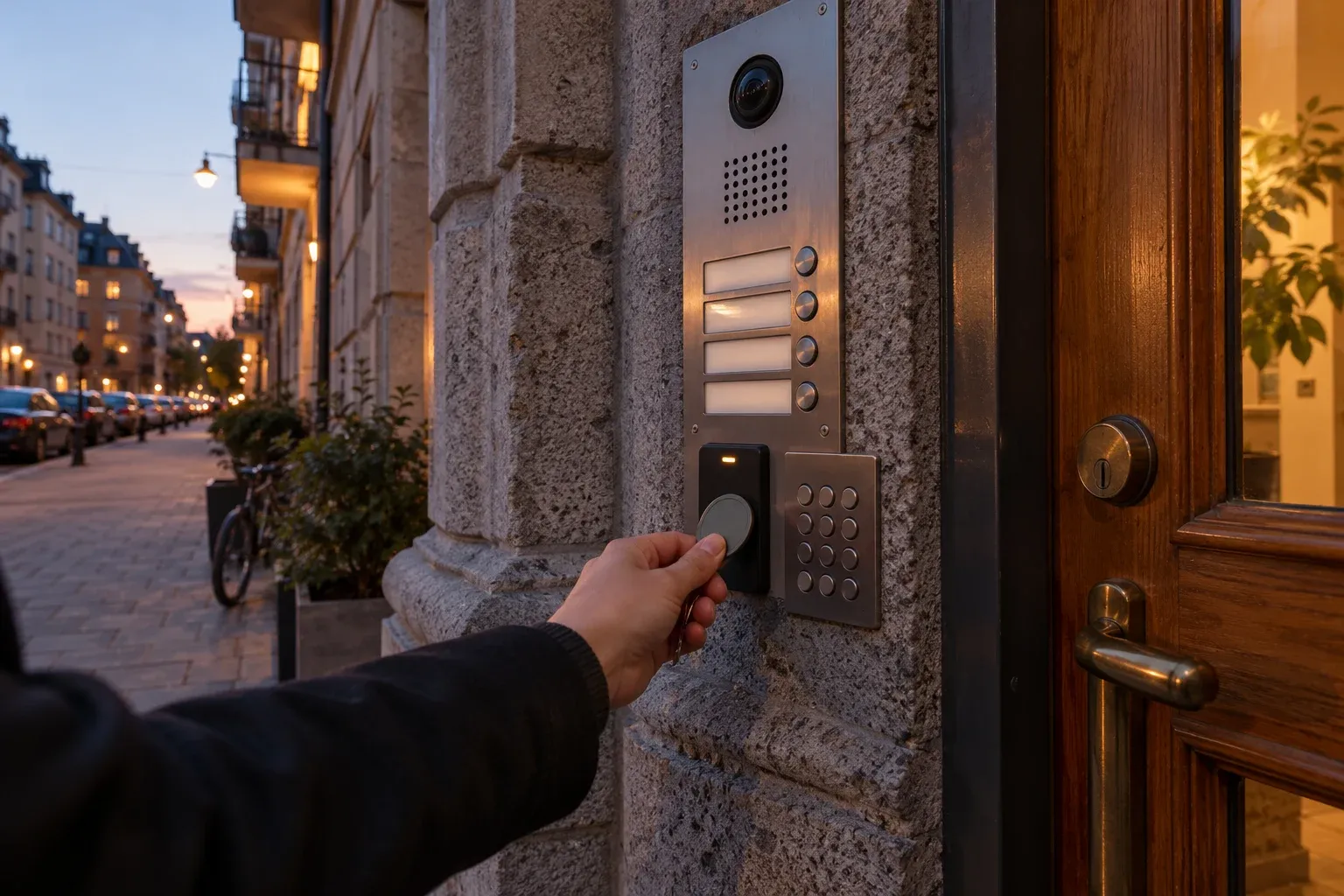
A Swedish apartment block runs on shared systems: a coded street door, a basement laundry room, a waste room and a stairwell that doubles as the fire escape. Each building sets its own rules. Here is what is law, what is fire guidance, and what is just house rules.
When you need this
You’ve just arrived at a holiday rental or a friend’s flat in a Swedish city. Maybe you’re standing at the street door at 23:30 and the code no longer works. Maybe you need to wash clothes and the basement has a booking board you can’t read, or you’re holding a bag of mixed rubbish and can’t find the bins. Or you’re wondering whether the stroller can stay on the landing and whether you may grill on the balcony.
The four things to get at handover
Most Swedes in cities live in apartment blocks, and almost every block works the same way. No national law sets how these systems work. Each landlord or housing cooperative (bostadsrättsförening, or brf) writes its own house rules (ordningsregler or trivselregler), so hours and limits differ from building to building.
Ask your host for these four things before they leave:
| What | Why you need it |
|---|---|
| Street-door code (portkod) and its hours | Many codes stop working in the evening |
| Key tag (tagg or passerbricka) | Opens the door after hours, the laundry room and the waste room |
| Laundry booking system | Slots are booked, not first-come |
| Way to the waste room (soprum, miljörum) | Sorting is expected, and required for food waste |
Door codes, tags and the intercom
The portkod is the keypad code for the street door (port). In many buildings it works only part of the day. In the two cooperatives we checked, the code ran until 21:00 in one and 03:00 to 23:00 in the other. Outside those hours the door opens only with a tag or through the intercom. Buildings change codes several times a year and ask residents not to share them, so don’t pass it on.
The intercom (porttelefon) lists residents by name or number. Many systems call the resident’s phone, and the resident unlocks the door by pressing a key on it. Some buildings have no keypad code at all, only tags and the intercom. If a friend or delivery driver is coming, tell them which name or number to select. Delivery notes are the place for the code or intercom name; see our guide to receiving parcels in Sweden.
The tag opens more than the front door: often the basement, the waste room, bike and pram rooms and the laundry room. Report a lost tag to your host at once so it can be blocked. Replacements are billed to the resident.
The laundry room
The tvättstuga is the building’s shared laundry room, usually in the basement. You book a slot on the booking board (bokningstavla) or in the building’s app, usually with your tag. Start on time. Never touch someone else’s laundry, and clean the machines and the lint filter afterward. Laundry use is normally included in the rent, so it costs a guest nothing. Our laundry guide covers booking boards, slot rules and detergent in detail.
The waste room
Since 1 January 2024 every household in Sweden must keep food waste (matavfall) separate from other rubbish. Packaging must also be separated from what it contained. In the waste room, food waste goes in its own bag and bin, packaging goes by material (paper, plastic, metal, clear and coloured glass), and the rest is residual waste.
By 1 January 2027 every municipality must collect packaging at or near each building, so the bins in your waste room will increasingly take all packaging. Bag colours and bin types still vary by municipality. Never leave bags beside a full bin; use another bin or take the bag back up. Cans and bottles with a deposit go back to the shop. The full system is in our recycling guide, and the deposit in our guide to returning cans and bottles.
Stairwells and balconies
Two rules come from fire safety, not etiquette.
The stairwell (trapphus) is the escape route and the fire service’s way in. The national civil-defence agency MCF (formerly MSB) says combustible items such as prams with their fabric insert, newspapers and building materials must not be stored there, however they are placed. A bare pram chassis or a walker may stand there only if it blocks nothing. Small doormats and door wreaths are normally fine. Smoke can fill a stairwell within minutes, which is why fire services take strollers on the landing seriously. Use the flat or the building’s pram room (barnvagnsrum). The building owner may set stricter rules.
Balconies: no national rule bans balcony grilling, but it must never create a fire risk, and the owner decides whether it is allowed. Electric grills are generally accepted. Smoky charcoal is the usual cause of complaints and bans, so check the house rules or ask your host before you light anything. Fire guidance allows one LPG bottle of up to 26 litres (P11) on an apartment balcony and two 5-litre bottles inside the flat. A glazed balcony counts as inside.
| Question | Answer | Type of rule |
|---|---|---|
| Stroller in the stairwell? | No, unless it’s a bare chassis that blocks nothing | Fire guidance |
| Doormat or wreath? | Normally fine | Fire guidance |
| Grill on the balcony? | No national ban; owner decides | Fire guidance plus house rules |
| Smoking on the balcony or in the stairwell? | No statutory ban; house rules decide | House rules |
| Quiet hours? | No national law; house rules set hours | House rules |
The Tobacco Act’s indoor smoking bans don’t cover ordinary residential stairwells or balconies. Any smoking rule there comes from the building’s house rules.
Your host answers for you
This is the one part that is national law. A tenant must keep order in the building and must not expose neighbours to disturbance they shouldn’t reasonably have to tolerate. Tenants must also keep careful watch that household members and guests behave the same way. If a guest causes damage through carelessness, the tenant pays. Cooperative owners have the same duty and must also follow the cooperative’s own rules.
When disturbance happens, the landlord must first ask the tenant to stop it at once. Repeated disturbance after a warning can lead to termination. In other words, a loud party in a rented flat can cost your host their home.
There’s no national quiet-hours law. Many buildings set hours in their house rules, for example quiet between 23:00 and 06:00, but the duty not to disturb applies at any time. Our guide to quiet hours and noise rules covers what happens when neighbours complain.
One more thing for longer stays: subletting a rental flat or a cooperative flat needs the landlord’s or board’s consent, and that includes short-term letting to visitors. A sublet without consent can cost the host the flat and you your stay. See our guide to long-stay rentals.
Step by step
- At handover, ask for the four basics: the door code and its hours, the tag and what it opens, how laundry is booked, and where the waste room is.
- Save the code and the host’s number offline, on paper as well as in your phone.
- Learn the intercom and tell visitors which name or number to select.
- Book the laundry room with your tag, start on time and clean up afterward.
- Find the waste room and sort: food waste, packaging by material, the rest.
- Read the house rules on the notice board (anslagstavla) in the entrance. It also lists the caretaker (fastighetsskötare).
- Keep shared spaces empty: prams, bikes and boxes stay in the flat or a storage room.
- Report a lost tag at once so it can be blocked.
And take your shoes off at the door, as Swedes do; see shoes off in Swedish homes.
Practical information
| Item | What to expect |
|---|---|
| Door-code hours | Set per building; examples checked: until 21:00, and 03:00–23:00 |
| Replacement key tag | Set per building; 200 kr and 300 kr in two cooperatives checked |
| Laundry room in a rented flat | Normally part of the rent |
| Waste collection | Paid by the building; nothing for the guest |
| Locksmith call-out | Set by the locksmith; not published here |
| LPG on a balcony | Up to one 26-litre (P11) bottle |
| Food-waste sorting | Required since 1 January 2024 |
| Packaging collected at every building | By 1 January 2027 |
FAQ
What is a portkod in Sweden?
A portkod is the keypad code for the street door of an apartment block. Many buildings let the code work only during the day or evening, for example until 21:00 or 23:00; after that the door opens only with the residents’ key tag or through the intercom. Ask your host for the code, its hours and the tag before you go out.
How does a Swedish apartment intercom work?
The porttelefon at the street door lists residents by name or number. When a visitor selects one, many systems call that resident’s phone, and the resident opens the door by pressing a key on their phone. If you are staying in someone’s flat, make sure the visitor or delivery driver knows which name or number to choose.
Can I use the laundry room in my Airbnb apartment?
Usually yes, if your host gives you the tag or code and shows you the booking system. The laundry room belongs to the building, and house rules decide booking limits and hours. Book a slot, start on time, never touch other people’s laundry, and clean the machines and lint filter afterward. A complaint about you goes to your host.
Can I grill on the balcony of a Swedish apartment?
No national rule bans balcony grilling, but it must never create a fire risk, and the landlord or cooperative may ban it in the house rules. Electric grills are generally accepted; charcoal that smokes into neighbours’ windows is a common reason for complaints and bans. Check the house rules or ask your host before you light anything.
Can I leave a stroller in the stairwell?
Generally not. Swedish fire guidance treats a pram with its fabric seat or carrycot as combustible material that does not belong in a stairwell, because the stairwell is the escape route and the fire service’s way in. A bare metal chassis may stand there if it blocks nothing. Use the flat or the building’s pram room.
Are there quiet hours in Swedish apartments?
There is no national quiet-hours law. Tenants must not disturb neighbours at any time to a degree they should not reasonably tolerate, and many buildings set quiet hours in their house rules, such as 23:00 to 06:00. Repeated disturbance after a warning can cost the resident the tenancy, so as a guest, keep evenings calm.
Does my name need to be on the door?
For a short stay, no; mail and parcels can go to the host’s name with yours added. Someone living in a flat as a lodger or subtenant should not use a c/o address when registering a move, according to Skatteverket, but put their own name on the door and the mailbox. PostNord says an unmarked mailbox can mean mail is not delivered.
Related guides
- Laundry in Sweden — booking boards, slot rules and detergent for soft water
- Recycling as a visitor — what goes in which bin in the waste room
- Quiet hours and noise rules — what happens when neighbours complain
- Long stays in Sweden — sublets, consent and your rights as a tenant
- Self check-in hotels — the other place you’ll live by codes and tags
Facts verified 2026-10-05. Sources: Sveriges riksdag (Land Code, Housing Cooperatives Act, Tobacco Act), MCF, Räddningstjänsten Storgöteborg, Brandskyddsföreningen, Naturvårdsverket, Skatteverket, PostNord, Hyresgästföreningen and three HSB housing cooperatives — full register in this topic’s source file. Found something outdated? Tell us and we’ll fix it.