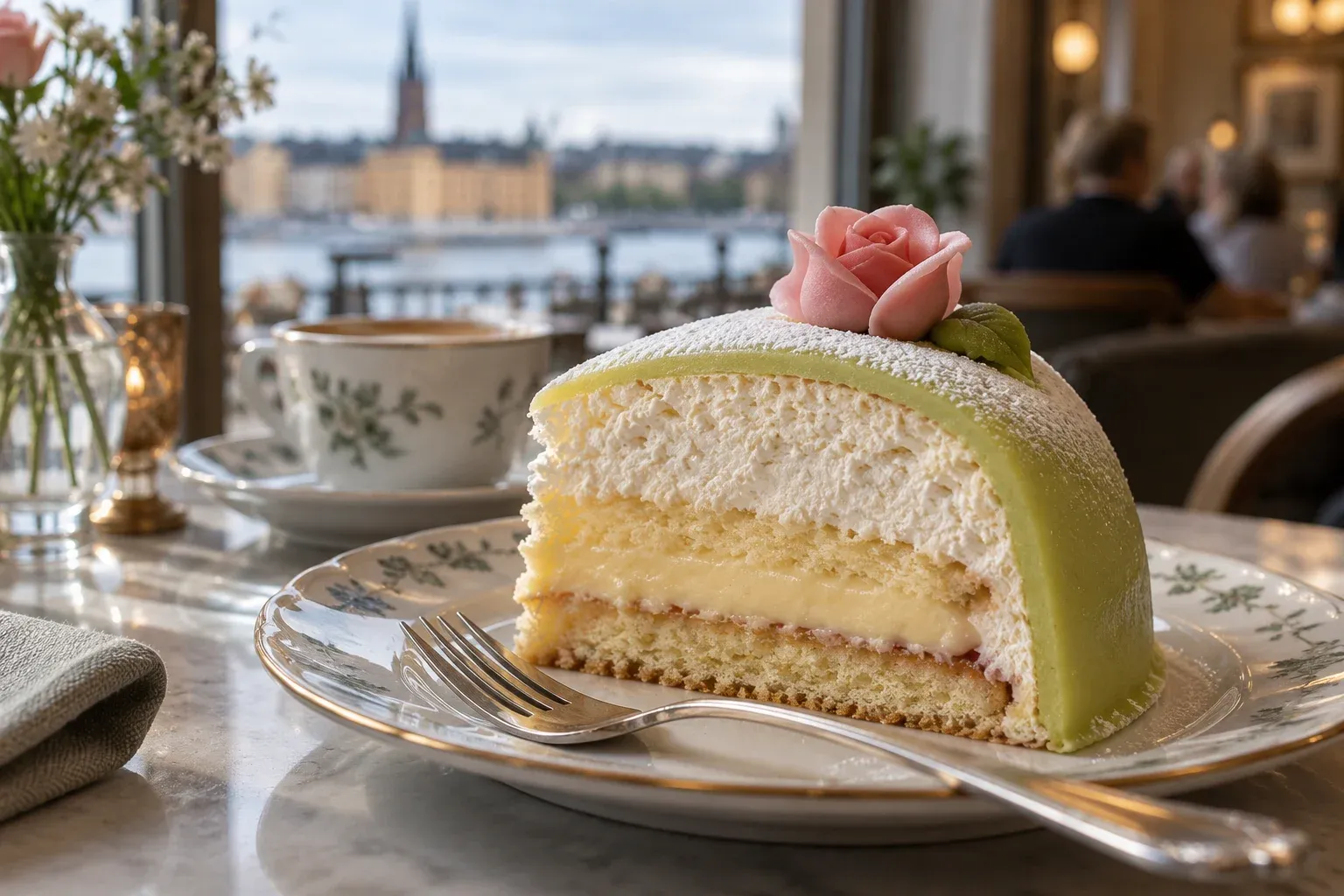
Every Swedish café counter has the same green, pink and chocolate cast. Here is what each one is, where it comes from (as far as anyone can prove), and which ones a nut allergy rules out.
When you need this
You’re at a konditori, a pastry shop with a café, looking at a dome of green marzipan and a tray of small green rolls, and you can’t name either. A colleague is bringing “the” Swedish cake to a birthday and you want to know what to expect. Or you have a nut allergy and want to know which classics to skip before you sit down for fika.
The counter at a glance
| Pastry | What it is | Built on nuts? |
|---|---|---|
| Prinsesstårta | Sponge, vanilla cream and whipped cream under green marzipan | Yes — marzipan (almonds) |
| Mazarin | Shortcrust tartlet, almond filling, white icing | Yes — almond paste |
| Dammsugare / punschrulle | Green marzipan roll, chocolate ends, crumb-cocoa-punch filling | Yes — marzipan |
| Kladdkaka | Dense, sticky chocolate cake | Not in the recipe |
| Chokladboll | No-bake ball of oats, fat, sugar and cocoa | Not in the recipe |
| Toscakaka | Cake with a cooked almond topping | Yes — almonds |
| Budapestbakelse | Hazelnut-meringue roll with cream and fruit | Yes — hazelnuts |
All of them are sold year-round. That sets them apart from the semla, which is a winter bun, and they sit on the counter next to the everyday cinnamon bun.
Prinsesstårta, the princess cake
The prinsesstårta is Sweden’s best-known celebration cake: layers of sponge with vanilla cream and a dome of whipped cream, covered in green marzipan, dusted with icing sugar and usually topped with a pink or red marzipan rose. Visit Stockholm calls it “a Stockholm specialty turned a Swedish classic”, and it is the standard cake at Swedish birthdays.
Where it comes from. The recipe was published by Jenny Åkerström, a Stockholm cookery teacher whose pupils included the princesses Margaretha, Märtha and Astrid. In her cookbook it was called grön tårta, “green cake”, and the princess name is usually explained by the princesses’ fondness for it. Sources differ on the edition: the bakers’ trade body credits Prinsessornas kokbok (first published 1929), while another account dates the first printed recipe to its 1939 sequel. Either way, it’s a 1930s cake. The name itself is older: “prinsesstårta” appears in a newspaper ad as early as 1893, for a different cake.
Jam or no jam? The original had no jam. Many bakeries today add a thin raspberry layer, and some Swedes insist that version is properly an operatårta. There’s no legal recipe, so ask if it matters to you.
| Variant | What you get |
|---|---|
| Prinsessbakelse | A slice or single-portion mini princess cake |
| Prinstårta | “Prince cake”: the same with yellow marzipan |
| Groda | “Frog”: a mini princess cake with a slit-mouth face |
Princess Cake Week. Sveriges Bagare & Konditorer, the bakers’ and confectioners’ trade body, has run Prinsesstårtans vecka since 2004 in the last week of September. A donation went to the Crown Princess Victoria Fund for each cake carrying a gold plastic crown. We could not confirm whether it ran in 2026, so check before planning around it.
Mazarin
A mazarin is a small shortcrust tartlet, oval or round, filled with an almond-paste mixture and topped with white icing. It counts as Swedish and belongs firmly to fika, but it is probably not Swedish in origin: it’s a 17th–18th-century type of pastry, possibly named after Cardinal Mazarin, possibly after a French dish called a mazarine. Look out for the cubamazarin with chocolate and hazelnuts and the katalan with raspberry jam.
Dammsugare, the “vacuum cleaner”
The dammsugare (“vacuum cleaner”), also called punschrulle (“punch roll”), is a small roll of green marzipan with both ends dipped in chocolate. Inside is a dense filling of cake crumbs, butter, cocoa and arrack punch.
Nobody knows for sure where it comes from; even Visit Stockholm calls it “of unknown origin”. The word punschrulle is recorded from 1967 and dammsugare from 1990. One theory says the nickname comes from the tube-shaped vacuum cleaners in Swedish homes; another says the filling “vacuums up” leftover crumbs.
Alcohol note: factory-made rolls usually use punch flavoring rather than an alcoholic drink, but a bakery may use real arrack punch. Ask if you avoid alcohol. Denmark’s cousin is the træstamme.
Kladdkaka and chokladboll
Kladdkaka, sticky chocolate cake, is made from flour, eggs, butter, sugar and cocoa, and baked without baking powder so the middle stays dense and gooey. Eat it with whipped cream or vanilla ice cream, sometimes with raspberries or strawberries. It’s a newer classic than it looks: one theory traces it to a 1940s brownie recipe without baking powder, another to a French chocolate cake whose recipe was published in a Swedish magazine in the late 1970s. The word appears only in the 1980s, and the cake broke through in the 1990s.
Chokladboll, the chocolate ball, is a no-bake mix of oats, butter or margarine, sugar and cocoa, often with a splash of coffee, rolled in coconut flakes or pearl sugar. It’s one of the easiest Swedish treats to make at home, and the earliest record is a 1943 Danish wartime recipe.
A note on the name. Until at least the 1970s the chokladboll’s most common name was built on the Swedish n-word. That name has faded since the early 2000s. Språkrådet, the Swedish language council, and Svenska Akademien advise against it, and the Academy’s word list dropped it in 2015. You may still see it on an old sign or hear it from older people. Say chokladboll.
Both have their own theme days, Chocolate Ball Day on 11 May and Sticky Chocolate Cake Day on 7 November. Neither is a holiday; our food days calendar has the rest.
Toscakaka and budapestbakelse
The toscakaka is a cake with a topping cooked from almonds, butter and cream. Its name probably comes from Puccini’s opera Tosca, and it appears in Swedish cookbooks from the 1930s.
The budapestbakelse is Swedish despite its name. It’s a roll of hazelnut meringue spread with whipped cream mixed with fruit such as canned peach, apricot or mandarin, drizzled with chocolate. It was created by the confectioner Ingvar Strid, born in Vetlanda in 1926, who named it after his interest in Budapest.
Sju sorters kakor: seven kinds of cookies
Sju sorters kakor, “seven kinds of cookies”, comes from the kafferep, the ladies’ coffee party of the late 19th century. Seven was the right number: fewer looked stingy, more looked like showing off.
The phrase is also the title of a cookbook first published in 1945 by ICA’s test kitchen, after a baking competition that drew more than 8,000 recipes. It became Sweden’s best-selling baking book and has been reprinted and modernised many times, most recently in a 2017 edition. Today nobody counts: one or two things on the table is normal.
Allergies: almonds everywhere
Almond paste and marzipan are the backbone of the Swedish classics. Almonds and hazelnuts are both declarable allergens under EU law, alongside cereals containing gluten, milk and eggs.
- Treat these as tree-nut foods: prinsesstårta, mazarin, dammsugare and toscakaka (almonds), budapestbakelse (hazelnuts).
- Kladdkaka and chokladboll recipes contain no nuts, but they share counters with the rest.
- You have the right to ask. A café or bakery must be able to tell you which declarable allergens an unwrapped cake contains, orally or in writing, not just what it doesn’t contain.
- “May contain” has no threshold. Livsmedelsverket, the Swedish Food Agency, has found high levels of milk protein, peanut and hazelnut in bakery products, and allergic visitors may need to avoid anything with the warning.
Our guides to eating out with food allergies and gluten-free travel cover how to ask in Swedish.
Practical information
| Item | What to expect |
|---|---|
| Season | Year-round for all the cakes on this page |
| Price of a slice or pastry | Varies by town, shop and size — check the counter |
| VAT, taken away / eaten in | 6% / 12%, 1 April 2026 – 31 December 2027; some cafés price the two differently |
| Prinsesstårtans vecka | Last week of September since 2004; 2026 status not confirmed |
| Theme days | Chokladbollens dag 11 May; Kladdkakans dag 7 November; not holidays |
| Contain almonds or hazelnuts | Prinsesstårta, mazarin, dammsugare, toscakaka, budapestbakelse |
FAQ
What is a prinsesstårta?
A prinsesstårta, or princess cake, is Sweden’s best-known celebration cake: layers of sponge with vanilla cream and a dome of whipped cream, covered in green marzipan and dusted with icing sugar, usually topped with a pink or red marzipan rose. The recipe was published by the Stockholm cookery teacher Jenny Åkerström, whose pupils included three princesses, under the name “green cake”.
Does a prinsesstårta have jam in it?
The original did not. The recipe in Jenny Åkerström’s cookbook had no jam, but many bakeries today add a thin raspberry layer, and Visit Stockholm describes the cake with raspberry jam. Some Swedes insist the version with jam is properly an operatårta. If it matters to you, ask at the counter; there is no legal recipe and bakeries vary.
What is a dammsugare?
A dammsugare (“vacuum cleaner”), also called punschrulle, is a small roll of green marzipan with both ends dipped in chocolate and a filling of cake crumbs, butter, cocoa and arrack punch. Nobody knows its origin for sure. One theory says the name comes from old tube-shaped vacuum cleaners; another says the filling “vacuums up” leftover crumbs. Factory-made rolls usually use flavoring, not alcohol.
What is a chokladboll, and why does it have another name?
A chokladboll is a no-bake ball of oats, butter or margarine, sugar and cocoa, often with a little coffee, rolled in coconut or pearl sugar. An older Swedish name built on the n-word was common until at least the 1970s. Språkrådet and Svenska Akademien advise against it, and the Academy’s word list dropped it in 2015. Say chokladboll.
What does “sju sorters kakor” mean?
“Seven kinds of cookies” was the etiquette of the kafferep, the late-19th-century ladies’ coffee party: fewer than seven looked stingy, more looked like showing off. It is also the title of a cookbook first published in 1945 after a baking competition, which became Sweden’s best-selling baking book. Today one or two things on the table is normal.
Which Swedish cakes contain nuts?
Many classics do. Prinsesstårta, mazarin, dammsugare and toscakaka are built on almond paste or marzipan, and the budapestbakelse base contains hazelnuts. Kladdkaka and chokladboll recipes contain no nuts, but bakery products can carry traces. Almonds and hazelnuts are declarable allergens, and staff must be able to tell you which allergens an item contains, even unwrapped.
When is Princess Cake Week in Sweden?
Prinsesstårtans vecka, Princess Cake Week, has been run since 2004 by Sveriges Bagare & Konditorer, the bakers’ trade body, in the last week of September. For each cake sold with a gold plastic crown, a donation went to the Crown Princess Victoria Fund. It is a promotion, not a holiday, and whether it ran in a given year is worth checking.
Related guides
- Swedish fika — the coffee break all these cakes belong to
- Swedish birthdays — where the prinsesstårta comes out, candles and all
- Sweden’s food days calendar — Chocolate Ball Day, Sticky Chocolate Cake Day and the rest
- Fika in Stockholm — the capital’s cafés and how to order
- Eating out with food allergies — how to ask about almonds, hazelnuts and milk
Facts verified 2026-10-06. Sources: Livsmedelsverket, Skatteverket, EU Regulation 1169/2011, Sveriges Bagare & Konditorer, Visit Stockholm, Visit Sweden, and Swedish reference works for the pastry histories — full register in this topic’s source file. Origin stories are hedged where sources disagree. No bakery names or prices are published here. Found something outdated? Tell us and we’ll fix it.