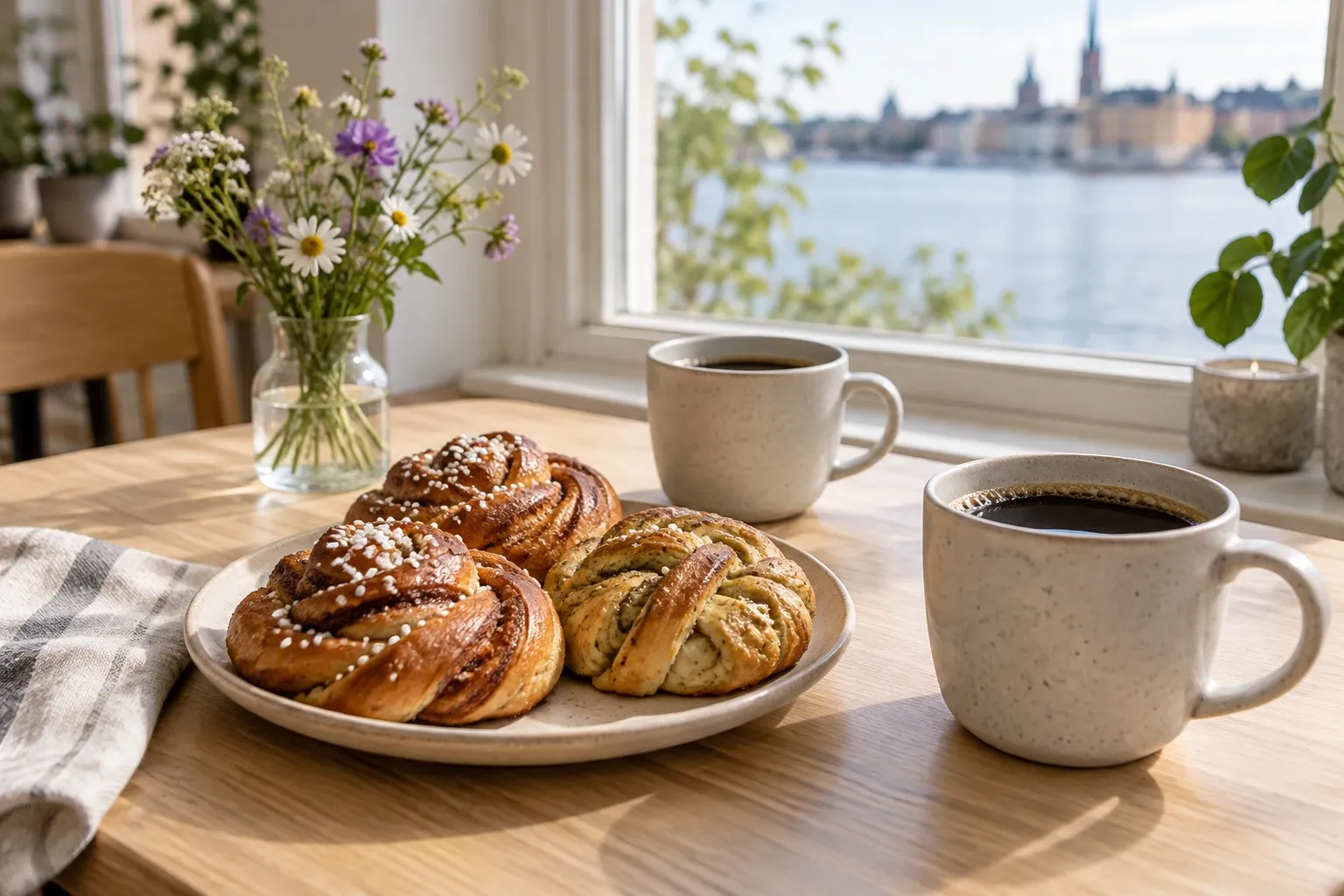
Most guides describe fika as a lifestyle. For a visitor it’s a practical custom with a vocabulary, a few unwritten rules and one question worth asking at the till. Here is what you need at the café counter, at work and in someone’s home.
When you need this
You’re at a café counter and don’t recognize half of what’s behind the glass. A new colleague asks “ska vi fika?” (“shall we have a fika?”) on your first morning. Someone has invited you home “for coffee”. Or it’s late winter and every bakery window is suddenly full of cream buns.
What fika actually is
Fika is a break, usually with other people, to talk, drink coffee or something else, and eat something, most often sweet. It works as a noun and a verb. The word is back-slang for kaffi, an old form of kaffe, and has been in use since at least 1910.
Sweden takes it seriously enough that fika is listed in the national inventory of intangible cultural heritage. That entry singles out the workplace habit of a morning and an afternoon break, taken together in a shared room.
Two things surprise visitors:
- Fika doesn’t require coffee. Tea, juice or a soft drink is fine; the break and the company are the point.
- Fika doesn’t require something sweet. An open sandwich (smörgås) is a perfectly normal fika.
What it isn’t is a takeaway cup. Fika means sitting down, even for ten minutes. Nothing about any of this is regulated — it’s all custom.
At the café
Swedish café fika is a low-cost way to sit down indoors at any time of day, in any town. The sequence is simple:
- Choose your bun or cake at the counter.
- Order your coffee there too.
- Pay — card is the default.
- Carry everything to a table. If refills are included, the pot is usually out for self-service.
Don’t tip at the counter. Nothing is expected at counter service, and pressing “no tip” on the card terminal is normal.
One thing is new since spring 2026, and older guides can’t know it. From 1 April 2026 until 31 December 2027, food taken away is taxed at 6% VAT, while the same food eaten at the table is a restaurant service taxed at 12%. Some cafés now price the two differently. It’s a small difference, but it’s why the takeaway price on the board may be lower.
What’s behind the glass
The fika counter is a fixed vocabulary, and it’s the same across the country.
| Swedish | What it is |
|---|---|
| kanelbulle | Cinnamon bun, topped with pearl sugar — the default fika |
| kardemummabulle | Cardamom bun, the cinnamon bun’s cardamom variant |
| kladdkaka | Sticky chocolate cake, best warm with whipped cream or ice cream |
| chokladboll | No-bake ball of oats, butter, cocoa, coffee and sugar, rolled in coconut or pearl sugar |
| prinsesstårta | Princess cake: sponge, vanilla cream, raspberry jam and cream under green marzipan — a Stockholm specialty turned national classic |
| semla | Wheat bun filled with almond paste and whipped cream — late winter only |
If you have an allergy or eat vegan, ask before choosing. Classic Swedish pastries are made with wheat, butter, milk and egg, and the open counter is rarely safe by default. A café must be able to tell you whether an item contains a declarable allergen, orally or in writing, even for unwrapped buns. Our gluten-free guide and vegan guide cover what to ask for.
The coffee and the refill
Swedish fika coffee is mostly plain brewed coffee, bryggkaffe. In a national survey, 73% of coffee drinkers said it is the coffee they drink most. Order it and you usually get the second custom too.
That custom is påtår, the refill. Seven in ten Swedes expect a free refill of coffee at cafés and restaurants — but that’s an expectation, not a rule. Many cafés include it and put out a self-serve pot. Some list a small charge. And the custom covers brewed coffee, not espresso drinks or soft drinks.
So ask once, when you pay: “Ingår påtår?” (“Is a refill included?”). A self-serve pot on the counter is usually your answer before you ask.
Having lunch out? A weekday dagens lunch already includes coffee, often with a small cake. On those days the after-lunch fika is already paid for.
Fika at work
If you’re working or studying in Sweden, this is the section that matters most. Many workplaces hold two fikas a day — mid-morning and mid-afternoon — in a shared room. It’s where colleagues talk about things other than work.
- Say yes, at least sometimes. Declining every fika to keep working reads as distance, not efficiency.
- Coffee is usually free. Eight in ten Swedes say the employer should provide it.
- Expect a cake rota. Many offices take turns bringing something, and bringing cake on your birthday or last day is common.
Invited home for fika
Being offered coffee is the default Swedish welcome, and the etiquette is short:
- Be on time. An invitation for 15:00 means 15:00, not “around three”.
- Take your shoes off at the door, whatever the season.
- Bring something small — flowers or bought pastries are safe.
- Let the host offer the refill — “Vill du ha påtår?” Accepting is polite; declining is fine.
- Put your phone away. Fika is for the people at the table.
- Offer the last piece around before taking it — it often sits on the plate for a while.
A traditional host once served sju sorters kakor, seven kinds of cookies: fewer looked stingy, more looked like showing off. The custom goes back to the ladies’ coffee parties of the late 19th century, and the cookbook of the same name, first published in 1945, has been reprinted many times. Today one or two things on the table is completely normal.
Dates to know
Kanelbullens dag — 4 October, every year. Cinnamon Bun Day was created in 1999 by the Home Baking Council, a body of baking-ingredient producers. It’s a promotional day, not a public holiday, so shops keep their normal hours. In 2026 it falls on a Sunday. Bakeries, cafés and supermarkets promote cinnamon buns around the day, which makes it a good time to try one.
Semla season — from around the turn of the year until fettisdagen. The semla goes back to a medieval Lent tradition and took its present cream-and-almond-paste form in the 20th century. Bakeries sell them from late December or early January — sales start earlier every year — until Shrove Tuesday (fettisdagen). That’s always the Tuesday 47 days before Easter Sunday, so it moves between 3 February and 9 March. Fettisdagen 2027 is Tuesday 9 February. Outside the season most bakeries don’t sell them.
Practical information
| Item | What to expect |
|---|---|
| Café fika (coffee + bun) | Varies by town and café — check the board |
| VAT on a bun and coffee taken away | 6%, 1 April 2026 – 31 December 2027 |
| VAT on the same order eaten at the table | 12% |
| Coffee refill (påtår) of brewed coffee | Often included; some cafés charge — ask |
| Coffee after a weekday lunch deal | Included, often with a small cake |
| Tip at the counter | None expected |
| Workplace fika coffee | Usually free to staff |
| Kanelbullens dag | 4 October (2026: Sunday) |
| Fettisdagen / end of semla season | Tuesday 9 February 2027 |
FAQ
What does fika mean in Swedish?
Fika means taking a break, usually with other people, to drink coffee or another drink and eat something, often sweet. It works as a noun and a verb: “ska vi fika?” means “shall we have a coffee break?”. The word is back-slang for kaffi, an old form of kaffe, and has been used since at least 1910.
Is a coffee refill free in Swedish cafés?
Often, but not always. Seven in ten Swedes expect a free refill, called påtår, of brewed coffee at cafés and restaurants, and many cafés put out a self-serve pot. Some list a small charge, and the custom covers brewed coffee, not espresso drinks or soft drinks. Ask “Ingår påtår?” (“Is a refill included?”) when you pay.
What should I order for my first fika?
A kanelbulle, the cinnamon bun topped with pearl sugar, and a cup of bryggkaffe, plain brewed coffee, which most Swedes drink and which usually comes with a refill. Other classics are the kardemummabulle (cardamom bun), kladdkaka (sticky chocolate cake), the no-bake chokladboll and the green marzipan-covered prinsesstårta.
When is Kanelbullens dag?
Kanelbullens dag, Cinnamon Bun Day, is 4 October every year; in 2026 it falls on a Sunday. It was created in 1999 by the Home Baking Council, an industry body, to promote baking. It is not a public holiday, and shops keep their normal hours. Bakeries, cafés and supermarkets promote cinnamon buns around the day.
When can you buy semlor in Sweden?
Semlor, wheat buns filled with almond paste and whipped cream, belong to late winter. Bakeries sell them from around the turn of the year, some in December, until Shrove Tuesday (fettisdagen), the Tuesday 47 days before Easter Sunday. Fettisdagen 2027 is 9 February. Outside the season most bakeries do not sell them.
What do I do when colleagues invite me to fika?
Say yes. Many Swedish workplaces hold a morning and an afternoon fika in a shared room, and it is where colleagues talk about things other than work. Coffee is usually free; eight in ten Swedes say the employer should provide it. If the office runs a cake rota, expect your turn to bring something, and bring cake on your birthday or last day.
What is the etiquette when invited home for fika?
Arrive on time, take your shoes off at the door and bring something small, such as flowers or pastries. Your host will offer coffee and a refill; accepting is polite, declining is fine. Traditionally a host offered seven kinds of cookies, but today one or two things is normal. Offer the last piece around before taking it.
Related guides
- Eating out in Sweden — where fika fits in the wider price picture
- Dagens lunch — the weekday deal that already includes your coffee
- Gluten-free in Sweden — the fika counter is wheat; here’s what to ask
- Swedish etiquette — the rest of the unwritten rules
- Tipping in Sweden — why you don’t at the counter
Facts verified 2026-09-24. Sources: Levande kulturarv (Sweden’s intangible heritage inventory), Isof, Nordiska museet, Skatteverket, Livsmedelsverket, Visit Sweden — full register in this topic’s source file. No café prices or recommendations are published here; check the board. Found something outdated? Tell us and we’ll fix it.