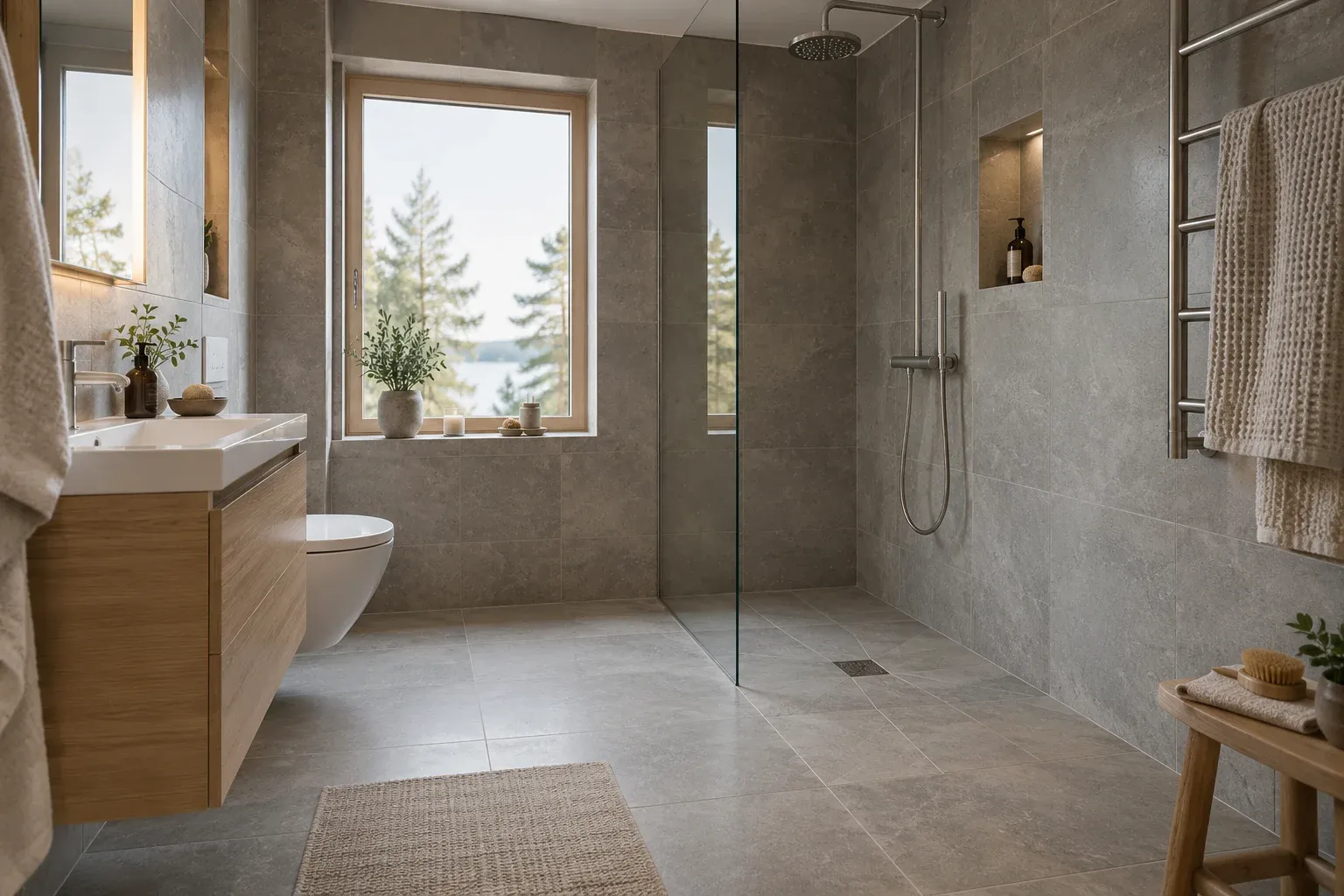
Nothing is broken. A Swedish bathroom is built as one waterproof box, by law, and that explains the missing shower tray, the drain in the middle of the floor, the shortage of sockets and the warm towel rail. Here is what is rule, what is habit, and what you should do.
When you need this
You’ve just showered in a Swedish flat and the water has spread halfway across the floor. Or you’re hunting for a socket for your hair dryer, the towel rail is stone cold in July, and the toilet has two buttons and a little hand shower beside it. This page covers all of it.
The whole room is the shower tray
A Swedish bathroom (badrum, or våtrum, “wet room”) has a waterproof membrane (tätskikt) under the tiles, and the floor slopes towards a floor drain (golvbrunn). The shower is simply the lowest corner of the room. That’s why there is often no tray, no step and sometimes not even a curtain: water on the floor is part of the design.
What you do about it is simple:
- Use the squeegee. Most bathrooms have a rubber floor squeegee (golvskrapa) in a corner. Push the water towards the drain, not away from it.
- Keep water inside the tiled area. Wooden thresholds and hallway floors are not waterproofed.
- Leave the door ajar afterwards so the vent and any heated floor can dry the room.
Hotels usually add a glass screen or a lip around the shower, but the floor drain is still there. Older flats may have a shower tray or a bathtub instead.
What the rules say
The rulebook changed in 2026. Most Swedish bathroom guides still quote Boverket’s building regulations, known as BBR. They were replaced in stages from July 2025 and finally repealed on 1 October 2026. The wet-room rules now sit in new regulations, BFS 2024:8 and BFS 2024:9:
| Rule | What it means for you | Type |
|---|---|---|
| Surfaces that meet liquid water need a watertight layer | The whole floor and the shower walls are sealed | Law |
| In often-wet floors, the only hole allowed is the floor drain | No pipes or fixings pierce the shower floor | Law |
| The floor slopes to the drain where it gets wet; no part may slope away (bakfall) | Water runs to the drain by itself | Law |
| The slope to a shower drain must not be steep enough to be a slip risk | Floors stay walkable | Law |
| Industry wet-room rules (GVK’s Säkra Våtrum, updated 1 January 2026; Byggkeramikrådet’s tiling rules) | How authorised firms waterproof and document the job | Voluntary trade standard |
These rules apply to new buildings and to the part of a building that is renovated, so an older bathroom reflects the rules of its time. For owners the industry rules matter a lot: Sweden’s consumer disputes board has upheld insurers that refused to pay for bathroom water damage when the room was not built to the industry rules of its day.
Electricity: few sockets, no extension cords
Elsäkerhetsverket, the electrical safety board, says the risk of electrical accidents is especially high in bathrooms, which are damp and full of earthed surfaces. Bathrooms are divided into zones by how wet they get:
- Nearest the shower or bath: only fixed appliances. No sockets, nothing with a plug.
- Elsewhere in the room: sockets are allowed, but must be protected by an earth-leakage breaker (jordfelsbrytare, RCD).
- Older bathrooms may have a small socket meant only for shavers.
- Every electrical product used in a bathroom needs an IP rating suited to its zone. No rating means it doesn’t belong there.
The one hard instruction for a guest: never run an extension cord into the bathroom from another room, not for a hair dryer, a heater or a washing machine. Use a bathroom socket, or dry your hair in the bedroom. For plugs and adapters in general, see power sockets in Sweden.
Towel rails, warm floors and the vent
Most Swedish bathrooms have a heated towel rail (handdukstork), and many have underfloor heating (golvvärme). They dry towels and keep the room dry. They come in two kinds:
| Type | How to tell | What to expect |
|---|---|---|
| Electric | A switch or timer on the wall or the rail | Works all year when switched on |
| Water-connected | Pipes into the wall, no switch | Follows the heating or hot-water system; may be cold in summer |
Some run hot enough to burn, so keep small children away. Don’t drape towels over the extract vent: humidity that can’t escape leads to mould. The heating system behind all this is explained in why Swedish homes are so warm.
Many flats also put the washing machine in the bathroom. For the shared basement laundry room, see laundry in Sweden.
Toilets: two buttons, a hand shower and a short list
- Two flush buttons: small for a short flush, large for a full one.
- A small hand shower beside the toilet in some newer bathrooms is a bidet shower (bidédusch or toalettdusch).
- Only pee, poo and toilet paper go in the toilet. Swedish water utilities repeat this constantly as kiss, bajs och toapapper.
Wet wipes, cotton pads, tampons, paper towels, floss, hair and snus do not belong in the toilet, even if the packet says “flushable”. Umeå’s water utility says its residents flush about four tonnes of such waste a week, causing blockages and damage costing millions of kronor a year. If there’s no bathroom bin, use the kitchen bin. A blocked pipe in a rental is the kind of damage a host may pass on to you; see staying in a Swedish apartment.
Hot water and cabins
Swedish hot water is hot. The rules require installations to reach at least 50 °C at the tap, to keep bacteria down, and allow up to 60 °C for washing; only where there is a special scalding risk is the limit 38 °C. Test the water before putting a child in the shower.
Cabins are different. Many have a small water heater (varmvattenberedare) that runs out after a couple of showers and needs time to reheat, so take turns and keep showers short. Some have water only in summer, a separate shower building, or no flush toilet at all. See what to expect from a Swedish cabin, outhouses and composting toilets and well water at cabins.
Mistakes to avoid
- Thinking the wet floor means the shower is leaking.
- Mopping water away from the drain instead of towards it.
- Plugging a travel kettle into a bathroom socket through an adapter that drops the earth.
- Using the toilet as a bin because you can’t see a waste bin.
- Shutting the door and covering the vent after a long shower.
- Expecting a water-connected towel rail to be warm in summer.
Practical information
| Item | What applies |
|---|---|
| Building rules | BFS 2024:8 (wet rooms, hot water) and BFS 2024:9 (slip, scalding); BBR repealed 1 October 2026 |
| Industry wet-room rules | GVK Säkra Våtrum 2026:1 (from 1 January 2026); Byggkeramikrådet’s rules |
| Hot water at the tap | At least 50 °C possible; at most 60 °C (38 °C where scalding risk is special) |
| Bathroom sockets | RCD-protected; none in the zone nearest shower or bath |
| Fixed wiring, new socket, fixed towel rail | Registered electrical contractor only |
| What may be flushed | Pee, poo and toilet paper |
| Cost to a guest | Included in your stay; damage from blockages or flooding may be claimed by the host |
FAQ
Why do Swedish showers have no shower tray?
Because the whole bathroom is the shower tray. Swedish rules require a watertight layer under the tiles and a floor that slopes to a floor drain wherever it often gets wet, so water on the floor is expected. The shower zone is just the lowest corner. Push leftover water towards the drain with the rubber squeegee most bathrooms have.
Is it normal for the bathroom floor to get wet in Sweden?
Yes. In a modern Swedish wet room the floor is waterproofed and drains, so a wet floor after a shower is normal and does no harm inside the tiled area. Keep water off wooden thresholds and out of the hallway, use the squeegee, and leave the door ajar so the vent and any heated floor can dry the room.
Why are there no sockets in Swedish bathrooms?
There often are a few, but never near the shower or bath. Bathrooms are divided into zones by how wet they get; nearest the water only fixed appliances are allowed. Sockets elsewhere in the room must be protected by an earth-leakage breaker. Elsäkerhetsverket warns against running an extension cord in from another room, even for a hair dryer.
What is a handdukstork?
A heated towel rail, found in most Swedish bathrooms. Some are electric, with a switch or timer; others are connected to the heating or hot-water system, which can leave them cold in summer when the heating is off. It dries towels and keeps the room drier. Some get hot enough to burn, so keep small children away.
Can you flush wet wipes in Sweden?
No. Swedish water utilities say only urine, feces and toilet paper belong in the toilet. Wet wipes, paper towels, cotton pads, tampons, floss, hair and snus cause blockages and damage; Umeå’s utility says residents flush about four tonnes of such waste a week. Put them in the bathroom bin, or the kitchen bin if there is none.
Why do Swedish toilets have two flush buttons?
They are dual-flush toilets: the small button gives a short flush for urine, the large one a full flush. Dual-flush cisterns are standard in Swedish homes and hotels. Some newer bathrooms also have a small hand shower beside the toilet, a bidet shower, which you use like a bidet and then dry off. No rule requires either; both are simply common practice.
Related guides
- Staying in a Swedish apartment — door codes, the laundry room, the waste room, and who pays for damage.
- Why Swedish homes are so warm — the heating system behind the towel rail and the warm floor.
- Power sockets in Sweden — plugs, earthing and which adapters are safe.
- What to expect from a Swedish cabin — water, showers and toilets away from the city.
- Swedish hotels — what hotel rooms and bathrooms are like.
Facts verified 2026-10-06. Sources: Boverket (BFS 2024:8, BFS 2024:9), Elsäkerhetsverket, GVK, Konsumenternas Försäkringsbyrå, Vakin — full register in this topic’s source file. Found something outdated? Tell us and we’ll fix it.