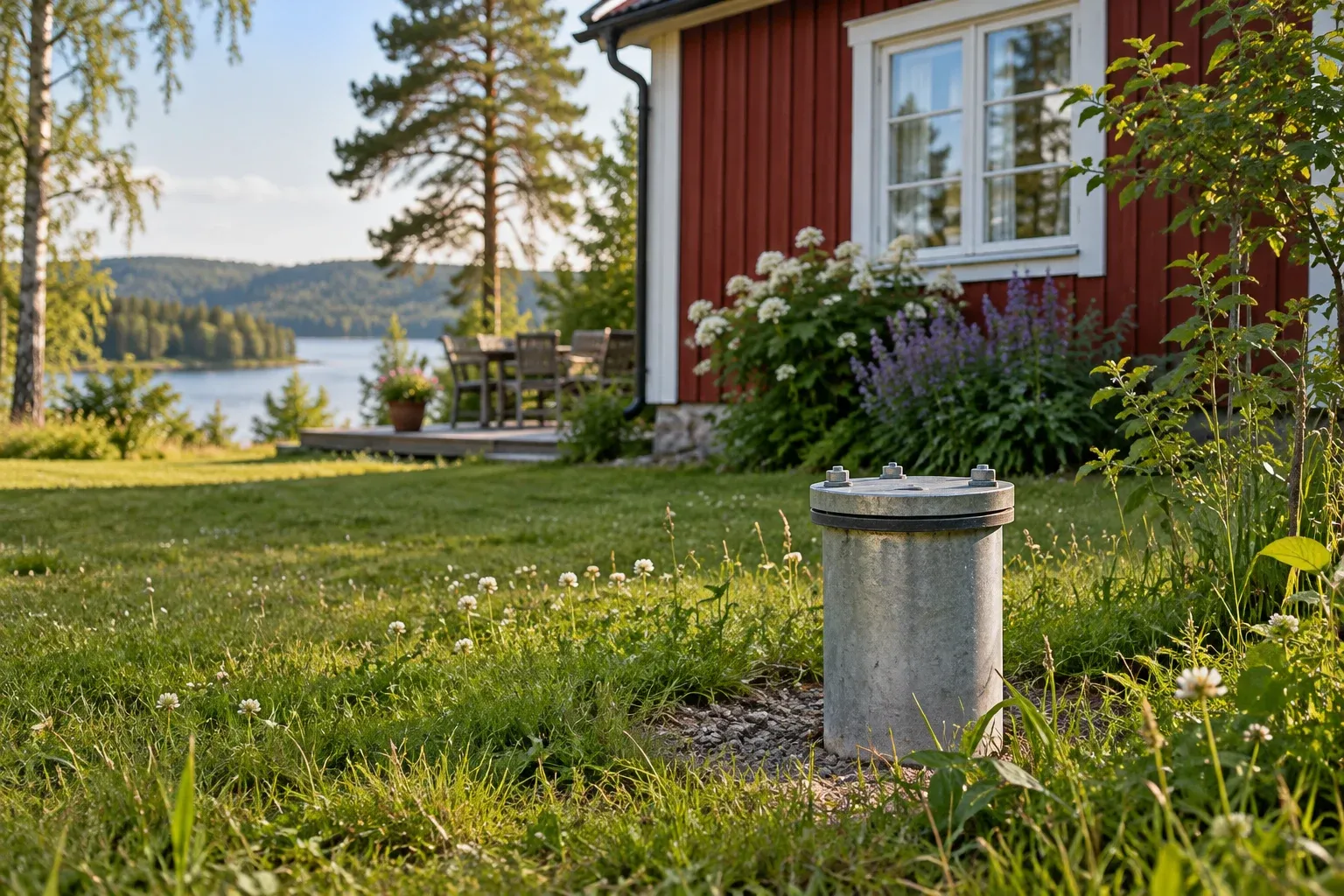
Many Swedish cabins don’t run on town water. They have their own well. Here is how to find out whether yours has been tested, how to read the report, and when to boil the water or buy bottled.
When you need this
- The listing or the host says egen brunn and you want to know whether to drink from the tap
- You’re traveling with a baby or a toddler, or you’re pregnant, and the cabin runs on a well
- The water is brown, yellow, black-flecked or tastes salty
- The host sends a lab report full of Swedish terms
- It’s a dry late summer and the tap sputters or the water tastes different
- Heavy rain or flooding has hit the area during your stay
Why nobody tests a private well for you
Most of Sweden drinks municipal water that is regulated and tested as food (see our guide to tap water in Sweden). The countryside is different. Livsmedelsverket, the Swedish Food Agency, estimates that about two million people get their drinking water from a private well or another small private supply, and says wells are also common in holiday homes. SGU, the Geological Survey of Sweden, puts it as just over a million permanent residents plus roughly as many holiday residents.
For a private well, the owner alone is responsible for the water’s quality and for making sure there’s enough of it. Livsmedelsverket publishes guideline values (riktvärden) and recommends a test at least every three years, or every year if children up to and including five drink the water or the well serves more than two properties. That’s advice, not law. The guideline values themselves are explicitly not legally binding, and no authority samples a private well unless the owner asks.
Most private wells deliver good water. But “the cabin’s water is fine” is something the owner has to show you, not something the state guarantees.
Where the law draws the line for rentals
The law reaches a rented cabin only above a size threshold:
| Situation | What applies |
|---|---|
| Rented holiday cabin for at most eight guests | Exempt from the drinking-water regulations; owner’s responsibility, testing advised |
| Rented permanent home in a one- or two-family house | Also exempt |
| Larger lets, campsites and other paid activities with their own well | The drinking-water regulations (LIVSFS 2022:12) apply whatever the size |
| Any supply of 10 m³ a day or 50 people | The drinking-water regulations apply |
So whether anyone outside the owner checks the water depends on how many beds the cabin has. What registration and sampling involve for larger lets is covered in our guide to what to expect in a Swedish cabin.
What to ask the host
Ask before you book, or at least before you arrive:
- “Is it municipal water or a private well?” In Swedish: Är det kommunalt vatten eller egen brunn?
- If it’s a well: “When was the last water test, and can I see the report?” (När togs senaste vattenprovet?)
A careful owner keeps the lab report and can send you a photo. Check two things: the date, because a report older than three years is outdated by Livsmedelsverket’s own standard, and the verdict line. Don’t rely on taste or smell. The agency says plainly that smelling and tasting the water tells you nothing about the substances that matter most.
How to read the lab report
A standard test (normal analys) covers E. coli, coliform bacteria and culturable microorganisms, plus about two dozen chemical and physical parameters: arsenic, fluoride, uranium, chloride, nitrate, iron, manganese, pH and more. Radon and PFAS are added only when there’s a reason, such as a drilled well or a former fire-training site nearby. The report ends in one of three verdicts:
| Verdict | Means | What you do |
|---|---|---|
| tjänligt | Fit to drink | Drink and cook with it |
| tjänligt med anmärkning | Fit, with a remark: a warning sign | Check which parameter; often still drinkable |
| otjänligt | Unfit | Don’t use it for drinking or cooking |
The parameters that matter most to a guest:
| Parameter | Livsmedelsverket’s value | What it means for you |
|---|---|---|
| E. coli | Unfit if found in 100 ml | Fecal contamination; boil before drinking |
| Coliform bacteria | Remark at 50, unfit at 500 per 100 ml | Often surface water after heavy rain; boil at the unfit level |
| Arsenic | Unfit above 5.0 µg/l | Cancer risk with long exposure; boiling doesn’t help |
| Fluoride | Unfit above 1.5 mg/l (since 1 Feb 2026) | Can harm a fetus; boiling doesn’t help |
| Uranium | Remark above 30 µg/l (no unfit level) | Minor kidney effect, nothing to do with radiation; still drinkable |
| Radon | Unfit above 1,000 Bq/l | Main risk is breathing it in the shower |
| Chloride (salt) | Remark above 100 mg/l | Corrodes pipes; tastes salty above about 300 |
Two exceptions are useful to know. At a holiday home, adults who drink the water for at most three months a year may drink water with up to 10 µg of arsenic per liter. If children are part of the household, the stricter 5 µg value applies. And uranium has no unfit level at all.
Boil or bottle? It depends on the problem
Boiling is the right fix for microbes and the wrong fix for everything else:
- Microbial remark (E. coli, or coliforms at the unfit level): boil all water for drinking and cooking until a new test is clean. Bring it to a vigorous boil, cool it in a clean covered container, and use it for drinks, the coffee maker, ice, brushing teeth and rinsing raw fruit and vegetables. Unboiled water is fine for showering, washing up and cooking pasta or potatoes.
- Chemical remark (arsenic, fluoride, uranium, radon, salt): boiling does nothing. Drink bottled water, or ask whether the cabin has a working filter for that specific substance.
- Lake intakes: algal toxins (cyanotoxins) survive boiling too.
Discolored water is a separate question. Brown water usually means iron and black flakes mean manganese. Both mostly stain sinks and laundry. Arsenic and fluoride are invisible, so go by the report, not the color.
Babies, toddlers and pregnancy
This is where the report matters most. Young children are more sensitive to arsenic, fluoride, lead, manganese and nitrite, and catch stomach bugs more easily. Since 1 February 2026, Livsmedelsverket rates fluoride above 1.5 mg per liter as unfit because high levels can harm the developing nervous system of a fetus.
Without a recent report, use bottled water or ready-to-drink formula for the whole stay. Our baby food and formula guide covers where to buy it.
Drought, floods and the seasons
- Late summer drought: groundwater runs low after a thin winter and a dry summer. Shallow dug wells (grävd brunn) run dry first, especially in moraine, Sweden’s most common soil, where levels often swing by up to a couple of meters a year. Refilling a dry dug well doesn’t work, because most of the water seeps away. Drilled wells (bergborrad brunn) last longer. Their first warning is a change in smell, taste or appearance, or air in the pipes.
- Salt creep: near the coast, and in drilled wells in areas once covered by the sea, heavy pumping or drought can draw salt water in. Long showers in a dry spell can damage the owner’s well.
- Floods and snowmelt can change quality. If you have to use the water, boil it, and keep boiling for a couple of days until it looks, smells and tastes normal again.
- Heavy rain: coliforms without E. coli often mean surface water has run into the well.
In a dry spell, save water, skip watering the garden or filling a paddling pool, and keep a few liters of drinking water in a clean container. Livsmedelsverket plans for 3 to 5 liters per person per day. Tell the host about any change in color, taste or pressure.
Practical information
| Item | Detail |
|---|---|
| Recommended testing interval | At least every 3 years; yearly with children up to 5 or more than two properties sharing |
| Exemption threshold for rentals | Holiday let for at most 8 guests |
| Fluoride guideline | 1.5 mg/l (unfit), since 1 February 2026 |
| Arsenic guideline | 5.0 µg/l; 10 µg/l for adults at a holiday home, max 3 months a year |
| Emergency drinking water | 3–5 liters per person per day |
| Cost of a water test | Owner’s cost; varies by laboratory and package |
| Who to ask about local conditions | The municipality’s environmental office (miljökontoret) |
| Groundwater levels | SGU’s live map of current groundwater levels |
FAQ
Is well water in Sweden safe to drink?
Usually, yes. Most private wells deliver good water, but no authority tests them: the owner is responsible, and Livsmedelsverket only recommends a test every three years, yearly with children up to five. So the honest answer depends on that particular well. Ask the host for the latest lab report; a verdict of tjänligt means it is fine for drinking and cooking.
How do I know if a cabin’s well water has been tested?
Ask the host directly, before you book if possible: municipal water or private well, and when was the last water test? A careful owner keeps the lab report and can send a photo. Check the date and the verdict line. A report more than three years old is outdated by Livsmedelsverket’s advice, and an unanswered question is itself an answer.
Does boiling make well water safe?
Only against microbes. Bringing water to a vigorous boil kills bacteria, viruses and parasites, so it is the right response to E. coli or high coliform counts. It does not remove arsenic, fluoride, uranium, salt or other chemicals, and it does not destroy algal toxins. If the report flags a chemical, use bottled water instead of boiling.
Can I give well water to a baby or drink it while pregnant?
Not without a recent test. Young children are more sensitive to arsenic, fluoride, lead, manganese and nitrite, and to stomach bugs. Since 1 February 2026, fluoride above 1.5 mg per liter counts as unfit because it can harm a fetus’s developing nervous system. Without a current report, use bottled water or ready-to-drink formula.
Why is the cabin’s well water brown, black or salty?
Brown water usually means iron and black flakes mean manganese. Both mostly stain sinks and laundry and are rarely a health issue. A salty taste means chloride, from seawater, road salt or old salt water in the bedrock, and above about 300 mg per liter you can taste it. A sudden color change can mean surface water is leaking in, so tell the host.
What happens to a well in a drought?
Dug wells are shallow and can run dry in a long dry spell, especially in moraine soil; refilling them does not work. Drilled wells last longer, but quality can change and coastal wells can draw in salt water. If the tap sputters or the taste changes, save water, skip long showers and tell the host.
Is radon in well water dangerous?
Radon is a radioactive gas from the bedrock and occurs mainly in drilled wells. The chief risk is breathing it in when it escapes from the water during showers and washing, which over time raises lung-cancer risk. Drinking it is a much smaller risk. Livsmedelsverket rates water above 1,000 Bq per liter as unfit and suggests owners of drilled wells check radon occasionally.
Related guides
- Tap water in Sweden: the municipal network, the cold-tap rule and boil-water notices
- What to expect in a Swedish cabin: toilets, sewage, linen and the departure clean
- Renting a stuga: contracts, payments and where to complain
- Baby food and formula in Sweden: ready-to-drink formula for cabins with untested wells
- Refilling water outdoors: bottles, lakes and streams away from the cabin
Facts verified 2026-10-06. Sources: Livsmedelsverket (Swedish Food Agency), SGU (Geological Survey of Sweden), Kristianstads kommun — full register in this topic’s source file. Found something outdated? Tell us and we’ll fix it.