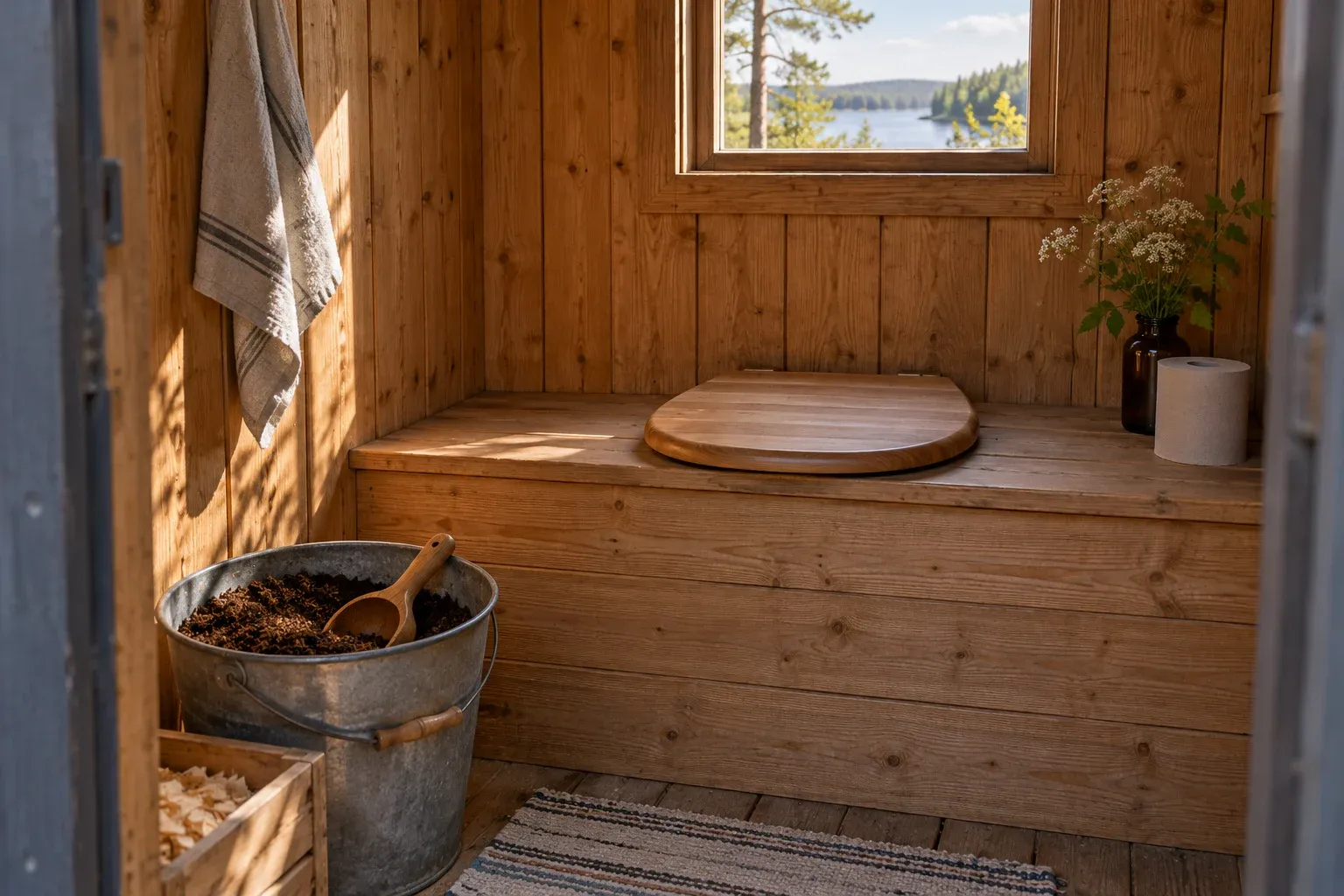
The little red hut behind the cabin is nothing to dread. Here is how each kind of Swedish dry toilet works, the routine that keeps it clean, and why emptying it is the owner’s job, not yours.
When you need this
- Your cabin listing says torrtoalett, dass, utedass or mulltoa
- You are facing an outhouse with a bucket of peat and no instructions
- The indoor toilet has two openings, or a button marked with a flame
- The host asks you to “change the bin” or “take the latrine to the road”
- You are staying on an island or in the mountains with no road access
- You own or are buying a cabin and want to know what the municipality requires
Four kinds of dry toilet
A dass (also utedass or torrdass) is an outhouse. Its indoor relatives are just as common in Swedish cabins, and none of them flush. They exist because many cabins sit outside the municipal sewer network, where a flush toilet would need a permitted private sewage system.
| Type | Swedish | How it works | Your one job |
|---|---|---|---|
| Outhouse | dass, utedass | A seat over a bin or bucket in a separate hut | A scoop of bedding after each visit |
| Composting toilet | mulltoa, förmultningstoalett | Waste collects in a container under the seat and starts to break down | Bedding, lid closed |
| Urine-separating toilet | urinsorterande toalett | Urine goes into a front outlet, solids into the rear | Sit down, every time |
| Incinerating toilet | förbränningstoalett | Burns the waste, leaving a little ash | A paper liner before every visit |
You may also meet a freezing toilet, which needs electricity, or a packaging toilet that seals each deposit in film. Both are rarer.
How to use a dry toilet, step by step
The routine takes ten seconds once you know it. The bedding, called strö, is the whole trick: dry peat moss, sawdust, bark mulch or wood shavings that soak up moisture and keep smell and flies away.
- Ask before you book which toilet the cabin has and whether you are expected to empty or swap anything.
- Find the bedding and the instructions. A bucket or sack of strö with a scoop usually stands next to the seat, often with a note from the owner.
- Sit down, every time. On a urine-separating toilet that keeps urine and solids apart; on any dry toilet it stops splashing.
- Cover after each visit with a scoop of bedding, so nothing is left exposed.
- Toilet paper only. Wipes, pads, tampons, nappies, food and cigarette ends go in the household bin.
- Never add chemicals. No bleach, toilet cleaner or blue caravan toilet fluid; they stop the biological breakdown.
- Keep the lid shut and the door closed so the ventilation pipe can draw air out above the roof.
- Wash your hands. Many outhouses have only a water can or sanitiser, so bring your own.
- Report problems before you leave: a full container, a smell, a broken fan, an empty bedding sack.
Two habits make the first night easier: visit the outhouse in daylight so you know the path and the light, and keep a headlamp by the door. With children, show them the scoop routine on day one and pack a child’s seat if the hole is large.
Incinerating toilets
An incinerating toilet (förbränningstoalett) burns everything at high temperature and leaves only a small amount of ash. Put a paper bowl liner in before every visit, then start the burn cycle as the instructions say.
A cycle runs for about an hour. In a big group that matters, so plan around it, and never open the toilet mid-cycle. Skipping the liner gives you a dirty bowl and a smell.
Who empties it, and the rules behind that
In a rental, you don’t. Handling the waste is the owner’s job, and the law is strict about it. Since 1 July 2026, Miljöbalken (the Environmental Code), chapter 15, section 12, names “waste from dry toilets and similar solutions” as a municipal responsibility. Only the municipality, or a contractor it engages, may handle it, unless municipal rules let the owner compost it on the property (section 16). The municipality must also collect it if the owner asks, unless that is unreasonable (section 13).
That rewrite of the waste chapter (Lag 2026:507) is recent. Older guides cite section numbers that no longer exist, so trust the chapter as it reads now.
So the practical rules for a guest are:
| Situation | What to do |
|---|---|
| The bin or bucket is full | Tell the host; don’t empty it yourself |
| The host asks you to swap a latrine container | Close the lid properly, keep it under the weight limit, put it at the collection point |
| You are tempted to tip it in the forest or the bin | Don’t: it risks wells and bathing water, and breaks Miljöbalken |
| You have a caravan cassette toilet | Never empty chemical toilet waste into a cabin’s dry toilet or compost |
Latrine collectors are strict about contents. Vafab Miljö, the waste company for Västerås and neighbouring municipalities, takes only containers holding latrine, toilet paper and bedding, at no more than 15 kg, and leaves anything else behind.
If you own the cabin
The national framework is short; the detail is municipal. A municipality may require a permit or notification for any toilet other than a flush toilet, under Förordning (1998:899), section 40, point 3. Härryda requires a permit for every dry toilet. A flush toilet always needs a permitted sewage system (section 13).
Composting the waste yourself needs the municipality’s approval, but the form varies:
| Municipality or guide | What it calls the approval |
|---|---|
| Södertälje | Permit (tillstånd) from the environmental board before you start; none needed if you use latrine collection |
| Avloppsguiden | Exemption (dispens) from the environmental board |
| Östhammar | Notification form for both the toilet and the latrine compost, with a product sheet and a site plan showing nearby water sources |
Södertälje’s guidance describes what a latrine compost should look like. It needs two chambers used in turn, about 2 × 500 litres for a holiday home, with a tight bottom, a rainproof lid and netted ventilation. Each full chamber rests at least a year after the last addition; Avloppsguiden describes 1.5 to 2 years of storage. A household compost is not a latrine compost, and lime does not belong in it.
Separated urine is spread only from April to October, at least 40–50 m² of planted area per person per year, not on food eaten raw and not close to a water source. A dry toilet does not end your sewage duties either: greywater from the sink, shower and dishes (BDT-vatten) must still be treated. Composting food waste at home is notifiable to the municipality too.
Seasons and regions
Dry toilets are most common in the archipelagos, on islands without roads and at mountain huts. Where latrine collection exists it usually runs in the warm season. Vafab Miljö, for example, collects every other week from early May to late September, with extra pick-ups bookable year-round. Avloppsguiden notes that many municipalities have stopped latrine collection, so composting is the norm in some places.
In winter an unheated outhouse is cold, composting slows or stops because it needs warmth, moisture and air, and urine tanks can freeze. Ask the host how the toilet works out of season.
Practical information
| Item | Detail |
|---|---|
| Cost to a guest | Included in the rental |
| Latrine collection | Owner pays, per the municipality’s waste tariff |
| Permit or notification | Fee per the municipality’s tariff, adjusted yearly |
| Latrine container limit (Vafab Miljö area) | 15 kg; latrine, toilet paper and bedding only |
| Incinerating burn cycle | About an hour |
| Latrine compost rest time | At least 1 year after the last addition (Södertälje) |
| Urine spreading season | April to October |
| Governing law | Miljöbalken 15 kap. 12, 13, 16 §§ (since 1 July 2026); Förordning 1998:899, 13 and 40 §§ |
FAQ
What is a dass in Sweden?
A dass, or utedass, is an outhouse: a small hut with a dry toilet, common behind Swedish summer cabins, at mountain huts and on islands without sewers. Nothing is flushed. Waste collects in a container and you cover each visit with a scoop of dry bedding such as peat or sawdust. Used correctly, a dass is clean and close to odourless.
How do you use a composting toilet in a Swedish cabin?
Sit down every time, so urine and solids go where they should. After each visit, sprinkle a scoop of the bedding (strö) kept by the seat. Put in toilet paper only: wipes, sanitary products and food go in the bin. Never add cleaners or chemicals. Keep the lid closed, and leave emptying to the host unless told otherwise.
Do I have to empty the toilet in a rented cabin?
Normally not. Handling toilet waste is the owner’s job, and by law it belongs to the municipality unless local rules let the owner compost it on the property. If the host asks you to swap a latrine container, follow the written instructions: close the lid, respect any weight limit, and put it at the collection point. Never empty it in nature.
What do you put in a dry toilet to stop the smell?
A dry bedding material, called strö: peat moss, sawdust, bark mulch or wood shavings. A scoop after each visit absorbs moisture and keeps smell and flies down. The cabin usually provides it; tell the host if it runs out. Do not use chemicals, toilet cleaner or caravan fluid, which stop the composting process.
How does an incinerating toilet work?
An incinerating toilet (förbränningstoalett) burns the waste at high temperature, leaving only a little ash. Place a paper bowl liner before every visit, then start the burn cycle as the instructions say. A cycle runs for about an hour, so a large group should plan around it. Do not open it mid-cycle.
Do you need a permit for a dry toilet in Sweden?
It depends on the municipality. National rules let each municipality require a permit or notification for toilets other than flush toilets, and composting the waste on your property needs municipal approval. Härryda requires a permit for every dry toilet; Södertälje requires one only to compost latrine yourself. Ask the municipal environmental office before installing.
Related guides
- What to expect in a Swedish holiday cabin: linen, cleaning, water and the other surprises
- Renting a stuga: get the toilet answer in writing before you pay
- Well water at Swedish cabins: the other off-grid system you’ll meet
- Owning a Swedish cabin: sewage, utilities and closing up for winter
- Wild camping in Sweden: what to do when there is no toilet at all
Facts verified 2026-10-06. Sources: Riksdagen/Regeringskansliet (Miljöbalken 15 kap., Förordning 1998:899, Avfallsförordning 2020:614), Södertälje, Härryda and Östhammar municipalities, Vafab Miljö, Avloppsguiden — full register in this topic’s source file. Found something outdated? Tell us and we’ll fix it.