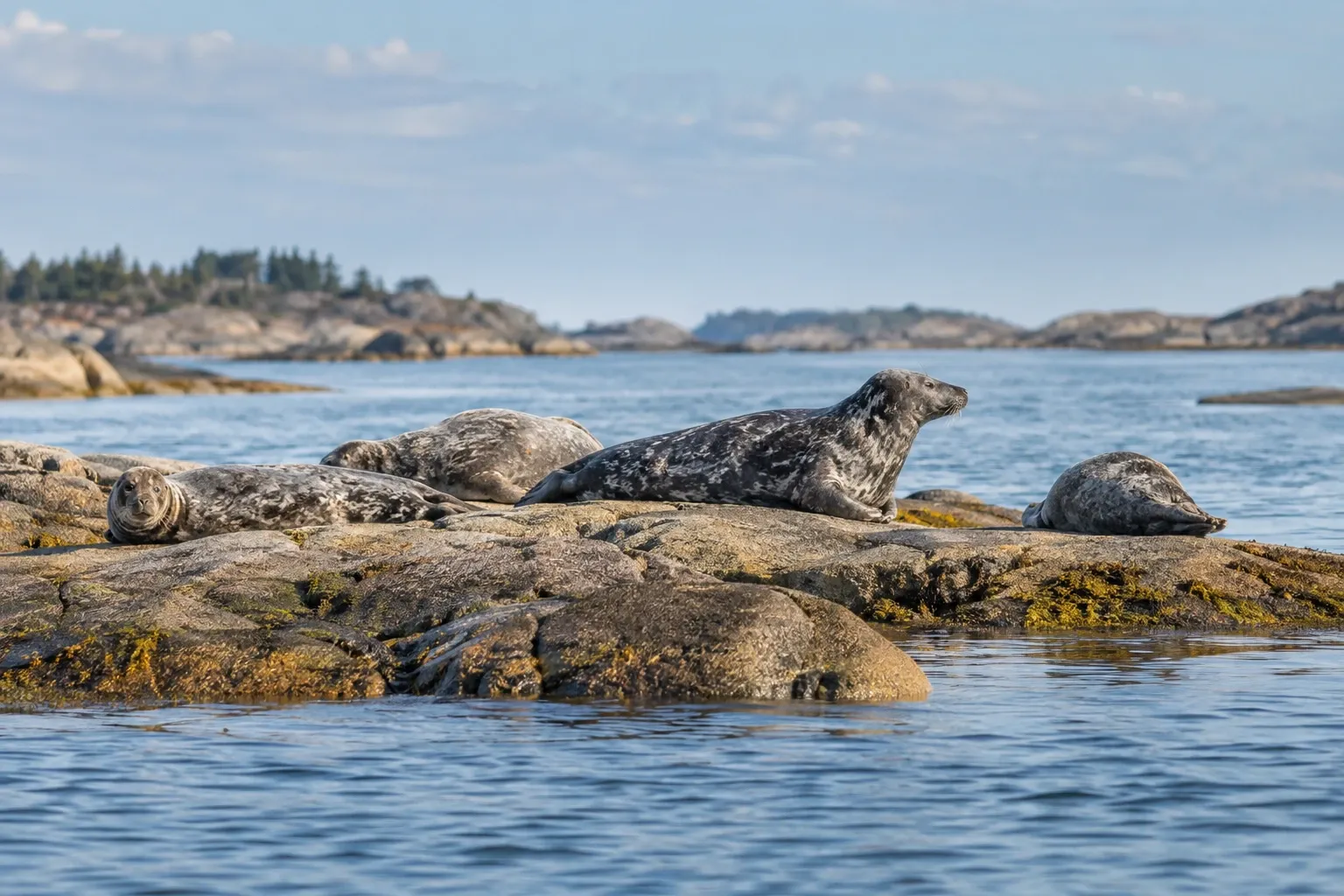
Seals are the large wild animal you are most likely to see on the Swedish coast, often from land and for free. Which species depends on which coast you are on. Whether you may go near them depends on the calendar and a yellow sign.
When you need this
You are travelling the coast and want a real chance of wild seals, or you are weighing a seal boat trip against watching from shore. You are paddling and see seals on a skerry with a yellow sign. A seal pup is lying alone on the beach and you want to help. Or you read that Sweden shoots seals and wonder what that means for watching. For every other animal, start with our overview of wildlife in Sweden.
Three species, three coasts
All three are true seals that eat mainly fish, and each has its own part of the coast.
| Species | Swedish | Where | Pups born | Latest estimate |
|---|---|---|---|---|
| Grey seal | gråsäl | Mainly the Baltic; only scattered animals on the west coast | February–March | About 46,000 counted in the Baltic in 2024; 57,000–76,000 in total |
| Harbour seal | knubbsäl | Most common on the west coast; small isolated group in Kalmarsund | June | About 4,300–5,000 in the Swedish Skagerrak; 13,000–15,000 in the Kattegat population shared with Denmark |
| Ringed seal | vikare | Bothnian Bay only | February–March, in snow caves on the ice | 20,000–36,000 in 2024 |
The figures come from the Swedish Environmental Protection Agency’s (Naturvårdsverket’s) 2026 hunting decisions, which quote the Swedish Museum of Natural History’s surveys. Grey seals have grown by about 4.8% a year since 2003. On the west coast, harbour seal growth has stalled since 2020. The ringed seal is an Arctic species that was trapped in the Baltic after the last ice age. We found no public viewpoint for it.
Where to watch from land
Three official viewpoints give a good chance of wild seals without a boat, and all are free to visit on foot.
| Place | Coast | Seals | The catch |
|---|---|---|---|
| Säludden, Gotska Sandön | Baltic, north of Gotland | Grey seals from a hide on a roped path; usually three to five, once more than 180 | Island national park reached by tour boat from Nynäshamn or Fårösund; book ahead |
| Måkläppen, Falsterbo | South-west Skåne | Harbour and grey seals on sandbars, seen with binoculars from the platform at Sjömärket (a sea mark) | The reserve may be visited only November–January, never with a dog |
| Kullaberg | North-west Skåne | Harbour seals from the cliffs | Only when the sea is still, without waves |
Säludden is the national park’s designated seal spot. Seals haul out there only when the waves are low, so pick a calm day. The sanctuary around the hide is closed all year; stay on the roped path.
Måkläppen is the trap. A visiting ban covers the sandbars and the surrounding water from 1 February to 31 October. Two zones are closed all year, and the reserve rules forbid going close to seals or following them. The county board (Länsstyrelsen) also warns that the sea level can change sharply in a short time, and asks you not to cross the channel south of Sjömärket. Combine a winter visit with birdwatching at Falsterbo.
Near Stockholm, the only guaranteed seals are the grey and harbour seals at Skansen, kept in European zoo conservation programmes. Wild grey seals live in the outer archipelago, but many of their skerries are sanctuaries.
By boat: the sanctuary rules
On the west coast and in the archipelagos, a boat is the easiest way to reach seal skerries. That is also where the law is strictest. Many haul-outs are seal protection areas (sälskyddsområden), set up by county boards or municipalities under the Environmental Code. During their closed season you may not land. Some also close the water 50 or 100 metres around the islet. The most common seal closure is 1 February–31 August. Each area’s own decision sets the real dates, and they are printed on the yellow sign. Breaking the rules is an offence punishable by fines, even if no seal is in sight.
Two west-coast examples:
- Kosterhavet National Park forbids being in or travelling through its marked seal sanctuaries from 15 May to 15 July, and bans drones anywhere in the park. See our Koster Islands guide.
- Väderöarna nature reserve, on the Bohuslän coast, has bird and seal protection areas on many islands, and harbour seals give birth on several of them. The county board’s advice to boaters is to read the chart carefully.
Outside protected areas no law sets a distance. Seals are not covered by the Species Protection Ordinance’s ban on disturbing animals, and that will not change when the ordinance is rewritten on 1 November 2026. The working rule: if seals slide into the water, you are too close. Paddlers should read our landing rules for islands and skerries and kayaking in the Stockholm archipelago. On a guided trip, ask whether the route respects local closures; our wildlife safari guide lists the questions to ask.
Sanctuary lists change. In 2025 the government asked the county boards of Gävleborg, Södermanland, Skåne and Västra Götaland to review which seal protection areas are no longer needed, to open skerries to seal hunting. Check the sign and Naturvårdsverket’s Skyddad natur map each trip rather than a list you saved last year.
When to go
- February–March: grey and ringed seal pups are born. Grey seals pup on pack ice or, without ice, on outer skerries.
- Spring: grey seal mothers leave their pups after about a month, and lone pups can turn up far up on land.
- Late May–early June: the grey seal moult. Naturvårdsverket pauses the hunt in these weeks, and the museum flies its annual count while the seals lie up on their resting rocks.
- 15 May–15 July: Kosterhavet’s seal sanctuaries are closed.
- June: harbour seal pups are born. The mother leaves her pup after about three to four weeks.
- November–January: the only months Måkläppen may be visited.
Whatever the month, calm weather matters more than the date.
Found a lone pup?
Leave it. In summer it is normal to see harbour seal pups alone on beaches from Kalmar county round the whole south and west coast. The mother comes back to nurse and later leaves the pup to manage on its own. Naturvårdsverket asks you not to disturb them.
| Situation | What to do |
|---|---|
| Healthy pup near the water | Walk on; keep dogs well away |
| Grey seal pup far up on land in spring | It may be moved to the nearest shore, but only with the hunting-rights holder’s permission |
| Pup or adult clearly sick or injured | Report it to the National Veterinary Institute (SVA); don’t go close or touch it |
| Seal must be put down | Police on 114 14, or a municipal hunter |
| Dead seal | Report it to the Swedish Museum of Natural History’s online form |
A dead seal is not “state game” (statens vilt), so unlike a dead bear or eagle there is no duty to report it to the police. Reports to the museum feed the national health monitoring, and the museum or SVA may contact you.
Yes, Sweden hunts seals
This surprises visitors, and many English pages still describe Swedish seals as protected. Since 2021, the hunting ordinance has let Naturvårdsverket decide on licensed hunting of grey and harbour seals. The agency can also allow protective hunting of all three species. For 2026–27 it allows:
- 1,350 grey seals in all Baltic coast counties, 350 more than the year before;
- 200 harbour seals on the west coast, but none south of Höganäs and none in Kalmarsund, whose population is below the HELCOM threshold;
- 200 ringed seals, now in Gävleborg as well as the three northernmost coastal counties.
The stated aim is to limit damage to small-scale fishing and sensitive fish stocks. No licensed grey seal hunting is allowed in national parks, so the grey seals at Säludden are untouched by it. The hunt pauses during the grey seal moult. For watchers, the practical effect is small: seals near fishing gear may be shyer, which is one more reason to watch from a distance.
Practical information
| Item | Detail |
|---|---|
| Watching from public viewpoints | Free |
| Måkläppen visiting window | 1 November–31 January |
| Kosterhavet seal sanctuaries closed | 15 May–15 July |
| Most common seal-area closure | 1 February–31 August (check each sign) |
| Gotska Sandön tour boat | Set by the operator; book in advance |
| Seal boat trips | Set by the operator |
| Skansen admission | Set by Skansen; see our Skansen guide |
| Sick or injured seal | Report to SVA |
| Seal to be put down | Police, 114 14 |
| Dead seal | Swedish Museum of Natural History, online form |
FAQ
Where is the best place to see seals in Sweden?
For wild seals from land, Säludden on Gotska Sandön has a hide by a grey seal haul-out, Måkläppen at Falsterbo has a viewing platform over harbour and grey seals (open November–January), and Kullaberg’s cliffs give harbour seals in calm water. On the west coast, boat trips to skerries are the easiest option. Skansen in Stockholm has captive seals.
When is the best time to see seals in Sweden?
Calm days from late spring to autumn are best, because seals haul out when waves are low. Late May to early June, the grey seal moult, is when they lie up on their rocks for the annual count. Pups arrive in February–March for grey and ringed seals and in June for harbour seals. Check sanctuary closures before you go.
How close can you get to seals in Sweden?
No national law sets a distance, but seal protection areas ban landing, and some also boats within 50 or 100 m, during their closed season, most commonly 1 February–31 August. Kosterhavet’s sanctuaries are closed 15 May–15 July. Elsewhere, if seals slip into the water you are too close. Use binoculars from a fixed point and never fly a drone over a colony.
What should I do if I find a seal pup alone on the beach?
Leave it alone and keep your distance: the mother is often nearby. Harbour seal pups on southern and western beaches in summer are normal. If a pup is clearly sick or injured, report it to the National Veterinary Institute (SVA). If it needs putting down, call the police on 114 14. Report a dead seal to the Swedish Museum of Natural History.
Are seals hunted in Sweden?
Yes, by decision of the Swedish Environmental Protection Agency. For 2026–27 it allows a licensed hunt of 1,350 grey seals in the Baltic counties and protective hunting of up to 200 harbour seals on the west coast and 200 ringed seals in the north. Harbour seals in Kalmarsund are not hunted. The stated aim is to limit damage to small-scale fishing.
Can I see seals near Stockholm?
Skansen in Stockholm keeps grey and harbour seals, the only guaranteed sighting. Wild grey seals live in the Baltic, including the outer archipelago, but many of their skerries are seal sanctuaries. For a reliable wild sighting, Gotska Sandön’s Säludden hide is reached by tour boat from Nynäshamn, south of Stockholm, in summer.
Related guides
- Wildlife in Sweden — every other animal, where and when to look.
- Wildlife safaris in Sweden — seal boat trips and the questions to ask an operator.
- Islands and skerries: landing rules — how bird and seal protection areas work for boaters and paddlers.
- Gotska Sandön — getting to the island with the Säludden seal hide.
- Kullaberg — harbour seals and porpoises from the cliffs.
Facts verified 2026-10-15. Sources: Naturvårdsverket, Naturhistoriska riksmuseet, Länsstyrelsen Skåne and Västra Götaland, Sveriges nationalparker, Sveriges Riksdag (jaktförordningen, artskyddsförordningen, miljöbalken), Regeringen — full register in this topic’s source file. Found something outdated? Tell us and we’ll fix it.