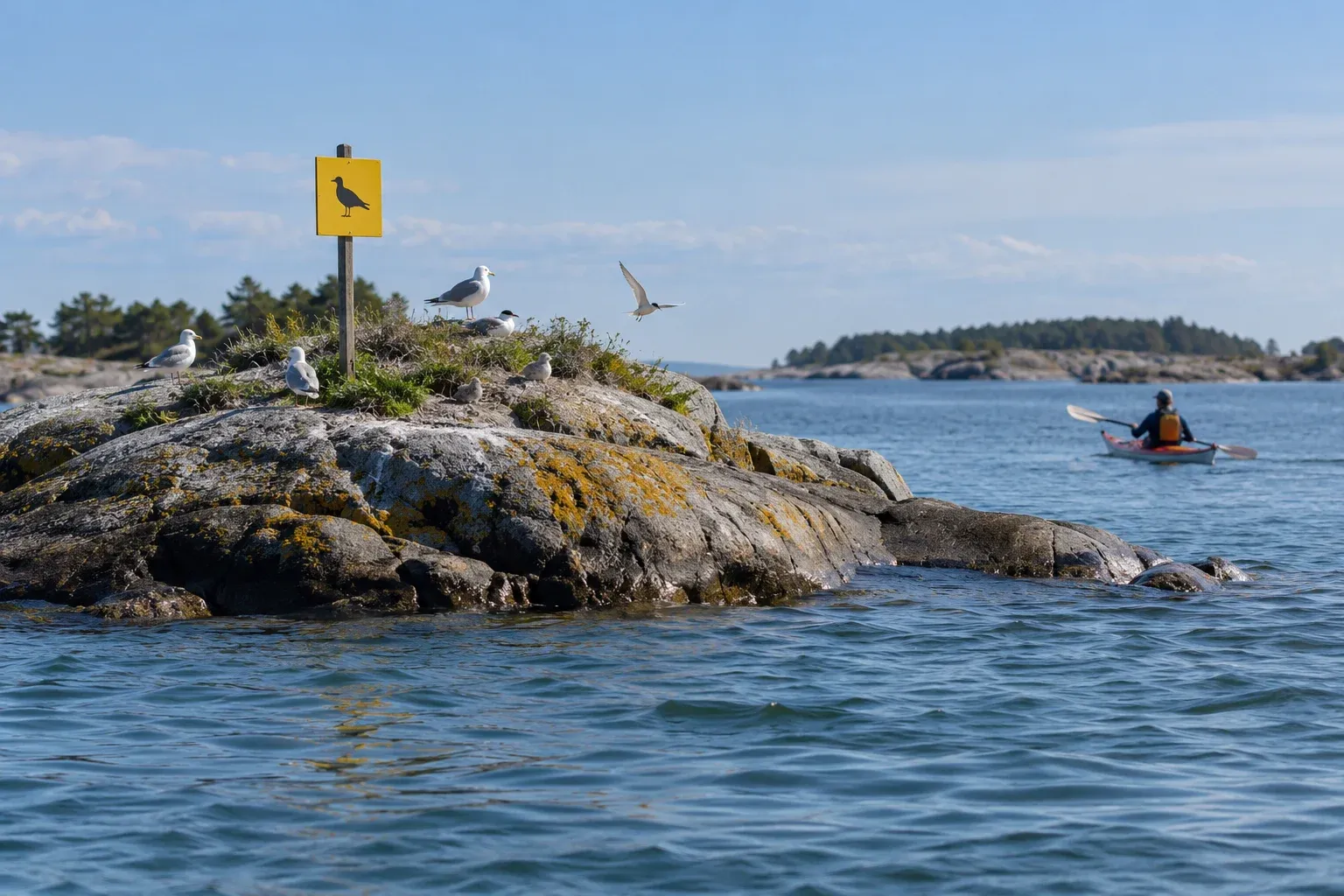
Sweden’s archipelagos are open to paddlers and sailors by default. What closes them is local: seasonal bird and seal protection areas, reserve rules and military zones, each with its own dates and boundaries. Here’s how to tell before your bow touches rock.
When you need this
You’re paddling past an empty skerry in May and want lunch on it. There’s a yellow sign on an islet and you can’t read it. You’ve found a jetty on an island and want to tie up for the night. Or you’re eyeing a smooth rock slab for a campfire. This page answers all four.
The default: you may go ashore
The right of public access (allemansrätten) follows you onto the islands. According to the Swedish Environmental Protection Agency (Naturvårdsverket), you may go ashore, swim, anchor and moor temporarily on any shore that is not part of someone’s garden plot (tomt), and is not protected for birdlife or other reasons.
- No fixed distance from houses. What decides how close you may come is the risk of disturbing the people who live there.
- Camping: one or two nights, two or three tents, away from homes — Naturvårdsverket’s rule of thumb. Bigger groups need the landowner’s permission.
- Sleeping aboard: a day or so in one spot. No rule sets a limit; the camping principle is applied. Longer at someone’s shore? Ask the landowner.
For the full right, see Sweden’s right of public access; for tent details, wild camping rules.
Bird and seal protection areas
Under the Environmental Code (miljöbalken chapter 7, section 12), county boards and municipalities may restrict the public’s — and the landowner’s — right to be in an area to protect a species. The result is the fågelskyddsområde (bird protection area) and sälskyddsområde (seal protection area). Naturvårdsverket counted 1,644 animal and plant protection areas in 2024.
There is no single national closing date. Each area’s decision sets its own. Naturvårdsverket’s guidance:
| Protection | Typical closed period |
|---|---|
| Birds, most common | 1 April – 15 July |
| Birds, in the north | 1 May – 31 July |
| Early-nesting species | from 1 February |
| Late-nesting species | 15 April – 31 August |
| Seals, most common | 1 February – 31 August |
Real examples show the spread. In the Stockholm archipelago, Nåttarö nature reserve bans landing on listed islets — and boats within 100 m of them — from 1 February to 15 August, while two other islets there close 1 April–31 July. On the northern coast, Holmöarna and Örefjärden in Västerbotten forbid being within 100 m of named islands from 15 April to 15 August.
Warning: The ban often reaches out over the water. Many decisions bar boats within 50 or 100 m of the islets, so paddling past too close is already a breach — even if you never touch land.
Breaking an area’s regulations is an offence punishable by fines, even if no bird is in sight. Staying in a protected area without permission in a way that harms what it protects can count as brott mot områdesskydd: fines or up to two years in prison. Landowner permission doesn’t help — the regulations bind landowners too.
How to know before you land
- Read the chart. Protection-area boundaries are marked on it — check before picking a lunch stop.
- Check the official map. Naturvårdsverket’s Skyddad natur map shows bird and seal areas and reserves; county boards link to it and list their areas with dates. The free Naturkartan app shows reserves, parks and trails.
- Look for the sign. Bans are usually marked with yellow or red-and-yellow signs stating the period. Their look can change with the season, so read them rather than recognise them.
- Walk around, not past. Information boards stand at popular landing places; land on a remote side of an island and you can miss them. Ignorance is no defence.
- Listen to the birds. Alarm calls, anxious flying or mock attacks mean you’re too close — leave at once.
In many areas marked trails, hides and towers stay open during the closure. The typical closures all end by 31 August, though individual reserve zones can run longer — the sign has the final word.
Jetties, anchoring and staying overnight
The jetty rule is more nuanced than “private means no”:
| Jetty | May you use it? |
|---|---|
| Part of a house’s plot (or a boathouse) | No — private land, outside allemansrätten |
| Outside the plot, out of sight of the house | Yes, temporarily — leave when the owner comes, never block their access |
| Longer stay at someone’s shore | Ask the landowner first |
Reserves and national parks add their own limits. In Nämdöskärgården national park off Värmdö, you may camp and anchor up to two days in one place in most of the park, and up to seven days at Bullerö’s tent site; some parts ban camping entirely. For harbor nights with facilities, see guest harbors; for anchoring and toilet-waste law, boating in Sweden.
Fires on rock
Archipelago rock slabs look fireproof. They aren’t. Naturvårdsverket advises against fires on bare rock and large boulders because they can crack and be permanently damaged. Use gravel or sand, a fixed fire site, or a stove. Many reserves allow fires only at marked places, and a fire ban in force applies in protected areas too — under a stringent ban, even fixed barbecue sites can close. More in campfire rules.
Military protected islands
Some coastal islands and installations are skyddsobjekt (protected objects) under the Protection Act. Unauthorised persons have no access — drones included — and a decision can add a ban on photography, or ban bathing, diving, anchoring or fishing instead. The owner must mark it with clear signs.
Warning: Unauthorised entry to a protected object can mean up to two years in prison; minor cases fines or up to six months. Signed protected islands are not optional. See also drone rules.
Mistakes to avoid
- Assuming one national date. Closures run from February to August depending on area and species.
- Thinking every private jetty is off-limits — or that every jetty is fair game. It depends on the plot and the sightline.
- Treating an empty skerry as free in May. Deserted-looking bird islets are nesting islets.
- Walking the shoreline of a small islet. Birds nest on shores and shore meadows; stay on the rocks.
- Letting the dog ashore on a small skerry. Keep it in the boat; nationally, dogs must be kept from running loose 1 March–20 August.
- Lighting a fire on a smooth slab. It cracks.
- Speeding past bird families. Wash and speed can split a brood of chicks.
Practical information
| Item | Cost / consequence |
|---|---|
| Landing, swimming, short mooring under allemansrätten | 0 kr |
| Breaching a protection area’s regulations | Fine, set case by case |
| Brott mot områdesskydd | Fines or up to two years in prison |
| Unauthorised entry to a skyddsobjekt | Up to two years in prison; minor cases fines or up to six months |
Season notes: earliest common closures start 1 February; the most common bird closure is 1 April–15 July (1 May–31 July in the north); seal areas most often 1 February–31 August; dog leash period 1 March–20 August; fire-ban season in summer — check the same day.
FAQ
Can I land my kayak on any island in Sweden?
On most, yes. Allemansrätten lets you go ashore, swim and moor temporarily wherever the shore is not part of a private garden plot. The exceptions are bird and seal protection areas during their closed season, parts of nature reserves and national parks, and military protected objects. Check the chart and the county board’s list before you pick an islet, and look for yellow signs.
When are bird protection areas closed in Sweden?
Each area’s own decision sets the dates. Naturvårdsverket’s guidance gives 1 April–15 July as the most common bird closure, and 1 May–31 July in the north. Early-nesting species can be protected from 1 February and late ones until 31 August; seal areas most often run 1 February–31 August. The dates are printed on the yellow signs.
What do the yellow signs on islands mean?
A yellow or red-and-yellow sign on a Swedish islet usually marks a bird or seal protection area with a seasonal landing ban, and often a ban on boats close to shore. The sign states the period and the area. The design can change with the season, so read it rather than recognising it, and treat a sign you cannot read as a stop sign.
Can I tie up at a private jetty in the archipelago?
Only sometimes. A jetty that belongs to a house’s plot is private and outside allemansrätten. A jetty outside the plot, out of sight of the house, may be used temporarily — but you must leave if the owner arrives and never block their access. For a longer stay at someone else’s shore, ask the landowner first.
How long can I stay overnight on an island?
For a tent, one or two nights with two or three tents is Naturvårdsverket’s rule of thumb, away from houses. Sleeping aboard at anchor follows the same idea: a day or so in one place, though no rule sets a limit. Reserves and national parks may set their own limits, often two days, and some ban camping entirely.
Can I make a fire on the rocks?
Better not. Naturvårdsverket advises against fires on bare rock and large boulders because they can crack and be permanently damaged; choose gravel or sand, or a fixed fire site, and bring a stove. Many reserves allow fires only at marked places, and any fire ban in force applies in protected areas too. Put the fire out completely before leaving.
Related guides
- Kayaking the Stockholm archipelago — routes, fairways, wind and the sanctuaries from the cockpit
- Boating in Sweden — anchoring, mooring and the toilet-waste ban
- Nature reserve rules — how reserve regulations override allemansrätten
- Shoreline protection (strandskydd) — why shores stay open and new jetties need a dispensation
- Birdwatching in Sweden — where to watch the birds these closures protect
Facts verified 2026-10-06. Sources: Naturvårdsverket (Swedish EPA), Länsstyrelsen Stockholm and Västerbotten, and the Swedish Environmental Code and Protection Act as published by the Riksdag — full register in this topic’s source file. Found something outdated? Tell us and we’ll fix it.