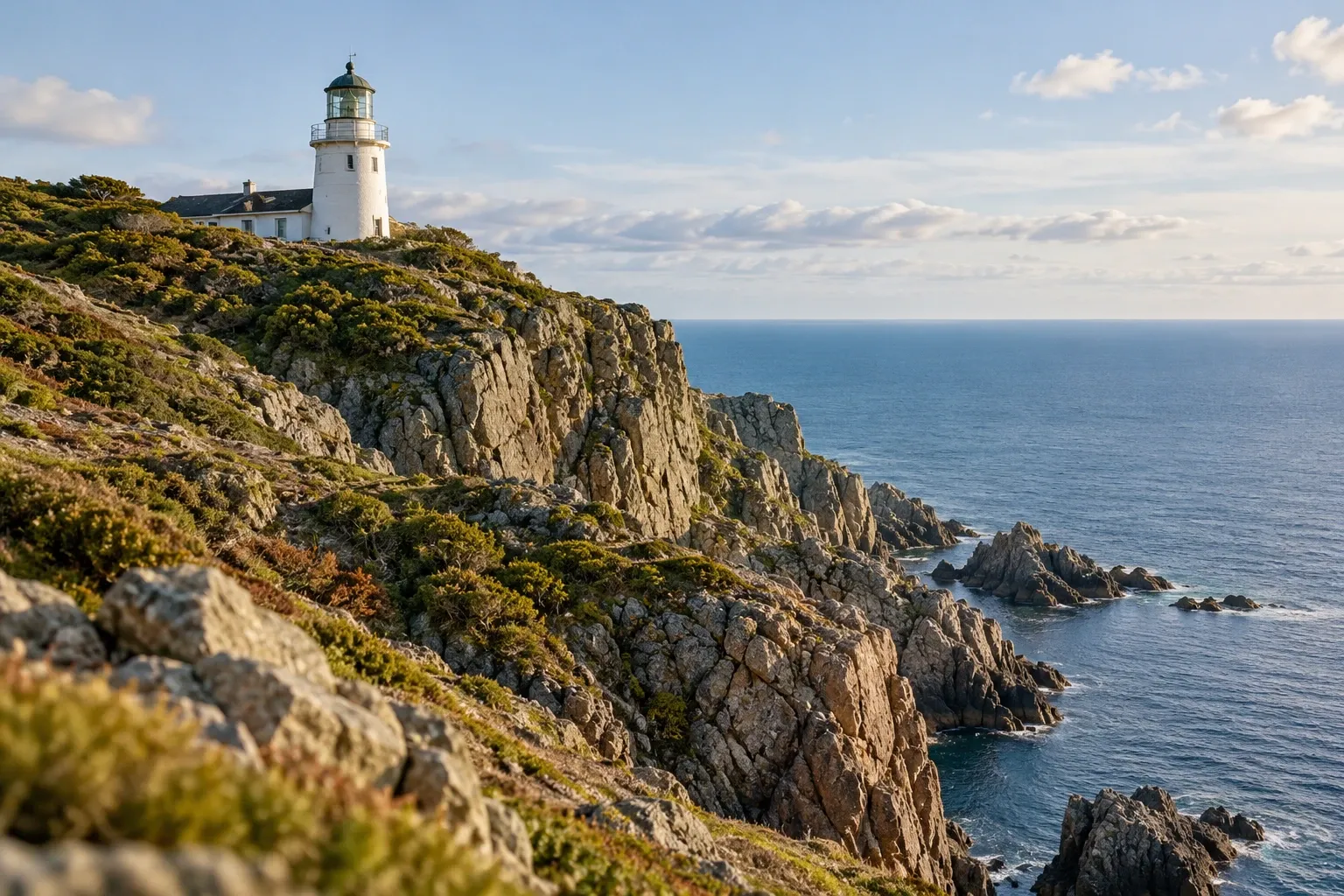
Kullaberg is Skåne’s most dramatic stretch of coast. It is also a nature reserve with stricter rules than the rest of Sweden. Here is what to see, how to spot a porpoise, and where you may actually sleep, cook and park.
When you need this
You’re in Helsingborg, Malmö or Copenhagen and want a day on wild coast. Maybe you hope to see a porpoise from the cliffs. Or you’re driving a campervan and wondering whether the lighthouse car park works for the night. Or you want to cook on your camping stove with a view of the sea. For that last pair, the answer at Kullaberg is no, and the reason matters.
What Kullaberg is
Kullaberg is an ancient rock ridge pushing into the sea at the north-west corner of Skåne, between the Öresund strait and Skälderviken bay. Geologists call it a horst: a block of bedrock raised between two faults. Most of it is red-grey gneiss, probably 1,700 million years old, cut by dark dykes of a local rock called kullait.
It is protected as two nature reserves (naturreservat), managed by the county board, Länsstyrelsen Skåne:
| Västra Kullaberg (west) | Östra Kullaberg (east) | |
|---|---|---|
| Formed | 1971 | 1965 |
| Size | 487 ha | 866 ha |
| Highlights | Kullens fyr (the lighthouse), naturum, the cliffs at the tip, the Josefinelust and Ransvik ravines | Björkeröd beech forest, Mölle mosse bog, Himmelstorpsgården, the accessible loops |
| Overnight | Tent site by the lighthouse car park; shelter at Josefinelust | Shelter at Himmelstorp; tents only with a county-board permit |
The reserve runs from the lighthouse at the tip to the village of Arild, and it’s always open. At the tip the cliffs drop nearly 80 m to the water. Kullens fyr stands 78.5 m above sea level and can be seen about 50 km away. The reserve manager calls it Scandinavia’s brightest lighthouse. The high point, Håkull, is 187 m, with views over the Bjäre peninsula and, to the south-west, Denmark.
The mix of cliff, shore, beech forest and grazed heath means about two-thirds of Sweden’s lowland plant species have been recorded here. Raptors pass on migration in spring and autumn. Westerly storms sometimes blow in gannets, fulmars and kittiwakes, and peregrine falcons use the cliffs.
Watching for porpoises
The harbour porpoise (tumlare) is the only whale that lives its whole life in Swedish waters, and it moves through Kullaberg’s sea all year. At the tip, brackish Öresund water meets cold, salty Kattegatt water, and a 300 m belt of sea round the coast has been a marine reserve since 1986.
Set your expectations right. A porpoise is about 1.5 m long and surfaces about every two minutes. It shows only a low, dark triangular fin, and it does not leap like a dolphin or ride a boat’s bow wave. Porpoises usually travel alone or in groups of two to four.
- Where: the cliffs at the tip near the lighthouse, the manager’s recommended lookout.
- When: any month, but pick a calm day. Flat water is what makes the fin visible, and you may see harbour seals (knubbsäl) as well.
- Report it: the Swedish Museum of Natural History collects sightings through an online form. The porpoises here belong to the Belt Sea population, which the museum says has declined very sharply in recent years.
- A dead porpoise is state game (statens vilt) and must be reported to the police. Don’t touch it.
The county board lists porpoise safaris by boat among the reserve’s activities. If you’re on a boat or kayak, keep a steady course without sudden turns and keep to speed limits. Take extra care in May and June, when calves are born.
The sea caves
Kullaberg has more than 20 caves (grottor), all of them shore caves. They formed in cracks or weaker dyke rock and were widened by weathering and surf. All are easy to reach by boat. From land, ravines lead down to the coves at Josefinelust, Ablahamn, Djupadal and Ransvik.
| Cave | What it is |
|---|---|
| Silvergrottan | A 16th-century mining adit following a silvery pegmatite vein |
| Visitgrottan | Large and open, easiest at low water — but inside a zone closed 1 March–15 July |
| Fredrik VII’s cave | Several rock types in one wall |
| Josefinelust caves | Flint tools from the hunter Stone Age have been found here |
| Lahibiagrottan | One of the best known, on the county board’s list |
The manager is blunt about the land approach. It needs “the greatest care” on scree slopes of loose blocks. At Visitgrottan, high water or strong wind sends the sea up the rocks you have to round. The old stone stairs down at Josefinelust can be unsuitable in wet weather.
Walking the headland
Marked trails start at naturum, the visitor centre by the lighthouse:
- Red loop: medium, along the south slope
- Blue loop: more challenging, along the steep drops on the north side
- Yellow links: short connections for round walks
For a full day, the county board suggests taking the bus to Mölle, walking through the reserve, and catching the bus home from Arild. That walk is Skåneleden SL5 stage 3, Arild–Mölle: 16 km, 4–5 hours. It’s graded red, the hardest grade on this route, which means loose or slippery ground and steep sections where you may need your hands. The 3 km shortcut, stage 3A Mölle–Himmelstorp, cuts Mölle–Arild to 6 km. Combine both for a loop round the tip of just under 18 km. See Skåneleden for the whole trail.
Sleeping, grilling and parking
This is where Kullaberg differs from the Sweden visitors expect. The right of public access (allemansrätten) normally lets you pitch a tent for a night or two. Here, binding reserve regulations override it, and breaking them is an offence that can be fined.
| You want to… | At Kullaberg |
|---|---|
| Pitch a tent | Only at the tent site by Fyrparkeringen (the lighthouse car park). First come, first served, no booking, mainly for hikers |
| Sleep in a shelter | Yes, in the open shelters (vindskydd) at Josefinelust and Himmelstorp, but no tent at them |
| String up a hammock or tarp | No, anywhere |
| Grill | Only at the fixed grill places by Fyrparkeringen, Josefinelust, Björkeröd and Himmelstorp. Bring your own wood or charcoal |
| Use a gas or spirit stove | Only at those same fixed grill places |
| Cook during a skärpt eldningsförbud (stringent fire ban) | No grilling and no stoves anywhere, not even at the grill places |
| Park a car | Free, in designated car parks, day or night, all year |
| Park a motorhome or campervan | Daytime only, in designated spaces at five car parks. Not between 22:00 and 06:00, any time of year |
| Sleep in a motorhome | No. The nearest overnight spot is at Mölle kapell, at the entrance to Mölle |
The stove rule catches people out. Under Sweden’s national model fire-ban regulation, gas and liquid stoves survive both ban tiers. The Kullaberg manager is stricter. Check the fire risk before you go, and see camping stoves during fire bans for the national picture. Motorhome travellers will find legal alternatives in motorhome wild camping in Sweden.
Closed zones and other rules
Every year from 1 March to 15 July, it is forbidden to be in, or bring a boat into, the zones marked on each reserve’s map annex. The zones cover sea as well as land, and entering one is an offence even if no bird is in sight. Download the map annexes from the county board’s page before a spring visit.
The other rules worth knowing:
- Dogs on a lead all year, in both reserves. Elsewhere in Sweden the national leash period runs only from 1 March to 20 August. See dogs in Swedish nature.
- No picking or digging up plants, breaking branches or damaging rock.
- In the sea out to 300 m: no collecting seaweed or catching bottom-living animals such as crabs (fish are exempt). No anchoring for more than 24 hours unless the weather stops you, and no touching wrecks.
- Riding only on marked paths, and some eastern pastures are restricted 15 November–1 April.
The county board stresses that its list is only a selection. The full regulations are on its Kullaberg page. For how reserve rules work in general, see nature reserves in Sweden.
Is there an entry fee? Not as of 2026. The western reserve’s regulations still contain a clause for an entry fee “during the period a fee is charged”. But the manager’s 2026 practical pages say parking is free and mention no entry fee. Some older descriptions still talk about paying to enter, so if a sign at the entrance says otherwise, follow the sign.
Getting there
Without a car, take a Skånetrafiken bus to Mölle, the nearest stop, about 5 km from naturum. In summer, bus 202 runs on from Mölle to the lighthouse car park. Buy your ticket in the app before you board; Skåne public transport explains how. Cyclists can follow the easy path from Höganäs along the old railway line.
By car, expect full car parks and crowds round the lighthouse in the summer holidays and at weekends. The manager’s advice is to come in the morning, or start in the quieter east at Björkeröd. Its practical page also links to live parking availability.
Accessibility and safety
All the accessible loops start from the Björkeröd car park:
- 800 m wheelchair loop: level ground through beech forest and pasture, with two self-closing gates.
- 3 km pushchair loop: partly on a 1.7 m boardwalk along Mölle mosse, with edge protection but no railings.
- 3 km all-terrain wheelchair loop: long climbs. You can borrow an all-terrain wheelchair free at Björkeröd if you book ahead.
Accessible parking is at the ice-cream kiosk by the lighthouse, the lower Ransvik car park and Björkeröd.
Every trail signpost carries a numbered plate called a rescue point (räddningspunkt). If you call 112, give the nearest number so the rescue service can find you. There’s an outdoor defibrillator at naturum, and drinking water is available there too.
One more thing you may hear about is Nimis, the late artist Lars Vilks’s driftwood sculpture on the west shore. It has never had permits, and SVT described the way down as steep and dangerous in January 2023.
Practical information
| Item | Details (checked 2026-10-14) |
|---|---|
| Opening | Reserve always open |
| Entry | Free; no entry fee mentioned by the manager in 2026 |
| Parking | Free in designated car parks; motorhomes not 22:00–06:00 |
| naturum Kullaberg | Italienska vägen 323, Mölle. 2026 season: daily May–1 November, 10–17 in July and August, mostly 11–16 otherwise; closed for the season from 2 November |
| Tent site | By Fyrparkeringen; first come, first served; no fee or booking stated |
| Shelters | Josefinelust and Himmelstorp (no tents) |
| Grill places | Fyrparkeringen, Josefinelust, Björkeröd, Himmelstorp |
| Closed zones | 1 March–15 July, land and sea |
| Bus | To Mölle all year; bus 202 Mölle–lighthouse in summer |
| Emergency | 112; give the rescue-point number |
FAQ
Can you see porpoises at Kullaberg?
Yes, often, and in any month: the porpoise lives in the reserve’s waters all year, and the cliffs by the lighthouse are the classic lookout. Choose a calm day and scan for a low, dark triangular fin; porpoises do not leap like dolphins. The population here is declining, so report sightings to the Swedish Museum of Natural History’s online form.
Can I camp at Kullaberg?
Only at the designated tent site by the lighthouse car park, first come, first served, mainly for hikers. You may also sleep in the open shelters at Josefinelust and Himmelstorp, but without a tent. Wild camping, tarps, hammocks and rooftop tents are banned anywhere else in the reserve. Breaking the rules is an offence that can be fined.
Is there an entrance or parking fee at Kullaberg?
Not as of 2026. The reserve manager says parking on Kullaberg is free in the designated car parks, and its practical pages mention no entry fee. The western reserve’s regulations still contain a clause for an entry fee during a charging period, so read any sign at the entrance. Parking outside designated places is not allowed.
How do I get to Kullaberg without a car?
Take a Skånetrafiken bus to Mölle, the nearest stop, about 5 km from naturum and the lighthouse. In summer, bus 202 continues from Mölle to the lighthouse car park. A good day out is to walk from Mölle through the reserve and catch the bus home from Arild. Cyclists can follow the easy path from Höganäs along the old railway.
Can I visit the caves at Kullaberg?
Yes. There are more than 20 sea caves, and all are easy to reach by boat. From land, several are reachable down the ravines at Josefinelust, Ablahamn and Djupadal, but the manager warns of loose scree and waves at high water. Visitgrottan lies inside a zone closed from 1 March to 15 July.
Can I sleep in my motorhome or campervan at Kullaberg?
No. Motorhomes, caravans, light trucks and campervans with fixed beds may not be parked in the reserve between 22:00 and 06:00 at any time of year, and sleeping in them there is banned. Daytime spaces exist at five car parks. The nearest place to stay overnight with a motorhome is at Mölle kapell, at the entrance to Mölle.
Can I bring my dog to Kullaberg?
Yes, but on a lead all year round in both reserves — not only during the national 1 March to 20 August period. In the 1 March to 15 July closed zones, nobody may enter at all, dogs included. Breaking the reserve rules is an offence that can be fined, so keep the lead on the beaches and cliffs too.
Related guides
- Skåne — the rest of the region, from Malmö to Österlen.
- Skåneleden — the trail that circles the Kulla peninsula, stage by stage.
- Nature reserves in Sweden — why every reserve’s rules differ, and how to read them.
- Helsingborg — the nearest city and the ferry to Denmark.
- Seals in Sweden — the other marine mammal you may see from the cliffs.
Facts verified 2026-10-14. Sources: Länsstyrelsen Skåne, Kullabergs naturreservat, Naturhistoriska riksmuseet, Skåneleden (Region Skåne), Naturvårdsverket, SVT — full register in this topic’s source file. Found something outdated? Tell us and we’ll fix it.