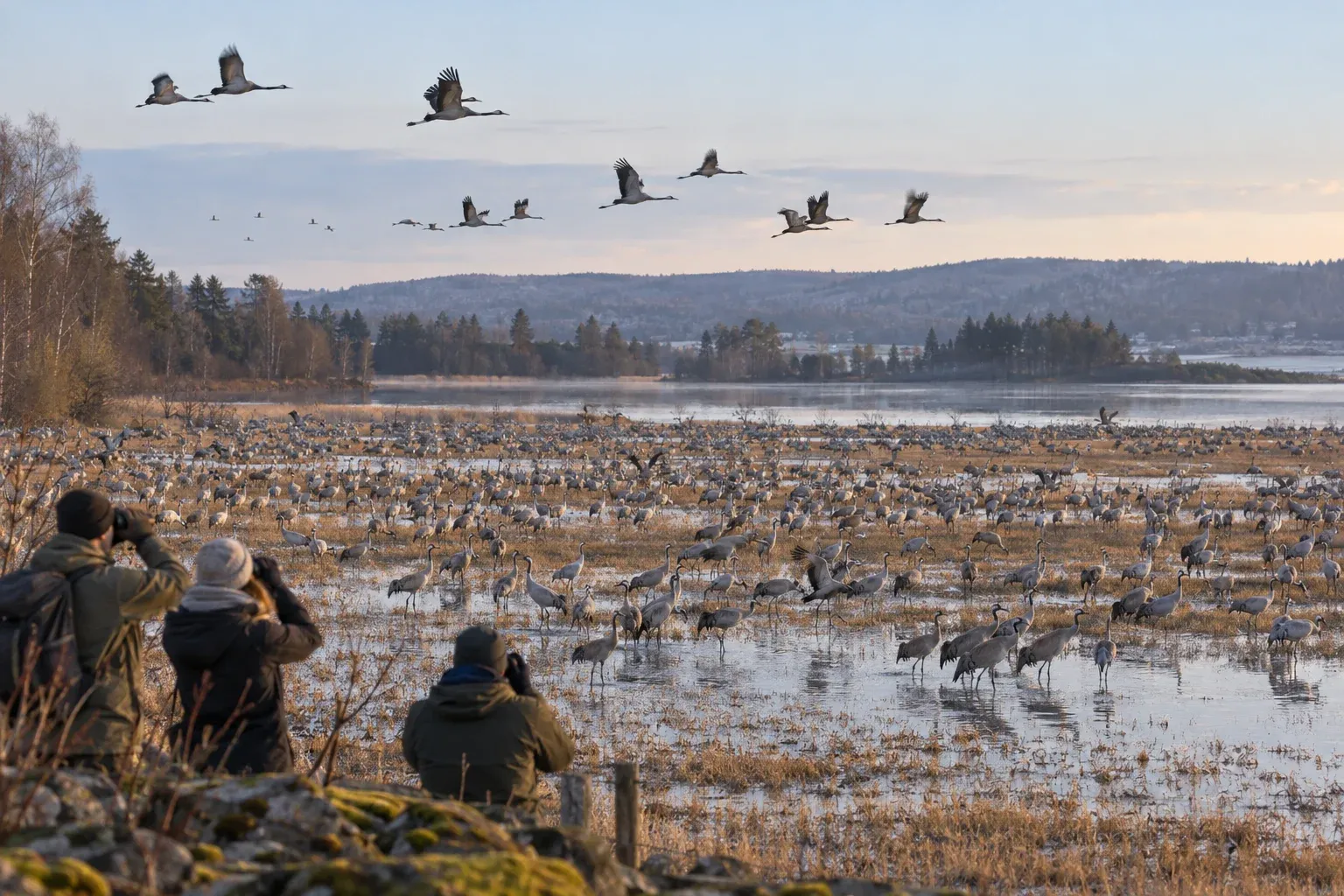
Sweden has two bird events worth planning a trip around, plus a ring of wetlands and observatories that are good almost all year. Here is when to go, where to stand, and the spring closures that catch visitors out.
When you need this
You want to time a trip for the crane gathering or the Falsterbo autumn migration, or you are choosing between bird sites and need to know what is open. Maybe you have just seen a yellow “bird sanctuary” sign and wonder whether the path behind it is allowed. Or you want to fly a drone, photograph a nest, report a sighting or borrow binoculars.
The two big spectacles
| Hornborgasjön cranes | Falsterbo migration | |
|---|---|---|
| Where | Västergötland, between Skara and Falköping | Falsterbo peninsula, Skåne’s south-west tip |
| When | Late March–early April; first cranes in February | August–October for raptors; counts run 1 August–20 November |
| What | About 30,000 cranes pass over a few weeks | Passerines and seabirds at dawn, raptors later in the day |
| Best time of day | Morning and evening | Dawn at Nabben; raptors about 10:00–15:00 |
| Cost | Free; parking fee at the crane site | Free; free weekend guiding |
Cranes at Hornborgasjön
Every spring about 30,000 cranes (tranor) pass the lake Hornborgasjön over a few weeks in late March and early April. They gather at the southern tip, a place called Trandansen (“the crane dance”), where the county board spreads grain for them to keep them off farmers’ fields. The first cranes usually arrive in February; in 2026 the first was seen on 27 February.
The peak usually falls in the last week of March or the first week of April, but it moves with the spring: an early spring or good southerly winds bring the birds sooner. The record so far is 27,300 cranes, counted on 3 April 2019. You do not need the peak; a day with 10,000 cranes is a spectacle too.
Plan your visit:
- Watch the count. The field station counts the cranes every evening at dusk as they fly out to roost, and the naturum publishes the figure in season.
- Come early or late. The cranes are usually at Trandansen from dawn to dusk, but mornings and evenings are the finest, and weekdays the quietest.
- Two visitor centers. Infocenter Trandansen, on road 184, opens only in the crane season, roughly mid-March to mid-April. The main naturum (visitor center) and Café Doppingen sit at Fågeludden on the east shore.
- By bus. Line 203 between Skara and Falköping stops at Trandansen. No bus links Trandansen with the naturum.
The site is open all year and entry is free. If you come by car or motorhome, a parking fee is charged, and it pays for the cranes’ feed.
Falsterbo’s autumn migration
The Falsterbo peninsula funnels migrating birds out over the sea, and it is counted among Europe’s leading raptor-migration sites, alongside the Bosphorus and Gibraltar. Falsterbo Bird Observatory (Falsterbo Fågelstation) has counted the passage from the Nabben headland in most autumns since the early 1940s. Its standardised count runs from 1 August to 20 November and has been part of Naturvårdsverket’s environmental monitoring since 1978.
Where and when to stand:
- Nabben at dawn for small birds and seabirds; many species start moving as soon as it gets light.
- Falsterbo lighthouse when it is windy; the small-bird passage often goes lower there.
- Skanörs ljung (south-west corner) or the Falsterbo canal for raptors, usually between about 10:00 and 15:00.
The species change week by week:
| Period | Main raptors |
|---|---|
| August | Ospreys, adult honey buzzards |
| Early September | Harriers, young honey buzzards, black kites, kestrels, hobbies |
| From late September | Common buzzards, red kites |
| Through October | White-tailed eagles, rough-legged buzzards, hen harriers, goshawks |
Wind decides the day. Moderate south-westerly winds press the passage low along the coast toward Nabben; on calm days it often goes very high, and easterly winds bring fewer raptors. On the best days several thousand birds of prey pass, and on poor days only a few dozen.
The observatory runs free guiding every Saturday and Sunday from the third weekend of August to the last weekend of October, 08:00–12:00, at the Fyrbrinken by Falsterbo lighthouse. Just turn up; parking is easiest at Flommens golf club. Groups can book a guiding with a ringing demonstration in April–May and August–October. Falsterbo Bird Show, a birding fair with excursions, ran 4–6 September 2026.
Two rules at the lighthouse: never approach the mist nets, which the station staff check regularly, and avoid the east side of the garden, which borders a golf course.
Five more classic sites
| Site | Region | What it offers |
|---|---|---|
| Ottenby | Öland’s southern tip | One of Sweden’s best bird sites; bird station run by BirdLife Sverige since 1946; naturum, bird hide, the 42 m Långe Jan lighthouse |
| Getterön | Varberg, Halland | About 170 species rest or breed each year; towers, two hides, accessible naturum; wintering birds on open water |
| Tåkern | Östergötland | Reed-fringed bird lake; naturum at Glänås, opened 2012 |
| Store Mosse | Småland | National park of bogs; bird towers over Kävsjön; free, wheelchair-accessible naturum |
| Kvismaren | 14 km south-east of Örebro | Ramsar wetland; nearly 300 species recorded; geese and cranes fly in to roost on autumn evenings |
Naturum Tåkern had its shortest season ever in 2026: open only 104 days, with the regular season ending on 16 August. Its manager has said it cannot keep operating on a similar budget next year. The reserve, trails and towers are not affected, but check before you count on the visitor center. Getterön’s naturum has also cut back: its own page says it is closed on Mondays, with the information desk unstaffed on Tuesdays.
Spring closures: where you can and cannot walk
Many bird sites are nature reserves or bird-protection areas (fågelskyddsområden). The county board or the municipality can ban the public from them for part of the year. The most common closed period for birds is 1 April–15 July, and 1 May–31 July in the north, but each site sets its own dates. Marked trails, towers and hides normally stay open; the ban covers the ground off them.
| Site | Off-trail closure |
|---|---|
| Hornborgasjön (south of Almeö) | 1 March–15 July |
| Hornborgasjön (north of Almeö) | 20 March–15 July |
| Store Mosse, Kävsjön bird area | 1 March–15 August (yellow signs) |
| Tåkern | 1 April–30 June; no paddling or rowing without a permit |
| Ottenby | 1 April–31 August; western reef to 15 November; lighthouse road 1 April–15 July |
| Getterön | All year, except marked trails, hides and viewing places |
| Måkläppen, Falsterbo | 1 February–31 October, land and water; open November–January |
Hornborgasjön’s southern closure now starts on 1 March, earlier than many older pages say, because spring birds arrive sooner. This is law, not etiquette. Breaking a reserve or protection-area rule is an offence punishable by a fine under the Environmental Code (miljöbalken), and causing harm by entering unlawfully can bring up to two years in prison. Landowners, some leaseholders and permitted researchers are exempt at Tåkern, so people on the water there are not necessarily breaking the rules.
Even when Måkläppen is open, the observatory asks visitors to stay away so the seals and resting birds get peace. Dogs are never allowed there.
Drones, nests and dogs
- Drones: generally, do not. Hornborgasjön asks visitors not to fly drones because they scare the birds, Ottenby treats drone flying as banned disturbance of wildlife, and national-park rules typically ban drone take-off and landing. See our drone rules guide.
- Nests: deliberately disturbing wild birds, especially while breeding, damaging nests or eggs and collecting eggs (even empty ones) are prohibited everywhere under the Species Protection Ordinance. At Hornborgasjön, photographing a nest at close range is named as banned disturbance. A bird flushed from its nest can lose its eggs or chicks to predators.
- Dogs: from 1 March to 20 August dogs must be kept from running loose where there is game, and most bird reserves require a leash all year. Our leash law guide has the details.
The right of public access, allemansrätten, does not override any of this: in reserves it is limited by the reserve’s own rules. Our allemansrätten guide explains where it stops.
Reporting and finding help
- Report sightings to Artportalen, the national species-observation system run by SLU Artdatabanken. It is free, and its mobile-friendly version is no longer in beta.
- Find more sites in BirdLife Sverige’s Svenska fågellokaler guide, with maps, parking, toilets, wheelchair access and what to expect by season.
- Borrow binoculars: Getterön’s guided bird walks invite you to borrow a pair, and its naturum has telescopes at the panorama windows. We found no binocular rental at these sites, so bring your own; at Falsterbo a telescope helps.
Practical information
| Item | What to know |
|---|---|
| Entry to trails, towers, hides | Free |
| Naturum entry | Free (checked for Trandansen, Store Mosse, Getterön) |
| Hornborgasjön parking | Fee charged at the crane site; it funds the cranes’ feed |
| Infocenter Trandansen | Crane season only, roughly mid-March to mid-April |
| Falsterbo weekend guiding | Free; Saturdays and Sundays, third weekend of August to last weekend of October, 08:00–12:00 |
| Booked group guiding, Falsterbo | Priced per person by group type; ask the observatory |
| Långe Jan lighthouse, Ottenby | Entrance fee set by the bird station |
| Naturum opening days | Vary by site and year; Tåkern and Getterön cut back in 2026; check each naturum’s page |
FAQ
When is the best time to see the cranes at Hornborgasjön?
Usually in the last week of March or the first week of April. About 30,000 cranes pass over a few weeks; the first arrive in February. The peak depends on whether spring is early or late and on southerly winds. The naturum publishes a daily count made at dusk. Mornings and evenings are the finest times, and weekdays the quietest.
When is the Falsterbo raptor migration?
The passage starts in August and continues into November, and the species change week by week. Ospreys and honey buzzards come first, buzzards and red kites from late September, eagles and rough-legged buzzards through October. Raptors usually pass between about 10:00 and 15:00, best on moderate south-westerly winds. On good days several thousand birds go by.
Can I walk anywhere at a bird lake in spring?
No. Many bird lakes are reserves with seasonal bans on leaving the marked trails, for example Hornborgasjön from 1 March or 20 March to 15 July, Tåkern from 1 April to 30 June and Kävsjön in Store Mosse from 1 March to 15 August. Trails, towers and hides stay open. Breaking the rules is a finable offence.
Can I fly a drone at a bird site in Sweden?
Generally you should not. Hornborgasjön asks visitors not to fly drones because they scare the birds, Ottenby treats drone flying as banned disturbance of wildlife, and national-park rules typically ban drone take-off and landing. Deliberately disturbing breeding birds is prohibited everywhere under species law. Check the reserve rules before you go.
Do I need to pay to visit a naturum?
No. Naturum visitor centers are free to enter, and trails, towers and hides cost nothing. You may pay for parking at Hornborgasjön’s crane site, where the fee funds the cranes’ feed, for booked group guiding, or to climb the Långe Jan lighthouse at Ottenby. Opening seasons differ by site and year, so check each naturum’s own page.
How do I report a bird I have seen in Sweden?
Use Artportalen, the national species-observation system run by SLU Artdatabanken. Anyone can search and report sightings of animals, plants and fungi, and the mobile-friendly version is built for reporting in the field. Your reports add to the knowledge of Sweden’s species, so give an accurate place and count. Reporting is free.
Related guides
- Wildlife in Sweden — the species, the official numbers and the protection rules behind this page
- Öland — Ottenby’s closed zones and the rest of the island in detail
- Skåne — getting to Falsterbo and what else the region offers
- Wildlife safaris in Sweden — if you would rather go with a guide, and what to ask before you book
- Sweden’s national parks — Store Mosse and the park rules on drones and camping
Facts verified 2026-10-01. Sources: Länsstyrelsen (Skåne, Västra Götaland, Östergötland, Kalmar, Halland, Jönköping, Örebro), Naturvårdsverket, Sveriges Riksdag (miljöbalken, artskyddsförordningen), naturum Hornborgasjön, Ottenby, Getterön and Tåkern, Falsterbo Fågelstation, BirdLife Sverige, SLU Artdatabanken — full register in this topic’s source file. Found something outdated? Tell us and we’ll fix it.