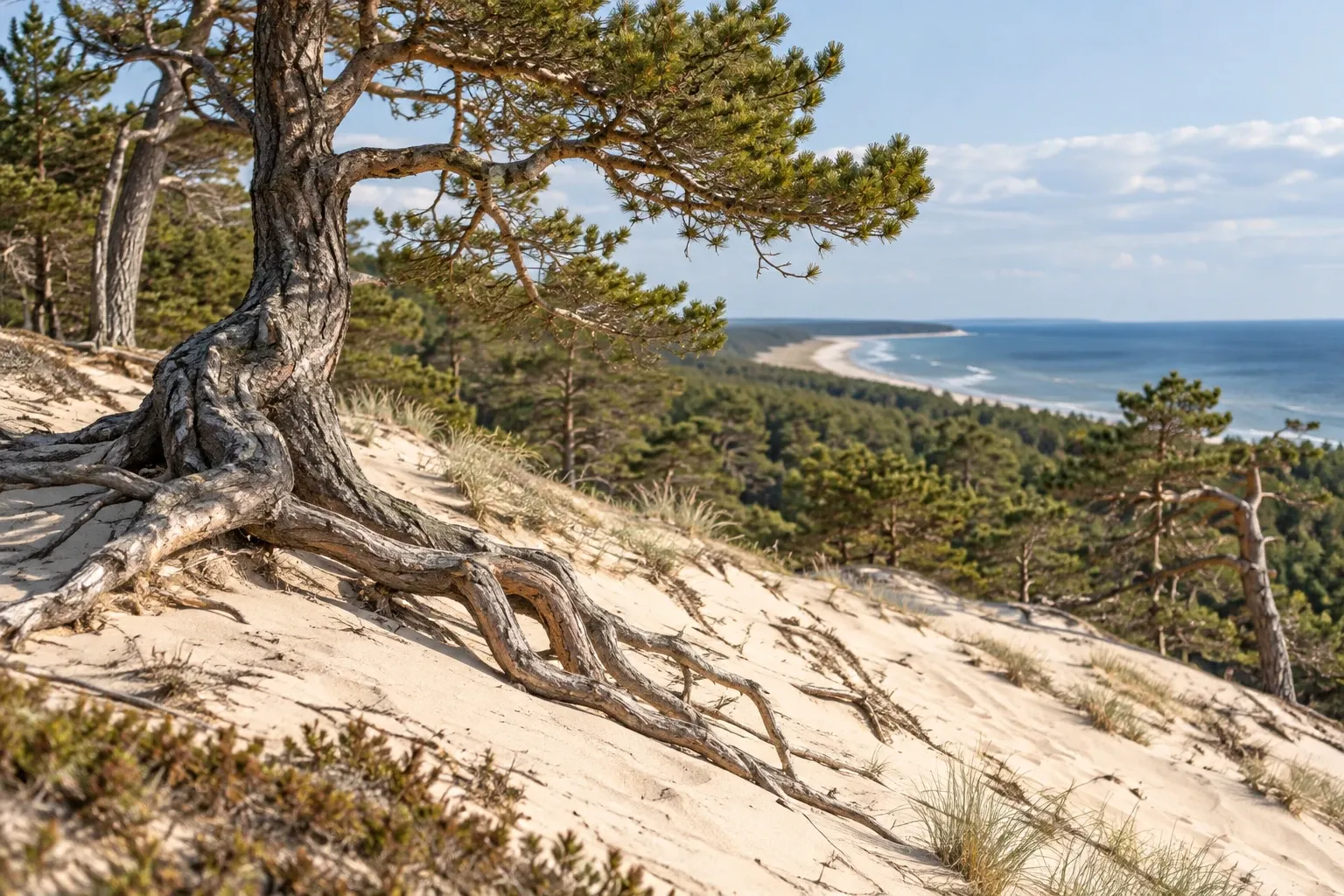
Gotska Sandön is a pine-covered sand island far out in the Baltic, with dunes, grey seals and a working 1859 lighthouse. Getting there takes more planning than any other Swedish island park. Here is how the boat, the landing, the beds and the rules actually work.
When you need this
You are thinking about a trip to Gotska Sandön and want to know whether a day trip is possible, how to book, and what happens when the boat arrives at an island with no harbor. Or you plan to sail there yourself, have a dog or a wheelchair user in the party, or want to see the seals. This page covers the island park itself. For how park rules work across the country, see Sweden’s 31 national parks; for getting to Gotland, see the Gotland ferry.
The island at a glance
Gotska Sandöns nationalpark lies 38 km north of Fårö and about 90 km from the nearest Swedish mainland. The park calls it the Baltic’s most remote island. It covers 4,464 hectares, 3,676 of them land and 788 water. The state agency Naturvårdsverket owns it, and the county board, Länsstyrelsen i Gotlands län, manages it with wardens on the island all year.
It is one of Sweden’s oldest parks: among the first nine decided in 1909. The park’s facts page dates the first protected part to 30 December 1910, the whole island to 1963 and the surrounding water, 300 m out, to 1988.
The island is a ridge of sand and gravel left by the retreating ice, with bedrock about 70 m below. It first rose from the sea about 6,000 years ago and is still moving: it shrinks in the south-west and changes shape daily at Bredsandsudde in the north-west. Wind-blown sand makes it surprisingly hilly. The dune ridge Höga Åsen runs from coast to coast and reaches 42 m, and the oldest pines are about 500 years old.
| Place | What it is |
|---|---|
| Fyrbyn (lighthouse village), north-west | The 1859 lighthouse and cabins with their own kitchens |
| Lägerplatsen (the camp), north | Hostel, simple cabins, rental tents, tent pitches, shared kitchens |
| Las Palmas, north-east | The usual landing beach, just over 4 km from the camp and Fyrbyn |
| Säludden, north-east | Grey seals, a hide, and a sanctuary closed all year |
| Höga Åsen, center | The 42 m dune and the island’s highest point |
| Gamla gården, south-west | Remains of the 1780s–1870s farm settlement |
| Nymans, south | Tent pitches only, no kitchen |
| Tärnudden, southern tip | No anchoring offshore |
Getting there
There are two ways: the park’s summer passenger boat, or your own boat.
The summer boat sails from Nynäshamn, south of Stockholm, and from Fårösund in northern Gotland. It runs one route, Nynäshamn–Gotska Sandön–Fårösund and back. The crossing takes about 3 hours 30 minutes from Nynäshamn and 2 hours 15 minutes from Fårösund, depending on wind and weather. Season dates and sailing days are in the practical information table below. Tickets must be bought in advance, in the same booking service as all the island’s beds and tent pitches, and you pay when you book.
Day trips run only in set periods, when the boat’s direction allows a return the same day. In 2026 that meant Nynäshamn in June and August and Fårösund in July, with just 50 day-trip seats per departure. Nynäshamn day trips can be booked at most seven days ahead. Most visitors stay at least a night.
To the ports: Nynäshamn is on the SL commuter train from Stockholm. For Fårösund, take the Gotland ferry to Visby and then bus line 20; see our guide to Gotland and Visby.
Your own boat is welcome all year, but the park warns that the position far out in the Baltic demands a seaworthy boat and real experience. There is no harbor, so you anchor off the lee side. Anchoring is banned at Tärnudden, and boats must keep out of the seal sanctuary at Säludden.
Freshness note: Many older guides tell you to book through a private booking company. The park’s 2026 pages send all bookings through one booking service linked from the official Gotska Sandön page. Gift cards are no longer sold, and those issued earlier by the former seller are valid only until their date. Book through the park’s own page.
Landing without a harbor
This is the part most trip reports skip. Gotska Sandön has no harbor, and the management plan says one cannot be built. On the morning of sailing, the crew decides from the wind and waves how you land:
| Landing | How it works | What it means for you |
|---|---|---|
| Landgång (gangway) | The normal case: the boat noses onto the beach at Las Palmas | A short step ashore; the camp is just over 4 km away |
| Läktring (lightering) | Passengers transfer to a rubber boat that runs up the beach; most common in northerly winds | Bags may get wet, the timetable can slip by an hour or two, and you must be able to walk up to 11 km one way |
Luggage is passed ashore by a chain of passengers, so each bag may weigh at most 15 kg. A tractor then carries bags to Fyrbyn and Lägerplatsen. There is no passenger transport on the island, and the tractor does not go to Nymans: campers there carry their own gear.
The park is frank that no harbor, sandy ground and hills make the island hard to visit for people with physical limitations. Electric wheelchairs and mobility scooters are allowed under the park regulation, but anyone with limited mobility should talk to the booking service before booking.
Where to sleep
All accommodation is the park’s own, and all of it must be booked in advance with the boat.
| Option | Where | What you get |
|---|---|---|
| Cabins | Fyrbyn | Own kitchen, toilet, shower and electricity; pillows and duvets |
| Hostel, simple cabins, rental tents | Lägerplatsen | Shared kitchens, a large cookhouse, two hot showers, food lockers, fridges, lockable cupboards for charging phones |
| Pitch for your own tent | Lägerplatsen | Use of the camp’s kitchens and showers |
| Pitch for your own tent | Nymans, south | Toilet and water; no kitchen — bring a stove |
Bring your own bed linen to cabins and the hostel. Tents are allowed only on the marked pitches at Lägerplatsen and Nymans — not on a quiet beach elsewhere.
What to pack
There is no shop and no food service on Gotska Sandön. Bring all the food you need, plus at least one extra day’s worth: the boat can be cancelled in rough weather, and the timetable itself suggests provisions for a couple of extra days.
Water is not a problem. Every tap on the island has fresh water — at Fyrbyn, Lägerplatsen, the boathouse and a pump at Nymans — and there are toilets or dry toilets at Las Palmas, Tärnudden, Nymans, Gamla gården, the boathouse and the camp. Recycling stations stand at Fyrbyn and Lägerplatsen; rinse your packaging, because waste leaves the island only about twice a year.
The park’s own list adds bed linen, a sleeping bag and pad if you camp, good shoes, rain and wind clothing, swimwear, a towel, a small daypack, a water bottle, a flashlight, binoculars and simple first aid. Pack in bags that tolerate water. Bikes, pushchairs, canoes and surfboards travel as bulky luggage for a fee paid on board.
The rules
Gotska Sandön’s rules are a binding regulation, NFS 2014:7, in force since 2015. Breaking it is punishable by fines under the Environmental Code. Some rules are stricter than in most Swedish parks.
| Activity | Rule | Type |
|---|---|---|
| Pets | Not allowed ashore; guide dogs for people with impaired vision are the exception | law |
| Tent or wind shelter | Only on the designated pitches | law |
| Fire, grill or camping stove | Only as directed by the warden (tillsynsman) | law |
| Seal sanctuary at Säludden | No entry on land or by boat, except the hide and its boardwalk | law |
| Cycling | Only on existing paths and roads | law |
| Fishing and hunting | Banned | law |
| Berries and edible mushrooms | Allowed for your own use, outside the sanctuary | law |
| Plants, mosses, lichens, fungi | No picking or digging up without a county permit; no breaking twigs or damaging trees | law |
| Stones and ground | No taking stones or digging | law |
| Drones | Starting or landing aircraft needs a county permit; the park lists drones as not allowed | law; guidance |
| Motor vehicles, jet skis | No vehicles; jet skis only the shortest way to land | law |
The fire rule covers stoves. The regulation counts a grill or camping stove as fire. In practice you cook in the kitchens at Lägerplatsen or at grills in marked areas, and the warden normally lets you use your own grill or stove near the waterline on the island’s lee side. During a fire ban in Gotland municipality, no permission is given at all.
The dog stays home. Most Swedish parks allow leashed dogs; this one does not. For dogs elsewhere, see dogs in Swedish nature. The county board can grant exemptions from the regulation in individual cases for special reasons.
Things to see
Seals at Säludden. From Lägerplatsen, the orange trail reaches Säludden in 6.3 km. A hide inside the point lets you watch grey seals on the stones close up; stay on the roped path, because the sanctuary is closed all year. Usually three to five seals lie out, but more than 180 have been seen at once. They haul out only when the waves are low, so pick a calm day.
The trails. The management plan counted 56 km of marked trail in 2017. The park’s routes, from the camp area:
| Trail | Length | Marking | Character |
|---|---|---|---|
| Kapellslingan | 1.5 km | Yellow | Easy loop past the chapel meadow and the boulder Elefanten |
| Bredsandsslingan | 3.2 km | Red | Lighthouse, dunes and seabirds at Bredsandsudde |
| Säludden | 6.3 km | Orange | Pine forest to the seal hide |
| Hamnudden | 6.8 km | Blue | Past Höga Åsen and Gamla gården |
| Tärnudden | 8.1 km | Purple | Through the big dune to the southern tip |
| Höga Åsenslingan | 15.2 km | Green | Along the dune crest; demanding in loose sand |
| Tärnudden–Säludden | — | Grey | Mostly unmarked, along the beach |
Lejonslingan is a trail for younger children.
The lighthouse. The northern lighthouse at Fyrbyn, lit in 1859, still works and is a listed state building. It reopened in June 2026 after a renovation that restored its red-tarred shingle cladding and fitted an LED light, and it houses the exhibition Fyrliv. If lighthouses are your thing, see lighthouse stays in Sweden.
Wildlife. White-tailed eagles breed on the island almost every year, hobbies nest in several pairs, and parrot crossbills gather by the hundred at the pond in the chapel meadow. Lesser black-backed gulls and common terns nest at Bredsandsudde. The dead wood suits beetles found nowhere else in Sweden; the 7 cm smedbock swarms on warm August evenings. For more on spring and autumn migration, see birdwatching in Sweden.
History. Gamla gården, begun in 1784, was the island’s center until the 1860s, with about 100 people living here at its peak. Franska bukten, one of the best sandy beaches, holds two Russian cannons from a shipwreck. The chapel holds an evening service every evening from midsummer to August.
Season by season
| Season | What to expect |
|---|---|
| Late May | Season opens with the boat; woods turn green, orchids flower |
| Summer | Seals sun at Säludden; crossbills at the ponds; wild strawberries |
| Autumn | Good birdwatching, mushrooms and lingonberries; young eagles on the wing |
| Outside the boat season | Wardens stay all year, but no guiding or visitor service; own boat only |
| Winter | Storms reshape the beaches; in cold winters ice piles up along the shore |
Mobile coverage reaches most of the island but varies by operator. In an emergency, call 112, which works without a SIM card.
Practical information
| Item | Detail |
|---|---|
| Entry | No entry fee mentioned on the official pages |
| Boat season | 29 May–30 August in 2026; 2027 dates not yet published (checked 2026-10-15) |
| Sailing days | Normally Wednesday, Friday, Sunday; midsummer week Tuesday, Thursday, Sunday (2026) |
| Crossing time | About 3 h 30 min from Nynäshamn, 2 h 15 min from Fårösund |
| Day trips (2026) | From Nynäshamn 29 May–21 June and 29 July–30 August; from Fårösund 1–26 July; 50 seats per departure |
| Booking | Boat, cabins, hostel, rental tents and pitches in one booking service linked from the official park page; paid when booking |
| Fares and bed prices | Shown only in the booking service; not published here |
| Bulky luggage | 400 kr per item, return, paid on board (checked 2026-10-15) |
| Luggage limit | 15 kg per bag; no limit on number of bags |
| Food | Nothing sold; bring all food plus extra days |
| Water | Fresh water in all taps |
| Emergency | 112; mobile coverage over most of the island |
FAQ
How do you get to Gotska Sandön?
By the park’s summer boat from Nynäshamn, south of Stockholm, or from Fårösund in northern Gotland, or in your own boat. In 2026 the boat ran three days a week from 29 May to 30 August; the trip takes about 3 hours 30 minutes from Nynäshamn and 2 hours 15 minutes from Fårösund. Tickets must be bought in advance.
Can you visit Gotska Sandön on a day trip?
Yes, in set periods. In 2026 day trips ran from Nynäshamn from 29 May to 21 June and 29 July to 30 August, and from Fårösund from 1 to 26 July. Only 50 seats per departure are sold for day trips, and Nynäshamn day trips can be booked at most seven days ahead. Most visitors stay at least one night.
Where do you stay on Gotska Sandön?
In the park’s own accommodation, booked with the boat: cabins with kitchens, toilets and showers in the lighthouse village, Fyrbyn, or hostel rooms, simple cabins, rental tents and tent pitches at Lägerplatsen. A second tent area at Nymans in the south has water and a toilet but no kitchen. Bring your own bed linen.
Can you camp on Gotska Sandön?
Only on the marked, booked pitches at Lägerplatsen or Nymans; the park regulation bans tents and wind shelters elsewhere. At Lägerplatsen you can use the kitchens and showers. At Nymans you need your own camping stove and must carry your gear from the boat yourself, since the luggage tractor goes only to Fyrbyn and Lägerplatsen.
Can I bring my dog to Gotska Sandön?
No. The park regulation bans bringing pets ashore. The only exception is a guide dog for a person with impaired vision. This is stricter than most Swedish national parks, where dogs are allowed on a leash, so arrange care for your dog before you travel to Nynäshamn or Fårösund.
Is there a shop or restaurant on Gotska Sandön?
No. Nothing is sold on the island, so bring all the food you need for your stay, plus food for an extra day in case rough weather cancels the boat. Tap water is fresh everywhere, and cabins and the camp have equipped kitchens. Fires and grills need the warden’s permission.
Where can you see seals on Gotska Sandön?
At Säludden, the north-east point, where a hide lets you watch grey seals resting on the stones close up. Follow the orange trail from Lägerplatsen, about 6.3 km, and stay on the roped path: the sanctuary around it is closed all year. Usually three to five seals lie out, more in calm weather.
Related guides
- Sweden’s national parks — how all 31 parks’ rules override allemansrätten
- The Gotland ferry — reaching Visby and on to Fårösund
- Gotland and Visby — buses, Fårö and the island the boat leaves from
- Fårö — the island next to the Fårösund departure
- Lighthouse stays in Sweden — other lighthouse beds along the coast
Facts verified 2026-10-15. Sources: Naturvårdsverket (park regulation NFS 2014:7, management plan, Sveriges nationalparker), Sveriges riksdag (nationalparksförordningen, Environmental Code), Länsstyrelsen i Gotlands län, Region Gotland, SOS Alarm — full register in this topic’s source file. Found something outdated? Tell us and we’ll fix it.