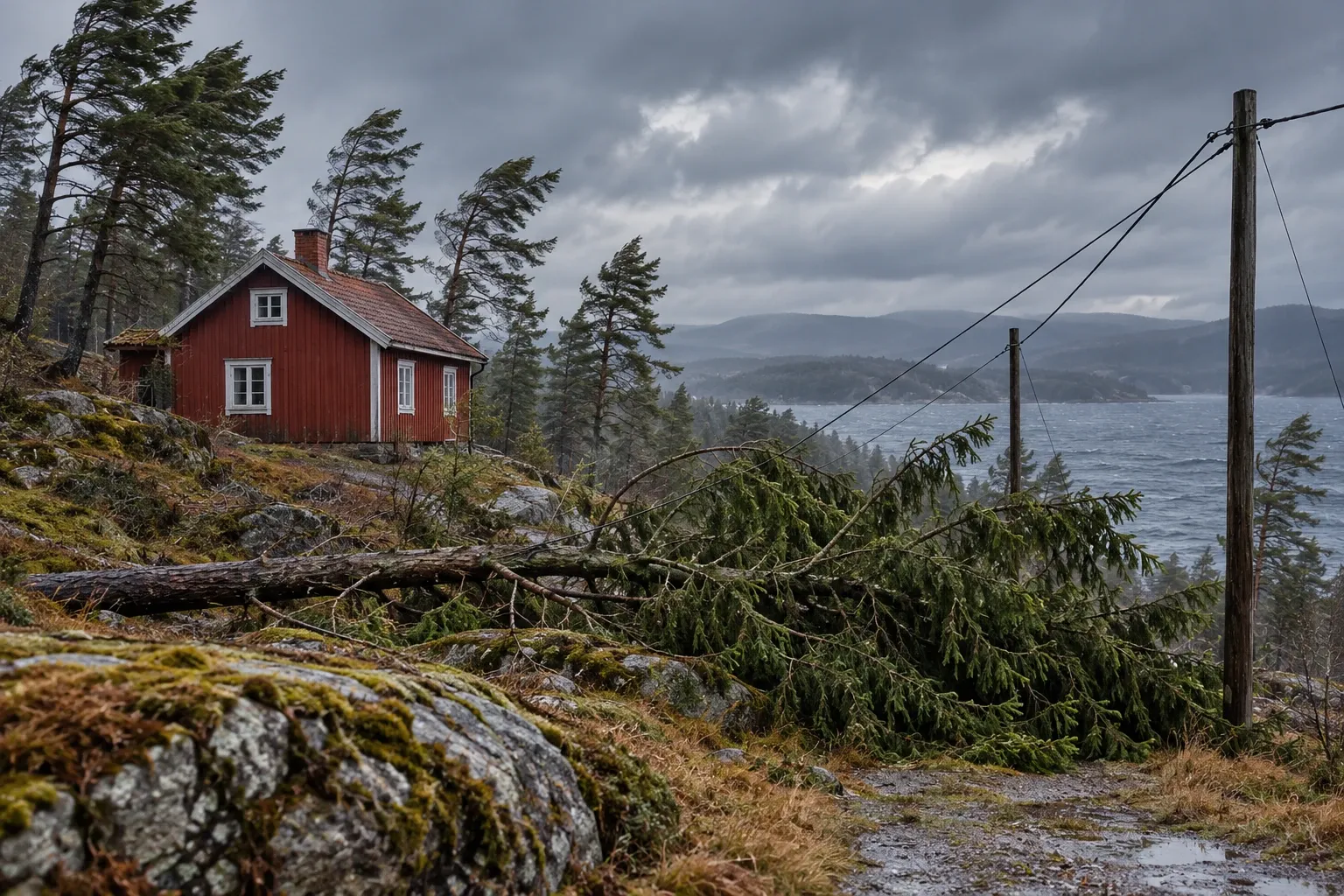
Most Swedish power cuts are over in minutes. The long ones come with storms, and at a rural cabin they take the heat, the water and sometimes the phone signal with them. Here is what to do, in order, and what the law says about how long it may last.
When you need this
The lights go out at a rented cabin and you can’t tell whether it’s only you. SMHI, the weather agency, has issued a wind or snow warning for where you’re staying. A tree is down across the road and over a power line. Or the tap has run dry, the toilet won’t refill and the house is getting colder by the hour.
Most cuts are caused by extreme weather: storms, thunderstorms and heavy snowfall. A long one takes out more than the lights. Heating, water, phones and the internet can go too. That hits hardest at a cabin, because most Swedish houses depend on electricity for heating, and a cabin with its own well loses its water when the pump stops.
First ten minutes: is it just your cabin?
Work through this before you call anyone:
- Check the fuse box (elcentral or proppskåp, often by the entrance) for a blown fuse or a tripped residual-current breaker (jordfelsbrytare).
- Look outside. If the street lights are out or the neighbours are dark, it’s a wider outage, not your cabin.
- Check the grid company’s website and report the outage if it isn’t listed. Ask the owner which company serves the cabin. Each area has one grid company and customers can’t switch, so the owner will know.
- Turn on Sveriges Radio P4, the public broadcaster, for information. The car radio works if there’s nothing else.
- Switch off the stove, iron and similar, so nothing starts by itself when the power returns.
- Unplug expensive electronics such as the TV and computer, to protect them when the power comes back.
One trap catches visitors: the company to contact is the grid company (elnätsföretag, nätbolag), which owns the lines and fixes faults. The company that sells the electricity can’t repair anything. Krisinformation’s English page says “electricity supplier”, but its Swedish original and the National Electrical Safety Board both say grid company.
If the outage drags on: water, food and warmth
Water comes first. Energimyndigheten, the Swedish Energy Agency, puts it plainly: a lack of water is more serious than a lack of food.
- After an hour, fill bottles and containers from the tap, a couple of litres per person. On municipal water the pressure can drop within a few hours; on a private well it stops at once.
- Plan for 3–5 litres per adult per day. In a long, area-wide outage the municipality may set up water points, announced on P4 or by loudspeaker vans.
- Lakes and snow are an emergency source, but boil the water before drinking, cooking or washing with it.
- The toilet won’t flush without water. A plastic bag in the bowl works as a temporary toilet.
For food, the rule is to keep doors shut and note the time the power went. Livsmedelsverket, the food agency, says fridge food is normally fine after up to 7 hours if the fridge was at 4 °C, or up to 4 hours at 8 °C; look and smell before you eat. Don’t open the freezer for the first two days unless you must. If it’s colder than +4 °C outside, an insulated box with newspaper or polystyrene keeps fresh food cold without freezing.
For warmth, gather everyone in one room. Hang blankets over windows and doors, lay rugs on the floor, dress warmly, and air briefly and regularly. The colder it is outside, the faster a house cools: Energimyndigheten’s tests show an old timber house falling to about 4 °C within a day at −10 °C. Our guide to how fast Swedish homes cool has the full comparison.
Cooking and heating without power, safely
This is where outages injure people. Carbon monoxide (kolmonoxid) from grills, gas heaters and wrong burning causes serious poisonings in Sweden every year, and deaths.
| Do | Never |
|---|---|
| Cook on a spirit or gas camping stove | Use a charcoal grill indoors, for heat or cooking |
| Grill outdoors | Put a camping stove under the kitchen extractor hood (grease can catch fire) |
| Use a gas heater only if it’s made for indoor use and works properly | Bring any outdoor heater or grill inside |
| Run a generator outdoors: it’s a combustion engine | Run a generator indoors |
| Keep gas bottles upright; close the bottle valve first, then the heater’s | Overfire a wood stove: the chimney can overheat and start a fire |
Headache, nausea or dizziness near a heater or stove can mean carbon monoxide: get into fresh air, then call for care. A wood stove is the classic cabin backup heat; see wood stoves and chimneys in Swedish cabins before you light one. Candles and any open flame indoors need the same care.
Storms and fallen power lines
SMHI’s wind warnings spell out the outage risk. At yellow, fallen trees and branches can block roads. At orange, power and phone outages are likely. At red, prepare for long and extensive outages. What SMHI’s warning colours mean explains the system.
Two rules matter more than anything else in a storm:
- Never go near or touch a fallen power line. It may still be live. Call the grid company, or 112 if it’s on the ground.
- Stay out of the forest during and after a strong wind warning, until the wind has dropped. Falling trees injure people where there may be no signal to call for help.
In larger buildings, avoid lifts when a storm or thunder makes a cut likely; you can be stuck until the power returns.
When the phone network goes down
Krisinformation warns that power cuts can bring down phone networks and make 112 hard to reach. A mobile can call 112 even without a SIM card, but that doesn’t help if the masts are dark. If nothing connects and you need help, go to the nearest fire station: it can raise the alarm for you.
So before a forecast storm, charge phones and power banks, fill the car’s tank or charge the electric car, find the nearest fire station, and write the owner’s and the grid company’s numbers on paper. Cash helps too, because card payments can fail with the power. For questions rather than emergencies, Sweden’s information line for accidents and crises is 113 13. See 112 and Sweden’s emergency numbers.
When the power comes back
Switch appliances and heating back on a few at a time. If every household switches on at once, the grid can overload and cut out again. Check that nothing is damaged, and check the fridge against the 4- and 7-hour guidance above.
Never open or tinker with electrical equipment during an outage to “fix” it. The power can return without warning and make it live.
The 24-hour rule and outage compensation
Sweden sets a legal ceiling on outages. A grid company must make sure an outage never exceeds 24 hours, unless it shows the cause was beyond its control and could not reasonably have been foreseen or avoided. Whether a given storm meets that test is decided case by case. Outages longer than 24 hours can be reported to Energimarknadsinspektionen (Ei), the energy regulator.
After 12 consecutive hours without power, the electricity customer gets outage compensation (avbrottsersättning), usually automatically:
| Outage length | Compensation |
|---|---|
| 12–24 hours | 12.5% of the customer’s estimated annual grid cost, with a minimum |
| Each further 24 hours started | +25% of annual grid cost, with a minimum |
| Maximum | 300% of annual grid cost |
An outage only counts as over after two hours of steady power. No compensation is due if the customer caused the outage, for safety work lasting no longer than needed, for faults beyond the company’s control, or for faults on the high-voltage transmission grid. Unpaid compensation must be claimed within two years. Damages for actual losses can be claimed whatever the outage length, and home insurance may cover some damage.
At a rented cabin you are not the customer. The money goes to whoever holds the grid contract, normally the owner. Any refund for your stay is between you and the owner, so ask rather than assume.
New law from 1 January 2027. The Electricity Act (ellagen) that every current guide cites is repealed at the turn of the year and replaced by the Electricity Market Act (elmarknadslagen). We read both: the 24-hour duty and the compensation scale carry over unchanged in substance, under new section numbers.
Practical information
| Item | Amount or rule |
|---|---|
| Outage the grid company must prevent | Over 24 hours (unless beyond its control) |
| Compensation threshold | 12 consecutive hours |
| Minimum compensation, 12–24 hours | 1,200 kr in 2026, paid to the grid customer |
| Deadline to claim unpaid compensation | 2 years |
| Fridge food after an outage | Up to 7 h (fridge at 4 °C) or 4 h (at 8 °C) |
| Freezer | Keep shut for the first two days |
| Water to plan for | 3–5 litres per adult per day |
| Fill containers | Once the outage passes an hour |
| Crisis information line | 113 13; from a foreign phone +46 77 33 113 13 |
| Emergency | 112 |
FAQ
What should I do first when the power goes out at a Swedish cabin?
Check the fuse box for a blown fuse or tripped breaker. If the neighbours or street lights are dark too, it is a wider outage: check the grid company’s website and report it if it is not listed. Turn on Sveriges Radio P4, switch off the stove, and keep the fridge and freezer closed.
How long do power cuts in Sweden last?
Most come back within minutes. By law the grid company must keep an outage under 24 hours, unless it shows the cause was beyond its control and could not reasonably be foreseen or avoided. SMHI warns that orange wind warnings make outages likely, and red ones long and extensive. Outages over 24 hours can be reported to the energy regulator, Ei.
Do I get compensation for a power cut in Sweden?
After 12 hours without power, Swedish law gives the electricity customer automatic compensation: at least 1,200 kronor in 2026, rising for each further day. At a rented cabin the customer is normally the owner, not you; a refund for your stay is between you and the owner. Unpaid compensation must be claimed within two years.
Will the water still work during a power cut?
Not always. A cabin with its own well loses water as soon as the pump stops, and the toilet will not refill. On municipal water the pressure can drop within a few hours. Fill bottles once the outage passes an hour, plan for 3–5 litres per adult per day, and boil lake water or melted snow before use.
How long does food last in the fridge and freezer without power?
Keep both closed. Livsmedelsverket says fridge food is normally fine after an outage of up to 7 hours if the fridge was at 4 °C, or up to 4 hours at 8 °C; look and smell before eating. Energimyndigheten advises not opening the freezer for the first two days unless you must.
Can I still call 112 during a power cut?
Usually, but not always. Krisinformation warns that power cuts can bring down phone networks and make 112 hard to reach. A mobile can call 112 even without a SIM card. If nothing connects, go to the nearest fire station, which can raise the alarm. Charge phones and power banks before a forecast storm.
Is it safe to use a gas heater or generator indoors?
Only a gas heater made for indoor use and in good working order, with regular airing. Never bring a grill or any outdoor heater inside: carbon monoxide causes serious poisonings in Sweden every year. A generator is a combustion engine, so run it outdoors. Headache, nausea or dizziness mean get into fresh air, then call for care.
Related guides
- What to expect in a Swedish holiday cabin — wells, toilets and the house rules nobody states.
- Wood stoves and chimneys in Swedish cabins — the backup heat, used without setting the roof alight.
- SMHI weather warnings — what yellow, orange and red mean before the storm arrives.
- Sweden’s emergency alerts: VMA and the 112 app — how warnings reach your phone.
- Cold risks: hypothermia and frostbite — if the cold gets to someone in the group.
Facts verified 2026-10-15. Sources: Sveriges Riksdag (Ellag 1997:857, Elmarknadslag 2026:1281), Energimarknadsinspektionen, Krisinformation.se, Elsäkerhetsverket, Energimyndigheten, Livsmedelsverket, Läkemedelsverket, SMHI, SOS Alarm — full register in this topic’s source file. Found something outdated? Tell us and we’ll fix it.