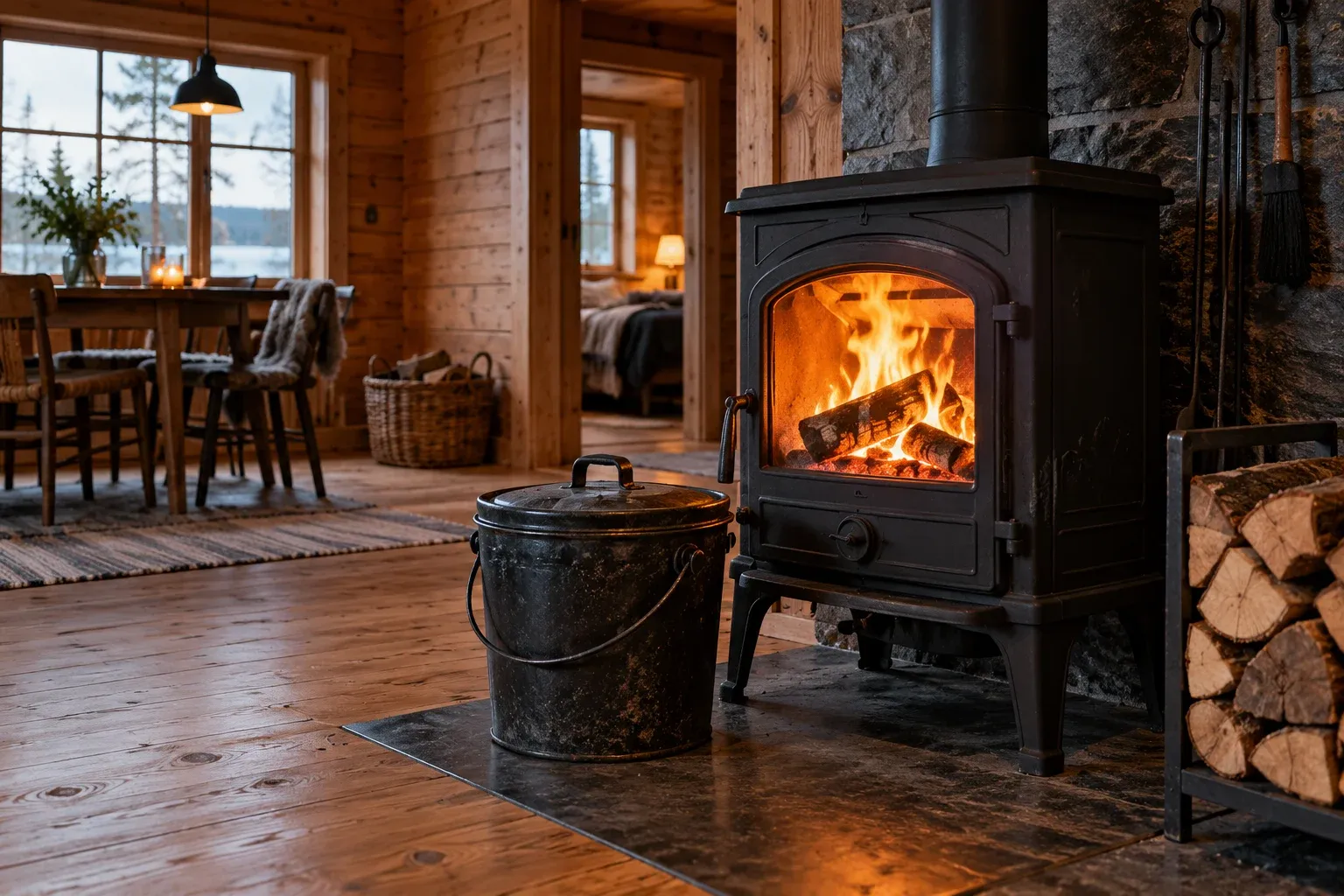
The wood stove is the best thing in a Swedish cabin and the only thing in it that can kill you. Swedish agencies teach one specific way to fire it, and it’s probably not the way you learned at home.
When you need this
You’ve rented a stuga (cabin) and the only heat on a cold evening is a stove. The host’s folder says “spjället måste vara öppet” and you don’t know where the damper is. It’s July, there’s a fire ban, and you wonder whether the stove is off-limits. Or it’s departure morning and there’s a stove full of ash.
Most cabins have at least one eldstad — the catch-all word for a fireplace or stove. You’ll meet four kinds:
| Swedish | What it is |
|---|---|
| braskamin / kamin | Cast-iron room stove, usually with a glass door |
| kakelugn | Tiled masonry stove, common in older houses |
| vedspis | Wood-fired cooking range — mainly for cooking, not heating the house |
| öppen spis | Open fireplace |
Before you light: three checks
1. Read the host’s instructions. If the stove has a firing instruction (eldningsinstruktion), it overrides everything below.
2. Ask whether the stove is in use and swept. By law, the municipality is responsible for chimney sweeping (sotning) and fire-safety inspection (brandskyddskontroll) of solid-fuel stoves, and the owner must give the sweep access. The owner also has to make sure every stove in use is on the sweep’s register — a stove that never gets visits may simply be missing from it. You have no paperwork as a guest, but a stove that has stood unused for years shouldn’t be lit on a guess. The owner’s side is covered in owning a Swedish cabin.
3. Find the smoke alarm and test it by pressing the button. Smoke alarms have been required in newly built homes since 1999. For older buildings — which covers many cabins — official advice says every home should have one, holiday homes included. In a rental the landlord normally installs it and the tenant looks after it.
How to light it the Swedish way
Naturvårdsverket (the Swedish EPA) and MCF, Sweden’s civil-defence and fire-safety agency (formerly MSB), teach top-down lighting (tända i toppen). It burns cleaner, gives more heat per log and leaves less tar in the chimney. Lit properly, a stove can cut its emissions by up to half.
- Open the damper fully — the spjäll, usually a lever, knob or pull-plate on the flue pipe or the tiled stove — and open the air vents.
- Stack dry wood airily: a couple of larger logs at the bottom, then a couple of layers of smaller logs crosswise on top.
- Put kindling at the very top — fire-lighters, finely split sticks or birch bark — just under the top logs. Skip the newspaper (it stalls the fire and makes soot flakes) and the lighter fluid.
- Light it and leave the door slightly ajar until the top logs have caught. Then close the door but keep the air generous.
- Turn the air down a little only once it’s going well. You want clear, lively yellow flames.
- Reload with two or three logs on a bed of embers, crosswise, air fully open until they catch.
The wood matters as much as the method. It should be lagom torr — 15–20% moisture, which takes at least six months and preferably a year under a roof outdoors. Quick test: brush soapy water on one end of a log and blow hard into the other. Bubbles mean it’s dry enough. Firewood is usually the guest’s purchase — from the owner, a filling station or a shop, as the listing says.
The damper and carbon monoxide
This is the part that matters most. Carbon monoxide (kolmonoxid) has no color, smell or taste. It forms when wood burns slowly and incompletely, and Giftinformationscentralen (the Swedish Poisons Information Centre) reports serious poisonings in Sweden every year, with deaths every year, many of them avoidable.
Keep the damper fully open while anything in the stove still burns or glows, and close it only when nothing does. Closing it over live embers to “keep the heat in” leaves the gas nowhere to go but the room.
The first signs are headache and nausea, then confusion, vomiting and unconsciousness. Never bring a charcoal grill indoors to warm a cabin — not even a recently used one — and never use an outdoor gas heater inside. If you rent cabins often, a carbon monoxide alarm near the stove is worth having; the Poisons Information Centre recommends one.
Do not overfire, do not smoulder
Two opposite mistakes cause chimney fires.
Overfiring. MCF’s rule of thumb, where there’s no instruction, is at most 3 kg of wood an hour, then let the stove cool as long as you fired it. Brandskyddsföreningen (the Swedish Fire Protection Association) notes most room stoves are designed for at most 2 kg an hour. A stove heats the room it stands in. Don’t try to heat the whole cabin from it.
Smouldering (pyreldning). Throttling the air to make a load last all night coats the chimney with tar — the fuel for a chimney fire (sotbrand), where temperatures can reach around 1,000°C. This is the habit many visitors bring from home, and it’s the one Swedish advice is most firmly against.
Check from outside: good firing shows only a shimmer above the chimney. White “smoke” on a cold day is water vapour. Yellowish, black or grey smoke means poor combustion.
Never burn rubbish, plastic, or painted or pressure-treated wood — it counts as waste incineration and isn’t allowed. Avoid beach driftwood: the salt damages the firebox, and many rental terms forbid it. Never light a stove with petrol, ethanol, methanol, T-sprit or camping-stove fuel.
Ash: the fire that starts next morning
Warm ash is a common cause of house fires. Embers can survive in ash for several days, even when it feels cold.
- Empty ash and soot into a metal bucket with a tight lid (askhink).
- Stand it on a non-combustible surface, never a wooden floor.
- Only put it in the rubbish when you’re sure it’s cold — never in a plastic bin or a paper bag.
Fire bans and local burning rules
A Swedish fire ban (eldningsförbud) does not apply to your indoor stove. Bans are issued under the rules on burning outdoors, and MCF states they cover forest and land. A properly installed stove inside the cabin is outside their scope. What a ban does stop is wood fires outdoors — the fire pit, and possibly a wood-fired hot tub. See fire bans in Sweden for how to check, and campfire rules for what a ban permits.
Municipalities have their own lever. They can temporarily ban small-scale burning of some solid fuels in a defined area to protect health, and order an owner to cut smoke that bothers neighbors. Guiding court rulings define burning for pleasure (trivseleldning) as up to four hours at a time, at most twice a week. These rules target built-up areas where smoke drifts between houses, especially on calm, clear winter nights when smoke is trapped near the ground. A remote cabin is rarely affected.
Sweeping rules are local too — and changing. Each municipality decides how often sweeping happens. Following a new MCF handbook, municipalities are rewriting their rules around needs-based intervals. Storstockholms brandförsvar’s new rules took effect on 1 April 2026. Many older pages still say MSB sets the intervals. That’s outdated: the municipality decides, and MSB has been MCF since 1 January 2026.
If something goes wrong
| Situation | What to do |
|---|---|
| Headache, nausea, dizziness near a burning stove | Get out into fresh air, air the room, contact healthcare |
| Severe symptoms — vomiting, confusion, unconsciousness | Call 112 and ask for poisons information |
| Less urgent poisoning questions | Giftinformationscentralen, 24 hours |
| Suspected chimney fire | Close all the stove’s doors, call 112, watch the chimney along its length, including loft and roof |
More numbers in Swedish emergency numbers.
Mistakes to avoid
- Lighting from the bottom with a wad of newspaper.
- Burning wood that hisses or steams.
- Closing the damper while embers still glow.
- Trying to heat the whole cabin from one stove.
- Burning beach driftwood.
- Tipping “cold” ash into the bin on departure morning.
- Assuming a summer fire ban forbids the indoor stove — or allows an outdoor wood fire.
Practical information
| Item | Detail |
|---|---|
| Lighting method | Top-down: big logs below, small logs crosswise, kindling on top |
| Wood moisture | 15–20%; stored under a roof 6–12 months |
| Damper | Fully open while anything burns or glows |
| Firing rate | At most about 3 kg/hour (MCF rule of thumb); many stoves 2 kg/hour |
| Ash | Lidded metal bucket on a non-combustible surface |
| Smoke alarm | Required in homes built since 1999; recommended in all homes |
| Sweeping and inspection | Municipal responsibility; owner pays under a local tariff |
| Example interval | Norrtälje holiday homes: swept every 3 years, inspected every 6 |
| Fire ban (eldningsförbud) | Outdoor fires only; indoor stoves not covered |
| Local burning limits | Possible in built-up areas; check the municipality |
| Poisons Information Centre | 010-456 6700 (less urgent); 112 when acute |
FAQ
How do you light a wood stove in a Swedish cabin?
Swedish agencies teach lighting from the top. Stack a couple of larger logs at the bottom and smaller ones crosswise on top, put fire-lighters or fine kindling at the very top, and open the damper fully. Light it with the door slightly ajar until the top logs catch, then close the door but keep the air generous until the fire is going well.
Can I use the wood stove during a fire ban in Sweden?
Yes. A Swedish eldningsförbud covers fires outdoors in forest and land, not an indoor stove. It is issued under the rules on outdoor burning, so a properly installed stove inside the cabin is outside its scope. The ban does stop wood fires at outdoor fire pits, so check the local status before lighting anything outside the house.
When should I close the damper on a Swedish stove?
Only when nothing in the stove is still burning or glowing. While the fire is alive the damper must stay fully open, because carbon monoxide forms when wood burns slowly and incompletely, and a closed damper keeps it in the room. The gas has no color or smell; the first warning signs are headache and nausea.
Who is responsible for chimney sweeping at a Swedish cabin?
The municipality, by law. It is responsible for sweeping and fire-safety inspection of fixed solid-fuel stoves and charges the owner under a local tariff; the owner must give the sweep access and make sure every stove in use is registered. A guest has no paperwork, but should ask the host whether the stove is approved and in use.
Is a smoke alarm mandatory in a Swedish holiday cabin?
Smoke alarms have been required in newly built homes since 1999. For older buildings, which includes many cabins, a general recommendation says every home should have one, holiday homes included, and the law requires owners to keep fire-safety equipment to a reasonable extent. In a rental the landlord normally installs it. Test it on arrival by pressing the button.
How do I get rid of ash from a wood stove?
Put ash and soot in a metal bucket with a tight-fitting lid and stand it on a non-combustible surface, never on a wooden floor. Embers can survive in ash for several days even when it feels cold, so only put it in the rubbish once you are certain it is cold. Never use a plastic bin or paper bag.
What wood should I burn in a Swedish stove?
Dry, split firewood with 15–20% moisture, stored under a roof outdoors for at least six months and preferably a year. Do not burn rubbish, plastic, painted or pressure-treated wood — that counts as waste and is not allowed. Avoid beach driftwood: the salt damages the firebox, and many rental terms forbid it.
Related guides
- What to expect in a Swedish holiday cabin — the rest of the house rules nobody tells you
- Owning a Swedish cabin — sweeping fees, winterizing and the owner’s legal duties
- Fire bans in Sweden — how to check the status before any outdoor fire
- Why Swedish homes are warm — how houses and cabins are heated
- Swedish emergency numbers — 112 and the poisons line
Facts verified 2026-10-06. Sources: MCF (formerly MSB), Naturvårdsverket, Giftinformationscentralen, 1177, Storstockholms brandförsvar, Brandskyddsföreningen and the Civil Protection Act (Lag 2003:778) — full register in this topic’s source file. Found something outdated? Tell us and we’ll fix it.