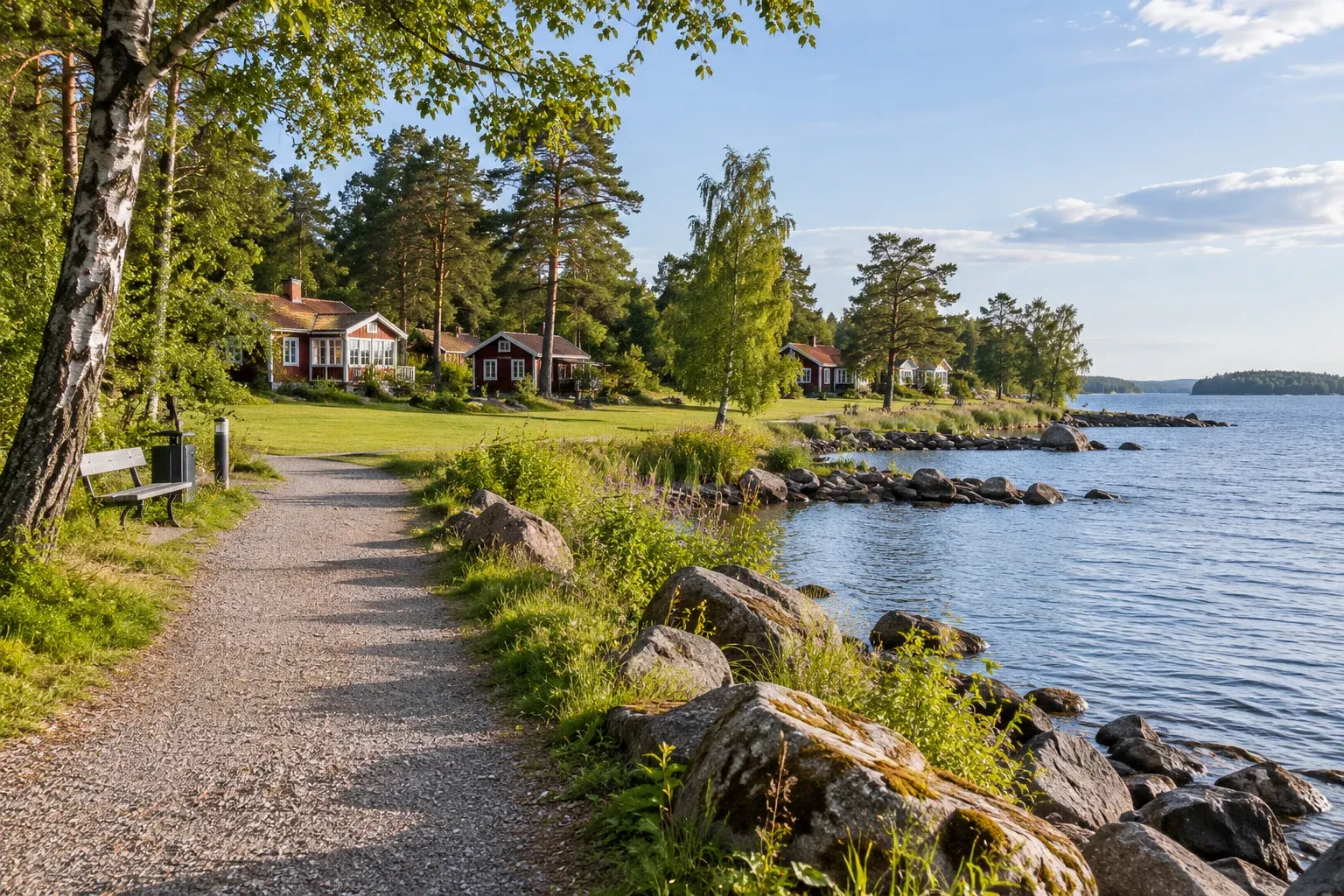
You can walk mile after mile of Swedish lakeshore without meeting a “private beach” fence. That isn’t luck or local generosity. It’s a building ban written into Swedish environmental law, and it shapes what you may do on the shore and what an owner may build there.
When you need this
- You’re by a lake and wondering whether the shore in front of a cabin is open to you.
- You’re walking or paddling along the coast and meet fences, jetties or privat signs.
- You’re renting or buying a summer house by the water and dreaming of a jetty, sauna or deck.
- You’ve seen Swedish headlines about strandskydd being “relaxed” and want to know what actually changed.
What strandskydd is
Strandskydd (shoreline protection) is a general protection in the Environmental Code (Miljöbalken). It covers the land and the water within 100 meters of the shoreline of the sea, lakes and watercourses, measured from normal mean water level. The county administrative board (länsstyrelsen) can extend the zone to at most 300 meters where a shore is especially valuable.
The law gives it two purposes. The first is to secure, over the long term, the public’s access to shores under allemansrätten. The second is to preserve good living conditions for plants and animals on land and in water. About a third of Sweden’s red-listed species depend on shore and water environments, according to the Swedish EPA (Naturvårdsverket).
Shore rules go back to the 1950s. They have protected all Swedish shores by default since 1975, and the wildlife purpose was added in 1994. With roughly 426,000 km of shoreline and nearly 100,000 lakes larger than one hectare, the rule touches an enormous share of the country.
The key point for visitors: strandskydd doesn’t give you any rights. It is a ban on building. What you may do on the shore comes from Sweden’s right of public access. Strandskydd keeps the space open so that right can be used.
What is banned in the 100-meter zone
Inside the protected zone, the Environmental Code forbids four things unless the owner has a dispensation (dispens):
| Prohibited | Examples |
|---|---|
| New buildings | Houses, saunas, sheds, boathouses |
| Changing buildings, their use, or building other structures, if that stops or deters the public | Turning a boathouse into a holiday home; jetties, piers, fences, flagpoles, garden paths, barbecue areas, playgrounds, parking, campsites, boat slipways |
| Digging or other groundwork for the above | Felling trees, blasting, building a road |
| Measures that substantially change conditions for plants or animals | Dredging, dumping earth, spreading fertilizer |
The second line is the one you notice on the shore. A structure is banned as soon as it deters people, not only when it physically blocks them. What counts is how the public perceives its right to be there. So a new deck that makes an open shore look like a private garden can be banned even where there’s no fence.
Even mobile things can count. Caravans and houseboats can be treated as buildings once they stay put considerably longer than a normal holiday period.
Breaking the ban is a crime. Building or carrying out a prohibited measure in the zone is punishable by fines or up to two years in prison, and breaking a regulation or decision for the area is punishable by fines.
What it means when you’re on the shore
Strandskydd protects the shore from new building. It doesn’t erase what was already there or turn a garden into a public beach.
Gardens are still private. A house by the water keeps its private zone (hemfridszon) and its plot, and allemansrätten doesn’t apply inside them. No law gives that zone a size; if you’d disturb the people living there, you’re too close.
Look for the free passage. When an owner gets a dispensation, the law says it may never cover the strip needed to keep a free passage for the public between the shoreline and the buildings, unless the building’s function makes that impossible. On built-up shores, that strip is your route.
The water normally stays open. Swedish courts and Naturvårdsverket hold that a home’s private zone does not normally extend out into the water. You may swim or paddle past a lakeside house even when the land in front of it is private. Don’t land on the garden jetty, which belongs to the plot (see swimming in Swedish lakes and boating in Sweden).
Fences that only exist to keep you out can be challenged. Under the Environmental Code, the supervisory authority can order an owner to put gates in a fence near outdoor recreation areas, or remove it if it plainly only exists to keep the public out. If a fence or gate seems to block an open shore, contact the municipality.
Camping is unchanged. A night or two in a tent on an open shore is an allemansrätten question, with the usual limits: away from homes, off farmland, and following nature reserve rules (see wild camping rules). Glamping tents on platforms, by contrast, usually need a dispensation.
Where strandskydd does not apply: the July 2025 change
Freshness note: Many guides still say strandskydd applies at every lake and stream. That stopped being true on 1 July 2025.
The first step of a government easing took effect on 1 July 2025. Since then, general strandskydd does not apply at:
| Water | Rule since 1 July 2025 |
|---|---|
| Lakes of one hectare or less | Not protected by default |
| Stream stretches two meters wide or narrower | Not protected, so protection can come and go along one stream |
| Lakes and watercourses created after 30 June 1975 | Not protected, whatever their size (dug ponds, flooded quarries, canals) |
The county board can still reinstate protection, up to 100 meters, at a small lake or narrow stream that matters for either purpose. A natural lake that has been dammed, straightened or dredged still counts as natural and keeps its protection.
Two older exceptions still apply as well. Many local detailed plans (detaljplaner) have lifted strandskydd in towns. And county boards in 11 counties decided under earlier law to exempt certain small lakes and streams: Gotland, Jönköping, Norrbotten, Skåne, Stockholm, Uppsala, Värmland, Västerbotten, Västmanland, Västra Götaland and Örebro.
There’s a catch for anyone trying to check a specific place. No complete map of strandskydd exists. The county boards’ map service shows extended zones and other decisions, but the general 100-meter protection isn’t mapped nationwide yet. An empty map proves nothing, so ask the municipality.
Owning or renting by the water
If you’re buying a summer house in Sweden, strandskydd is the rule most likely to surprise you.
- Every new jetty needs a dispensation, fixed or floating, however few weeks a year it is used. Courts treat a private leisure jetty as a weak interest, and Naturvårdsverket says dispensations are to be assessed restrictively.
- The municipality grants most dispensations. The county board decides cases involving defense installations, public roads, railways or state-protected areas.
- The reasons are a closed list. Examples include land already taken into use, land cut off from the shore by a road or buildings, and a facility that must lie by the water.
- The county board reviews municipal decisions. The municipality must send every dispensation to the county board, which must review it if there is reason to think the conditions weren’t met.
- Your plot has a defined size. Every dispensation must state how much land may be used as a private plot.
- Dispensations lapse. If work hasn’t started within two years, or finished within five, of the decision becoming final, it expires.
- Repairs are fine, rebuilding bigger isn’t. You may renovate an existing jetty without a dispensation if its size and appearance don’t change.
- Farming, forestry, fishing, aquaculture and reindeer herding are exempt for the non-residential buildings they need.
Owners get no compensation for these restrictions. Courts have refused private leisure jetties and decks, and upheld an order to remove a shed and a raft with a diving tower. Ask the municipality before you buy or plan anything (more in owning a Swedish cabin).
The reform coming next
The government wants it to be easier to build near water. An inquiry called the Strandskyddsutredningen was appointed in June 2025, and its report is due by 31 December 2026.
Its preliminary direction, published in June 2026, is to replace dispensations with a “shore permit” (strandlov), give the interest in building much more weight, drop the closed list of reasons, and add more exemptions. It would keep both purposes and keep the municipality mainly in charge.
None of this is law. Any change needs a government bill and a vote in the Riksdag, so treat “strandskydd abolished” headlines with care. Until then, the rules above apply.
Mistakes to avoid
- Treating strandskydd as a right to walk anywhere near water. It stops new building; it doesn’t override the private zone around existing homes.
- Assuming nothing can be built near Swedish water. Thousands of dispensation cases are decided every year, and many town plans lift the protection.
- Assuming a privat jetty means the water is private. The water normally stays open, but stay off the garden jetty.
- Planning a sauna, jetty or deck before checking with the municipality. These usually need a dispensation.
- Trusting guides from before July 2025 on small lakes and streams.
Practical information
| What | Detail |
|---|---|
| Standard zone | 100 m from the shoreline, on land and in water |
| Extended zone | Up to 300 m, decided by the county board |
| Not covered since 1 July 2025 | Lakes ≤ 1 ha, stream stretches ≤ 2 m wide, waters created after 30 June 1975 |
| Walking, swimming, landing on an open shore | Free |
| Who grants dispensations | Usually the municipality; the county board in some cases |
| Dispensation fee | Set by each municipality; ask for its current rate |
| Dispensation lapses | Not started in 2 years, or not finished in 5 |
| Building without a dispensation | Fines or up to 2 years in prison, plus possible removal order |
| Breaking a regulation or decision for the area | Fines |
| Where to ask | The municipality where the shore lies |
| Pending reform | Inquiry report due 31 December 2026; not law |
FAQ
What is strandskydd in Sweden?
Strandskydd is Sweden’s shoreline protection law. Within 100 meters of the sea, lakes and rivers, on land and in the water, new buildings, jetties, fences and other structures that deter the public are banned unless the owner gets a dispensation. County boards can extend the zone to 300 meters. It exists to keep shores open to the public and to protect wildlife.
Can I walk along any shore in Sweden?
Mostly yes, but not through gardens. Strandskydd stops new building that would block the shore, and allemansrätten lets you walk there. The private zone around a home still applies, even right by the water. On built-up shores, look for the free passage between houses and waterline that dispensations must normally leave open. If you would disturb the people living there, turn back.
Is the water in front of a lakeside house private?
Normally not. Swedish courts and Naturvårdsverket hold that the private zone around a home does not normally extend out into the water, so you may swim or paddle past. Land on the open shore, not on the garden jetty, which belongs to the plot. Keep a respectful distance from the house, and move on if residents are using the shore.
Can I build a jetty or sauna at my Swedish summer house?
Usually only with a dispensation from strandskydd, which the municipality grants for listed special reasons only. Every new jetty needs one, fixed or floating, and courts treat a private leisure jetty as a weak interest. A sauna is a new building. Ask the municipality before you plan; building without a dispensation can mean removal orders, fines or prison.
Did the strandskydd rules change in 2025?
Yes. Since 1 July 2025, general strandskydd no longer covers lakes of one hectare or less, stretches of streams two meters wide or narrower, or waters created after 30 June 1975. County boards can reinstate protection where it matters. A wider reform proposing a permit system called strandlov is still at the inquiry stage, with a report due by 31 December 2026.
How do I find out whether strandskydd applies at a place?
Ask the municipality; Naturvårdsverket points people there for specific sites. The county boards’ map service shows extended zones and other decisions, but the general 100-meter protection is not fully mapped, so an empty map proves nothing. Detailed plans may have lifted strandskydd locally, and small waters may be exempt since July 2025.
Does strandskydd let me camp on the beach?
No, it neither adds nor removes camping rights. A night or two in a tent on an open shore is governed by allemansrätten, with its usual limits: away from homes, off farmland, and following nature reserve rules. Strandskydd only protects the shore from building. Platform-based glamping tents usually need a dispensation; ordinary tent nights do not.
Related guides
- Allemansrätten: Sweden’s right of public access — what you may actually do once you’re on the shore
- Swimming in Swedish lakes — which beaches and jetties you may use
- Boating in Sweden — anchoring, mooring and going ashore from the water
- Buying a summer house in Sweden — what to check before you buy by the water
- How Sweden is governed — who the municipality and county board are, and what each decides
Facts verified 2026-10-05. Sources: Sveriges riksdag (Miljöbalken), Naturvårdsverket, Strandskyddsutredningen (Regeringskansliet) — full register in this topic’s source file. Found something outdated? Tell us and we’ll fix it.