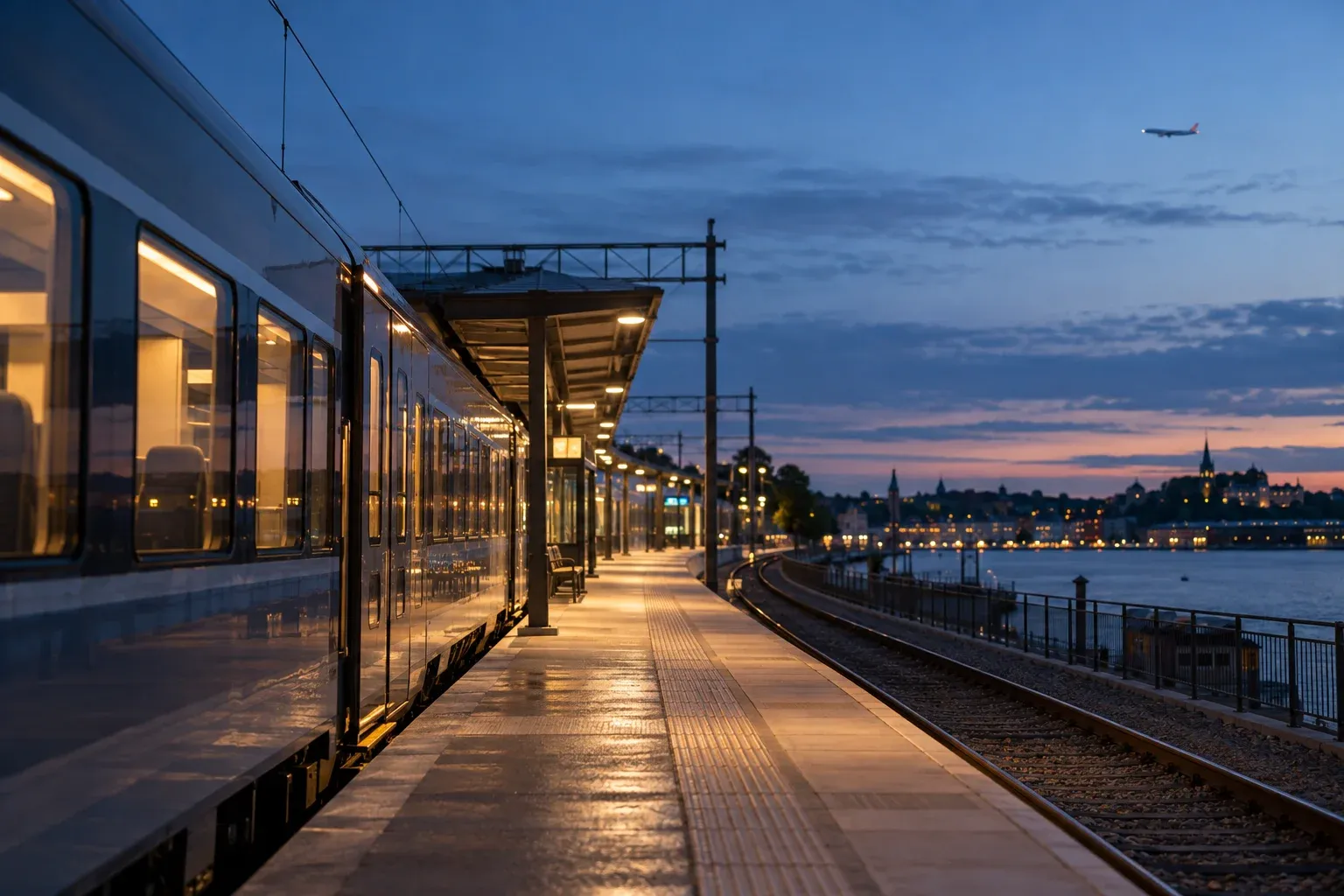
Sweden gave the world the word for feeling bad about flying, then taxed flights, then scrapped the tax. Here is what changed, what Swedes actually do now, and what it means for your ticket and your travel plans.
When you need this
- An older guide or fare breakdown mentions a Swedish flygskatt (flight tax) and you want to know if it still applies
- You’re choosing between a train and a short domestic flight and wonder what a Swede would do
- A Swedish colleague or host mentions flygskam, or tells you they “don’t fly”
- You’ve read that the 2026 election could bring the flight tax back
- You’re wondering why Swedish trains are so full and domestic routes so few
What flygskam means
Flygskam means “flight shame”: the feeling that flying is morally wrong because of its climate impact. The Swedish Language Council (Språkrådet) put it on its list of new Swedish words for 2018, and its new-words editor called it one of the year’s favorites because the word carries a message.
The joke vocabulary followed a year later. The 2019 list, compiled by Språkrådet and the magazine Språktidningen, added two words that only make sense in a country where flying had become awkward:
| Word | Literal sense | What it means |
|---|---|---|
| flygskam | flight shame | Feeling that flying is wrong because of the climate (2018 list) |
| smygflyga | sneak-flying | Flying, but keeping quiet about it (2019 list) |
| tågskryta | train-bragging | Going by train and making sure everyone knows (2019 list) |
Greta Thunberg helped popularise the idea far beyond Sweden. At home it was never a rule. It was, and is, a personal choice that some people make loudly and others quietly.
The flight tax, start to finish
Sweden turned the climate mood into a tax before the word was even on the new-words list. Lag (2017:1200) om skatt på flygresor, the aviation tax act, took effect on 1 April 2018. It charged airlines a fixed amount for every passenger departing a Swedish airport on an aircraft approved for more than ten passengers. Passengers never paid it at a counter; airlines built it into the fare.
The amount depended on which of three bands the final destination fell into. Annex 1 of the act listed European countries, Sweden included, so domestic flights paid the lowest rate. The amounts rose every year:
| Year | Annex 1 countries (Europe, incl. domestic) | Annex 2 countries | All other destinations |
|---|---|---|---|
| 2018 | 60 kronor | 250 kronor | 400 kronor |
| 2024 | 76 kronor | 315 kronor | 504 kronor |
| From 1 July 2025 | None | None | None |
Children under two, crew on duty and transfer passengers continuing within 24 hours were exempt.
Then the politics turned. The Riksdag repealed the act through SFS 2024:1138, with effect from 1 July 2025. The old law still applies to flights taken before that date, but nothing after it. The government that abolished it said the aim was better accessibility and more competitive Swedish airports, with regional airports framed as important for business, patient transport and preparedness.
Freshness note: many English pages and fare calculators still list Swedish flight tax rates. They describe a law that stopped applying on 1 July 2025. Don’t budget for it.
A “taxes and charges” line can still appear on a fare from a Swedish airport. Since July 2025 it can’t contain a Swedish ticket tax; it reflects airport and other charges, which our guide to taxes visitors ask about in Sweden explains. Fuel is still regulated at EU level: since 2025, fuel suppliers at EU airports must blend in at least 2% sustainable aviation fuel, rising to 70% by 2050.
What the numbers show
The popular story says flight shame emptied Swedish airports. The official statistics tell a narrower one.
| Measure | What happened | Source year |
|---|---|---|
| Domestic passengers at Swedavia’s ten airports | Down 9% to about 12.4 million | 2019 vs 2018 |
| International passengers at Swedavia’s airports | Down 2% to nearly 28 million | 2019 vs 2018 |
| All passengers to and from Swedish airports | Just under 31 million | 2025 |
| International air travel | 14% below 2019 | 2025 |
| Domestic air travel | Still 40% below pre-pandemic level; down 1% on 2024 | 2025 |
Three things stand out. First, the 2019 fall came before the pandemic, and it was mostly domestic. Swedavia reported the drop but didn’t name a cause, so the link to flygskam is plausible rather than proven. Second, Swedes have gone back to flying abroad: international traffic has nearly recovered. Third, domestic flying hasn’t come back. It fell again in 2025 even after the tax ended.
Attitudes point the same way. In Naturvårdsverket’s survey, published in January 2025, a growing share of Swedes said they could imagine taking the train instead of flying. Almost 8 in 10 said they could imagine holidaying close to home, and support for banning goods and services with large climate emissions rose from 63% to 71% since 2021.
The geography matters too. Stockholm Arlanda handled 60% of all scheduled and charter landings in Sweden in 2025 and Gothenburg Landvetter 14%. Stockholm’s city airport, Bromma, saw its landings fall by 87% between 2024 and 2025; our Bromma airport guide explains what still flies there.
Could the tax come back?
Possibly, and this is the part that will change. The election on 13 September 2026 gave the opposition a narrow majority, and government formation was still under way in mid-October 2026. Before the vote, the parties stated their positions:
| Party | Position on a flight tax before the 2026 election |
|---|---|
| Greens (Miljöpartiet) | Bring it back at double the old level |
| Left Party (Vänsterpartiet) | Bring it back, made progressive over time |
| Social Democrats | No, but may have to negotiate with the two above |
| Centre Party | No new flight-specific tax |
| Moderates, Christian Democrats, Liberals, Sweden Democrats | No; several prefer EU-level solutions |
Six of the eight parliamentary parties said no. Any new tax would need a law with a start date written into it, so it would be announced well before it applied. If you’re budgeting for travel well into 2027, check Skatteverket’s flight tax page before you book.
What it means for you
Your ticket. No Swedish tax is added to flights departing after 1 July 2025. A return leg from a country with its own air passenger tax still carries that country’s tax.
Your route. Domestic flying is roughly 40% smaller than before the pandemic, so check that a route in an older guide still flies. Our guide to domestic flights in Sweden covers who flies where now.
The train question. On the long north–south distances, flying is normal and nobody will think twice; see our guide to flying to Kiruna and Swedish Lapland. Between the big southern cities, the train is the default for many Swedes. Our guides to train travel in Sweden and the Stockholm to Gothenburg train help you compare. If you want to tågskryta properly, take the night train to Lapland or the train to Sweden from central Europe.
The conversation. When a Swede says they don’t fly, treat it as a personal choice. Ask about it the way you’d ask about vegetarianism, not as an opening for debate.
Practical information
| Item | Status (checked 2026-10-14) |
|---|---|
| Swedish flight tax (flygskatt) | None — repealed with effect from 1 July 2025 |
| Former rates, 2018 | 60 / 250 / 400 kronor per passenger by band |
| Former rates, 2024 | 76 / 315 / 504 kronor per passenger by band |
| Flights before 1 July 2025 | Still governed by the old law |
| Airport and security charges | Set by the airport, built into the fare; not published here |
| EU sustainable fuel minimum | 2% from 2025, 70% by 2050 |
| Political status | Greens and Left want it back; six of eight parties said no before the 2026 election |
| Where to check | Skatteverket’s flight tax page |
FAQ
Does Sweden still have a flight tax?
No. Lag (2017:1200) om skatt på flygresor was repealed by SFS 2024:1138 and stopped applying on 1 July 2025, so no Swedish tax is added to tickets for flights departing after that date. Fare breakdowns that still show a flygskatt describe the old law. Some parties want it back, but no bill had been tabled as of October 2026.
What does flygskam mean?
Flygskam means “flight shame”: the feeling that flying is wrong because of its climate impact. The Swedish Language Council put it on its list of new words for 2018. A year later the list added smygflyga, flying while keeping quiet about it, and tågskryta, bragging that you went by train. Greta Thunberg helped carry the idea abroad.
Do Swedes really fly less because of flight shame?
Partly, and less than the headlines suggested. Swedavia’s domestic passengers fell 9% in 2019, before the pandemic, but Swedavia did not attribute the drop to flygskam. In 2025 domestic air travel was still about 40% below pre-pandemic levels and fell another 1% even after the tax ended. International flying is only 14% below 2019.
Will Swedes judge me for flying?
Almost certainly not. Flight shame is a personal choice, not a social rule, and about 27 million passengers flew between Sweden and other countries in 2025. Flying to Kiruna or Luleå is normal because of the distance. Where you might notice it is choosing a short flight over a good train connection between the big southern cities.
Could the flight tax come back after the 2026 election?
Possibly, but nothing is decided. Before the September 2026 election, the Greens wanted the tax back at double the old rate and the Left Party wanted it reinstated and made progressive. The Social Democrats said no, as did the Centre Party and the four parties of the outgoing government. Government formation was still under way in October 2026.
How much was the Swedish flight tax?
It started on 1 April 2018 at 60, 250 or 400 kronor per passenger, depending on the final destination’s band, and rose each year; in 2024 the bands were 76, 315 and 504 kronor. Airlines paid it and built it into fares. Children under two, crew on duty and transfer passengers were exempt. It ended on 1 July 2025.
Related guides
- Domestic flights in Sweden — when flying beats the train, and who flies where now
- Getting to Sweden — how the tax repeal changed the routes into the country
- Train travel in Sweden — the train-first option, explained
- Night trains to Swedish Lapland — the classic tågskryt trip
- Who runs the trains? — why Swedish rail looks the way it does
Facts verified 2026-10-14. Sources: Sveriges riksdag, Skatteverket, Trafikanalys, Swedavia, Naturvårdsverket, the European Commission, Språkrådet’s new-words lists as reported by SVT and Sveriges Radio, and Transportföretagen — full register in this topic’s source file. No fares or airport charges are published here because they change. Found something outdated? Tell us and we’ll fix it.