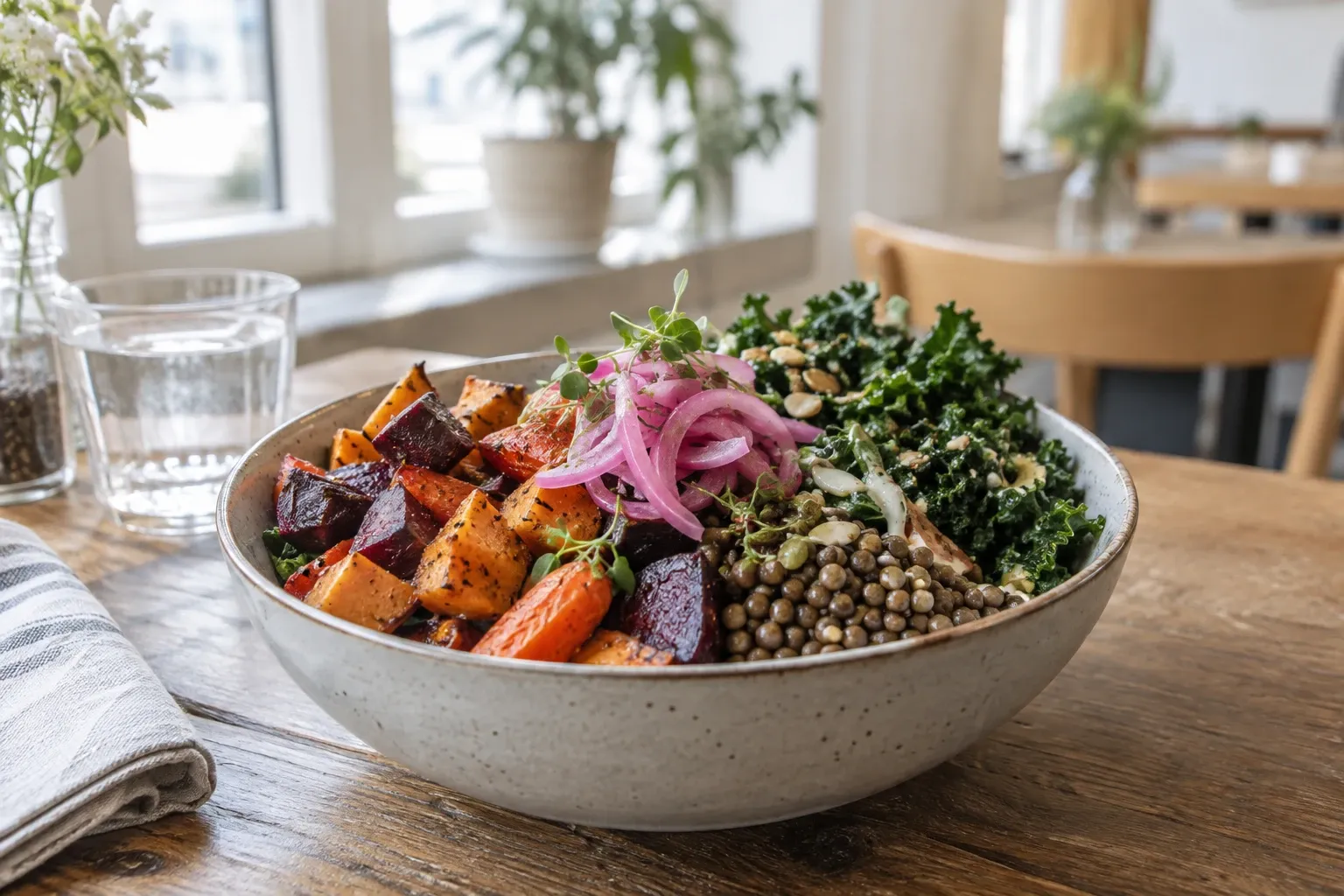
You probably packed snacks. You did not need to. The hard part of plant-based Sweden is not finding food — it is reading four words on a carton, one of which means the opposite of what it looks like.
When you need this
Your first supermarket run, in front of a wall of cartons that all say dryck. A Swedish ingredient list you cannot parse. A café counter where asking for oat milk feels like an imposition. Or the moment you drive out of the city into a town with one small grocery store.
Why Sweden is easier than you expect
Plant-based food here is ordinary retail, not a subculture: every major grocery group sells its own-brand plant range, so the cheapest options on the shelf are usually the plant-based ones rather than imported specialty brands.
Official Sweden points the same way, and this is the part no travel page mentions. In April 2025 Livsmedelsverket, the Swedish Food Agency, rewrote the national dietary advice for the first time in roughly two decades: at least 500 g of fruit, vegetables and berries a day, red and processed meat cut from 500 g to 350 g a week, and a new line telling the whole population to eat peas, beans and lentils often — preferably every day.
The behavior is already there. Jordbruksverket, the Swedish Board of Agriculture, puts Sweden’s “peak meat” at 88.3 kg per person in 2016, falling by just over 9 percent to around 80 kg in 2025 — with the sharpest drop between 2017 and 2019, which it attributes to rising interest in vegetarian food.
Supermarkets: the own-brand plant ranges
ICA’s own-brand vego line runs to plant mince, burgers, sausages, schnitzel, several tofus, falafel, wheat strips, plant “fish” fingers and vegan aioli and béarnaise, fresh and frozen. Axfood — the group behind Willys and Hemköp — describes its Garant brand as continuously developing vegetarian alternatives, and builds own-brand ready meals such as taco mince, bolognese and lasagne on Swedish-grown legume mince.
The thing to unlearn: stop hunting for a vegan aisle. The range is distributed — plant drinks with the dairy, mince and burgers with the chilled and frozen ready foods, plus a dedicated vego bay in larger stores. Read shelf edges for växtbaserad and vego rather than looking for a section. Discounters carry a narrower own-brand plant selection than ICA or Garant, which is a real trade-off against their prices; the chains are covered in Swedish supermarkets explained, and basket costs in grocery prices in Sweden.
Reading a Swedish label: four words that do all the work
| Swedish | What it means | What it does not mean |
|---|---|---|
| vegansk / vegan | The producer states there are no animal ingredients | Not an allergen claim — see below |
| växtbaserad | Plant-based | Not necessarily vegan-certified |
| mjölkfri | Milk-free: neither milk protein nor lactose | — |
| laktosfri | Lactose-free: milk sugar removed | Not dairy-free. Still contains milk protein |
Two more worth knowing. Berikad means fortified — with calcium, B12 and vitamin D — and it decides whether a plant drink is nutritionally useful. And vegetabilisk is not a dietary claim at all: it means “of plant origin” and appears inside ingredient lists, as in vegetabiliskt fett.
Vegan and vegetarian labelling in the EU is voluntary information, governed by Article 36.3 of the food information regulation — and the harmonised definitions that article provides for have never been adopted. Livsmedelsverket’s position is that a vegan-labelled product should contain no animal ingredients, but it is the producer making that claim, not a regulator certifying it. For a certified claim, look for a third-party mark: the international V-Label, or Djurens Rätt’s Swedish I’M VEGAN.
One change is coming, and worth stating precisely because the coverage was confusing. On 5 March 2026 the EU reached a provisional agreement reserving 31 terms — species names like beef and chicken, cuts like steak and ribeye — for products containing meat. The words the campaign was about, burger, sausage, nuggets and escalope, were kept for plant-based products clearly labelled as such. It is not yet adopted, and producers then get three years. Nothing on a Swedish shelf has changed.
The laktosfri trap
This is the most important paragraph on the page. Lactose-free milk is still milk. Laktosfri means only that the milk sugar has been removed; the milk protein is intact. Livsmedelsverket defines mjölkfri — milk-free — as containing neither milk protein nor lactose, and tells producers to reserve fri från wording for genuine free-from claims. The agency is equally explicit that lactose intolerance and milk allergy are different conditions: an allergic person can become seriously ill from very small amounts of milk protein, while intolerance is a reduced ability to break down milk sugar. Sweden’s dairy cabinet devotes a lot of space to laktosfri. None of it is dairy-free.
The second half of the same trap: a vegan mark is not an allergen claim. Livsmedelsverket’s own published answer states that vegan labelling and mjölkfri labelling mean different things, and that a vegan-marked product can still carry unintentional traces of milk. With a milk allergy rather than a preference, look for mjölkfri and take kan innehålla spår av (“may contain traces of”) seriously. The full picture is in eating out with food allergies in Sweden; celiac travelers should read gluten-free in Sweden.
The good news on the other side: under Swedish rules implementing the EU regulation, anyone serving non-prepacked food must be able to tell you whether it contains a declarable allergen — restaurant, café, counter or takeaway. The information may be spoken rather than written, but if it is, a visible notice must say it is available. Milk, eggs, soy, nuts and gluten are all on the list. Asking is routine, not a fuss.
The keyhole is not a vegan symbol
The green Nyckelhålet keyhole is Sweden’s best-known food symbol, and it will not help you here. It is a nutrition mark — limits on fat, sugar and salt, requirements for fibre and wholegrain — and meat and fish products carry it too.
There is a dedicated plant-product category with its own criteria — at least half wholegrain, vegetables (not potato), legumes, root vegetables or plant protein, and no meat or fish — but the symbol alone tells you nothing about whether a food is plant-based. The wider label system is covered in Swedish food labels explained.
Oat drink, and whether it costs extra
Oat drink is a Swedish invention. It came out of Lund University, where the researcher Rickard Öste spent the 1980s looking for a milk substitute and landed on oats, water and a patented enzyme mixture. The drink from Skåne became a global brand and a serious competitor to Sweden’s dairy industry — which is why it is a grocery staple here rather than a health-food item.
The carton says havredryck, not havremjölk, and that is law rather than modesty: EU Regulation 1308/2013 reserves mjölk for what comes out of an udder, with long-established names like kokosmjölk and jordnötssmör exempt. Expect sojadryck, mandeldryck and kokosdryck beside it.
In cafés, asking for oat drink is unremarkable — Oatly is served at every Espresso House café in the Nordics, and even fast-food chains list it as a coffee option. On the surcharge question, the honest answer is that free plant milk is common practice rather than policy. No Swedish chain publishes a rule either way, and the café trade is currently being urged to start charging, with free oat drink described in trade commentary as a classic margin trap. Ask if it matters. And note that “we have oat drink” and “every drink can be made with it” differ: MAX offers it with black coffee and espresso, but makes its milk-based coffees with dairy.
Eating out: the weekday vegetarian slot
Swedish weekday lunch boards run three fixed slots — dagens kött, dagens fisk and dagens vegetariska or dagens gröna. The vegetarian dish is part of the rotation, at the same posted price as the meat dish, with the salad buffet included. That makes it the cheapest good plant-based meal in the country; the mechanics are in dagens lunch. Note that Swedish vegetariskt excludes fish — the fish dish is its own line.
- The salad buffet at a weekday lunch is often a full table of vegetables, beans, pickles and grains, already inside the price.
- The takeaway box. Lunch restaurants sell dagens as a matlåda to take away, vegetarian dish included — the easiest hot plant-based meal to carry to a park or a train.
- Falafel. Kebab and falafel shops outnumber everything else in small-town Sweden and open late. See street food and korv kiosks.
In the cities, Stockholm’s official visitor site keeps separate lists of fully vegan, vegetarian and plant-friendly venues, and its own framing is that plant-based options appear on menus almost everywhere. Use a live listing rather than a guide’s top ten. For prices, VAT and ordering customs, see eating out in Sweden.
Traditional Swedish food: what works and what doesn’t
Husmanskost — Swedish everyday home cooking — is built on meat, fish, butter and cream, and this is where the reassurance stops. Restaurants rarely make a plant version of a classic; they serve a separate vegetarian dish instead. Do not go looking for meatless meatballs on a traditional menu.
The supporting cast is better than it sounds: boiled potatoes, dill, lingonberry jam, knäckebröd (crispbread), mushrooms, and the lunchtime salad buffet. In late summer, chanterelles, blueberries and lingonberries make Sweden genuinely excellent — and you may legally pick them yourself, covered in berry and mushroom picking. Two dates to plan around: December, when the animal-based julbord takes over and plant-based versions are a separate pre-booked menu (the julbord); and Midsummer, where the potatoes, dill, strawberries and crispbread are the parts that work.
Fika: assume butter
Butter, milk, egg and cream are the default in Swedish baking. Assume a kanelbulle contains all four unless it is labelled otherwise. City cafés and bakeries increasingly bake a marked vegan bun or cake, and it is often the best thing in the case — but treat it as something to look for, not to expect. Since staff must be able to answer questions about milk and egg, the reliable move is to ask. The ritual itself is in Swedish fika.
The other sweet trap is lösgodis, Sweden’s beloved pick-and-mix. The bins carry no ingredient list, gelatine is common, and gelatine is not a declarable allergen — so nothing obliges the store to flag it. Ask staff, or buy packaged.
What to say in Swedish
Everyone will switch to English, but these are the words on the packaging and the board.
| Swedish | Means |
|---|---|
| Är den vegansk? | “Is it vegan?” |
| Innehåller den mjölk eller ägg? | “Does it contain milk or egg?” |
| vegansk / växtbaserad / vego | vegan / plant-based / the retail shorthand |
| berikad | fortified (calcium, B12, vitamin D) |
| mjölkfri / laktosfri | milk-free / lactose-free but still dairy |
| kan innehålla spår av | may contain traces of |
| ägg, mjölk, grädde, smör | egg, milk, cream, butter |
| dagens vegetariska / dagens gröna | the day’s vegetarian dish |
| lösgodis | pick-and-mix sweets |
Outside the cities
Stockholm, Gothenburg and Malmö have dedicated vegan restaurants, plant-based bakeries and full café menus. Mid-size towns have no dedicated vegan restaurant but the same own-brand ranges, the same lunch-board vegetarian slot and a falafel shop — and this is the level at which Sweden is quietly better than most of Europe.
Small towns and the countryside are a different proposition: often a single small ICA or Coop with a narrow chilled range, two plant drinks and a couple of frozen vego products. The far north and the islands are thinnest of all. Buy staples at a large store before you leave the city, especially for a cabin week or a fortnight in Lapland.
Nutrition on a long trip
For a week, ignore this. For a month, one nutrient matters: vitamin B12 occurs only in animal foods, and Livsmedelsverket’s advice for vegans is fortified products, supplements, or both, at 4.0 µg a day for adults. The agency names fortified plant drinks as a good source of B12, riboflavin, vitamin D and calcium — the practical argument for reading a carton for berikad, since Swedish organic plant drinks frequently are not. Iodised salt covers iodine, which the agency singles out for people avoiding milk, eggs and fish.
Practical information
| Item | Detail |
|---|---|
| Supermarket own-brand plant ranges | ICA vego; Axfood’s Garant at Willys and Hemköp — fresh and frozen |
| Where plant products sit | Distributed: drinks with dairy, mince and burgers with chilled and frozen ready meals, plus a vego bay in larger stores |
| Plant drinks | havredryck, sojadryck, mandeldryck, kokosdryck — never labelled “milk” |
| Word that matters on a plant drink | berikad (fortified with calcium, B12, vitamin D) |
| Vegan labelling | Voluntary; no harmonised EU definition adopted; not an allergen claim |
| Milk-free versus lactose-free | mjölkfri = no milk protein or lactose. laktosfri = still dairy |
| Allergen questions | Must be answerable for non-prepacked food, in writing or speech |
| Nyckelhålet keyhole | A nutrition symbol, not a plant-based one; appears on meat too |
| Eating out | Dagens vegetariska is a standard weekday slot at the same price |
| Oat drink in cafés | Standard everywhere; usually no surcharge, but that is practice, not policy |
| B12 on a long trip | 4.0 µg a day for adults, from fortified products or supplements |
| National dietary advice | Updated April 2025: legumes often, preferably daily; red and processed meat max 350 g a week |
| Meat consumption | 88.3 kg per person in 2016, around 80 kg in 2025 (Jordbruksverket) |
FAQ
Is Sweden a good country for vegans and vegetarians?
Yes — unusually good, and better than its reputation. Every supermarket chain sells an own-brand plant range, oat drink is a Swedish invention and a normal staple, weekday lunch menus carry a fixed vegetarian slot, and the cities have dedicated vegan restaurants. Official dietary advice now tells the whole population to eat legumes daily.
Does laktosfri mean dairy-free in Sweden?
No, and this is the single most important thing on this page. Laktosfri means only that the milk sugar has been removed — the product is still dairy and still contains milk protein. The word you need is mjölkfri (milk-free), which Livsmedelsverket defines as containing neither milk protein nor lactose. Lactose intolerance and milk allergy are different conditions.
What does vegansk mean on Swedish packaging, and is it regulated?
It means the producer states the product contains no animal ingredients, and it is voluntary labelling: EU rules leave vegetarian and vegan claims to Article 36.3 of the food information regulation, and harmonised definitions have never been adopted. It is not an allergen claim — Livsmedelsverket warns that vegan-marked products can still carry milk traces.
Do Swedish cafés charge extra for oat milk?
Usually not, but treat that as common practice rather than a guarantee. Oat drink is served as standard across the Nordic café chains and by fast-food chains, and no operator publishes a surcharge policy either way. The Swedish café trade is currently being advised to start charging for it, so ask if it matters.
Is there always a vegetarian option at lunch in Sweden?
In practice, yes. Swedish weekday lunch boards run three fixed slots — dagens kött, dagens fisk and dagens vegetariska or dagens gröna — so the vegetarian dish is part of the rotation rather than a request. Note that vegetariskt excludes fish here; the fish dish is its own separate line.
Is traditional Swedish food vegetarian-friendly?
Husmanskost is built on meat, fish, butter and cream, and restaurants rarely make a plant version of a classic — they serve a separate vegetarian dish instead. What does work is the supporting cast: boiled potatoes, dill, lingonberry jam, knäckebröd, mushrooms and the salad buffet that comes with a weekday lunch.
Can vegans eat Swedish fika?
Cautiously. Butter, milk, egg and cream are the default in Swedish baking, so assume a kanelbulle contains all four unless it is labelled. City cafés and bakeries increasingly bake a marked vegan bun or cake, and staff must legally be able to answer questions about milk and egg — so ask rather than guess.
Does the Nyckelhålet keyhole symbol mean a product is vegetarian?
No. The keyhole is a nutrition mark covering fat, sugar, salt and fibre, and meat and fish products carry it too. There is a separate plant-product category with its own criteria — at least half wholegrain, vegetables, legumes, root vegetables or plant protein, and no meat or fish — but the symbol alone tells you nothing about whether a food is plant-based.
Related guides
- Dagens lunch — how the weekday vegetarian slot actually works, and what the one price includes
- Swedish supermarkets explained — which chain to use, and how to read a Swedish shelf label
- Eating out with food allergies in Sweden — where the vegan mark stops being enough
- Swedish food labels explained — Nyckelhålet, KRAV and organic in full
- Swedish fika — the ritual this page tells you how to navigate
Facts verified 2026-07-26. Sources: Livsmedelsverket (Swedish Food Agency), Jordbruksverket (Swedish Board of Agriculture), Sveriges Riksdag, Lund University, Visit Stockholm, and the retailers’ and operators’ own published information — full register in this topic’s source file. The EU’s March 2026 agreement on names for plant-based products is provisional and not yet in force; this page is on a 12-month review cycle. Found something outdated? Tell us and we’ll fix it.