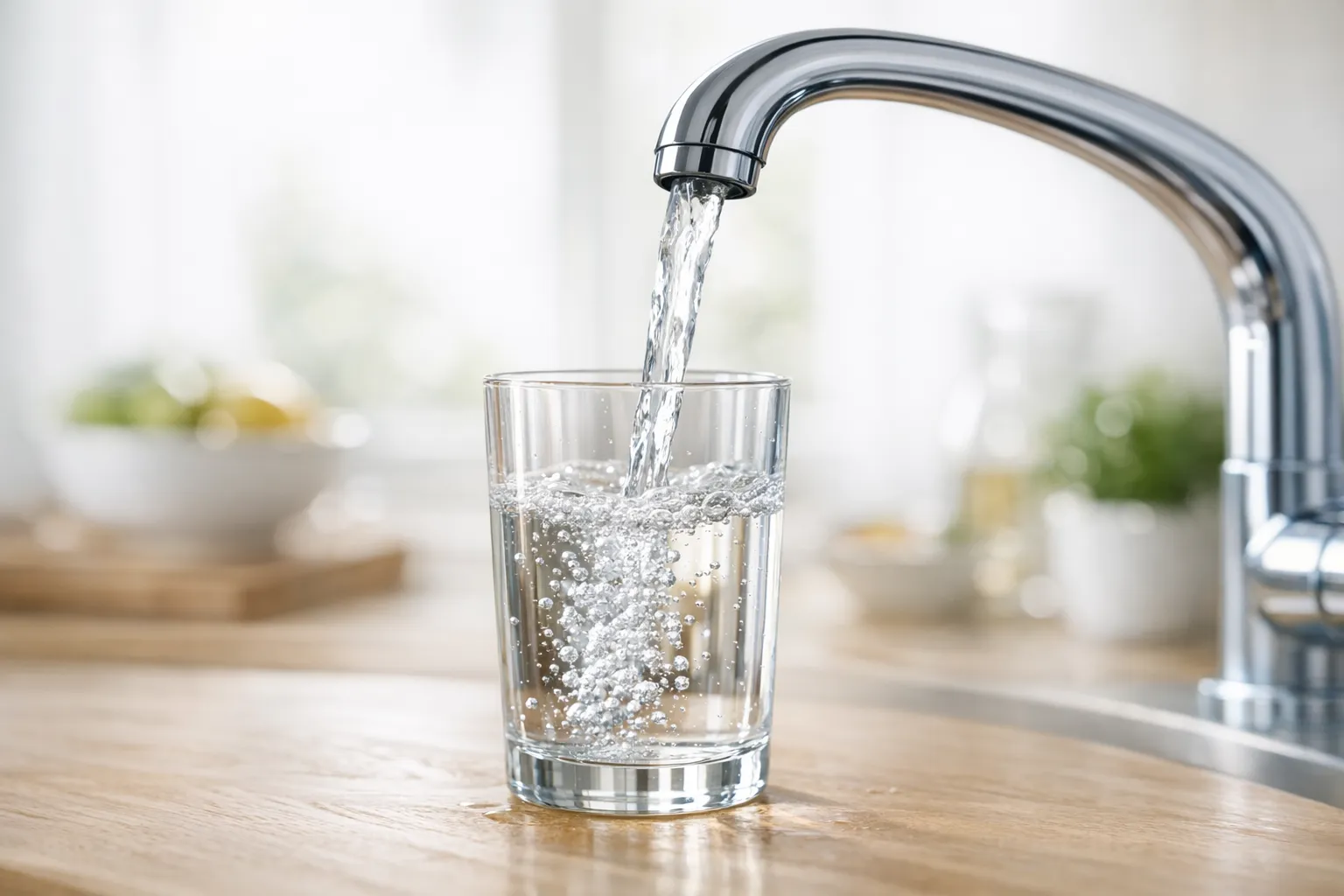
Most guides answer this question in one sentence and move on. The sentence is correct — but the four things they skip (why the water is legally food, the cold-tap rule, the cabin-well question, and the only two signs that ever say “don’t”) are what actually make you fluent. Two minutes, and this topic is settled for life.
When you need this
First morning, empty bottle, unfamiliar tap. Or you’re about to add a crate of bottled water to the cabin shopping list. Or the stuga’s water comes from a well in the garden and you’re suddenly not sure what the rules are.
The answer, and why it’s this good
Swedish tap water isn’t just “safe” — it’s legally a foodstuff. The Swedish Food Agency (Livsmedelsverket) regulates drinking water under binding food-law rules (LIVSFS 2022:12), covering every municipal supply plus the water used by schools, hospitals and food businesses. Waterworks test continuously; big utilities like Stockholm’s publish annual quality certificates.
The rules got tighter on 1 January 2026, not looser: the limits for arsenic and lead were halved, binding limits for PFAS came into force at levels stricter than the EU minimum, several new substances were added to the testing list, and waterworks must now monitor their raw water as well as the treated supply.
Culturally, the consequence is total: Swedes drink from the tap, restaurants pour it proudly, offices stock nothing else, and the bottled still water in the supermarket exists for habit, not health. Order kranvatten with your meal — it’s a completely normal request, customarily free with food.
The cold-tap rule
The one refinement locals grow up with: drink and cook from the cold tap. Hot tap water is not classified as drinking water in Sweden — it’s been sitting in heaters and pipes — so the guidance is simple: draw cold, then heat it yourself. It matters most for baby formula and tea; for everything else it’s just the correct default. (After a tap has sat unused overnight or between guests, run it cold for half a minute first — standard practice in any building, anywhere.)
Cabin wells: the one real exception
Out in stuga country, the tap isn’t automatically municipal: many rural cabins and summer houses run on a private well (egen brunn). Most are excellent — but well quality is the property owner’s responsibility, not the state’s, and testing for private households is recommended rather than enforced.
There is one threshold almost nobody knows, and it decides the honest answer. A well supplying rented accommodation for at most eight guests sits outside the drinking-water regulations entirely. Above eight, the same well becomes a commercial drinking-water facility: registered with the municipality, hazard-analysed, and sampled on an approved programme. So whether a cabin’s water is state-controlled depends on how many beds it has — a big rental cottage is held to a standard the little red stuga next door is not.
Either way, the whole precaution is one question to your host: “Municipal water or your own well — and if a well, when was it last tested?” Any good cabin owner answers instantly. For a rented stuga, the answer is usually in the listing; more on cabin realities in what to expect in a Swedish holiday cabin.
The two signs that mean “don’t drink”
Sweden will only ever warn you off water in two ways:
- Ej dricksvatten — “not drinking water.” Found on train and bus washroom taps (vehicle tanks, not the network), some campsite utility taps, garden irrigation points. It means exactly what it says.
- Kokningsrekommendation — a boil-water notice, issued by a municipality when tests find contamination after pipe work or flooding. Rare, local, loudly publicized through municipal channels and Krisinformation. Boil until the all-clear, then stop.
Everything unmarked and municipal: drink freely. That’s the entire national system, and its brevity is the point.
Mistakes to avoid
- Buying bottled still water by the crate out of home habit — ~20 kr a bottle for something the tap does better.
- Making formula from the hot tap to save three minutes.
- Assuming the cabin’s garden well is municipal-grade without asking.
- Dismissing an ej dricksvatten sticker because “Swedish water is safe” — the network is safe; that tank isn’t the network.
- Misreading a dry-summer bevattningsförbud (garden-watering ban) as a drinking-water problem — it never is.
Good to know
- Refill culture is universal: cafés, gyms, libraries and many parks will fill your bottle without a blink. In the wild, it’s a different judgment — high fjäll streams versus lowland waters — covered properly in drinking water outdoors.
- Taste tourism, unofficially: soft mountain water in the north, harder groundwater in the south. All excellent; subtly different. Swedes will happily debate whose kommun wins.
- The sparkling aisle is the real one. Swedes buy kolsyrat vatten (or carbonate at home) — bubbles are the only good reason to pay for water here.
- Restaurant maths: kranvatten free, bottled 30–60 kr. Over a two-week family trip, that habit difference buys a nice dinner. More menu strategy in eating out in Sweden.
Practical information
| Item | Detail |
|---|---|
| Municipal tap water | Drink everywhere, regulated as food |
| Drinking source | Cold tap (hot tap isn’t drinking-water classed) |
| Restaurants | Ask for kranvatten — normal, customarily free with meals |
| Cabins | Ask: municipal or private well; if well, last test date |
| The only “no” signs | Ej dricksvatten stickers · kokningsrekommendation notices |
FAQ
Can you drink tap water in Sweden?
Yes, everywhere on the municipal network — it’s among the best tap water in the world and legally held to food-grade standards set by the Swedish Food Agency. Locals drink it exclusively; restaurants serve it; bottled still water is a habit, not a need. The only real exceptions: private cabin wells (ask the host) and taps explicitly marked ej dricksvatten.
Is Swedish tap water safe for babies and formula?
Yes, with one rule: use the cold tap. Hot tap water isn’t classified as drinking water in Sweden, so draw cold and heat it yourself for formula, food or tea. On municipal supply that’s the whole precaution; at a cabin on a private well, ask the owner about the latest water test first.
Do restaurants in Sweden serve free tap water?
Customarily yes — ask for kranvatten and it arrives, usually free with food, sometimes with a small charge at the fanciest end. It’s an entirely normal request, not a budget-traveler faux pas; Swedes order it constantly. Bottled water on the menu is for bubbles, not safety.
What is a kokningsrekommendation?
A boil-water notice — the municipality’s instruction, after contamination is found (typically following pipe work or flooding), to boil tap water before drinking or cooking until further notice. They’re rare, local and well-publicized through municipal channels and Krisinformation. If you see the word, boil; when the all-clear comes, stop. That’s the entire system.
Can I drink the water at a Swedish summer cabin?
Usually yes — but ask one question first: municipal water or private well (egen brunn)? Municipal is guaranteed food-grade. A well is the owner’s responsibility; most rural wells are excellent, but quality isn’t state-tested for private households, so ask when it was last tested — any good host knows. One size threshold is worth knowing: a well supplying rented accommodation for more than eight guests counts as a commercial supply and must be registered and sampled under municipal control, so larger rental cabins are held to a standard smaller ones are not.
Is there PFAS in Swedish tap water?
Sweden regulates it tightly. Binding limits for PFAS4 and PFAS21 took effect on 1 January 2026 under the drinking-water rules, and the Swedish limits are stricter than the EU minimum. The same update halved the limits for arsenic and lead and now requires waterworks to monitor raw water, not just treated water. Municipal tap water is tested against these limits continuously.
Why does the train toilet tap say “ej dricksvatten”?
Because that water comes from the vehicle’s own tank, not the drinking-water network — it’s for handwashing only. Ej dricksvatten means “not drinking water,” and it’s one of only two signs in Sweden (the other being a boil notice) that ever tells you not to drink. Everywhere unmarked and municipal: drink away.
Related guides
- Refilling water outdoors: streams, taps and stations — the wilderness version of this question
- What to expect in a Swedish holiday cabin — wells, outhouses and other stuga realities
- Public toilets in Sweden — the other everyday logistics question
- Eating out in Sweden — the kranvatten habit and other menu math
Facts verified 2026-07-25, including the drinking-water limits that took effect on 1 January 2026. Sources: Livsmedelsverket (the Swedish Food Agency), Krisinformation.se, Stockholm Vatten och Avfall — full register in this topic’s source file. Found something outdated? Tell us and we’ll fix it.