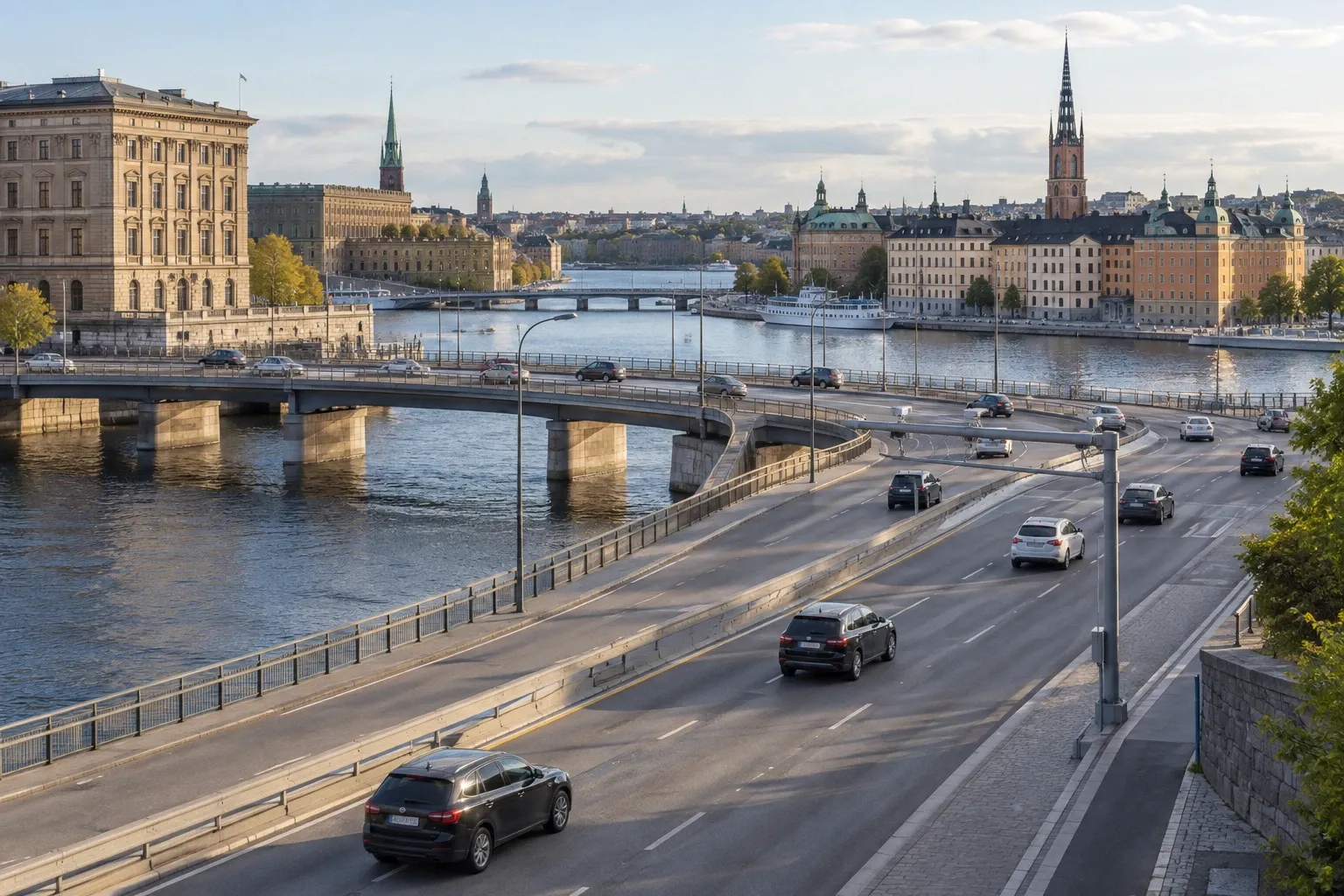
You won’t see a booth, a barrier or a ticket machine. The gantry photographs your plate, and the bill finds you at home weeks later. Here is what you’ll pay, when, and how the letter reaches a foreign car.
When you need this
You’re driving into Stockholm or Gothenburg, or taking the E4 past Stockholm, in your own car or a rental. Or a July road trip goes through one of the cities. Or an envelope from EPASS24 has just arrived and you’re wondering whether it’s real.
How the congestion tax works
Trängselskatt (congestion tax) is a state tax set by Lag (2004:629) om trängselskatt. You’re charged when your car passes a control point (betalstation) in Stockholm or Gothenburg, and those are the only two cities that have one.
Nothing happens at the roadside. Cameras read the number plate, and the owner is billed afterwards for the whole calendar month. Transportstyrelsen (the Swedish Transport Agency) takes the decisions on behalf of Skatteverket, the tax agency.
The owner pays, and that includes an owner listed in a foreign vehicle register. That has been the law since 1 January 2015. If you rent, the owner is the rental company.
The two cities follow different rules, set out in two separate annexes to the law.
Stockholm: seasons, peaks and Essingeleden
Stockholm charges on weekdays from 06:00 to 18:29, at rates that depend on the time of day and the season:
- High season: 1 March to the day before Midsummer Eve, and 15 August to 30 November.
- Low season: the rest of the year, which means from 1 December this year.
The peaks are 07:00–08:29 and 16:00–17:29. The midday window, 09:30–14:59, costs 11 kr a passage all year, so it’s the time to cross if you can choose.
Every passage is charged until the daily cap for that car is reached.
Essingeleden, the E4 bypass west of the centre, has its own control line. Through traffic on the E4 is charged even if you never enter the inner city. Its peak rates are a little lower than the inner city’s. Passing both the Fredhäll and Kristineberg points counts as one passage. Traffic to and from Drottningholmsvägen east of Essingeleden, or Lindhagensgatan, is not charged there.
Gothenburg: one charge per hour
Gothenburg charges on the same weekday hours, 06:00–18:29, at 9, 16 or 22 kr a passage, with no seasons. Two rules make it gentler than Stockholm:
- The 60-minute rule. If you pass several control points within 60 minutes, you pay once, at the highest amount among those passages.
- A lower daily cap of 60 kr per car.
There is also a Backa rule. Some control points in the Backa area charge only if the car passes another control point within 30 minutes, so traffic just passing through that area isn’t taxed.
Holidays and July
| Stockholm | Gothenburg | |
|---|---|---|
| Weekends and public holidays | Free | Free |
| Day before a holiday | Free, except the days before Good Friday, Ascension Day and All Saints’ Day, and the days before 1 May and National Day when they fall on a weekday | Free, no exceptions |
| July | First five weekdays charged, the rest free | Free all month |
For the rest of 2026, the only weekdays with no Stockholm charge are 24, 25 and 31 December. Transportstyrelsen publishes each year’s list.
How a foreign car gets billed
You don’t pay at the roadside, and there’s nothing to register before you drive. After the month of travel:
- Transportstyrelsen decides the tax, one decision per car per month, by the 20th of the next month.
- Its notification partner finds the owner from your home country’s vehicle register and sends the invoice by post via EPASS24.
- Pay by the date printed on it. By law that falls no later than the last day of the second month after the month you drove.
If you’d rather not wait for the letter, you can register with EPASS24 to see and pay your passages online.
Paying late adds a 500 kr surcharge (tilläggsavgift), at most once per car per month. The tax and surcharge then fall due within 30 days, after which the debt is sent for enforcement.
Think a charge is wrong? Ask Skatteverket for a review (omprövning) within 60 days of the decision. Pay by the due date anyway: a review does not pause it, and a late payment still triggers the surcharge. Skatteverket may also waive tax or surcharge where charging it would be manifestly unreasonable.
Scam warning: Transportstyrelsen never demands congestion-tax payment by email or text message. A message with a payment link is a scam. The real foreign invoice comes by post.
Rental cars
With a rental, the company is the owner, so it receives the tax decision and pays it. It then charges you, usually adding an administrative fee and VAT, and that charge can reach your card weeks after you returned the car. The fee comes from your rental contract, not from the state.
Ask at the desk how the company bills congestion tax before you drive into either city. Our guide to renting a car in Sweden covers the other charges that follow a rental home.
Who is exempt
- Motorcycles. The tax applies only to a bil (car, lorry or bus).
- Emergency vehicles, buses of 14 tonnes or more, diplomatic cars and military vehicles. Trailers, tractors and motorized equipment fall outside the tax too.
- Disabled parking permit holders, including those with a permit from another EEA country, can apply to Skatteverket to exempt a car (two cars in special cases). The permit alone exempts nothing: apply before you travel. The exemption doesn’t cover a car used in commercial traffic or as a taxi.
Electric cars pay like any other car. The law lists no exemption for them.
Four myths that cost visitors money
| Myth | Reality |
|---|---|
| “Foreign cars don’t pay.” | They have since 1 January 2015. |
| “My electric car is exempt.” | The law lists no exemption for electric or clean cars. |
| “July is free.” | Only in Gothenburg. Stockholm charges the first five weekdays. |
| “Gothenburg’s one-charge-per-hour rule works in Stockholm.” | Stockholm charges every passage up to the daily cap. |
Practical information
| Item | Detail |
|---|---|
| Hours, both cities | Weekdays 06:00–18:29 |
| Stockholm inner city | 11–45 kr a passage (peak 45 kr high season, 35 kr low season) |
| Stockholm Essingeleden | 11–40 kr a passage (peak 40 kr high season, 30 kr low season) |
| Stockholm cheapest window | 09:30–14:59, 11 kr |
| Stockholm daily cap | 135 kr high season, 105 kr low season |
| Gothenburg | 9, 16 or 22 kr a passage; once per 60 minutes |
| Gothenburg daily cap | 60 kr |
| Late-payment surcharge | 500 kr per car per month |
| Review deadline | 60 days from the decision, to Skatteverket |
| Foreign-car invoices | By post via EPASS24 |
| Rental admin fee | Set by the rental contract |
| Rates checked | 2026-09-24, against the law and Transportstyrelsen |
FAQ
Do foreign cars have to pay congestion tax in Sweden?
Yes. Since 1 January 2015 the tax falls on the owner listed in a foreign vehicle register as well as a Swedish one. Cameras read the plate, and Transportstyrelsen’s partner finds the owner and sends an invoice by post through EPASS24. Older pages saying foreign cars are exempt describe the rules before 2015.
How much is the congestion tax in Stockholm?
Between 11 and 45 kr per passage on weekdays from 06:00 to 18:29, depending on the time and the season. Peak hours cost 45 kr in high season and 35 kr in low season, and the 09:30–14:59 rate is 11 kr all year. Every passage is charged, up to 135 kr a day in high season or 105 kr in low season.
Is there congestion tax in July?
In Gothenburg, no: the whole of July is free. In Stockholm, only the first five weekdays of July are charged; the rest of the month is free. Both cities also charge nothing on weekends, public holidays and most days before a holiday. Stockholm does charge a few of those days, for example the day before Good Friday.
How do I pay congestion tax with a foreign car?
You don’t pay at the roadside. After the month of travel, an invoice arrives by post from Transportstyrelsen’s notification partner via EPASS24. Pay it by the date printed on it. You can also register with EPASS24 to see and pay your passages online. Paying late adds a 500 kr surcharge per car and month.
Who pays congestion tax on a rental car?
The rental company does, as the car’s owner, and then charges you. Companies usually add an administrative fee and VAT, set by the rental contract, so the card charge can arrive weeks after you return the car. Ask at the desk how the company bills congestion tax before you drive into Stockholm or Gothenburg.
What is the 60-minute rule in Gothenburg?
If you pass several Gothenburg control points within 60 minutes, you are charged once, at the highest amount among those passages. Together with the 60 kr daily cap, this keeps errand-heavy days cheap. Stockholm has no such rule: each passage there is charged separately until the daily cap is reached.
Do I pay congestion tax driving through Stockholm on the E4?
Yes, if you use Essingeleden, the E4 bypass west of the centre. Crossing its control line is charged on weekdays at up to 40 kr in high season, even if you never enter the inner city. Passing both the Fredhäll and Kristineberg points counts as one passage.
What if I don’t pay the congestion tax invoice?
A 500 kr surcharge is added, at most once per car per month, and the tax plus surcharge fall due within 30 days. After that the debt is sent for enforcement. For a Swedish-registered car, Kronofogden adds a 600 kr base fee. Contesting the charge does not delay the due date.
Related guides
- Driving in Sweden: the core rules for the same trip, from headlights to the 0.2 limit
- Renting a car in Sweden: insurance, damage and every charge that follows a rental home
- Bridge tolls and EPASS24 invoices: the other camera-billed state charge
- Driving to Sweden from Germany: the bridge and ferry tolls on the way up
- Parking in Sweden: the other cost of bringing a car into the cities
Facts verified 2026-09-24. Sources: Lag (2004:629) om trängselskatt (Sveriges Riksdag), Transportstyrelsen, Skatteverket — full register in this topic’s source file. Found something outdated? Tell us and we’ll fix it.