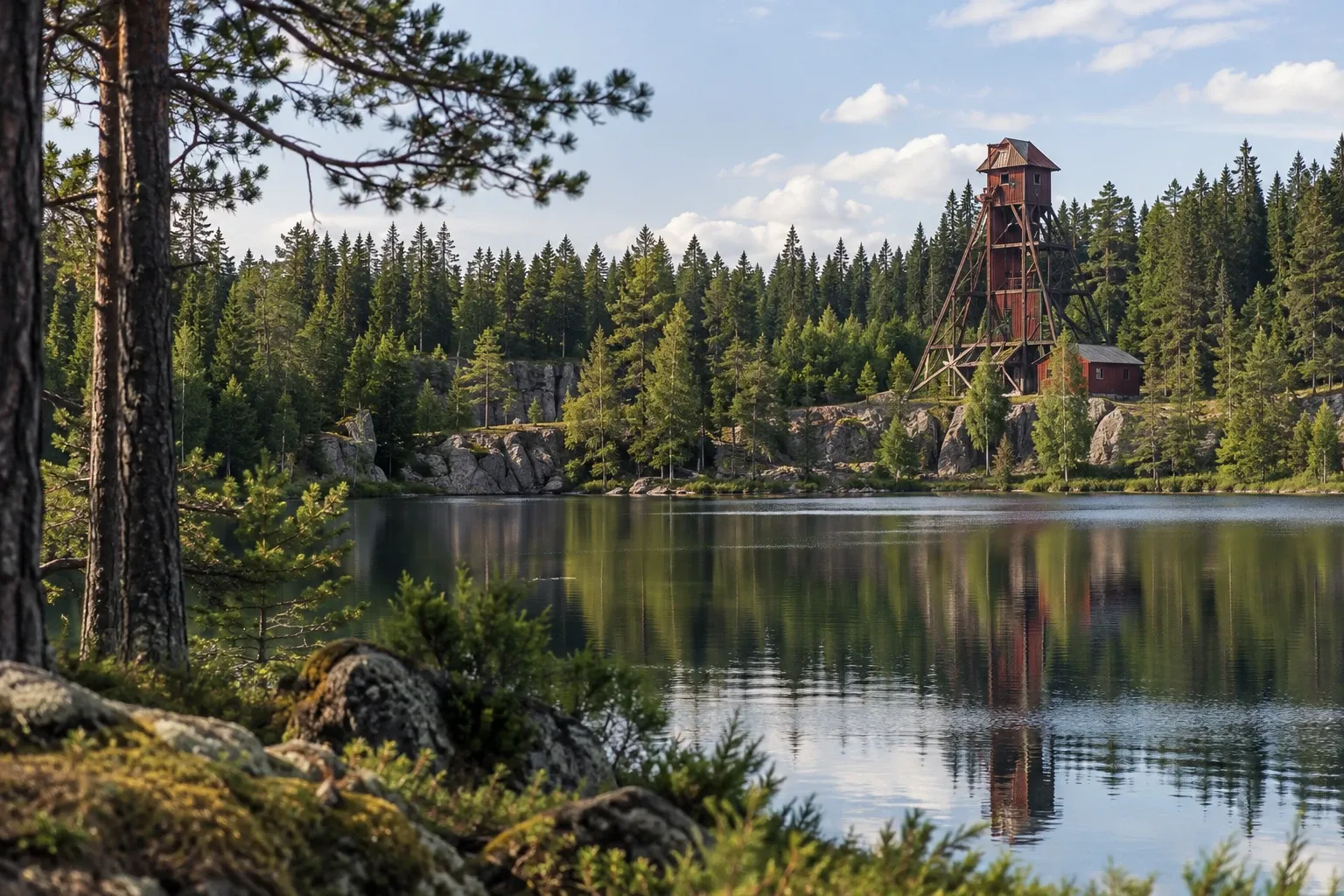
Bergslagen has no border, no county board and no single ticket. What it has is six centuries of mines, furnaces and ironworks villages in forest and lake country. Here they are sorted into four areas you can actually plan around, with the season for each site.
When you need this
You saw “Bergslagen” on a train or a map and want to know if it’s somewhere you can go. You’re planning a day trip from Stockholm, Västerås or Örebro to a mine or an ironworks. Or it’s October, and you need to know what is still open.
What Bergslagen is, and isn’t
Bergslagen is a historical mining district, named for its mines (berg means rock or mine). The Ekomuseum Bergslagen foundation describes it as a large, loosely bounded area covering parts of Värmland, Närke, Västmanland, Dalarna, Uppland and Gästrikland. The word was probably first used for a region around medieval Norberg, which had its own court in 1400. A royal charter of 1444 allowed a smelting house there, and the name was applied to a large area from 1508.
So don’t look for a “Bergslagen county” or a regional pass. Each site has its own owner, season and booking system. Falun’s copper mine marks the northern edge, and it is a World Heritage site in its own right; see Falun and the copper mine.
The four areas
| Area | Main sites | Season in practice |
|---|---|---|
| Sala, northern Västmanland | Sala Silver Mine; Hälleskogsbrännan fire area | Mine tours every day of the year; reserve open all year |
| Ludvika–Fagersta–Västerås valley | Engelsberg Ironworks, Norberg, Fagersta, Grängesberg, Strömsholm Canal | Guided tours mainly in summer |
| Nora and Kilsbergen, Örebro county | Nora, Pershyttan, the heritage railway, Bergslagsleden | Railway late June–August; town and trail all year |
| Filipstad, eastern Värmland | Långban mining village | Summer only |
Measured driving times, without stops:
| Route | Distance | Time |
|---|---|---|
| Stockholm–Sala | 117 km | about 1 h 40 min |
| Stockholm–Ängelsberg (Engelsberg) | 165 km | about 2 h 15 min |
| Stockholm–Nora | 229 km | about 2 h 55 min |
| Örebro–Nora | 34 km | about 35 min |
| Västerås–Ängelsberg | 61 km | about 1 h |
| Nora–Långban | 74 km | about 1 h 15 min |
Engelsberg Ironworks
Engelsberg (Engelsbergs bruk), at Ängelsberg in Fagersta municipality, is an ironworks founded in 1681. Its manor, park, offices, workers’ housing and industrial buildings survive. Sweden’s heritage board calls it the only Swedish works that keeps both its buildings and most of its technical equipment, and it has been a World Heritage site since 1993.
It has also been privately owned since 1916, and that shapes a visit. Guided tours run at 11:30 and 14:00 on selected dates, in Swedish or English, booked and paid online; no cash is taken. Regular tours ended for 2026 and return in May 2027. Outside tours you may walk the grounds and see the blast furnace from outside, but much of the area is private property, and the smithy is shown only on a tour. Private tours can be requested in September and October with a week’s notice.
For Engelsberg among Sweden’s other World Heritage sites, see UNESCO sites in Sweden.
Sala Silver Mine
Sala Silvergruva, in northern Västmanland, is the easiest Bergslagen site to visit: tours run every day of the year, and the grounds are free and open day and night. Silver was mined here from the late 1400s until 1908, and again after the Second World War until 1962. In 1538–48 it produced about 4,000 kg of pure silver a year, and Gustav Vasa called it the treasury of the realm.
Underground there are about 20 km of passages and some 200 rock chambers; the deepest shaft reaches 318.6 m, and a few thousand bats spend the winter here. The standard tour goes down to the 60-metre level and takes 75 minutes. Longer ones, such as the three-hour Stora gruvturen, cover more of the workings. Above ground the site has 48 historic buildings and two nature reserves.
Know the operator’s rules before you book:
- Stairs only. There is no lift; every tour goes down and up by stairs.
- It’s about 4 °C all year. Bring warm clothes and closed shoes, even in July.
- Minimum age is five, and children must walk the stairs themselves; no carrying, and no infants.
- Bookings are binding within 48 hours, and tours leave on time.
- Dogs are welcome on a lead above ground but banned underground and in most buildings.
- No mine? An exhibition ticket, paid on site at a price you choose, covers the exhibitions for the day.
Nora, Pershyttan and the heritage railway
Nora, in Örebro county, is a wooden town of 1700s and 1800s houses on a street grid. The municipality calls it one of northern Europe’s best-preserved wooden towns. The Göthlinska gården museum shows a town home from the late 1800s.
The Nora–Ervalla line of 1856 was Sweden’s first standard-gauge railway open to public traffic, and in 2026 it turned 170. A volunteer association, Nora Bergslags Veteran-Jernväg, runs summer trains to Järle and to Pershyttan. If you’ve read that the Nora railway has closed, that news is out of date. In May 2024 the association’s board resigned after a dispute with the foundation that owns the track, and that summer’s steam trains were cancelled. Trains ran again from 31 August 2024, and the 2026 season started on 27 June:
| Month (2026) | Trains |
|---|---|
| July | Railbus to Järle on Fridays; steam to Järle Saturdays and Sundays; railbus to Pershyttan on Saturdays |
| August | Steam to Järle on Saturdays; special timetable at Nora’s market on the last weekend |
At high fire risk the steam locomotive may be swapped for an old diesel. For how these lines work in general, see heritage railways and draisines.
Pershyttan, just south of Nora, is a mining village with roots in the 1300s. In 2004 the county board made it a kulturreservat (culture reserve), the only one in Örebro county. Its blast furnace is one of Sweden’s best-preserved charcoal furnaces, and in the Lockgruvan mine you go about 40 m underground.
Långban and Grängesberg
Långban, in Filipstad municipality in Värmland, is a mining village where iron was mined from the early 1500s until the 1970s. Värmlands Museum runs it today, with a mineral collection. It is the birthplace of John Ericsson, who designed the warship Monitor, and of his brother Nils Ericson, builder of canals and railways. In 2026 it opened daily from 6 June to 23 August, then on weekends to 27 September. Nearby, Tilas Stoll, a mine entrance in the Högbergsfältet nature reserve, is free to visit.
Grängesberg, in Ludvika municipality, was an iron-ore town whose mines date from the 1500s and closed in 1989. Mojsens museum has a show mine and archive, Stora Hagen has workers’ housing from 1898, and the railway museum (Lokmuseet) holds 135 locomotives, carriages and vehicles from the 1850s to the 1970s.
Hälleskogsbrännan: the forest after the fire
On 31 July 2014 a forest fire broke out in Västmanland. Norberg municipality calls it Sweden’s largest forest fire in modern times: about 13,100 hectares were burning at its peak, one person died and about 1,000 people were evacuated. Since 2015, 6,420 hectares of the burned area have been the Hälleskogsbrännan nature reserve.
It’s an unusual sight: a burned forest slowly coming back to life. The main visitor site, Grävlingsberget, has trails, a toilet, a barbecue area and a lookout tower that wheelchairs and pushchairs can reach but not go up. The Brandstigen trail starts where the fire began, and there are benches for stargazing. The reserve’s three entrances are at Hörnsjöfors, Virsbo (Skräddartorp) and Seglingsberg.
Two cautions. Dead trees fall more easily here, especially in wind, so stay off the trails in a storm and don’t camp under standing dead trees. And the reserve’s regulations are binding: no collecting firewood, no damaging trees, no digging, and cars only on the marked roads. Berries and edible mushrooms for your own use are allowed.
Ekomuseum Bergslagen
Ekomuseum Bergslagen isn’t a building but a network of about 70 heritage sites, from Engelsberg, Grängesberg and Fagersta to furnaces, mines and the Strömsholm Canal. It is run by a foundation of seven municipalities: Hallstahammar, Surahammar, Skinnskatteberg, Norberg and Fagersta in Västmanland, and Smedjebacken and Ludvika in Dalarna. It calls itself Sweden’s largest museum and turned 40 on 31 May 2026.
One change older guides miss: the nine-day Järnrutten week, long the classic way to see the sites, was scrapped in 2025. Opening hours and events are now in a year-round calendar on the ecomuseum’s website.
Getting around without a car
Regional trains do much of the work. Tåg i Bergslagen’s autumn 2026 timetables (valid to 12 December) run three lines:
| Line | Route | Useful for |
|---|---|---|
| 50 | Mora–Borlänge–Sala | Sala |
| 54 | Gävle–Fagersta–Örebro | Fagersta |
| 55 | Ludvika–Fagersta–Ängelsberg–Västerås | Engelsberg, Ludvika |
Some departures on line 55 carry footnotes at Ängelsberg, so check that your train stops before relying on it. Buses 61, 62 and 569 run from Sala’s station to the silver mine. Nora, Pershyttan, Långban and Hälleskogsbrännan are much easier by car. For tickets around Lake Mälaren, see Mälaren regional trains.
If you walk in the forest with a dog, keep it on a lead. In winter 2025/26 Örebro county had the most wolf territories in Sweden, followed by Västra Götaland and Västmanland; see wolves in Sweden.
When to go
June to August is when everything is open: Engelsberg’s tours, Långban, the Nora railway and Sala’s busiest season, when tickets are sold at the mine entrance. May and September still work for Sala, Hälleskogsbrännan, Nora’s streets and Långban’s weekends. October to April, plan around Sala’s daily tours and the open-air sites; the county board suggests Hälleskogsbrännan for ski tours and clear-night stargazing in winter. For hiking, Bergslagsleden runs 280 km through Örebro county in 17 stages, each with a wind shelter, fireplace, woodshed and toilet.
Practical information
| Item | Detail (checked 2026-10-15) |
|---|---|
| Sala Silver Mine grounds | Free, open day and night all year |
| Sala 60-metre guided tour | 275 SEK per person, 75 min (no year stated) |
| Sala exhibitions only | Pay what you choose, Swish or cash |
| Engelsberg guided tour | 100 SEK; under 12 free; online, no cash (no year stated) |
| Engelsberg regular tours | Return May 2027 |
| Långban 2026 season | 6 June–23 August daily, weekends to 27 September |
| Nora railway 2026 season | From 27 June, Fridays to Sundays in July, Saturdays in August |
| Hälleskogsbrännan, Tilas Stoll | Free |
| Långban, Nora railway, Pershyttan, Grängesberg prices | Set by each site yearly; check before you go |
FAQ
Where is Bergslagen in Sweden?
Bergslagen is Sweden’s historic mining district in the middle of the country, north and west of Lake Mälaren. It has no official borders: the area is usually taken to cover parts of Västmanland, Örebro county, southern Dalarna and eastern Värmland, with fringes in Uppland and Gästrikland. Sala is about 1 hour 40 minutes’ drive from Stockholm, Nora just under three hours.
What is there to see in Bergslagen?
Mostly industrial heritage in forest and lake country. The headline sites are Engelsberg Ironworks, a World Heritage site; Sala Silver Mine, with tours 60 metres underground; the wooden town of Nora with Pershyttan and its heritage railway; Långban’s mining village; and Grängesberg’s iron-ore town. Hälleskogsbrännan shows a forest regrowing after Sweden’s 2014 fire.
Can you visit Engelsberg Ironworks in autumn or winter?
Only the grounds. Engelsberg’s regular guided tours ended for 2026 and return in May 2027, and the smithy can only be seen on a tour. Outside the season you may walk the grounds and see the blast furnace from outside, respecting the private property. Private tours can be requested in September and October with a week’s notice.
Is Sala Silver Mine open all year?
Yes. Guided tours run every day of the year, and the grounds are free and open day and night. The standard tour goes down to the 60-metre level by stairs, as there is no lift, and the mine stays at about 4 °C all year. The minimum age underground is five, and children must walk the stairs themselves.
Can you reach Bergslagen without a car?
Partly. Tåg i Bergslagen’s regional trains reach Sala, Fagersta, Ängelsberg for Engelsberg, Ludvika and Västerås, and local buses run from Sala station to the silver mine. Nora, Pershyttan, Långban and the Hälleskogsbrännan reserve are far easier by car. Check that your train stops at Ängelsberg, since not every departure does.
Does the Nora heritage railway still run?
Yes. The volunteer association’s board resigned in May 2024 and steam trains were cancelled that summer, but trains ran again from 31 August 2024. The 2026 season started on 27 June with steam trains to Järle and summer railbuses to Pershyttan, and the line marked 170 years in September 2026. Check the association’s site for next summer.
Related guides
- UNESCO World Heritage sites in Sweden — where Engelsberg fits among the country’s 15 sites.
- Falun and the Falu copper mine — the copper side of Bergslagen, open all year.
- Örebro travel guide — the city base for Nora, Pershyttan and Bergslagsleden.
- Heritage railways and draisines — how museum lines and rail bikes work.
- Wind shelters on Swedish trails — for walking Bergslagsleden overnight.
Facts verified 2026-10-15. Sources: Ekomuseum Bergslagen, Engelsbergs bruk, Riksantikvarieämbetet, Sala Silvergruva, Nora Bergslags Veteran-Jernväg, Nora, Norberg and Ludvika municipalities, Filipstad tourist information, Länsstyrelsen Västmanland, Naturvårdsverket, Region Örebro län, Tåg i Bergslagen, SVT — full register in this topic’s source file. Found something outdated? Tell us and we’ll fix it.