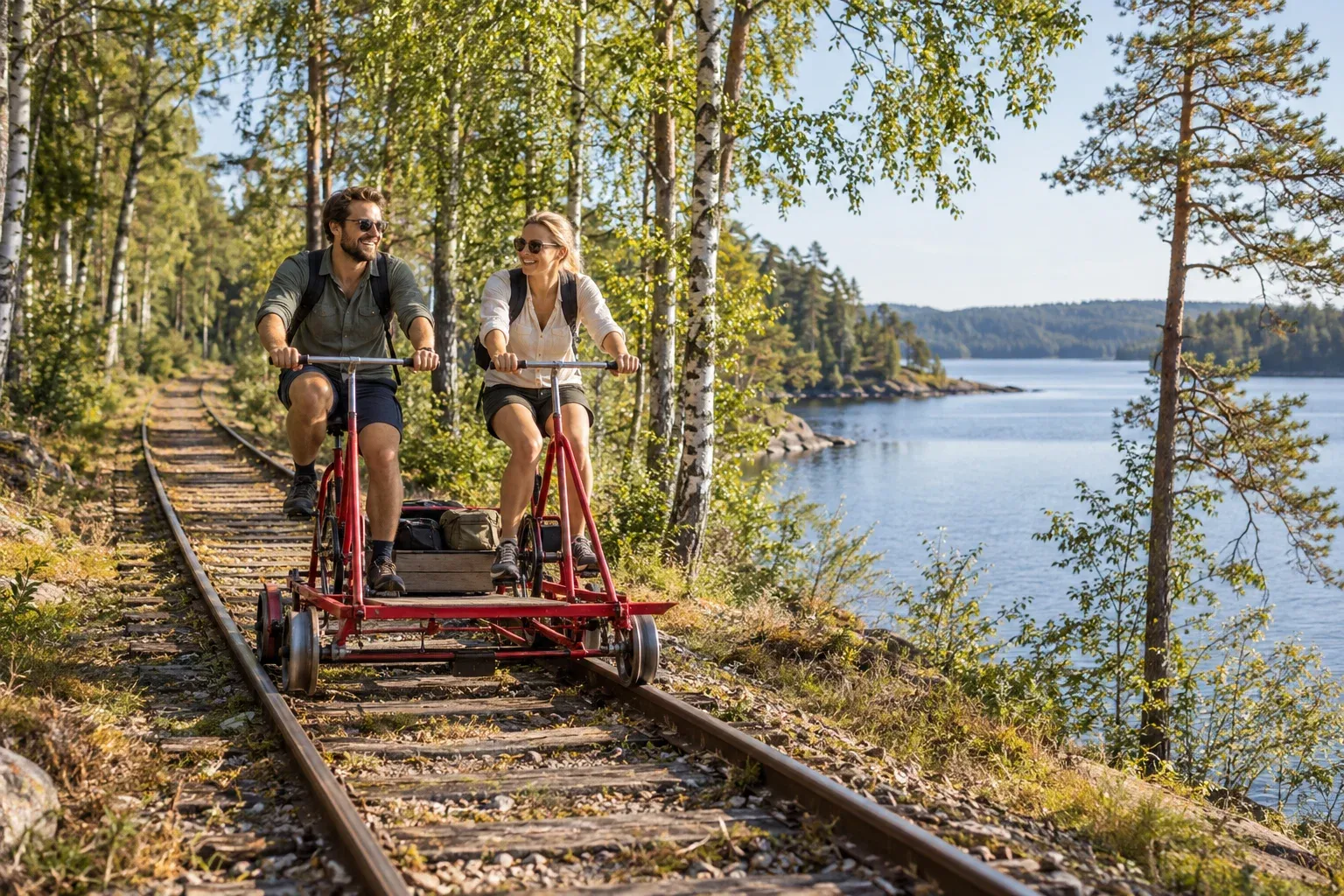
Pedalling a rail bike through forest and past lakes on a line that lost its trains decades ago is one of Sweden’s best family days out. It takes no skill beyond cycling, but every line has its own season, booking rules and a rule for who gives way.
When you need this
You’re in Sweden in summer with a car, a bike or children, and a tourist leaflet says dressinuthyrning (draisine rental) or museijärnväg (museum railway). Or you’ve found an old track in the woods and wonder whether you can just walk along it. This page explains how both activities work, what the operators expect of you, and where the law draws the line.
What a draisine is
A dressin is a light rail vehicle with pedals, a saddle and usually a bench for a passenger. You ride it along an old railway line at around 10 km/h, which is gentle enough for most adults and older children.
Many Swedish branch lines lost their regular trains long ago, yet the track is still there on some of them. The 122 km narrow-gauge Växjö–Västervik line, for example, carried passengers until 1984 and is now kept by a volunteer association. Local operators, often associations or municipal tourist offices, rent draisines on such track. Some museum railways rent them too, on days without trains.
How a draisine day works
Most lines run out and back. You pedal as far as you like, lift the draisine round, and ride back. On DVVJ’s 50 km line in Dalsland and Värmland, the operator says many customers ride about halfway before turning. Some operators can carry the draisine back for an extra fee.
| Step | What to do |
|---|---|
| Choose a line | Check the operator’s season; most open in May and close in September |
| Book | Online or by phone; in summer, book ahead. Gullspång needs two days’ notice from 1 September |
| Pick a vehicle | A single draisine takes one or two people, a tandem two or three |
| Plan the distance | About 10 km/h, plus stops; half a long line and back is a full day |
| Get the briefing | Ask who gives way, how to lift the draisine, where you must stop |
The rules on the rails
The law is short. Nobody may enter a railway track area without permission from the track’s manager or a railway company, except at places clearly open to the public such as stations and level crossings. Breaking that ban is punished with a fine. A draisine booking is your permission, for that line, on that day. Heritage and tourist lines fall under Sweden’s Act on national railway systems, which also bans drinking alcohol on the railway except at licensed serving or with the operator’s permission.
These rules come from the 2022 railway acts. The old Railway Act of 2004, still quoted on some older pages, was repealed on 1 June 2022.
The rest is set by each operator. Two lines, two different meeting rules:
| Rule | DVVJ (Dalsland–Värmland) | Gotlandståget (Gotland) |
|---|---|---|
| Who gives way at a meeting | Draisines coming from Årjäng have priority | Riders heading out from Hesselby give way |
| Road crossings | Stop at every crossing | Stop at stop signs and walk across |
| Switches | Not stated | Stop and walk the draisine over |
| Spacing and speed | At least 20 m apart, max 10 km/h | Take care on downhill meetings |
| Alcohol | Advised against | Not stated |
On a single track, giving way means lifting your draisine off the rails so the other one can pass. Lift by the frame or the handles under the bench, never by the saddle or handlebars. Downhill meetings are where it goes wrong: Gotlandståget warns riders to take special care there, and Gullspång warns about braking on the slope back into town.
Draisines with children
This is the question families should ask before booking, because the answers differ:
- DVVJ seats small children with an adult and recommends helmets for them.
- Gullspång allows two adults and one child per draisine, and no dogs.
- Gotlandståget requires the renter to be 18, allows at most two people per draisine, and does not take small children who cannot hold on by themselves, because they can be hurt in a derailment.
Dogs vary too: DVVJ lets you bring one if you think it will cope, and Dressin på Österlen asks for dogs to be on a leash. Pack water, snacks, a sun hat and insect repellent; many lines run through forest with no shop along the way. For more ideas, see our guide to Sweden with kids.
Museum railways
Museijärnvägar are volunteer-run lines with historic steam, diesel or railbus traffic, mostly on summer days. Each is run by its own association. Svenska Järnvägsklubben, often named in connection with them, is the national enthusiasts’ club and magazine publisher, not a line operator.
| Railway | Where | What to know |
|---|---|---|
| Lennakatten | Uppsala Östra–Faringe, 33 km, 891 mm narrow gauge | Steam, diesel and railbuses; 2026 season over, no Christmas trains this year because of a bridge replacement; back summer 2027 |
| Östra Södermanlands Järnväg | Mariefred–Läggesta, near Stockholm | From 1 May to mid-September; no advance booking; 50% off with Interrail or Eurail |
| Anten–Gräfsnäs Järnväg | Near Alingsås, 12 km to Gräfsnäs castle park | Summer months; water stop at Kvarnabo, locomotive turned on a turntable; tickets only at Anten or Gräfsnäs station |
| Gotlands Hesselby Jernväg | Hesselby (Dalhem)–Roma, Gotland | Diesel-hauled trains; autumn and Christmas event trains in 2026, including an All Saints’ train on 31 October |
The Mariefred line pairs well with Gripsholm Castle and the steamboat; see our Mariefred guide. To find more lines, ask the regional tourist office or browse the enthusiasts’ federation Järnvägshistoriska Riksförbundet (JHRF).
Where to ride a draisine
| Region | Operator | Track |
|---|---|---|
| Dalsland–Värmland | DVVJ | 50 km Bengtsfors–Kyrkerud (Årjäng); trains south to Mellerud |
| Västergötland–Värmland | Gullspång | Torvedsbanan 12.5 km; Trelänsbanan 38 km to Degerfors |
| Småland | Smalspåret Växjö–Västervik | Draisines from Virserum, Flaten, Hultsfred and Åseda; railbus Virserum–Åseda |
| Skåne | Dressin på Österlen | Tomelilla–Fyledalen and S:t Olof–Gyllebo |
| Gotland | Gotlandståget | From Hesselby: about 5.5 km to Tule (1 hour) or 13 km to Roma (2 hours), only on non-train days |
On Gotland and the Växjö–Västervik line, the same association runs both trains and draisines, so you can do both in a day when the timetable allows. Getting to the lines by public transport is covered in our guide to train travel in Sweden.
Mistakes to avoid
- Treating a disused line as a free path. If the rails are still there, the line has a manager and the trespass ban applies. Only converted trails with the rails removed are open to all.
- Turning up in late September without a booking. Most lines close mid- to late September.
- Planning 50 km in an afternoon. At 10 km/h with stops, half a long line and back fills a day.
- Bringing a toddler without checking the operator’s child rule.
- Expecting online museum-train tickets. Anten–Gräfsnäs sells only at its stations, and ÖSlJ doesn’t sell in advance.
Practical information
| Item | Detail |
|---|---|
| Draisine season | Mostly May–September; Gullspång 2026: 2 May–20 September (checked 2026-10-06) |
| Booking | With each operator; Gullspång needs two days’ notice from 1 September |
| Draisine rental | Priced per operator by hour, half day or day |
| Return transport of the draisine | Extra fee where offered (DVVJ) |
| Museum trains | Operator’s fare by route; ÖSlJ 50% off with Interrail or Eurail |
| Trespassing on track | Fine (penningböter) |
| 2027 dates | Published by each operator in spring |
FAQ
What is a dressin in Sweden?
A dressin (draisine) is a light rail vehicle you pedal along an old railway line, like a bicycle on rails. In Sweden you rent one from a local operator for an hour, a half day or a full day. You ride at around 10 km/h, give way to oncoming draisines according to the line’s rule, and usually turn back the way you came.
Can you ride a draisine with children?
Usually yes, with limits. DVVJ seats small children with an adult and recommends helmets; Gullspång allows two adults and a child per draisine. Gotlandståget requires the renter to be 18 and does not take small children who cannot hold on by themselves, because of the injury risk in a derailment. Check the operator’s rule before you book.
What happens when two draisines meet?
On a single track one of them lifts off and lets the other pass. Each line decides who gives way: on DVVJ, draisines coming from Årjäng have priority; on Gotland, riders heading out from Hesselby give way. Lift by the frame or the handles under the bench, never by the saddle or handlebars, and take care on downhill sections.
Can I walk or cycle on an abandoned railway track?
Not if the rails and track area are still there. Swedish law forbids anyone to enter a track area without permission from the infrastructure manager or a railway company, except at places clearly open to the public, and the penalty is a fine. Former lines with the rails removed and turned into cycle trails are a different matter.
When is draisine season in Sweden?
Mostly from May to September. Gullspång’s 2026 season ran from 2 May to 20 September, with the most opening days between midsummer and late August; Dressin på Österlen planned weekend openings into October. Gotlandståget had already closed for 2026 by early October. Dates for 2027 are published by each operator in spring.
Where can I ride a steam train in Sweden?
On museum railways, mostly in summer. Lennakatten runs 33 km from Uppsala Östra to Faringe with steam and diesel trains; Östra Södermanlands Järnväg runs between Mariefred and Läggesta; Anten–Gräfsnäs Järnväg near Alingsås runs 12 km to Gräfsnäs castle park. Each is run by volunteers and publishes its own timetable.
Related guides
- Mariefred and Gripsholm — the ÖSlJ steam train with a castle and a steamboat
- Inlandsbanan — a summer tourist train on a working line through the interior
- Sweden with kids — more family days out
- Gotland and Visby — combine the island with Gotlandståget
- Cycling in Sweden — the road rules once you’re back on two wheels
Facts verified 2026-10-06. Sources: Sveriges Riksdag (railway acts of 2022), DVVJ, Gullspång tourist information via Västsverige, Gotlandståget, Dressin på Österlen, Smalspåret Växjö–Västervik, Lennakatten, Anten–Gräfsnäs Järnväg, Östra Södermanlands Järnväg, Svenska Järnvägsklubben and JHRF — full register in this topic’s source file. Found something outdated? Tell us and we’ll fix it.