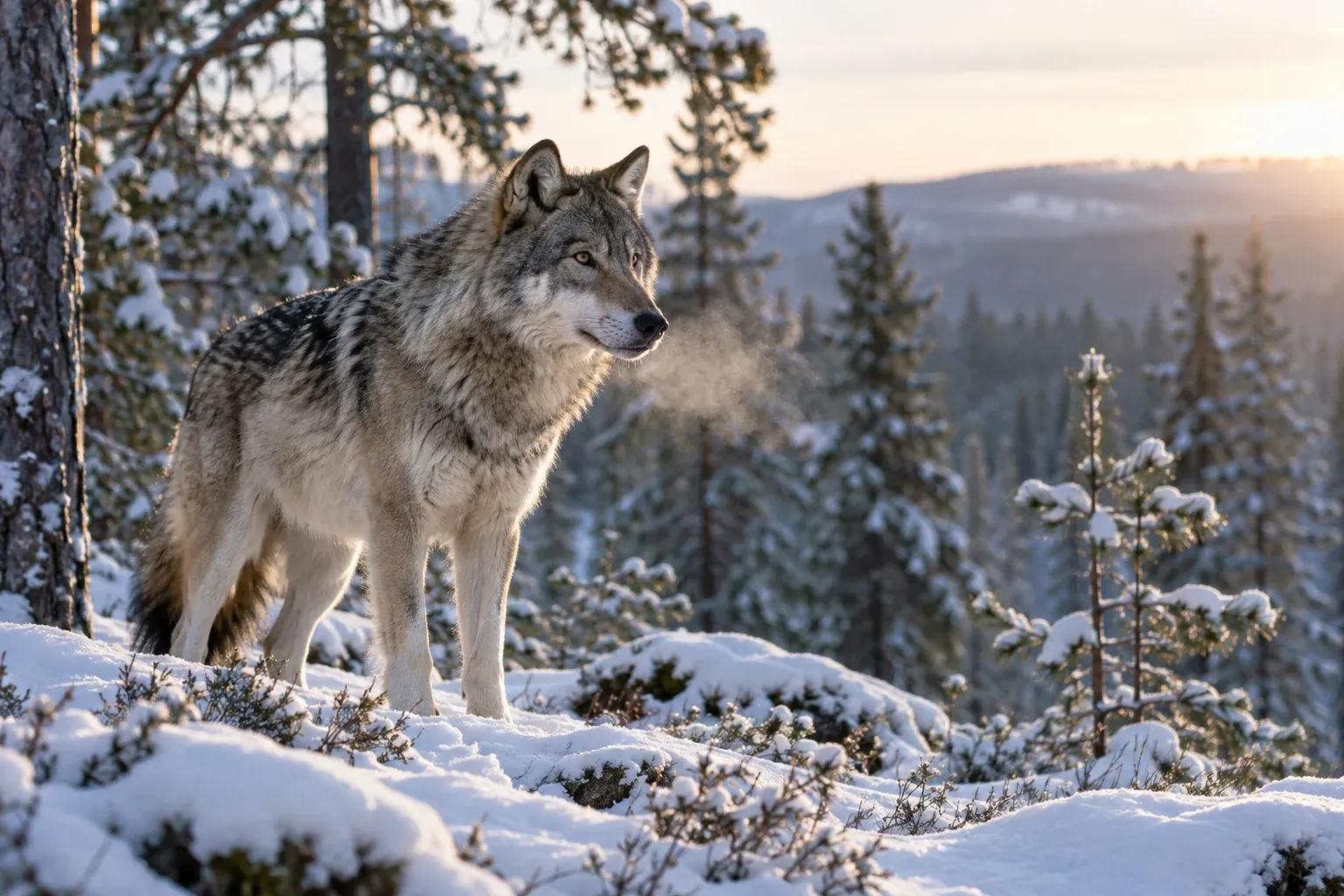
Sweden has wolves, and they are not a danger to you. They can be a danger to a dog running loose. This guide gives you the current count, where wolves live now, what to do if you meet one, and what the law lets you do to protect your dog.
When you need this
You’re planning a hike, a mushroom walk or a berry trip in central Sweden: Örebro, Västmanland, Västra Götaland, Värmland, Dalarna or Gävleborg. You’re travelling with a dog, especially one used to running off-leash. You’ve just seen a wolf by the road or tracks in the snow. Or you’re coming in January or February and have read that a wolf hunt might be on.
How many wolves, and where
Sweden’s wolves (varg) belong to one population shared with Norway. Naturvårdsverket, the Swedish Environmental Protection Agency, counted about 390 wolves in Scandinavia in winter 2025/26, about 355 of them in Sweden. A newer, DNA-based method gives 370 for Sweden. The number was unchanged from the year before, after four years of decline from 460 in 2021/22.
The survey runs every winter from 1 October to 31 March, using snow tracking, trail cameras and DNA from droppings and urine. It reflects the population at the start of October. That means the effect of a hunt shows only in the following year’s figure.
The map has moved. Older pages call Värmland the wolf heartland, but its territories (revir) fell from 20 to under five in four winters. Wolves are shifting east:
| Area | Situation in 2025/26 |
|---|---|
| Örebro county | Most territories, second winter running; wolves throughout the county, including farmland |
| Västra Götaland, Västmanland | Second and third most territories |
| Värmland | Under five territories, down from 20 |
| Southern Sweden | Spreading; wanderers in Jönköping county came from territories in Skåne and Örebro |
| Reindeer-herding north | Few wolves; those causing problems for herders are usually removed by protective hunts |
| Gotland | No wolves |
In all, 14 counties had at least one territory with a family group or a territorial pair. Young wolves leave home at about a year old and can turn up anywhere, sometimes near houses. That is normal and usually brief.
Are wolves dangerous?
To people, almost never. The last attack on a person by a wild wolf in Sweden was in 1821, at Gysinge. That wolf had very probably been kept in captivity and released. The county boards put it plainly: no wild wolf has attacked a person in the Nordic countries in modern times. Sweden has no rabies, which is part of the reason.
Wolves have sharp hearing and a good nose, and they usually leave before you see them. The ones that end up near people have almost always been drawn by food or by dogs. Treat a wolf with the respect you’d give any wild animal. Keep an eye on small children and teach them, as you would about traffic, to walk away from a wild animal and call an adult.
If you meet a wolf
The county boards’ advice, which follows the Wildlife Damage Centre’s (Viltskadecenter) leaflet, comes in four steps:
- Make yourself known. Talk loudly, whistle, shout or clap. A wolf normally leaves once it realises you’re there.
- Call in your dog and leash it. A wolf focused on a dog may notice you, the human, only when you shout or clap.
- If you feel uneasy, leave. Keep walking even if the wolf follows. If it comes closer, turn around, shout, take a couple of steps towards it, clap and make yourself big.
- If it snaps at you or your dog, shout, kick and hit as hard as you can.
If your dog runs towards the wolf instead of to you, try to call and lure it back first. Running at both of them often makes the wolf leave, but the dog may follow it out of sight.
Afterwards, note the time, the place and the distance, take a photo if you can, and report it (see below).
Dogs and wolves
This is where the real risk is. In 2025, large carnivores attacked 36 dogs in Sweden, according to SLU Viltskadecenter’s figures. Wolves were behind 15 of those attacks, lynx 19, and six dogs died in all. Gävleborg county had the most attacks, 13. Most of the dogs were running loose in forest during hunting.
The county boards’ advice is simple: always keep your dog leashed in wolf country. A dog close to its owner is judged to run a minimal risk.
The law points the same way. From 1 March to 20 August a dog must not run loose where there is wildlife. The rest of the year it must be kept from chasing game. Naturvårdsverket’s own reading is that in practice the dog almost always needs a leash. Our leash-law guide has the details.
What the law lets you do: § 28
Swedish dog owners often talk about “paragraf 28”, section 28 of the Hunting Ordinance (jaktförordningen). Here is what it says:
| You may | When |
|---|---|
| Scare the wolf off | Anyone, whenever a wolf attacks a domestic animal or there’s good reason to fear it will |
| Kill the wolf (owner or keeper) | Only while it attacks and injures the animal, when an attack is obviously imminent, or right after an attack when a new one is feared |
| Only if it can’t be scared off or stopped another way | |
| Report it | Anyone who kills a wolf must tell the county board as soon as possible and leave the carcass where it is |
Others may act for the owner to protect a hunting dog working with a hunting team. Inside national parks, the right to kill applies only to protecting reindeer.
For a visitor, the usable part is the first line. You won’t be carrying a rifle, so your tools are your voice, your feet and your hands. In July 2026 the government also launched an inquiry into wider rights to kill wolves to protect hunting dogs. Nothing in the ordinance has changed yet.
If a wolf does attack your dog, call the county board. It inspects predator damage, and owners can then apply for compensation. Call 112 if a person is hurt.
Hunting and the 220 debate
Wolves are protected. They can be hunted only in licence hunts (licensjakt), quota hunts decided by the county boards, or protective hunts (skyddsjakt) of specific problem animals. When a licence hunt is decided, it normally runs from 2 January to 15 February.
Recent winters show how unpredictable that is:
| Winter | What happened |
|---|---|
| 2025 | Licence hunt; 25 wolves shot in Sweden |
| 2026 | A 48-wolf hunt was decided, then annulled by the administrative court in December 2025; no hunt took place |
| 2027 | Not yet decided; Naturvårdsverket has told county boards to wait for new minimum levels |
Behind all this is the reference value (referensvärde): the smallest population that counts as favourably conserved under EU law. The government lowered it from 300 to 170 in 2025. Then, on 31 July 2026, it raised it to 220, which is now the figure Naturvårdsverket works from. Many pages, including some county-board pages, still say 170.
The reason it matters is genetics. Scandinavia’s wolves descend from a few immigrants from the east and are badly inbred. That is why the target is contested. It was a government decision, not a Riksdag vote: the Riksdag set the overall goal in 2013.
Seeing wolves and reporting them
Seeing a wolf from the car is not unusual, because wolves like to travel along roads. On foot you are more likely to find tracks in snow. A wolf has a large head, a thick neck, a straight back and a straight, often hanging tail, unlike spitz-type dogs that carry theirs curled. Its paws are big.
Report sightings and tracks to Skandobs, the Scandinavian system for large-carnivore observations, or to the county board. A photo helps. The boards use these reports to map territories.
Guided wolf-howling evenings and tracking tours exist. Prices and formats vary by operator; our wildlife safaris guide explains how guided watching works. Don’t try to attract a wolf yourself: leaving food or slaughter waste near houses or camps teaches wolves to linger near people.
Practical information
| Item | Detail |
|---|---|
| Wolves in Sweden | About 355 (winter 2025/26; DNA method 370) |
| Scandinavia | About 390 |
| Most territories | Örebro county, then Västra Götaland and Västmanland |
| Last attack on a person | 1821 (Gysinge) |
| Dog attacks by wolves, 2025 | 15 (of 36 by all large carnivores) |
| Reference value | 220 wolves (since July 2026; previously 170) |
| Licence-hunt window | 2 January–15 February, in years a hunt is decided |
| Dog leash period by law | 1 March–20 August where there is wildlife |
| Survey period | 1 October–31 March |
| Report a sighting | Skandobs or your county board |
| Emergency | 112 |
| Cost of watching on your own | Free under the right of public access |
FAQ
How many wolves are there in Sweden?
About 355 in winter 2025/26, according to Naturvårdsverket, out of about 390 in the shared Scandinavian population. A DNA-based method gives 370. The number was unchanged from the year before, after falling from 460 in 2021/22 with licence hunting. The government’s reference value for a viable population is 220 wolves, raised from 170 in July 2026.
Where do wolves live in Sweden?
Mainly in central Sweden. In winter 2025/26 Örebro county had the most territories, followed by Västra Götaland and Västmanland, and 14 counties had at least one. Värmland, once the core, now has fewer than five. Young wolves wander widely and can turn up in the south, but few live in the reindeer-herding north and none on Gotland.
Are wolves dangerous to people in Sweden?
Almost never. The last attack on a person by a wild wolf in Sweden was in 1821, and county boards say none has happened in the Nordic countries in modern times. Wolves are shy and usually leave before you see them. Treat one with the respect due to any wild animal, and keep an eye on small children.
What should I do if I meet a wolf?
Make yourself known by talking loudly, shouting or clapping, and the wolf will normally leave. Call in and leash your dog. If you feel uneasy, walk away, even if it follows. If it comes closer, turn, shout, take a step towards it and make yourself big. If it snaps at you or your dog, kick and hit.
Do wolves attack dogs in Sweden?
Sometimes. In 2025 large carnivores attacked 36 dogs in Sweden and wolves were behind 15 of those attacks; six dogs died across all attacks. Most victims run loose in forest during hunting. A leashed dog close to its owner is judged to run a minimal risk, which is why county boards advise always leashing your dog in wolf country.
Am I allowed to kill a wolf that attacks my dog?
The law lets anyone scare off a wolf that attacks or threatens a domestic animal. The owner may kill it only during the attack or immediately after, and only if it cannot be scared off. Any killing must be reported to the county board at once. In practice a visitor has no gun: shout, kick and hit.
Is there wolf hunting in Sweden?
Only in licence hunts decided by county boards, normally 2 January to 15 February. Sweden shot 25 wolves in the 2025 hunt. A 48-wolf hunt planned for 2026 was annulled by the courts in December 2025. The 2027 hunt waits for new minimum levels after the target was raised to 220 wolves.
Related guides
- Dogs in nature in Sweden: every other seasonal risk to your dog, from adders to algae.
- Bears in Sweden: the other large carnivore, with very different encounter advice.
- Hunting seasons in Sweden: when hunts run, so you know when loose dogs and hunters are out.
- Wildlife in Sweden: the full species picture and the rules for watching.
- Hiking in Sweden: trails, markings and the basics of the right of public access.
Facts verified 2026-10-03. Sources: Naturvårdsverket, Regeringen, Länsstyrelsen Örebro, Värmland, Jönköping and Västra Götaland, SLU Viltskadecenter (via Svensk Jakt), Rovdjurscentret De 5 Stora and the Swedish Hunting Ordinance (1987:905). Full register in this topic’s source file. Found something outdated? Tell us and we’ll fix it.