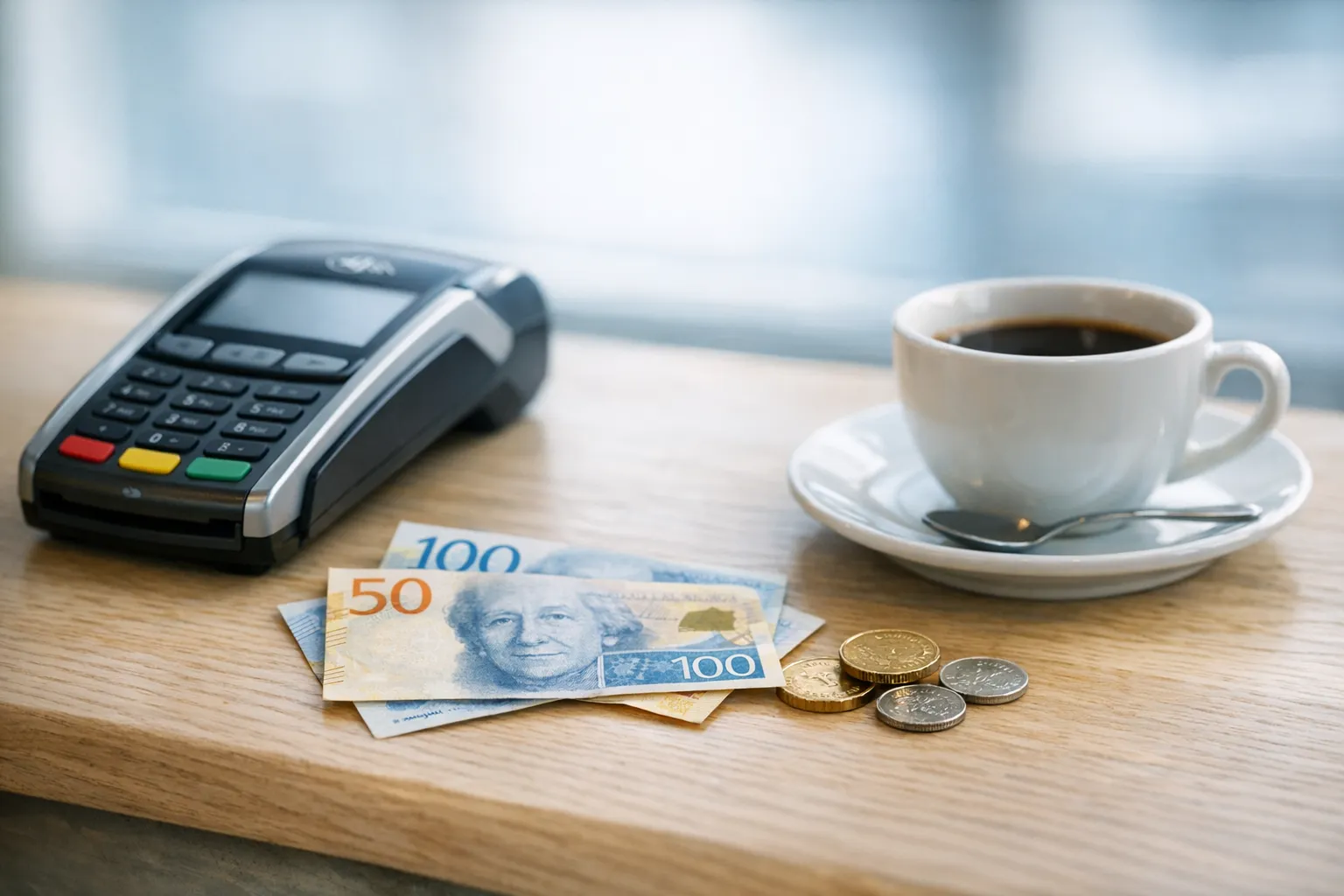
Sweden is the world’s most nearly-cashless country, and it catches visitors from both directions: some exchange money they’ll never spend, others assume “legal tender” means a shop must take their notes. Here’s how it actually works — including the legal twist, the bus trap, and the one card mistake that costs real money.
When you need this
You’re deciding how many kronor to exchange before flying (probably: zero). You’re facing a vi tar ej kontanter sticker with notes in hand. You’re about to board a bus with coins. Or it’s the last day and a pocketful of kronor needs a plan.
The short version: card country
Cards and phone wallets are accepted everywhere in Sweden — supermarkets, market stalls, public toilets, church collections, a cinnamon-bun stand on an island with eleven inhabitants. Visa and Mastercard debit/credit from any country work as locals’ cards do; Apple Pay and Google Pay work wherever cards do, including transit gates. Cash, meanwhile, keeps retreating: the central bank’s own payment reports track acceptance shrinking year by year.
So the operating rule for a visitor: your card is your wallet. Cash is an optional backup, not a requirement.
The legal twist: legal tender that shops may refuse
Swedish kronor are legal tender under the Sveriges Riksbank Act — and Swedish law still lets any business refuse them. Payment is treated as a contract: by posting terms before purchase (a “card only” sign counts), the shop lawfully overrides the legal-tender default. Swedish courts have confirmed the arrangement. The main exception is the publicly-funded sector — public healthcare, notably — which court practice requires to accept cash.
The consequence worth internalising: the sign wins. Arguing “legal tender” at a Stockholm café achieves nothing.
The law changed on 1 July 2026
That “may genuinely change” caveat has now fired, and most travel content has not caught up.
Lag (2026:769) obliges grocery stores and pharmacies to accept cash, at physical sales points with a staffed checkout. It is narrower than the Riksbank originally proposed — groceries and pharmacies, not fuel — and it is bounded:
| Who must accept | Grocery stores and pharmacies, staffed checkout, physical premises |
| Up to | 0.1 of the price base amount, and a maximum of 25 coins |
| Exceptions | Security cannot be maintained · cash-handling costs would prevent staying open · a justified reason in an individual case |
| In force | 1 July 2026 |
Two practical readings. If you are holding notes and need food or medicine, you are now covered at a staffed till. And everywhere else the old rule stands — cafés, museums, transport and self-checkouts may still refuse cash, and plenty do.
The motivation was not visitor convenience: it was emergency preparedness and digital exclusion. But the effect for a traveller stranded with cash is the same.
Where cash works — and where it never does
Still takes your notes: supermarket staffed tills, Systembolaget, pharmacies, most restaurants outside big-city centers, and tourist businesses along the coasts.
Never on any terms: city buses and trams anywhere in urban Sweden (no cash ticket sales on board — tap a bank card or use the app; details in paying for buses), most inner-city cafés in Stockholm, many museums, city parking meters, and most self-checkout kiosks.
The odd one out — flea markets (loppis): the classic cash venues, except Sweden’s answer is Swish, the mobile payment app that tourists can’t use (it needs a Swedish bank account and BankID). If loppis hunting is on your agenda, that’s the one activity where small notes genuinely earn their pocket space.
How much cash to bring
For most visitors: none at all. If you want a reserve, withdraw 200–500 kr in 100-kr notes from a silver Bankomat ATM after arrival — the machines charge no fee of their own (your bank may) and exist nationwide because Swedish law obliges banks to maintain cash services. Skip the exchange desk at home and especially at the airport — desks set their own rates, usually dearer than an ATM. And plan the exit: notes spend fine at any supermarket on the last day; spend coins at a staffed supermarket checkout or drop them in a charity box, because no exchange desk abroad wants them.
The traps: DCC, buses and Swish
- DCC — the home-currency offer. Terminals and ATMs will ask if you’d like to pay “in EUR/USD”. Always decline; always choose SEK. The built-in conversion costs several percent and is the most common way visitors overpay in Sweden.
- Buses. Covered above, worth repeating: nobody on board sells tickets for cash. Contactless bank card at the reader or the operator’s app, arranged before the doors close.
- Swish envy. You’ll watch Swedes pay each other and market sellers by phone all day. It’s locals-only infrastructure — your workaround is card, small notes at markets, or a generous travel companion.
- PIN, not signature. Contactless taps above a threshold prompt for your card’s PIN — know it before you travel. A backup card packed separately covers the real risk here, which is card failure, not cash shortage.
Mistakes to avoid
- Exchanging money at home “to be safe,” then re-exchanging the leftovers at a second loss.
- Boarding a bus with coins and optimism.
- Accepting the terminal’s home-currency conversion out of politeness.
- Reading “legal tender” as “must accept” — in Sweden, the sign wins.
- Counting on Swish because a blog said “everyone uses it” — everyone Swedish.
Practical information
| Item | Cost |
|---|---|
| Card surcharges in shops | None in practice |
| Bankomat ATM fee | 0 kr from the machine; your bank’s fees vary |
| DCC “home currency” conversion | Several percent worse than SEK — always decline |
| Airport/home exchange desks | Own rates, usually dearer than an ATM — skip |
FAQ
Can you pay with cash in Sweden?
Partly. Since 1 July 2026, grocery stores and pharmacies with a staffed checkout must accept cash for small payments. Everywhere else, Swedish law still lets a business refuse it by posting terms, and many do: cafés, museums, self-checkouts and all city buses are commonly cash-free. The universal answer remains a bank card or phone wallet, which works everywhere.
How much cash should I bring to Sweden?
For most visitors: none. Cards cover everything, and if you want a security reserve, withdraw 200–500 kr from a Bankomat ATM after arrival rather than exchanging at home or at airport desks — exchange desks set their own rates; an ATM is usually cheaper. The main place small notes help is flea markets (loppis), where sellers without card readers expect Swish — which tourists can’t use.
Why do Swedish shops get to refuse legal tender?
Because Swedish law treats payment as a contract: by stating terms before purchase — a “card only” sign — a business lawfully overrides the legal-tender default, a position confirmed in Swedish court practice. Publicly-funded services like healthcare are the exception and must generally accept cash. Since 1 July 2026, grocery stores and pharmacies with a staffed checkout are the exception: they must accept cash for small payments.
Can I use euros or dollars in Sweden?
No — Sweden uses the Swedish krona (SEK), not the euro, and foreign notes are not accepted in ordinary shops. A handful of border and ferry businesses price in euros, but the rate is poor. Pay by card and let your bank do the conversion — in SEK, never via the terminal’s home-currency offer.
How do tourists pay for buses in Sweden?
Not with cash — urban transit across Sweden sells no tickets on board for cash. Tap a contactless bank card or phone at the reader (Stockholm on all services, Gothenburg in Zone A), or buy in the operator’s app before boarding. Buying nothing and hoping to pay the driver ends with you at the curb.
Are there still ATMs in Sweden?
Yes — Bankomat machines remain in about 600 towns, because banks are legally required to keep cash services within reach nationwide. The machines charge no fee of their own (your home bank may), and they’ll offer to convert to your home currency — decline and choose SEK.
Related guides
- Money in Sweden: the complete guide — the full picture: cards, budgets, fees
- Swish for tourists — why you can’t use it and what to do instead
- Using credit and debit cards in Sweden — limits, PINs, declines
- ATMs in Sweden — fees and finding one
- How to pay for buses — the cash-free transit system
Facts verified 2026-07-25. Sources: Sveriges Riksbank (legal-tender rules and reform proposals), Library of Congress legal monitor, Visit Stockholm — full register in this topic’s source file. The cash-acceptance law is under active political debate; this page is on a 12-month review cycle. Found something outdated? Tell us and we’ll fix it.