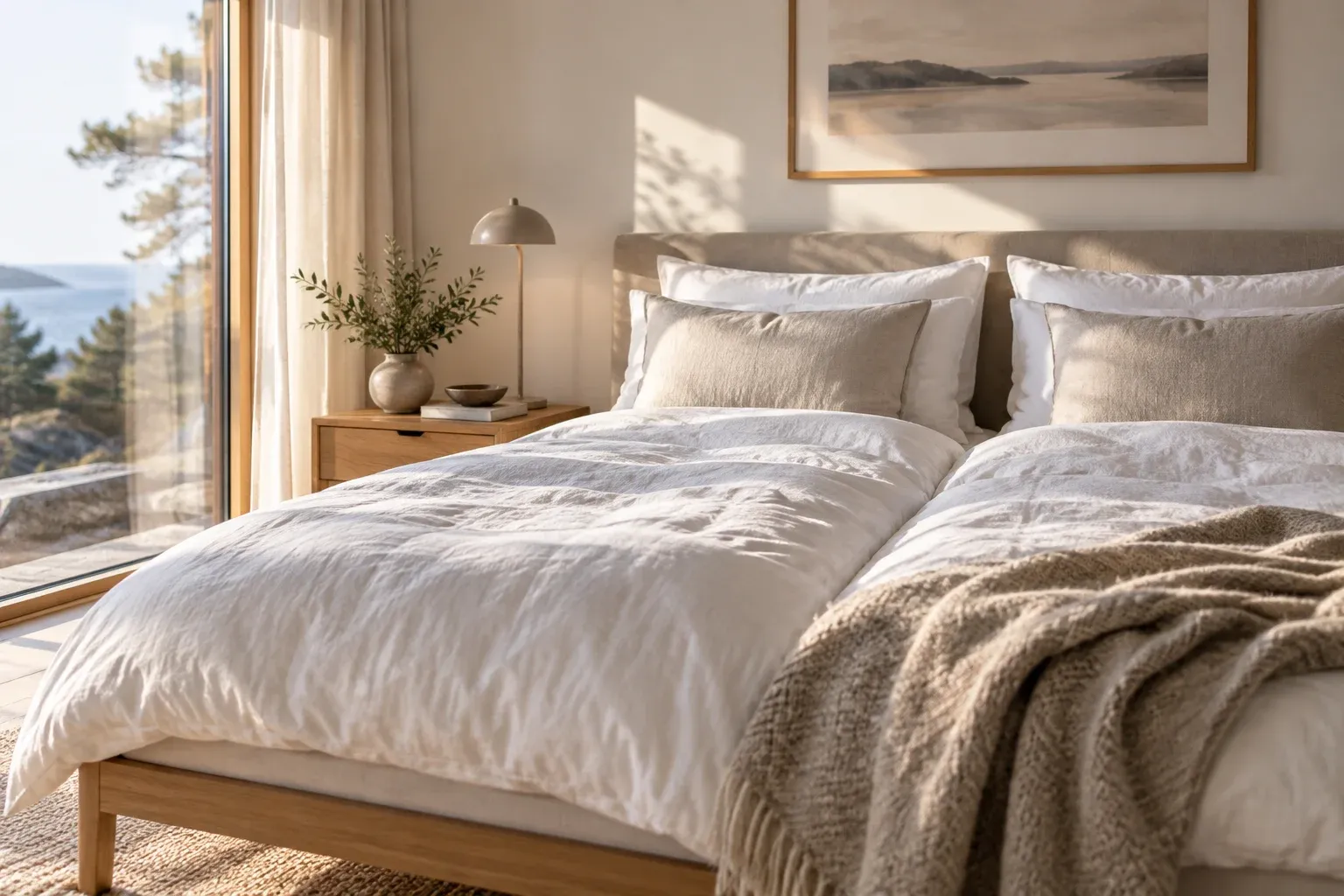
You check in, pull back the bedspread and find two narrow duvets on one wide bed, perhaps with a seam down the middle. Nothing is wrong with your booking. This is how Sweden sleeps, and here is the rest of the Swedish bedroom explained.
When you need this
You booked a double room and found two duvets, or a gap between two mattress halves. You are a guest in a Swedish home and wondering whether it is rude to ask for one big duvet. You are packing covers and sheets for a cabin or a hostel, or buying bedding for a first Swedish flat, and the sizes do not match home. Your bedroom is too warm to sleep, there is a draughty vent above the window, or it is June in Lapland and the sun will not go down.
Two duvets, one bed
A Swedish double bed is usually made up with two separate single duvets (täcken), each in its own cover. You will see it in homes, hotels and holiday cabins alike. The reason is practical: each sleeper picks their own warmth, one can kick the duvet off while the other stays wrapped up, and nobody wakes at 3 a.m. without covers.
It says nothing about the couple. Two duvets is simply the default way to make a bed, in the same way that a British or American bed comes with one shared duvet or a top sheet and blanket. No Swedish agency regulates it, and we found no reliable statistic on how many couples do it, so take it as everyday practice rather than a measured fact.
A note on the hype. In the last couple of years English-language lifestyle sites have presented the habit as “the Scandinavian sleep method”, a new trick for better sleep. In Sweden it is not a method or a trend. It is how beds have been made for generations, and no Swedish official source uses the term.
If you prefer one shared duvet, ask. Large duvet covers exist in Swedish shops, and some hotels keep a double duvet for guests who want one. Expect the two-duvet version unless you do.
The continental bed
The bed underneath is often a continental bed (kontinentalsäng). It is built in layers:
| Layer | What it is |
|---|---|
| Base | A sprung base on legs, often pocket springs in a wooden frame |
| Mattress | A pocket-spring mattress fixed on the base |
| Bäddmadrass | A thin, separate top mattress (topper) laid on top |
Swedish retailers sell continental beds in widths from 120 to 180 cm, all 200 cm long. The detail that surprises visitors: in the specification we checked, a bed from 160 cm wide stands on two separate bases under one continuous fabric cover. A double can therefore feel like two beds side by side, with a slight ridge where the halves meet; the topper smooths most of it out.
That construction is why Swedish hotels can often turn a double into a twin. Our guide to Swedish hotels explains that a dubbelrum is often two single mattresses on a joined frame. If you need two separate beds, ask for dubbelrum med separata sängar (a twin room) when you book rather than at the desk. Not every bed is continental: frame beds (ramsäng) are common too, especially in cabins and flats.
Bedding sizes: why your sheets from home won’t fit
Two single duvets means single-sized bedding, even on a king-size bed. IKEA Sweden’s duvet-cover range shows the pattern clearly:
- Duvet cover 150×200 cm — the bulk of the range, described as the more standard size.
- Pillowcase 50×60 cm — sold with those covers.
- Duvet cover 240×220 cm — a smaller range, for one shared duvet on a larger bed.
That matters when you bring your own linen. Swedish holiday cabins usually supply duvets and pillows but expect you to bring covers, pillowcases and sheets, and many hostels ask you to bring or rent them — see what to expect in a Swedish holiday cabin and hostels in Sweden. A British double duvet cover or a US queen comforter set will not fit a 150×200 cm Swedish duvet, so pack covers in Swedish sizes or rent locally.
A cool, aired bedroom
Here the common description of “cool Swedish bedrooms” is only half right. Swedish flats are warm: Folkhälsomyndigheten, the Public Health Agency, advises landlords to steer heating towards 20–23 °C, with 18 °C as the lowest acceptable temperature. Sweden’s health information service, 1177, says most people sleep best in a slightly cooler room, around 14–18 °C. The cool bedroom is something Swedes make, not something the building delivers. Why flats run that warm is explained in why Swedish homes are so warm.
How to close the gap:
- Turn the bedroom radiator down in the evening; most radiators have their own thermostatic knob.
- Air briefly before bed: the window wide open for a few minutes, then shut. A window left open all night in January mostly heats the street.
- Air the bedding: many Swedes hang duvets out on a balcony or line now and then.
- Switch duvets with the season: shops sell duvets in different warmth levels, and many households use a lighter summer duvet (sommartäcke).
Leave the air vent alone. Above the window or high on the wall there is usually a small vent (ventil or tilluftsdon). It is how fresh air reaches the room. Folkhälsomyndigheten’s general advice on ventilation, FoHMFS 2014:18, expects a home to get at least 0.35 litres of outdoor air per second per square metre of floor area and an air change of at least 0.5 room volumes per hour. It lists unventilated rooms, and air flowing from kitchen or bathroom into a bedroom, as signs that ventilation is failing. Taping the vent shut against a draught gives you exactly that. If it is draughty, tell the landlord or host. These values are guidance for municipal inspectors, not statute, and the advice is under revision — the agency had published no replacement as of October 2026.
In a summer heatwave the same warm building can make the bedroom hot. A thin sheet instead of a duvet and airing in the cool of the night help; more in heatwaves and staying cool in Sweden.
Light summer nights
In June and July light, not heat, is what keeps visitors awake. North of the Arctic Circle, at about 66.5° N, the sun stays above the horizon around the clock; in Kiruna, SMHI quotes the almanac at 29 May to 14 July. Further south it sets, but from about the Dalälven river northwards it never gets fully dark in summer. Details and places are in the midnight sun in Sweden.
1177’s advice for light nights:
| Tool | 1177’s advice |
|---|---|
| Dark roller blind or blackout curtain (mörkläggningsgardin) | Can help during the light summer months |
| Sleep mask | Protects the eyes; sold at pharmacies |
| Earplugs | Help if sounds disturb you |
Not every room has blackout blinds. Ask before booking in the north, and pack a mask anyway for trains, tents and cabins.
Babies and small children
A Swedish host may kindly offer a duvet for the cot. 1177’s safe-sleep advice is clear: let a baby sleep on its back, keep the face free of duvets and other bedding, and do not let the baby get too warm — the risk of sudden infant death rises if it does. Babies under three months sleep safest in their own bed, and sharing a bed raises the risk of the baby turning onto its stomach. Dress the baby for the room’s temperature, and ask the hotel or host for a cot rather than tucking the baby under an adult duvet.
Practical information
| Item | What to expect |
|---|---|
| Duvets on a double bed | Two single duvets as the default (homes, hotels, cabins) |
| Standard duvet cover / pillowcase | 150×200 cm / 50×60 cm |
| Large shared duvet cover | 240×220 cm (smaller range) |
| Continental bed widths | 120–180 cm, 200 cm long; from 160 cm often two bases |
| Twin room in Swedish | dubbelrum med separata sängar |
| Sleep temperature (1177) | Around 14–18 °C |
| Typical flat temperature | 20–23 °C (Folkhälsomyndigheten guidance) |
| Bedding in hotels | Included in the room rate |
| Bedding in cabins and hostels | Duvets usually provided; bring or rent covers and sheets |
| Bed and bedding prices | Not published here; they vary by retailer, size and season |
FAQ
Why do Swedish couples sleep with two duvets?
Because each person gets their own temperature and nobody steals the covers. A Swedish double bed is usually made up with two single duvets, in homes, hotels and holiday cabins alike. It is a long-standing custom rather than a rule or a sign of a distant relationship; foreign media now call it “the Scandinavian sleep method”, but in Sweden it is simply how beds are made.
What is a continental bed?
A continental bed, kontinentalsäng, is a sprung base with a pocket-spring mattress on top, finished with a thin separate top mattress called a bäddmadrass. Swedish retailers sell them from 120 to 180 cm wide and 200 cm long. From 160 cm wide the base is usually two separate bottoms under one fabric cover, so a double can feel like two beds side by side.
What size are Swedish duvets and pillows?
The most common Swedish duvet cover is 150×200 cm, with a 50×60 cm pillowcase; IKEA Sweden calls this the more standard size. Larger covers of 240×220 cm exist for one shared duvet on a bigger bed, but they are the smaller range. If you bring your own bedding to a cabin or hostel, pack covers in these sizes, not British or American ones.
Can I ask a Swedish hotel for one big duvet?
Yes, you can ask, but expect two single duvets as the default on a double bed. Some hotels have large double duvets on request; others do not. If you want the opposite, two separate beds, ask for a twin room, dubbelrum med separata sängar, when booking, because a Swedish double is often two mattress halves pushed together.
What temperature should a bedroom be in Sweden?
Cooler than the rest of the flat. 1177, Sweden’s health information service, says most people sleep best at around 14–18 °C, while flats are usually heated to 20–23 °C, the range Folkhälsomyndigheten advises landlords to aim for. Turn the bedroom radiator down in the evening and air the room briefly with the window wide open before bed.
Should I close the air vent in my Swedish bedroom?
No. The vent above the window or in the wall is how fresh air reaches the room. Folkhälsomyndigheten’s ventilation advice expects a home to get at least 0.35 litres of outdoor air per second per square metre, and treats unventilated rooms or kitchen air flowing into bedrooms as signs of failing ventilation. If it is draughty, tell the landlord or host instead.
How do Swedes sleep during the midnight sun?
With the room made dark. 1177 recommends a dark roller blind in the light summer months, a sleep mask for the eyes and earplugs if sounds disturb you. North of the Arctic Circle the sun stays up all night for weeks; in Kiruna roughly late May to mid-July. Ask whether your room has blackout blinds before booking.
How should a baby sleep in a Swedish bed?
On its back, with the face free of duvets and other bedding, and not too warm. 1177 says babies under three months sleep safest in their own bed and that the risk of sudden infant death rises if the baby gets too warm. Ask your hotel or host for a cot rather than putting the baby under an adult duvet.
Related guides
- Why Swedish homes are so warm — radiators, district heating and the 20–23 °C flat that makes a cool bedroom your job.
- The midnight sun in Sweden — where and when the sun stays up, and how to sleep through it.
- Swedish hotels: what to expect — room types, twin requests and what is included.
- What to expect in a Swedish holiday cabin — which bedding is supplied and what you bring.
- Heatwaves and staying cool in Sweden — for the summer nights when the bedroom gets hot.
Facts verified 14 October 2026. Sources: 1177, Folkhälsomyndigheten, SMHI, IKEA Sweden and Sova — full register in this topic’s source file. Found something outdated? Tell us and we’ll fix it.