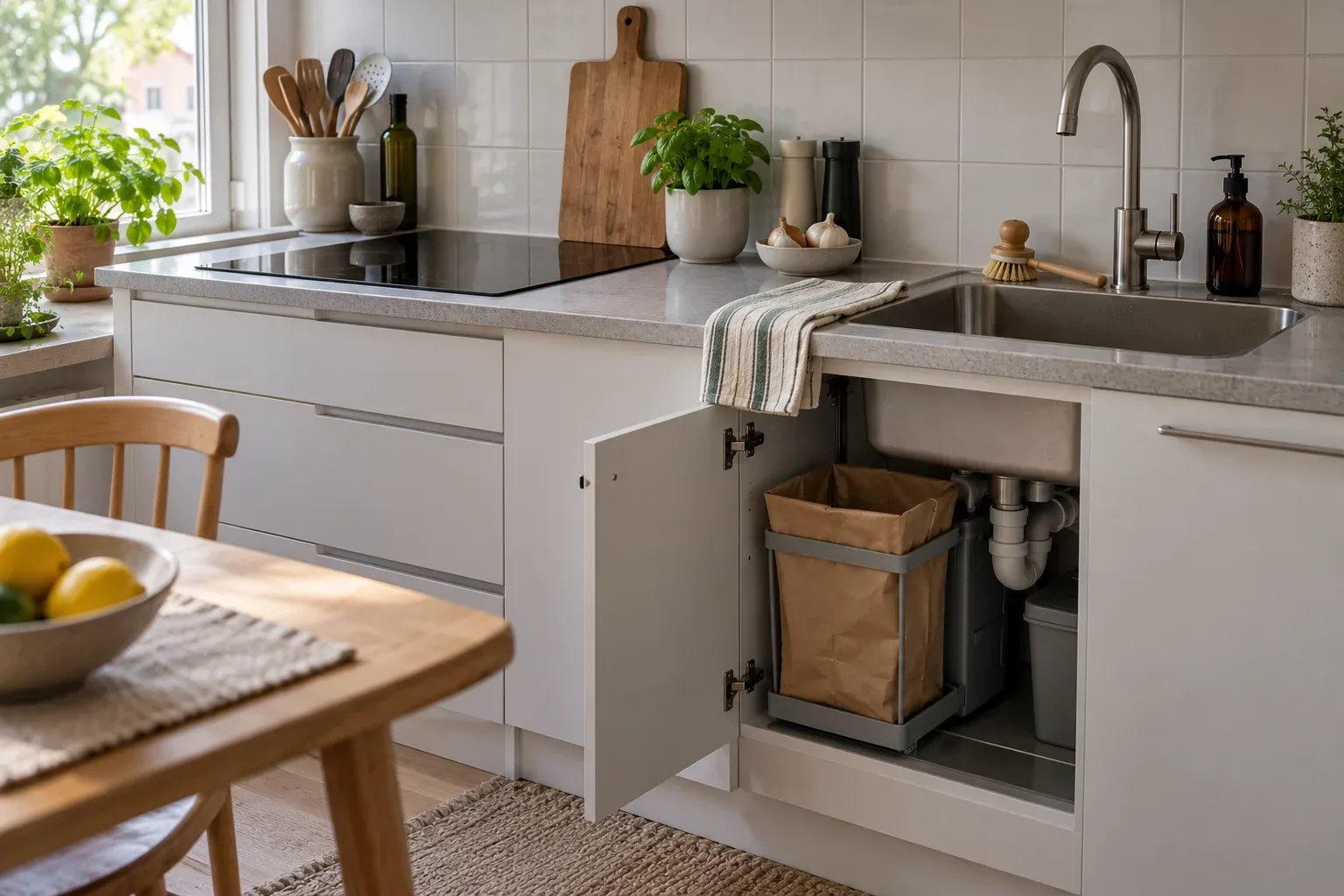
A Swedish rental kitchen looks familiar until the pan stays cold, the bin turns out to be a paper bag and the recipe asks for “2 dl”. Here is what each thing is, which parts are law, and the one fire rule worth learning first.
When you need this
- You have just arrived at a rented apartment, Airbnb or cabin with its own kitchen
- The hob does not react when you put your pan on it
- You are looking for the bin for vegetable peel and find a holder with a paper bag
- A recipe asks for “2 dl” or “1 krm” and you have no measuring jug
- Something is smoking on the stove and you need to know what to do
- You wonder whether the dishwasher tablets, brush and cloths are yours to use
The hob: induction and your pans
Many Swedish hobs are induction (induktionshäll). Induction heats only cookware with a magnetic base: cast iron, enameled iron and magnetic stainless steel work, while aluminium, copper and non-magnetic stainless steel stay cold unless they have a magnetic layer underneath. If a magnet sticks to the bottom of the pan, it will work.
So a hob that “doesn’t work” is usually a pan problem. Use the rental’s own pans, which were bought for that hob. Cabins and older homes more often have ordinary hot plates, where any flat pan works.
Find the switch for the cooker hood (spisfläkt) before you fry. Use it, and glance at the filter: grease that builds up there can catch fire from the heat of a forgotten pan.
Fire safety and the stove guard
Kitchen fires are the real risk in a rental. Of the roughly 6,000 residential fires Sweden’s fire and rescue services are called to each year, just over 1,500 start in the kitchen, according to the civil-defense agency MCF (formerly MSB). The typical cause is something left alone on the hob until it boils dry and ignites.
Many visitors assume a spisvakt (stove guard) will catch that. Most rentals do not have one. Sweden’s building rules require a stove guard only for residents’ cooking appliances in shared and assisted housing (building classes 3B and 3C); ordinary homes have no such requirement, and a simple timer does not count. A tenant who wants one needs the landlord’s permission.
| Situation | What to do |
|---|---|
| Pan or pot on fire | Put a lid on, turn the heat off |
| Tempted to use water | Don’t: it flashes to steam and throws burning oil |
| Fire you cannot put out | Get everyone out, close the door, call 112 |
| Smoke in the stairwell (fire elsewhere) | Stay in the flat with the door closed |
The order MCF teaches is rädda, varna, larma, släck: rescue, warn, call 112, extinguish. Look for the fire blanket (brandfilt) and extinguisher when you arrive; MCF recommends at least one of each, plus a smoke alarm, on every floor.
Food waste and the paper bag
Since 1 January 2024 every household in Sweden must sort food waste (matavfall) out and keep it apart from other rubbish, and that duty applies to you in a rented kitchen too. Edible oil and liquid fat count as food waste; coffee, tea, milk and juice do not.
In practice, look under the sink for a holder with a paper bag. Peel, leftovers and coffee grounds go in; close the bag and take it to the building’s food-waste bin, usually brown. Do not swap the paper bag for plastic where the municipality uses paper. A few areas have dispensations and no food-waste bin; then follow the local instructions. Packaging and everything else is covered in our guide to recycling in Sweden.
Keep frying fat out of the sink. Municipal water services warn that fat sets as the wastewater cools and sticks to the pipe walls, causing blockages and, at worst, basement flooding. Wipe pan fat with paper into the food-waste bag, and bottle cooled oil if the local rules say so.
Washing up: brush, cloth and dishwasher
Swedes wash up with a long-handled dish brush (diskborste) as much as with a cloth, and the habit matches official advice. The Swedish Food Agency says dishcloths (disktrasor) soak up liquid and are the hardest kitchen item to get clean unless they are boiled or machine-washed, so germs spread to every bench, tap and handle they wipe. Use paper towel, not the cloth, for raw meat and poultry juices.
| Item | Swedish | Use it for |
|---|---|---|
| Dish brush | diskborste | Hand washing-up |
| Washing-up liquid | diskmedel | The sink only |
| Dishwasher detergent | maskindiskmedel | The dishwasher only |
| Dishcloth | disktrasa | Wiping, then into the washing machine often |
Hand washing-up liquid in a dishwasher foams over, so use the tablets. Modern city apartments often have a dishwasher; cabins often don’t (see what a Swedish cabin expects).
Fridge, coffee, water and measures
Fridge and freezer. The Food Agency’s advice is 4 °C in the fridge and −18 °C in the freezer. If the dials have a scale, set them there.
Coffee. Expect a drip coffee maker before a capsule machine: 70% of Swedish coffee drinkers say filter coffee, bryggkaffe, is their usual type. Ground coffee for it is labelled bryggmalet. An electric kettle is common but not guaranteed. More in coffee in Sweden.
Water. Drink and cook from the cold tap; municipal water is regulated as a foodstuff, while hot tap water is not held to drinking-water standards. A rural cabin with its own well is the exception, so ask the host. See Swedish tap water.
Measures. Swedish recipes measure by volume, even flour and sugar.
| Abbreviation | Swedish | Volume |
|---|---|---|
| krm | kryddmått (spice measure) | 1 ml |
| tsk | tesked (teaspoon) | 5 ml |
| msk | matsked (tablespoon) | 15 ml |
| dl | deciliter | 100 ml |
Many rentals keep a measuring set in a drawer. For hard cheese, use the osthyvel (cheese slicer) and slice flat across the block rather than carving a ramp. Before you pour milk, read our guide to Swedish milk types.
Step by step: your first hour in the kitchen
- Find the sorting point: the food-waste holder under the sink and the building’s waste room.
- Test your pans on the hob; use the rental’s if yours stay cold.
- Find the cooker hood switch and use it when you fry or boil.
- Stay with the hob while it is on, and never use it as a shelf.
- Learn the fire drill: lid on, heat off, never water; if it spreads, get out, close the door, call 112.
- Set the fridge to 4 °C and the freezer to −18 °C if the dials have a scale.
- Wash up the Swedish way: brush and washing-up liquid, paper towel for raw meat juices, tablets only in the dishwasher.
- Handle fat and leftovers: fat wiped into the food-waste bag, plates scraped into food waste.
- Leave it as you found it: food-waste bag emptied, dishwasher run or emptied, hob wiped.
Practical information
| Item | What applies | Source |
|---|---|---|
| Food-waste sorting | Required of every household since 1 January 2024; bags usually supplied | Naturvårdsverket |
| Stove guard (spisvakt) | Required only in building classes 3B and 3C, not in ordinary homes | Boverket, BFS 2024:7, 4 kap. 25 § |
| Kitchen fires | About 6,000 residential fires a year; just over 1,500 start in the kitchen | MCF |
| Fridge / freezer | 4 °C / −18 °C | Livsmedelsverket |
| Emergency number | 112 | MCF |
| Dishwasher tablets, coffee | Prices vary by shop; ask the host what is provided | — |
FAQ
Why doesn’t my pan work on the stove in my Swedish rental?
The hob is probably induction, which heats only cookware with a magnetic base. Pans of aluminum, copper or non-magnetic stainless steel stay cold unless they have a magnetic layer underneath. Hold a magnet to the bottom: if it sticks, the pan works. Otherwise use the rental’s own pans, which are chosen for the hob.
Do I have to sort food waste in a Swedish rental?
Yes. Since 1 January 2024 every household must keep food waste apart from other rubbish, and that includes a visitor cooking in a rental. Use the paper bag in its holder, usually under the sink, then empty it into the building’s food-waste bin. Cooking oil counts as food waste; coffee and milk do not.
What is a spisvakt?
A spisvakt is a stove guard: a device connected to the stove that senses heat, smoke or movement and can sound an alarm, cut the power or even put out the fire. Swedish building rules require one only in shared and assisted housing, not in ordinary homes, so most rentals do not have one. Stay with the hob.
What should I do if a pan catches fire?
Put a lid on the pan and turn the heat off. Never pour water on it: the water turns instantly into steam that throws burning oil and spreads the fire. If the fire grows, get everyone out, close the door behind you and call 112. In a flat, closing the door keeps smoke out of the stairwell.
What does dl mean in a Swedish recipe?
A deciliter, 100 milliliters. Swedish recipes measure by volume, even for flour and sugar. The other abbreviations are msk (tablespoon, 15 ml), tsk (teaspoon, 5 ml) and krm (spice measure, 1 ml). A standard Swedish measuring set has exactly these sizes, and many rental kitchens keep one in a drawer.
Can I drink the tap water in a Swedish kitchen?
Yes, from the cold tap. Municipal drinking water is regulated as a foodstuff and safe everywhere on the public network. Hot tap water is not held to drinking-water standards, so do not use it for cooking or drinks. A rural cabin with its own well is the exception: ask the host about the water.
Why do Swedes use a dish brush instead of a cloth?
Habit, but it matches official advice. The Swedish Food Agency says dishcloths soak up liquid and are the hardest kitchen item to get clean unless boiled or machine-washed, so germs spread to every surface they wipe. A brush dries quickly. Use paper towel for raw meat juices and wash cloths often.
Related guides
- Staying in a Swedish apartment — door codes, the laundry room and the waste room
- Recycling in Sweden — every waste stream beyond food waste
- Swedish tap water — why the cold tap is all you need
- Swedish groceries to try — what to cook now that you have a kitchen
- Coffee in Sweden — bryggkaffe and the drip machine
Facts verified 2026-10-06. Sources: Boverket, MCF (Myndigheten för civilt försvar), Naturvårdsverket, Livsmedelsverket, Kalix kommun — full register in this topic’s source file. Found something outdated? Tell us and we’ll fix it.