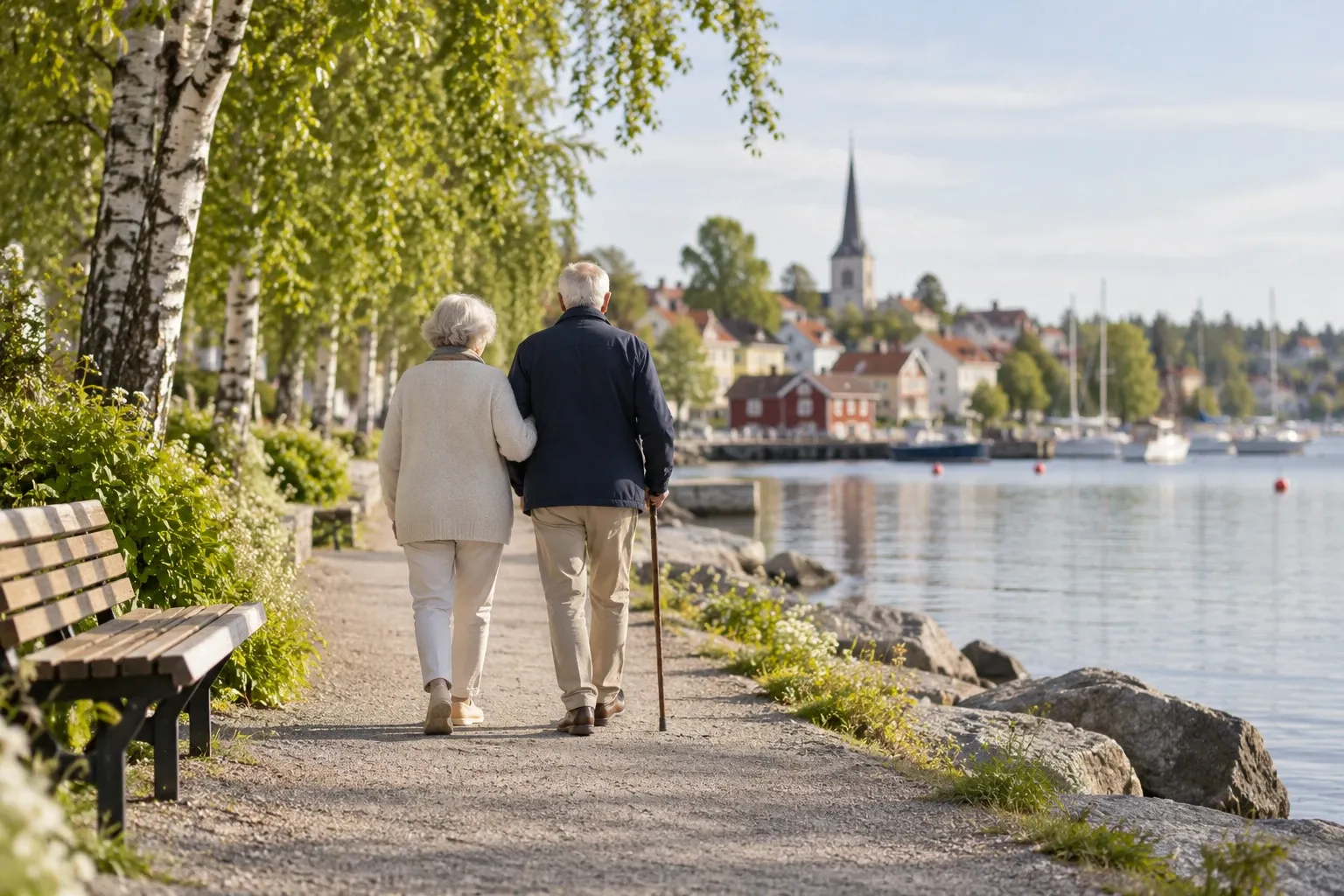
Sweden is easy to travel in at 65 or 85. What catches older visitors is the systems: senior ages that change between regions, card-only habits, logins built for Swedes, and a few health rules where your age changes the answer.
When you need this
You’re planning a trip to Sweden in your sixties, seventies or later. You may be travelling as a couple, alone, or taking the grandchildren. Maybe you’re organising the trip for older parents from abroad. Typical questions at this stage:
- Should I tick “senior” or “pensioner” when I buy tickets?
- Will my cash still work?
- What happens if I need a doctor or run out of my tablets?
- Is the countryside or the winter city break a sensible idea at my age?
This page covers what is different for older travellers and links to the detailed guides for everything else.
Senior discounts: the age that counts
Swedish transport discounts for older people are based on your date of birth, not where you live or whether you have retired. No law creates them, so every operator sets its own rules. Most will take a foreign passport as proof of age.
| Operator | Senior age | What to show |
|---|---|---|
| SL (Stockholm metro, buses, commuter trains) | 65 | Passport or ID card |
| SJ (national trains) | 65 | Passport or ID card |
| Skånetrafiken (Skåne, around Malmö) | 70 | ID showing your age |
| Västtrafik (Gothenburg and the west) | No senior fare for visitors | — |
Three traps follow from that table:
- Retired but under 65? You pay the adult fare on SL and SJ. Under 65, both accept only a Swedish pensionärsintyg (pension certificate) or, on SJ, Swedish sickness-compensation papers. A foreign pension card or early-retirement letter counts for nothing.
- Gothenburg is different. Västtrafik has no senior category. The free senior travel you may read about there is a benefit for registered residents.
- Skåne uses 70. Other regions set their own ages too. Kalmar’s senior ticket starts at 67, for example. Our guide to student, youth and senior discounts lists them operator by operator.
Carry the passport every day you travel on a reduced ticket. A senior ticket without proof counts as no ticket. Inspectors can then charge a surcharge (tilläggsavgift) of well over 1,000 kronor on top of the fare.
Museums work the same way, venue by venue. Moderna Museet in Stockholm gives pensioners a reduced price, while Livrustkammaren (the Royal Armoury) charges retirees the regular adult price. Ask at the desk, but check the museum’s own page first.
Paying: card first, cash where the law says
Sweden runs on cards. City buses take no cash, most cafés don’t either, and many public toilets are card-only. Stockholm’s new street toilets, for instance, take payment by card or Swish, a Swedish mobile payment app. Your main way to pay should be a chip card with contactless payment.
Since 1 July 2026, cash is protected in two places. Lag (2026:769) obliges grocery stores and pharmacies to accept notes and coins wherever there is a staffed checkout. Most English-language pages about Sweden still say shops may refuse cash. For these two kinds of shop, that is now out of date.
The new rule has limits:
- It covers a single payment of up to 0.1 prisbasbelopp (Sweden’s price base amount), which is 5,920 kronor in 2026, and no more than 25 coins.
- A store can refuse if security can’t be maintained, or if handling cash would make it too costly to stay open. It can also refuse a single sale for an acceptable reason.
- Kiosks, petrol-station shops and self-scan-only stores are outside the duty.
So a small cash reserve is useful for the supermarket and the pharmacy, but it can’t be your only way to pay. Our guide to cash in Sweden covers ATMs and exchange.
Four ages that matter for your health
Four age thresholds change the practical answer for older visitors.
| Age | What changes | Rule type |
|---|---|---|
| 50 | The TBE (tick-borne encephalitis) vaccine’s first course needs four doses instead of three | Official guidance |
| 65 | You’re in 1177’s risk group for heat stroke | Official guidance |
| 65 | SL and SJ senior discounts apply (above) | Operator practice |
| 85 | Swedish law bars outpatient patient fees | Law |
At 85, outpatient care is free by law. The Health and Medical Services Act forbids charging fees for outpatient care to patients aged 85 or older. Regions apply this at clinics and emergency departments. For visitors, it depends on your entitlement. With a physical EU health insurance card, EU, EEA and Swiss visitors pay the ordinary resident fee for necessary care. Visitors with no entitlement pay the full cost, and the regional fee handbooks we read don’t say the 85+ exemption covers them. Ask at reception.
Bring the physical EU card. Regions say they don’t yet accept the digital version. Without a valid card you may be billed the full cost. Our EHIC and GHIC guide explains what the card covers, and our travel insurance guide covers the gaps.
From 50, plan TBE vaccination early. TBE is a virus spread by ticks. Folkhälsomyndigheten, the Public Health Agency, recommends the vaccine for people at risk of tick bites in municipalities it lists as risk areas. From age 50 the first course is four doses: the second a month after the first, the third one to three months later. Start with your doctor at home two to three months before a summer trip to forests, meadows or the archipelago. The ticks guide has the risk areas.
For advice, call 1177. From a foreign phone, dial +46 771 11 77 00. Nurses answer around the clock, and the menu has an English option. For anything life-threatening, call 112.
Medicines and prescriptions
Bring every medicine you take, in its original pack with the pharmacy label. You may bring up to a year’s supply from an EEA country, or three months’ supply from outside it. Medicines classed as narcotics have tighter limits and may need a Schengen certificate from home. See bringing medicines into Sweden.
The bigger risk is running out. A Swedish apotek (pharmacy) can dispense a prescription from another EEA country only if it is on paper. Electronic, emailed or faxed foreign prescriptions cannot be dispensed. If you lose your tablets, you will need to see a Swedish doctor. Ask your doctor for a paper prescription before you leave. Our pharmacies guide explains how the counter works.
Help at airports and stations
You don’t have to use a wheelchair to ask for help. The EU regulation on air passengers’ rights defines reduced mobility as including mobility reduced by age. Long airport corridors are reason enough to ask.
- Flights: request assistance through your airline, not the airport, when you book and at least 48 hours before departure. It’s free, and staff meet you at a marked meeting point.
- Trains: book with the company that sold the ticket at least 24 hours ahead, and describe what you need. If you book late, the company must still take all reasonable measures to help.
Our accessible Sweden guide covers assistance in detail: meeting points, companions, buses and parking cards.
Winter and summer
Winter means ice. Trafikverket, the Swedish Transport Administration, says over 95% of serious pedestrian injuries in traffic areas are falls. Slipperiness is the most common cause. Wear shoes with grippy soles and slip-on ice grips (broddar). They’re sold in shoe, outdoor and hardware shops and many supermarkets. Some municipalities give free ice grips to older people, but only to residents. Days are short, so plan sightseeing around the daylight. See walking on ice.
Summer can bring heat. Watch for heat stroke: a body temperature over 40 °C, confusion or dizziness. It’s an emergency, so call 112. People over 65 and anyone on medicines that affect fluid balance are most at risk. The heatwave guide explains the warnings.
Many older travellers find May–June and late August–September easiest. You avoid the ice and darkness of winter and the midsummer heat.
The login wall: why 1177 online won’t work
Swedish digital services assume a personnummer (Swedish personal identity number) and a Swedish e-ID such as BankID. Visitors have neither, and 1177’s logged-in services don’t accept foreign e-IDs. So you can’t book or message a clinic online through 1177, but the phone line works without logging in. Save the number before you travel. Our BankID guide covers the other places this wall appears.
Practical information
| Item | Detail (checked 2026-10-15 unless noted) |
|---|---|
| SL senior fare | From 65; price varies by ticket (checked 2026-10-03) |
| SJ senior discount | 10% from 65, on ID (checked 2026-10-03) |
| Skånetrafiken senior discount | 25% from 70, within Skåne (checked 2026-10-03) |
| Västtrafik | No senior fare for visitors |
| Cash at grocery stores and pharmacies | Must be accepted up to 5,920 kr per payment in 2026, max 25 coins |
| Outpatient care aged 85+ | No fee by law |
| 1177 advice line from abroad | +46 771 11 77 00 |
| Emergencies | 112 |
| Air assistance | Free; book via airline 48 hours ahead |
| Train assistance | Free; book via ticket seller 24 hours ahead |
FAQ
Do tourists get senior discounts in Sweden?
Yes, where the discount is based on age. SL in Stockholm and SJ on national trains give a reduced price from 65 to anyone who proves their age with a passport or ID card. Skånetrafiken’s senior group starts at 70, and Västtrafik around Gothenburg has no senior fare. A foreign pensioner card does not count; only your date of birth does.
Can older visitors still pay with cash in Sweden?
Partly. Since 1 July 2026, grocery stores and pharmacies with a staffed checkout must accept notes and coins for payments up to 5,920 kronor in 2026, with narrow exceptions. Elsewhere, shops, cafés, city buses and most public toilets may refuse cash. Bring a contactless chip card as your main way to pay and keep a little cash as a backup.
Is healthcare free for people over 85 in Sweden?
Outpatient care is: Swedish law bars regions from charging patient fees to anyone aged 85 or older, and regions apply this at clinics and emergency departments. Visitors from the EU, EEA or Switzerland pay the resident rate for necessary care with a physical EU card. Visitors without any entitlement pay full cost, and the handbooks checked do not extend the exemption to them.
Can I refill my prescription in Sweden?
Only with a paper prescription from another EEA country, for a medicine approved in Sweden. Electronic, emailed or faxed foreign prescriptions cannot be dispensed, so most travellers cannot refill from home. Bring enough medicine for the whole trip in original packaging with the pharmacy label: up to a year’s supply from the EEA, three months from elsewhere.
Do I need a TBE vaccine for Sweden if I am over 50?
Only if you will spend time in tick country such as forests, meadows and archipelago islands. Folkhälsomyndigheten recommends it for people at risk of tick bites in municipalities it lists as TBE risk areas. From age 50 the first course is four doses spread over months, so start with your doctor at home two to three months ahead.
How do older travellers get help at Swedish airports and stations?
Ask for assistance when you book, through the airline or the train company that sold the ticket: at least 48 hours ahead for flights and 24 hours ahead for trains. It is free, and the EU air regulation expressly counts reduced mobility due to age, so you need not be disabled to ask. Staff meet you at a marked meeting point.
Is Sweden safe for older travellers in winter?
Yes, with one real hazard: ice. Over 95 percent of serious pedestrian injuries in Sweden’s traffic environment are falls, and slippery surfaces are the most common cause. Wear shoes with grippy soles and slip-on ice grips, walk where the pavement has been gritted, and allow extra time. Days are short, so plan sightseeing around daylight.
Related guides
- Student, youth and senior discounts in Sweden — every operator’s age rules and the proof each one wants.
- Accessible Sweden: traveling with limited mobility — the full assistance chain, from booking to meeting point.
- Getting sick in Sweden as a tourist — where to go and what you will pay.
- Bringing medicines into Sweden — quantity limits and the Schengen certificate.
- Can you pay with cash in Sweden? — the 2026 cash law in full.
Facts verified 2026-10-15. Sources: Sveriges riksdag, Regeringen, Region Kalmar, 1177 Vårdguiden, Läkemedelsverket, Folkhälsomyndigheten, Trafikverket, the European Commission, SL, SJ, Skånetrafiken and Västtrafik — full register in this topic’s source file. Found something outdated? Tell us and we’ll fix it.