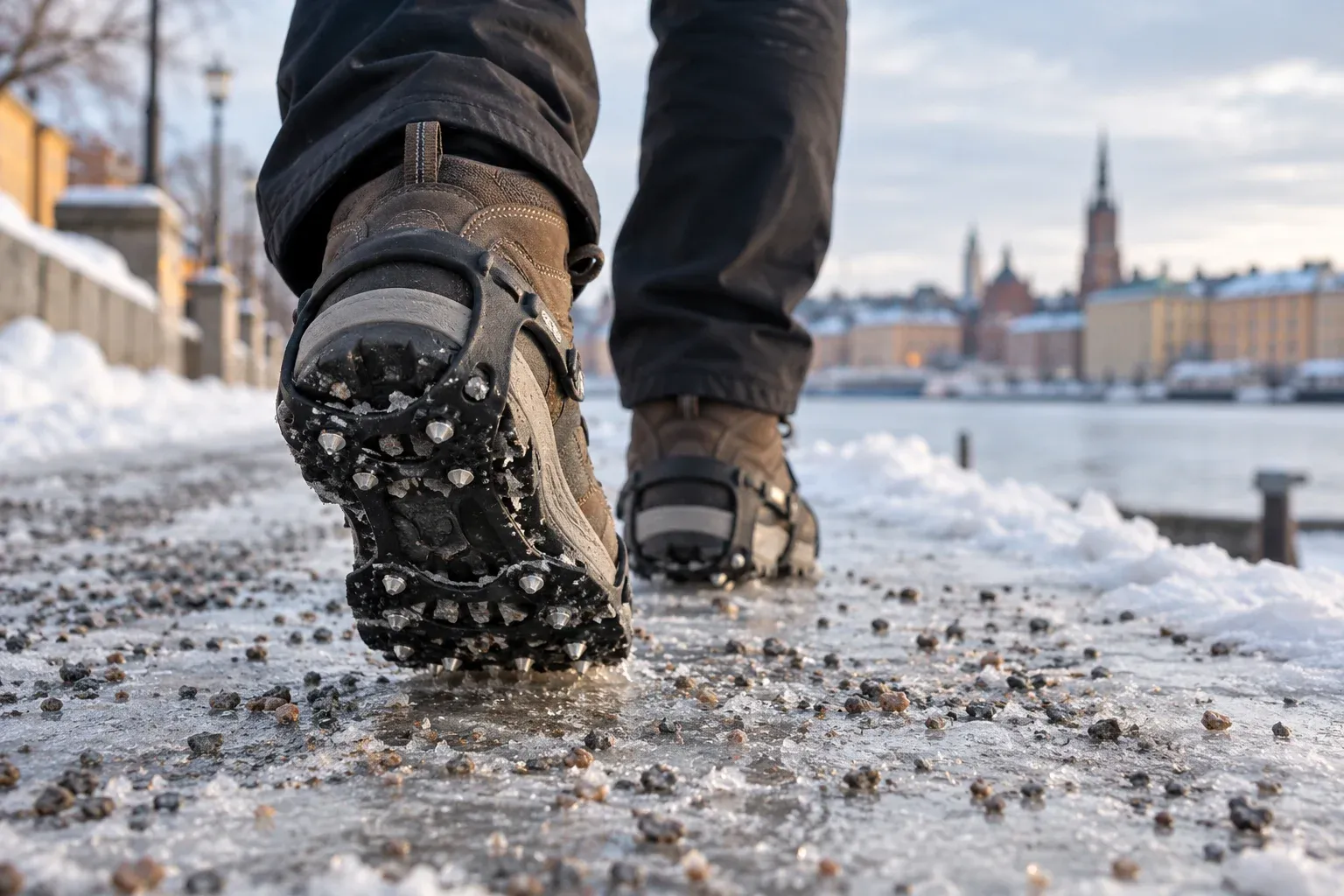
Swedish towns handle winter well, but the pavement is still where most visitors get hurt. Here’s what to wear, how to walk, what the gravel and the cordons mean, and who is responsible for keeping the sidewalk safe.
When you need this
You’re in a Swedish town sometime between November and April, and the sidewalk is packed snow, glazed ice or refrozen slush. You’re wondering whether to buy ice grips, what the red-and-white tape across the pavement is for, or who should have gritted the stretch you just slipped on.
Why falls are the real winter risk
Trafikverket, the Swedish transport administration, is blunt about it. About 3,000 pedestrians are seriously injured in Sweden each year, and:
- Well over 95 % of serious pedestrian injuries happen in falls
- Nine in ten seriously injured pedestrians have fallen, not been hit
- Slipping (halka, slipperiness) is the most common cause of falls in the street
Its advice for people on foot comes down to two things: good winter shoes and ice grips.
Shoes matter more than most visitors think. Sweden only got a national test method for how well a shoe sole grips on ice in March 2024 (SS 657177:2024), and it explicitly doesn’t cover studded or spiked soles. A “winter” label on a city boot tells you little.
Ice grips: which kind and where to buy
Broddar (ice grips or cleats) are rubber harnesses with metal studs or spikes that stretch over your boots.
| Type | Best for | Watch out for |
|---|---|---|
| Full-sole spikes | Icy paths, parks, day hikes, unplowed side streets | Slippery on indoor floors; take off at the door |
| Heel grip | Mostly cleared city streets, getting in and out of buildings | Less grip on steep icy slopes |
| Fold-up heel spike | City walking with frequent shop and museum visits | Remember to flip it up indoors |
| Ice tip for a walking stick (isdubb) | Anyone using a stick or crutch | Sold alongside shoe grips |
Forgot them? In winter you’ll find broddar in sports and outdoor shops, shoe shops, hardware stores, many pharmacies and supermarkets. They’re an inexpensive everyday item. Some municipalities hand out free ice grips to older residents — Gothenburg has done so for residents aged 65 and over — but those schemes are for locals only.
How to walk on an icy sidewalk
- Check the surface. Packed snow, refrozen slush and wet-looking ice are the slippery ones; days that thaw and then freeze at night are the worst.
- Wear warm boots with soft, deep-treaded soles, not smooth leather.
- Put on your ice grips before you step out, not after the first slip.
- Walk on the gritted strip. Gravel or sand is usually spread along part of the sidewalk; stay on it.
- Take short, flat steps with your weight over your front foot, hands out of your pockets. A backpack beats a bag in each hand.
- Keep away from building walls under icicles, and never walk under a cordon.
- Wear a reflector after dark, and where there’s no sidewalk, walk on the left, facing traffic.
- Cross at a crossing, but make eye contact — a car on ice may not stop.
- Take the grips off indoors. Metal studs skid on stone, tile and polished floors.
Black ice is the trap. Clear ice on asphalt looks like a wet pavement — dark and shiny. Treat every dark patch as ice.
Gravel, sand and salt
The grit on the sidewalk (sandning, gritting) gives your soles something to bite where ice can’t be scraped away. Stockholm fights slipperiness with salt, brine, sand or a mix, and brush-salts (sopsaltning) about 340 km of foot and cycle paths. Many other towns rely mostly on sand or crushed-stone gravel (grus, stenflis).
Two things to know. Grit sinks into fresh snow and gets kicked aside, so the patches between gritted strips can stay icy. And local rules often require only a strip — Mölndal’s, for example, asks for gritting to a width of 1.0 m where possible, and bans salt on concrete steps. In spring the winter’s grit is swept up again.
Who clears the sidewalk
This is where forum answers go wrong. Under the street-cleaning law (Lag 1998:814), the municipality must keep the public streets, squares and parks it is responsible for in a condition that meets reasonable demands of accessibility and traffic safety, through snow clearing and similar work. State roads are Trafikverket’s job.
But the law also lets the municipal council pass the duty for the sidewalk outside a property to the property owner (fastighetsägare), through local rules. So it depends on the town:
| Who | Clears what |
|---|---|
| Municipality | Public streets, squares, parks; sidewalks unless passed to owners |
| Property owner, where local rules say so | The sidewalk outside the property, including gritting |
| Property owner, everywhere | Entrances, private paths open to the public, roof snow and icicles |
| Trafikverket | State roads |
Stockholm clears its own sidewalks, giving priority to main roads and bus streets together with their sidewalks, while owners handle their entrances and any ice from their drainpipes. Mölndal, by contrast, makes owners clear and grit the sidewalk outside their buildings. An owner who neglects a duty under these rules can be fined.
Found a dangerous stretch? Report it to the municipality — in Stockholm through the “Tyck till” service or 08-651 00 00. The snow-clearing order of priority is covered in our snow clearing guide.
Roof snow, icicles and cordons
Snow sliding off a roof (takras) and falling icicles (istappar) can cause serious head injuries, which is why Sweden makes clearing them a national legal duty. Under the Public Order Act (Ordningslagen), snow and ice that could fall and injure people on a public place must be removed from roofs and gutters without unreasonable delay, by the building’s owner. Breaking that rule is punishable by a fine.
In practice that means:
- Red-and-white tape or a cordon (avspärrning) on the sidewalk marks a roof being cleared or a risk of falling snow — walk around it, even if that means crossing the street.
- “Varning för takras”-type signs mean the same: keep out from under the eaves.
- Thaw days are the dangerous ones: snow loosens on the roof, and meltwater refreezes on the pavement below the drainpipes overnight.
- Report dangerous icicles to the property owner or manager first; call 112 only if someone is in immediate danger.
Walking in the dark and crossing the road
Winter afternoons are dark, and a driver on dipped beam sees a pedestrian in dark clothes at only 20–30 m. With a reflector (reflex), it’s about 125 m, according to Trafikverket. Hang it low on the side facing traffic.
The traffic rules for pedestrians are simple: use the sidewalk or the shoulder; where there’s neither, walk as far to the left as possible, facing traffic. Cross at a pedestrian crossing if there’s one nearby — drivers must give way to you there. On ice, though, a car may not be able to stop, so wait until you’re sure.
If you fall
- Suspected fracture, head injury or heavy bleeding: call 112.
- Not sure whether you need care: call 1177, the healthcare advice line, open around the clock.
- Afterwards: tell the municipality or property owner where you fell so the spot gets gritted, and keep receipts and medical notes for your travel insurance.
Practical information
| Item | Detail | Type |
|---|---|---|
| Serious pedestrian injuries from falls | Over 95 %; about 3,000 seriously injured pedestrians a year | Official statistics |
| Main cause of falls | Slipping on ice and snow | Official statistics |
| Ice grips (broddar) | Inexpensive; sports, shoe, hardware shops, pharmacies, supermarkets | Practice |
| Sidewalk clearing | Municipality, unless local rules pass it to property owners | Law |
| Roof snow and icicles | Building owner must remove them without unreasonable delay; fine if not | Law |
| Gritted width (example rule, Mölndal) | 1.0 m where possible | Local rule |
| Reflector visibility | About 125 m with a reflector vs 20–30 m in dark clothes | Guidance |
| Pedestrian at an uncontrolled crossing | Drivers must give way | Law |
| Report an unsafe pavement (Stockholm) | “Tyck till” or 08-651 00 00 | Practice |
| Emergency | 112 | — |
| Medical advice | 1177, around the clock | — |
FAQ
Do I need ice grips in Sweden?
For winter town walking, usually yes. Trafikverket says slipping is the most common cause of pedestrian falls and advises good winter shoes and ice grips (broddar). Even well-run cities leave icy patches between gritted strips, especially on thaw-and-freeze days. A pair is cheap and light, and sold in sports, shoe and hardware shops and many supermarkets.
Who clears snow and ice from sidewalks in Sweden?
The municipality is responsible for public streets and sidewalks, but it can pass the sidewalk duty to the owner of the property alongside through local rules. Some towns do; Stockholm clears its own sidewalks, while owners handle entrances and ice from drainpipes. Roof snow and icicles are always the building owner’s legal responsibility.
What do the cordons and “takras” signs on Swedish pavements mean?
Takras means snow sliding off a roof. A cordon or warning sign marks a risk of falling snow or ice, or a roof being cleared. The building owner must remove snow and ice that could fall on a public place, and fence off the area while doing it. Walk around the cordon, even if it means crossing the street.
Why is there gravel on Swedish sidewalks?
Grit — sand, gravel or a sand-salt mix — gives your soles something to bite on where ice cannot be cleared. Municipalities and, in some towns, property owners spread it when it’s slippery, often on a strip about a meter wide. It is swept up again in spring. Salt is used too, but not on concrete steps in some local rules.
Where can I buy ice cleats in Sweden?
In winter, broddar are sold in sports and outdoor shops, shoe shops, hardware stores, pharmacies and many supermarkets. Full-sole slip-on spikes suit icy paths; a heel grip is easier for city walking, and fold-up versions can be flipped away at the door. Some municipalities give free ice grips to older residents, but those schemes are for residents only.
What should I do if I slip and get hurt on ice in Sweden?
For a suspected fracture, head injury or heavy bleeding, call 112. For advice on whether and where to get care, call 1177, the healthcare advice line. Then tell the municipality or property owner where you fell, so the spot gets gritted. Keep receipts and medical notes for your travel insurance.
Related guides
- What to pack for Sweden in winter — boots, layers and the rest of the winter kit
- How snow clearing works in Sweden — which streets and paths get cleared first
- Ice safety on lakes and the sea — frozen lakes are a different hazard from icy pavements
- Cold safety in Sweden — hypothermia, frostbite and wind chill
- Shoes off indoors — what to do with wet boots and grips at the door
Facts verified 2026-10-05. Sources: Sveriges riksdag (Lag 1998:814 on street cleaning, Ordningslagen, Trafikförordningen), Trafikverket, Svenska institutet för standarder, Stockholms stad, Mölndals stad, Polisen, 1177 — full register in this topic’s source file. Found something outdated? Tell us and we’ll fix it.