Sweden makes this easy for most travellers and unforgiving for a few. The difference is one question — is any of your medication narcotic-classed here? — and the answer is not the one your own country gives.
When you need this
Packing prescription medication for any trip to Sweden. Taking ADHD medication, strong painkillers, or benzodiazepine or z-drug sleep medication. Arriving from outside the Schengen area with a controlled prescription. Travelling on testosterone or growth hormone, carrying insulin pens or EpiPens, or staying longer than a month and wondering whether you can bring enough.
Who makes these rules — and it is not customs
Almost every English-language page on this subject attributes it to Swedish Customs. Swedish Customs says otherwise, in its own words: Läkemedelsverket — the Swedish Medical Products Agency — writes the rules on travelling with medicines and syringes, and Tullverket only checks at the border that those rules have been followed.
That is not a technicality. It means the answer is not in the customs allowance table next to the alcohol and tobacco limits, which is where most travellers look and where the general customs allowances for Sweden live. It also means the second sentence on Tullverket’s own page is the one to remember:
Ett preparat som är klassat som läkemedel i Sverige lyder under svensk lag oavsett om det klassas som läkemedel eller inte i ett annat land.
A preparation classed as a medicine in Sweden falls under Swedish law regardless of how it is classed anywhere else. Your prescription is evidence that the medicine is yours. It is not evidence that Swedish law treats the substance the way your country does.
Ordinary medicines: the easy case
If none of your medicines is narcotic- or doping-classed in Sweden — and for most travellers none is — the rule is generous and short. Under LVFS 1996:5, the regulation that governs personal imports:
| Arriving from | Maximum per entry |
|---|---|
| Inside the EEA (all EU countries plus Iceland, Norway, Liechtenstein) | One year’s supply |
| Outside the EEA (including Switzerland, the UK, the US) | Three months’ supply |
No customs duty, no VAT, no other tax. Medicines you bought abroad travel on the same terms as medicines from home, as long as they are for your own medical use. If everything complies, you take the green or blue lane and declare nothing.
Two edges catch people. Switzerland is outside the EEA even though it is inside Schengen, so the three-month limit applies to arrivals from Zurich. And the medicine must be for you — carrying a course for a friend or an adult relative is not permitted, however innocent the reason. Medicines prescribed by a vet for a pet travelling with you are the one extension.
Proving the medicine is yours
The regulation is specific about what counts, and the easiest option is one you already have.
- A pharmacy label on the pack showing both your name and the prescriber’s name. This is the simplest accepted proof there is.
- A written certificate from a doctor (or a vet, for an animal’s medicine).
- A copy of the prescription itself.
1177, Sweden’s official health guide, recommends carrying a printed list of your prescriptions or a certificate, gärna på engelska — preferably in English. Läkemedelsverket recommends keeping medicines in their original packaging, both because the label is the proof and because it moves faster through airport security.
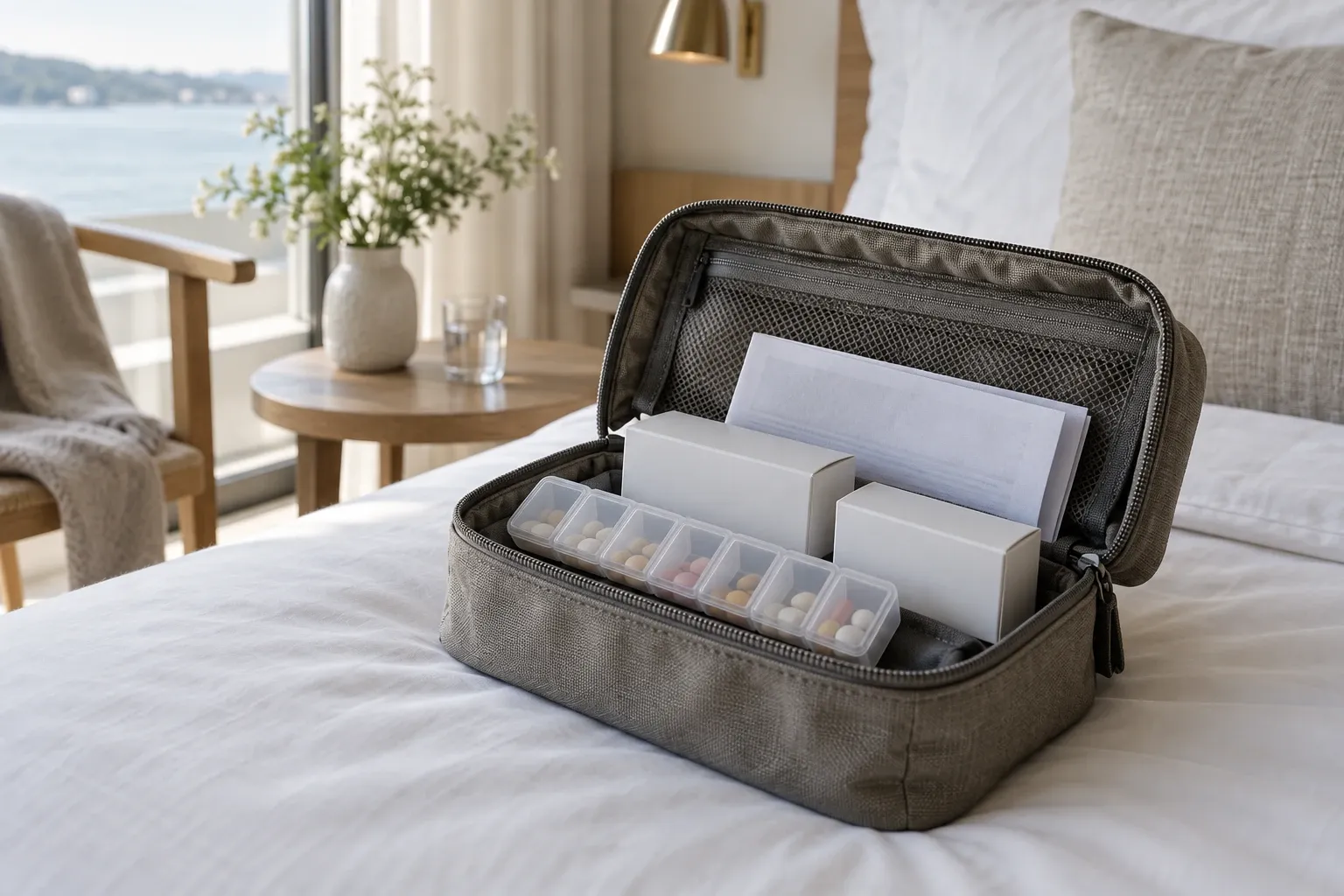
The practical consequence is worth spelling out: do not decant everything into a weekly pill organiser before you fly. Doing so throws away the label that does the work. Carry the boxes; decant when you arrive.
Narcotic-classed medicines: where it gets serious
Sweden classifies substances as narkotika through its own government decisions as well as through the 1961 and 1971 UN conventions, and Läkemedelsverket states the consequence plainly: classification brings “stricter limits on the amounts that may be carried when travelling to Sweden.”
The medicines involved are ordinary ones. Läkemedelsverket’s own examples are certain sleeping medicines, certain painkillers and certain ADHD medicines. To show the shape of it — and only that, because you must check your own — methylphenidate, amphetamine, morphine and oxycodone sat in schedule II when we last read the regulation, codeine and tramadol in III, ketamine, zolpidem and diazepam in IV, and pregabalin and zopiclone in V.
We deliberately do not publish a brand-name lookup table. Sweden’s schedules regulation, LVFS 2011:10, has been amended more than thirty times and twice already in 2026, most recently reconsolidated on 10 July 2026. A stale row in a table like that could get a reader arrested. Instead, here is the check, which takes two minutes:
- Search your medicine — by active substance, not brand, since brands differ between countries — in Läkemedelsverket’s Läkemedelsfakta service.
- Or ask any pharmacist: “is this narcotic-classed in Sweden, and which schedule?”
- Or read the schedules in LVFS 2011:10 directly.
The schedules mean something. Förteckning I is for substances with no normal medical use. II–IV are substances with medical use. V covers certain nationally classified substances.
How much you may actually carry
This is the section that changes trips. The narcotic limits do not sit alongside the one-year figure — they replace it.
| Your situation | Maximum per entry |
|---|---|
| Arriving from a Schengen state, not resident in Sweden | Enough for the trip, and never more than 30 days’ supply |
| Arriving from outside Schengen — schedule II or III | Five days’ supply |
| Arriving from outside Schengen — schedule IV or V | Three weeks’ supply |
| Resident abroad, visiting temporarily, from outside Schengen — schedule IV or V | 90 days’ supply |
| Schedule I | Only with an individual Läkemedelsverket permit, on exceptional grounds |
| Doping-classed medicines (testosterone, growth hormone) | 14 days’ supply |
Read the third row again. A visitor arriving from the US, the UK, Canada, Australia or Japan with methylphenidate, amphetamine, morphine, oxycodone, codeine or tramadol may lawfully carry five days’ supply. Not a year. Not three months. Five days — and unlike Schengen arrivals, there is no certificate that raises it.
Note also that Ireland and Cyprus are in the EEA but outside Schengen. A flight from Dublin gets the one-year rule for ordinary medicines and the five-day rule for schedule II and III narcotics. Norway, by contrast, is in both, so the Schengen rules apply on the whole Sweden–Norway land border — including at the many crossings with nobody standing at them.
The Schengen certificate, and who issues it
For travel between Schengen states there is a purpose-built document: the certificate under Article 75 of the Schengen Convention, known in Sweden as a Schengenintyg. Article 75 says travellers may carry the narcotic drugs they need for medical treatment provided that, at any check, they produce “a certificate issued or authenticated by a competent authority of their State of residence.”
Those last five words are the ones that matter, and they are why arranging this at the Swedish border is impossible.
| What | The rule |
|---|---|
| Who issues it | A competent authority in your country of residence — never Sweden, for an inbound visitor |
| Validity | 30 days maximum, covering at most 30 days’ consumption. No extension exists for longer trips |
| How many | One certificate per substance. Three narcotic-classed medicines means three certificates |
| The form | A uniform Schengen form in your national language, with English and French translations of the printed headings on the reverse |
| Basis | Issued or authenticated on the strength of a medical prescription; the issuing authority keeps a copy |
Because Article 75 says “issued or authenticated”, countries do it differently — which is why “ask your pharmacy” is good advice in exactly one country:
- Sweden: a community pharmacy issues it, and by law may not charge a fee.
- Germany: your treating doctor completes the BfArM form, and the highest state health authority (or a body it designates) authenticates it before you leave.
- Netherlands: the CAK issues the Schengen medicijnverklaring.
Elsewhere, ask your prescriber or your usual pharmacy who does it where you live. We deliberately do not publish a table for all 29 Schengen states — the Schengen Executive Committee’s own 1994 contact list is now thirty-two years out of date, which tells you what happens to lists like that.
One timing note: because the certificate is valid for 30 days, you cannot get it months ahead of a summer trip. Aim for the fortnight before departure.
The substances that require a certificate
Here the law does something unusually helpful. The certificate is not required for every narcotic-classed medicine — only for those containing a substance named in Bilaga 2 to förordning (1992:1554), and that annex is a closed list that has not changed since 2006. For those substances, arriving from a Schengen state, the ordinance says the certificate krävs — is required. Not advised.
alfacetylmethadol · alfentanil · amphetamine · buprenorphine · dextropropoxyphene (over 135 mg per dose unit, or over 2.5% undivided) · diazepam · fentanyl · flunitrazepam · hydromorphone · ketobemidone · codeine (over 100 mg per dose unit, or over 2.5% undivided) · cocaine · methadone · methylphenidate · morphine · nicomorphine · opium · oxycodone · pentazocine · pentobarbital · pethidine · sufentanil
Read the active substance off your own box and check it against that list. Note two things. First, the quantity limit and the certificate requirement are separate tests — diazepam is schedule IV, so a visitor from outside Schengen may carry three weeks of it, while a visitor from within Schengen needs a certificate for it. Second, this list is by substance, so it is the same whatever the medicine is called where you live.
If your medicine is narcotic-classed but its substance is not in Bilaga 2, no certificate is required — but the quantity limits still are.
The exemption that saves most people
Before anyone panics about the codeine in their painkillers: the annex to LVFS 2011:9 exempts a set of low-dose preparations from the narcotic travel rules entirely, when they are for medical use only. They travel under the ordinary one-year and three-month limits instead, with no certificate.
The one that matters most is codeine. A preparation that is mixed with other ingredients and contains no more than 100 mg of codeine per dose unit (or 2.5% if it is not divided into doses) is exempt — which covers every ordinary combination painkiller and cough preparation sold in Europe. The same exemption applies to dihydrocodeine, ethylmorphine, pholcodine and related substances at the same threshold, and to named low-dose diphenoxylate, difenoxin, dextropropoxyphene, opium and cocaine preparations.
If you need more than the limit allows
There are two answers, and which you get depends on where you are flying from.
Arriving from outside Schengen: you can apply to Läkemedelsverket for a dispensation (dispens) before you travel, enclosing a copy of the doctor’s certificate or the prescription. Apply early; no processing time is published.
Arriving from within Schengen: you cannot. Läkemedelsverket states directly that it cannot grant a dispensation for a narcotic medicine brought in from within the Schengen area — the 30-day cap sits in a government ordinance rather than in an agency regulation, so the agency has no power to waive it.
If your stay outlasts your lawful supply, the legal route is a Swedish prescription, not a bigger suitcase. Plan it before you travel: see healthcare for visitors in Sweden and how Swedish pharmacies work. For the everyday things — painkillers, antihistamines, rehydration salts — check what Sweden sells over the counter before you fill a suitcase with them.
Cannabis, doping medicines and needles
Medical cannabis is the sharpest edge on this page. Cannabis and cannabis resin sit in schedule I in Sweden — the schedule for substances with no recognised medical use — and schedule I medicines may be brought in only with an individual Läkemedelsverket permit granted on exceptional grounds, applied for in writing. A prescription issued lawfully in Germany or anywhere else does not change that. This is the case where a traveller is most likely to arrive believing they are compliant and not be.
Doping-classed medicines — synthetic anabolic steroids, testosterone and its derivatives, growth hormone — may be imported only for a medical or scientific purpose, and only 14 days’ supply per entry. Long-stay travellers on testosterone or growth hormone need to plan around that ceiling.
Syringes and needles are governed by their own statute, and it is more generous than the medicines rule: a private individual may bring them in for their own or a family member’s medical use. Tullverket’s own worked example confirms that a visiting diabetic may bring their syringes on showing a prescription or a doctor’s certificate.
Packing and crossing the border
- Original packaging, pharmacy label intact. The label is the proof.
- Prescription or doctor’s letter, printed, ideally in English.
- Certificates in the same bag as the medicines, not in hold luggage.
- Hand luggage. Liquid medicines such as insulin are permitted in the cabin, and hold baggage can be delayed.
- Green or blue lane if you comply. If anything is uncertain, Läkemedelsverket’s own advice is to walk under the varor att deklarera — goods to declare — sign instead.
That last instruction is the one that converts a legal problem into an administrative one. Under Sweden’s smuggling act the offence turns on failing to declare goods subject to an import condition; where the goods are narcotics it is narkotikasmuggling, punishable by up to three years’ imprisonment, or a fine or up to six months where it is minor. Declaring costs nothing but time. No Swedish authority publishes what actually happens to a traveller who arrives with prescribed medication and the wrong paperwork, so we make no claim about it — only about the offence that exists and the official instruction to declare when unsure.
Practical information
| Item | What applies |
|---|---|
| Who writes the rules | Läkemedelsverket (Swedish Medical Products Agency); Tullverket checks compliance at the border |
| Ordinary medicines, from the EEA | One year’s supply per entry |
| Ordinary medicines, from outside the EEA | Three months’ supply per entry |
| Narcotic-classed, from a Schengen state | Proportionate to the trip, never more than 30 days |
| Narcotic-classed, from outside Schengen | Five days (schedule II–III); three weeks (IV–V); 90 days (IV–V, resident abroad, temporary visit) |
| Narcotic-classed, schedule I | Individual Läkemedelsverket permit only, on exceptional grounds |
| Doping-classed | 14 days’ supply per entry |
| Schengen certificate | Required for the 22 substances in Bilaga 2 to förordning (1992:1554); issued in your country of residence; 30 days maximum; one per substance |
| Proof of personal use | Pharmacy label with your name and the prescriber’s name, or a doctor’s certificate, or the prescription |
| Tax | None — no duty, VAT or other tax on medicines for personal medical use |
| Cost of a Swedish certificate | Free; a Swedish pharmacy may not charge, and Läkemedelsverket must supply the forms free |
| Where to check classification | Läkemedelsfakta (search the active substance), any pharmacist, or LVFS 2011:10 |
| If you are unsure at the border | Red lane, varor att deklarera |
FAQ
Can I bring my prescription medication into Sweden?
Yes, for your own medical use. From an EEA country you may bring up to one year’s supply, from outside the EEA up to three months, with no duty or tax. You must be able to prove it is yours — a pharmacy label showing your name and the prescriber’s name, or a doctor’s certificate. Narcotic-classed medicines have far tighter limits.
How much medication can I bring to Sweden?
It depends on classification, not on the size of your suitcase. Ordinary medicines: one year’s supply from the EEA, three months from outside it. Narcotic-classed medicines: 30 days maximum arriving from a Schengen state, or five days for schedules II–III and three weeks for IV–V from outside Schengen. Doping-classed medicines: 14 days.
Do I need a Schengen certificate to bring medication to Sweden?
Only if you arrive from a Schengen state carrying a medicine whose active substance is listed in Bilaga 2 to förordning (1992:1554) — amphetamine, methylphenidate, morphine, oxycodone, diazepam, fentanyl, methadone and others. For those it is required, not advisory. It must be issued or authenticated by a competent authority in your own country of residence.
How do I get a Schengen certificate for medication?
In your country of residence, before you travel. Article 75 of the Schengen Convention makes it the job of a competent authority there. In Sweden a pharmacy issues it; in Germany your doctor completes the BfArM form and the state health authority authenticates it; in the Netherlands the CAK issues it. Ask your prescriber or pharmacy who does it where you live.
Can I bring ADHD medication into Sweden?
Usually yes, with the right paperwork. Methylphenidate and amphetamine are narcotic-classed in Sweden and appear in Bilaga 2, so arriving from a Schengen state you need an Article 75 certificate and may carry at most 30 days’ supply. Arriving from outside Schengen the limit is five days’ supply, with no certificate route available.
Can I bring medical cannabis to Sweden?
No, not on a foreign prescription. Cannabis and cannabis resin are in schedule I of Sweden’s narcotics lists, the schedule for substances with no recognised medical use. Schedule I medicines may be brought in only with an individual permit from Läkemedelsverket granted on exceptional grounds, applied for in writing before travel.
Do I have to declare medicines at Swedish customs?
Not if they comply — take the green or blue lane. Tullverket checks at the border that Läkemedelsverket’s rules have been followed, so if you are inside the limits with proof of personal use, nothing needs declaring. If anything is uncertain, Läkemedelsverket’s own advice is to walk under the “goods to declare” sign instead.
What happens if I bring too much medication into Sweden?
The medicine cannot lawfully be imported, so it will be stopped. Failing to declare goods subject to an import condition is smuggling; where the goods are narcotics the offence is narkotikasmuggling, with imprisonment up to three years, or a fine or up to six months if minor. No Swedish authority publishes its handling practice for prescribed medication, so we make no claim about the usual outcome.
Related guides
- Sweden’s customs allowances — everything else you may carry across the border, and the EU/non-EU fork that governs it.
- How Swedish pharmacies work — the apotek system, the over-the-counter range, and what to do if you run out.
- Healthcare for visitors in Sweden — how to see a doctor, and what it costs, if your stay outlasts your supply.
- Eating out with food allergies in Sweden — why it tells you to pack your own adrenaline and spares, and why that is comfortably within these limits.
- Bringing your dog to Sweden — the pet procedure, including your animal’s own prescriptions.
- 112 and Sweden’s emergency numbers — the number to have before you need it, and what else it does.
Facts verified 2026-07-26. Sources: Läkemedelsverket, Tullverket, 1177 Vårdguiden, the Swedish statute book (lag 1992:860, förordning 1992:1554, LVFS 1996:5, LVFS 2011:9, LVFS 2011:10, lag 1991:1969, lag 2012:595, lag 2000:1225), Article 75 of the Schengen Convention, BfArM and the CAK — full register in this topic’s source file. Sweden’s narcotics schedules were amended twice in the first half of 2026; this page is on a six-month review cycle and deliberately publishes no brand-name lookup table. Found something outdated? Tell us and we’ll fix it.