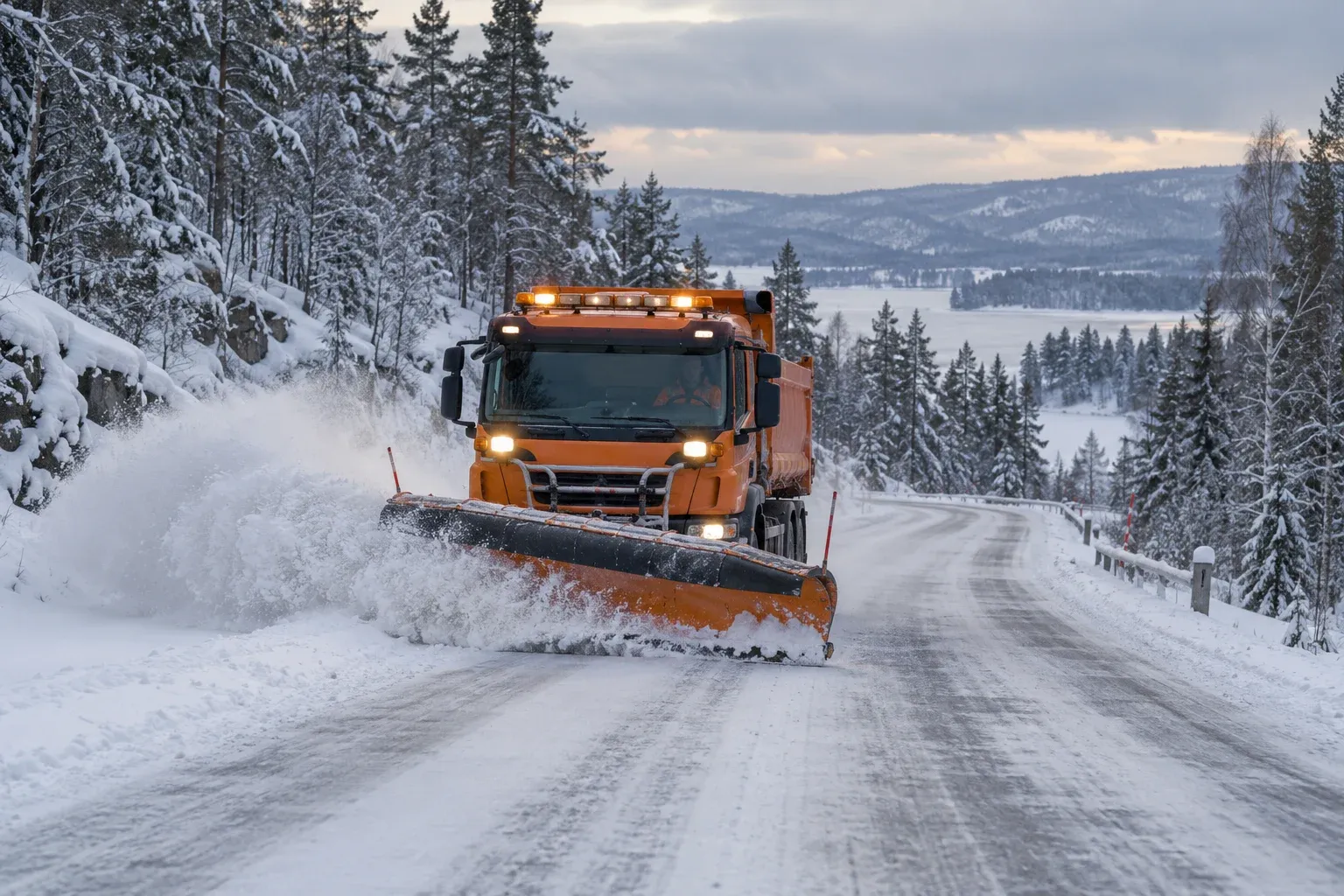
After a Swedish snowfall, the highway is black, the side road is white and the sidewalk outside your rental is still knee-deep. None of that is chance. Four different keepers clear four kinds of surface, each to its own published standard.
When you need this
You’re driving after a snowfall and wondering why one road is clear and the next isn’t. Or you’ve booked a winter cabin, a ski apartment or a holiday house and want to know if you’ll actually reach it. Maybe you’re parking overnight in a Swedish town between October and April, cycling to work in a Swedish city, or staring at a sign that reads Varning för takras.
Who clears what
The first question is always who owns the road in front of you.
| Surface | Who clears it | Standard set by |
|---|---|---|
| Numbered state roads, E-roads | Trafikverket (Swedish Transport Administration) and its contractors | Five national winter classes |
| Town streets, squares, cycle paths | The municipality | The municipality’s own priority plan |
| Sidewalks outside buildings | Often the property owner | Municipal rules under national law |
| Private roads (enskilda vägar) | The properties that use the road, usually via a road association | The association |
Trafikverket runs a full winter organization from October to April across about 100,000 km of state road. Inside towns, the law makes the municipality responsible for clearing streets, squares and parks in the local plan, for accessibility and traffic safety. A private road is the responsibility of the properties that benefit from it, and no public body will plow it for them.
State roads: the five winter classes
Trafikverket can’t clear every road to the same standard, so every state road has a winter class (vägklass) based on traffic volume and function. The class decides when the plow starts, how long it has, and how much snow may stay on the road afterwards.
| Class | Plow starts at | Time allowed | Result after snowfall ends | Treatment |
|---|---|---|---|---|
| 1 | 1 cm | 2 hours | Free of snow and ice within 2 hours | Salt |
| 2 | 1 cm | 3 hours | Free of snow and ice within 3 hours | Salt |
| 3 | 1 cm | 4 hours | At least bare wheel tracks; snow ridges may remain | Salt |
| 4 | 2 cm | 5 hours | At most 2 cm of snow left | Sand |
| 5 | 3 cm | 6 hours | At most 3 cm of snow left | Sand |
The split explains what you see from the driver’s seat. Class 1 is only about 2,000 km but carries 22 percent of all traffic. Class 5 is about 51,500 km and carries 7 percent. Most of the network by length is class 4 or 5, which means packed snow on purpose, not neglect.
Two caveats are written into the standard. Below −6 °C, Trafikverket accepts that some snow and ice can remain on some roads even after treatment. In extreme weather, contractors may not manage the times at all.
On motorways and 2+1 roads you may meet two plows working side by side about 200 meters apart. Don’t overtake them: one blade reaches into the lane you’d use, often hidden by snow, and Trafikverket calls overtaking a danger to life. Technique for the drive itself is in our winter driving guide, and tyre rules in the winter tires guide.
Town streets and bike paths
Every municipality writes its own plan, so there’s no single national order. What they share is a priority list. Main streets, bus routes, access for emergency services and school routes come first, and residential streets come last. Many cities also put the main cycle routes near the top.
| City | What comes first | Typical times |
|---|---|---|
| Umeå | Priority cycle routes start at 3–5 cm; priority streets at 4–10 cm | Priority within 5 hours, residential streets within 8 |
| Gothenburg | Cycle lanes start at 2 cm and are salted; bus streets prioritized | Bus stops within 6 hours; no fixed time for residential streets |
| Uppsala | High-priority cycle paths and bus streets | 4 hours for those, 5–6 hours for other streets |
| Malmö | New top tier for supercykelstråk (cross-city cycle highways) from winter 2026/2027 | Villa streets only in heavy snow or prolonged ice, weekdays 07:00–16:00 |
| Sorsele (small northern town) | Priority streets, school routes, bus stops | Start at 6 cm; 6 hours priority, 10 hours others |
Treat these as examples. Your town’s standard is on its own snöröjning (snow clearing) page, often with a map.
Salt has limits. Gothenburg salts its cycle lanes, but at about −5 °C or colder salt stops working and the city switches to stone chippings, so snow and ice can return to a lane that’s usually bare. Some gravel park paths and small forest trails aren’t cleared at all.
Sidewalks and roof snow
Here’s the rule that surprises most visitors: in many towns, the sidewalk outside a building is the property owner’s job, not the city’s. Swedish law lets municipalities oblige owners to clear the pedestrian space outside their property. Gothenburg applies it to sidewalks within 10 meters of the property boundary, and Malmö, Uppsala and Umeå also put the duty on owners.
The duty ends where the municipality starts using the sidewalk to store plowed snow; then it’s the city’s again. Some central pavements, such as Malmö’s pedestrian zones, are cleared by the city anyway.
For a visitor this matters in two ways. If you rent a house on a short stay, the host normally handles it, but on a long let, check the contract. And sidewalk quality varies stretch by stretch, because each owner clears their own frontage. Our guide to walking on icy sidewalks covers the footwork.
Then look up. The public-order law requires building owners to remove snow and ice that could fall onto a public place, without undue delay. Until they do, a sign reading Varning för takras (danger, snow falling from the roof) is your warning. Walk on the curb side of the pavement.
Private roads and cabins
Private roads are cleared by the properties that use them, usually through a vägförening or samfällighetsförening (road or joint-property association) that hires a plow and charges dues. The municipality doesn’t plow them. In Uppsala, for example, villages outside the main towns rely on such associations, while Trafikverket clears the larger roads between them.
Roads that receive Trafikverket’s annual road grant must stay open to public traffic, and the grant covers winter work such as plowing. The grant rules changed on 1 January 2026, so older pages still call it driftbidrag; it’s now vägbidrag. On roads used mostly in summer, winter service may be limited, since summer-only users may pay a smaller share.
So before you book a winter cabin, ask the host three things: who plows the access road, how soon after snowfall, and where you can park. Municipal plows also leave a ridge of snow (plogvall) across driveways and don’t come back to open them; Sorsele states this outright. Keep a shovel at the house. Owners will find more in our guides to private roads and owning a Swedish cabin.
Parking and towing on snow nights
Many towns use datumparkering (date parking) in winter: on even dates you can’t park on the side with even house numbers, and on odd dates the odd side, during the hours on the sign. The date changes at midnight, so park in the evening for tomorrow’s rule. Full sign rules are in our parking guide.
Getting it wrong costs more than a fine. A car parked against the parking rules that obstructs snow clearing may be towed, and the owner pays for the move.
Checking the roads
- Trafikverket’s traffic-information map: road conditions, road-weather camera images, closures and incidents, free.
- Trafiken.nu: extra detail for the Stockholm and Gothenburg regions.
- County plow maps: Trafikverket publishes a PDF per county showing every state road’s class.
- Sveriges Radio P4: the traffic desk reports live conditions.
- Your municipality’s map: Uppsala and Malmö, among others, show prioritized streets and cycle paths.
Since winter 2025/2026, Trafikverket also uses data from cars in traffic to spot slippery stretches, alongside about 750 road-weather stations whose cameras photograph the surface every ten minutes. If traffic stops in a queue, pull far to the right so plows and emergency vehicles can pass. Before a big storm, check the SMHI weather warnings too.
Mistakes to avoid
- Expecting every road to be black. Classes 4 and 5 are meant to keep a few centimeters of packed snow. Plan extra time on side roads.
- Assuming the town plows the road to your holiday house. Private roads belong to their users; ask the host.
- Parking on the wrong side on a snow night. Read the datumparkering sign and remember the midnight switch.
- Waiting for the plow to open your driveway. It won’t. Grab the shovel.
- Walking close under the eaves after a thaw. Step away where takras is signed or icicles hang.
Practical information
| Item | What to know |
|---|---|
| Trafikverket winter season | Full organization October–April |
| Fastest state-road standard | Class 1: clear within 2 hours after snowfall ends |
| Slowest state-road standard | Class 5: within 6 hours, up to 3 cm left |
| Municipal standby (examples) | Uppsala 15 October–30 April; Malmö 29 October 2026–1 April 2027 |
| Datumparkering (example) | Hedemora: 1 October–31 March, 00:00–08:00 |
| Towing for obstructing snow clearing | Owner pays the cost of the move |
| Free grit for residents | Uppsala, at municipal collection points |
| Urgent hazard on a state road | Trafikverket 0771-921 921 (24 hours); danger to life: 112 |
| Live road conditions | Trafikverket’s traffic-information map, free |
FAQ
How quickly are roads plowed in Sweden?
It depends on the road’s class. Trafikverket’s busiest roads, class 1, start at 1 cm of snow and must be free of snow and ice two hours after it stops. The quietest, class 5, start at 3 cm and may still carry 3 cm of snow six hours after snowfall. Towns set their own times, typically four to eight hours.
Why are side roads still white when the highway is clear?
That is the system working as designed. Trafikverket ranks state roads by traffic, and classes 4 and 5, which make up most of the network by length, are sanded rather than salted and may keep a couple of centimeters of snow. Only classes 1–3 are normally salted bare. Drive for packed snow on small roads.
Who clears the snow on sidewalks in Sweden?
Often the property owner, not the city. Swedish law lets municipalities oblige owners to clear and grit the sidewalk outside their property, and Gothenburg, Malmö, Uppsala and Umeå all do. The duty ends where the municipality uses the sidewalk to store plowed snow. Main cycle paths and some central pavements are cleared by the municipality itself.
Will the road to my rental cabin be plowed in winter?
Only if someone has arranged it. Private roads are the responsibility of the properties that use them, usually through a road association, and the municipality does not plow them. Roads with a state grant must stay open to traffic, but on roads used mostly in summer, winter service may be limited. Ask the host before booking and when to expect the plow.
Can my car be towed for snow clearing in Sweden?
Yes. A car parked against the parking rules that gets in the way of snow clearing may be moved, and the owner must pay for it. The rule you are most likely to meet is datumparkering: on winter nights one side of the street is off-limits, alternating by date, and the rule changes at midnight. Read the sign before you leave the car.
Do Swedish cities really plow bike paths first?
Many prioritize them. Umeå starts plowing priority cycle routes at 3–5 cm, sooner than priority streets. Gothenburg starts its cycle lanes at 2 cm and salts them. Uppsala clears high-priority cycle paths within four hours, the same as bus streets, and Malmö has made cross-city cycle highways its top cycle priority for winter 2026/2027.
How do I check if a road is passable?
Use Trafikverket’s free traffic-information map, which shows road conditions, road-weather camera images, closures and incidents. Trafiken.nu adds detail for the Stockholm and Gothenburg regions, and the traffic desk on Sveriges Radio P4 reports live conditions. Trafikverket’s county plow maps show each state road’s winter class, so you can see which roads get cleared first.
Related guides
- Winter driving in Sweden: how to drive the roads this page describes
- Parking in Sweden: datumparkering and every other sign, in full
- Private roads in Sweden: how road associations and their dues work
- Owning a Swedish cabin: the winter road, the pipes and the rest of the owner’s list
- Winter tires in Sweden: the tire law that applies on all these roads
Facts verified 2026-10-05. Sources: Trafikverket, Sveriges Riksdag (Lag 1998:814, ordningslagen, vehicle-removal rules), Lantmäteriet, and the municipalities of Umeå, Gothenburg, Malmö, Uppsala, Sorsele and Hedemora — full register in this topic’s source file. Live road status changes by the hour and is never published here. Found something outdated? Tell us and we’ll fix it.