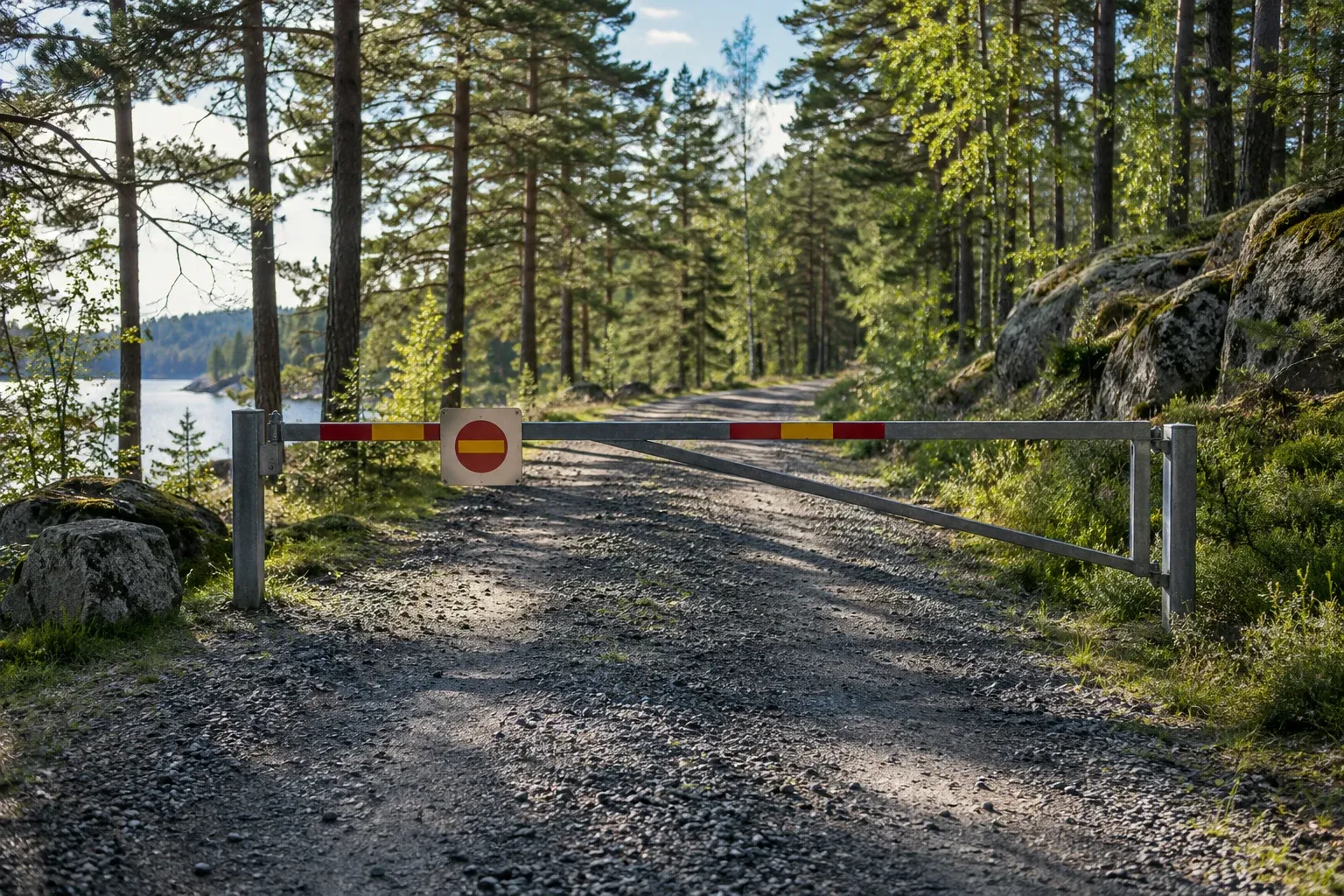
In Sweden, “private road” rarely means “keep out”. It means someone other than the state looks after the road. Here’s when you may drive on one, what the signs and barriers mean, and where your car may stop.
When you need this
Your sat-nav has turned you onto a gravel road towards a lake, a trailhead or the cabin you’ve rented. At the turn-off there’s a yellow sign, a red-and-white barrier, or a hand-painted board saying Ej genomfart. Or you’re in a motorhome looking for a quiet place to stop, and every forest road looks inviting.
Most Swedish roads are private
Sweden has roughly 600,000 km of road. Only about 140,000 km are kept by the state or a municipality. The rest, around 460,000 km, are enskilda vägar (private roads), and that figure includes some 150,000 km of forest roads built for timber trucks. These are the figures of the national road-keepers’ association.
A private road belongs to no one in the way a driveway does. The properties that benefit from it are its väghållare (road keeper) and are responsible for it, usually through a road association (vägförening or samfällighetsförening) that shares the costs. Year-round residents often pay a bigger share than summer-cabin owners.
About 22,500 road keepers receive a state grant for roughly 74,000 km of private road. That grant comes with strings attached, which matter to you as a driver (see below).
What the signs mean
| Sign or text | What it means | Is it binding? |
|---|---|---|
| Yellow direction sign with red border | The road is private | Information only |
| Enskild väg | Private road | Information only |
| Förbjudet för motorfordon or a red-ringed prohibition sign | Motor vehicles banned | Yes: the owner’s marked ban |
| Closed barrier (bom) | Motor vehicles banned | Yes |
| Weight limit in spring | Vehicles over the limit banned | Yes |
| Ej genomfart | No through traffic | Owner’s marking; visitors to a property normally pass |
| Obehöriga äga ej tillträde | No unauthorized entry | Usually marks a work area or yard; respect it |
Blue direction signs point along public roads; yellow signs with a red border point along private ones. That colour rule is set in the road-sign ordinance. On a private road, the owner puts up their own signs.
Ej genomfart is not a sign defined in law. It’s the owner telling shortcut-takers to stay out. If you’re heading to a property on the road (your rental cabin, a farm shop), you’re normally fine. If in doubt, ask.
Barriers and bans: the owner decides
This is the rule most visitors and many forum posts get wrong. Under the Swedish traffic ordinance (trafikförordningen, chapter 10, section 10), the owner of a private road decides whether motor vehicles may use it. The owner can also ban vehicles above a certain width, length or weight.
The ban must be marked “with a road sign or in another clear way”. It doesn’t need a decision from the municipality. A driver who breaks a marked ban is fined. So the popular claim that a landowner’s sign “has no legal force” is wrong; a clear sign is binding.
A closed barrier is the clearest marking there is. Don’t drive round it on the verge: that adds an off-road driving offence. And never cut across a garden plot or planting to avoid a barrier or a mud hole. That’s tagande av olovlig väg (unlawful passage) under the penal code, punishable by fines or up to six months in prison.
In spring, when the frost comes out of the ground (tjällossning), many gravel roads get weight limits. They’re binding like any other marked ban. A heavy motorhome on a soft road can also break the surface or get stuck.
Grant roads: open to all, no toll
New since 1 January 2026: a new ordinance on state grants for private roads (SFS 2025:753) replaced the one from 1989. It says the annual road grant may be paid only if the road is “kept open for public traffic without a fee”. Older pages describe this as a mere Trafikverket condition; it’s now statute.
What that means for you:
- A grant road must let you through. Trafikverket warns that a barrier, a C3 prohibition sign or other blocking on a grant road can cost the road its grant.
- A grant road can’t charge you. Some ferries can be exempted, and Trafikverket may set out exemptions, but the rule is: if a road charges you, it’s not running on the annual grant.
- Roads without the grant are fully under the owner’s control. Conditions there are the owner’s call.
To check whether a road is public or private, use Trafikverket’s national road database map (NVDB). It’s worth a look before you take a rental car down a long gravel road.
Road or terrain: where your car may go
A private road that’s generally used by motor traffic counts as a road in Swedish traffic law, so the ordinary rules apply:
- default speed limits: 50 km/h in built-up areas, 70 km/h elsewhere, unless signed otherwise
- winter tyres from 1 December to 31 March when there are winter conditions
- the ordinary parking bans
Anything that isn’t a road is terräng (terrain). The Off-Road Driving Act (terrängkörningslagen) bans driving a motor vehicle in terrain on bare ground, except for farming and forestry. That’s why the forestry machine may leave the road and you may not. The clearing at the end of the forest road, the lakeshore and the meadow are all terrain. See our guide to motorhome wild camping in Sweden for where a vehicle can legally spend the night.
Stopping and parking
You may stop on a private road where traffic rules allow, but never in a passing place marked with sign E18 (mötesplats) or in front of a driveway. Don’t block the road: forest roads are work sites for timber trucks, which can’t stop or reverse easily. Leave turning places and timber-loading areas free.
On private car parks, a landowner who signs the conditions with proper road signs may charge a kontrollavgift (control fee) for parking against them. It is capped at the municipality’s parking-fine level. Pulling off the road onto the ground isn’t parking: it’s off-road driving.
On foot or by bike
None of this stops walkers or cyclists. Under allemansrätten (the right of public access) you may walk and cycle on private roads, provided you cause no damage. A barrier or a motor-traffic ban is aimed at cars. Close any gate you open, since gates on rural roads usually keep grazing animals in, and keep out of people’s gardens. See our allemansrätten guide.
Renting a cabin at the end of a private road? Ask your host for the barrier code or key, who ploughs in winter, and where guests may park. The municipality doesn’t plough private roads by default.
Practical information
| Question | Answer |
|---|---|
| Share of road network that is private | About 460,000 of 600,000 km (industry figure) |
| Private roads on the annual state grant | About 74,000 km, 22,500 road keepers |
| Who may ban cars on a private road | The road’s owner, by sign or other clear marking |
| Penalty for ignoring a marked ban | Fine, set case by case |
| Grant roads | Must be open to public traffic without a fee (since 1 Jan 2026 in statute) |
| Default speed limit on private roads | 50 km/h built-up, 70 km/h elsewhere |
| Winter tyres | 1 December–31 March in winter conditions, private roads included |
| Parking on private car parks | Control fee possible if signed with road signs |
| Driving off the road onto bare ground | Banned (Off-Road Driving Act) |
| Walking and cycling | Allowed under allemansrätten, without causing damage |
| Who ploughs | The road keeper (the properties along the road) |
| Check public or private | Trafikverket’s NVDB map |
FAQ
Can I drive on a private road in Sweden?
Usually yes. Most Swedish roads are private, and unless the owner has banned motor traffic with a sign or another clear marking, you may drive on them. Roads that receive the annual state grant must stay open to public traffic. Where a ban or closed barrier is clearly marked, it is binding, and drivers who ignore it are fined.
What does “Enskild väg” mean on a sign?
It means “private road”: the road is kept by the properties that use it, not by the state or municipality. On its own it is information, not a ban. A ban on motor traffic needs to be marked, for example with a prohibition sign, a barrier or a clear text such as “Förbjudet för motorfordon”.
Is it legal to drive around a road barrier?
No. A closed barrier is the owner’s way of banning motor traffic, and the owner of a private road has that right. Driving round it on the verge also counts as off-road driving, which is a separate offence on bare ground. Walk or cycle past if there is room; leave the car.
Can a private road charge a toll in Sweden?
Not if it receives the annual state road grant: since 1 January 2026 the grant ordinance requires the road to be open to public traffic without a fee, except for some ferries. A road without the grant is under the owner’s control, so conditions are possible there. If a road charges you, it is not a grant road.
Can I park on a private road or forest road?
You may stop where traffic rules allow, but not in a signed passing place or in front of a driveway, and never block the road. Forest roads carry timber trucks, so leave turn-outs and loading areas free. On private car parks, signed conditions can lead to a control fee. Pulling off onto the ground is off-road driving.
Can I walk or cycle on a private road?
Yes. Under allemansrätten you may walk and cycle on private roads, provided you cause no damage. A barrier or a motor-traffic ban stops cars, not people on foot or bike. You still need to keep out of people’s private gardens and close any gates you open.
Who clears the snow on a private road?
The road keeper, meaning the properties that benefit from the road, usually through a road association. The municipality does not plough it by default. Roads with the state grant receive money for winter maintenance such as ploughing and gritting, but timing is decided locally, so ask your host before arriving in winter.
Related guides
- Driving in Sweden — the general road rules that also apply on private roads
- Swedish road signs — prohibition signs, passing places and what the colours mean
- Motorhome wild camping in Sweden — where a vehicle may legally stop overnight
- Owning a Swedish cabin — road dues and ploughing from the owner’s side
- Swedish forestry explained — why forest roads and timber trucks are everywhere
Facts verified 2026-10-05. Sources: Sveriges riksdag (Förordning 2025:753 om statsbidrag till enskild väghållning, trafikförordningen, förordningen om vägtrafikdefinitioner, terrängkörningslagen, vägmärkesförordningen, lagen om kontrollavgift vid olovlig parkering, brottsbalken, miljöbalken), Trafikverket, Lantmäteriet, Länsstyrelsen Skåne, Riksförbundet Enskilda Vägar — full register in this topic’s source file. Found something outdated? Tell us and we’ll fix it.