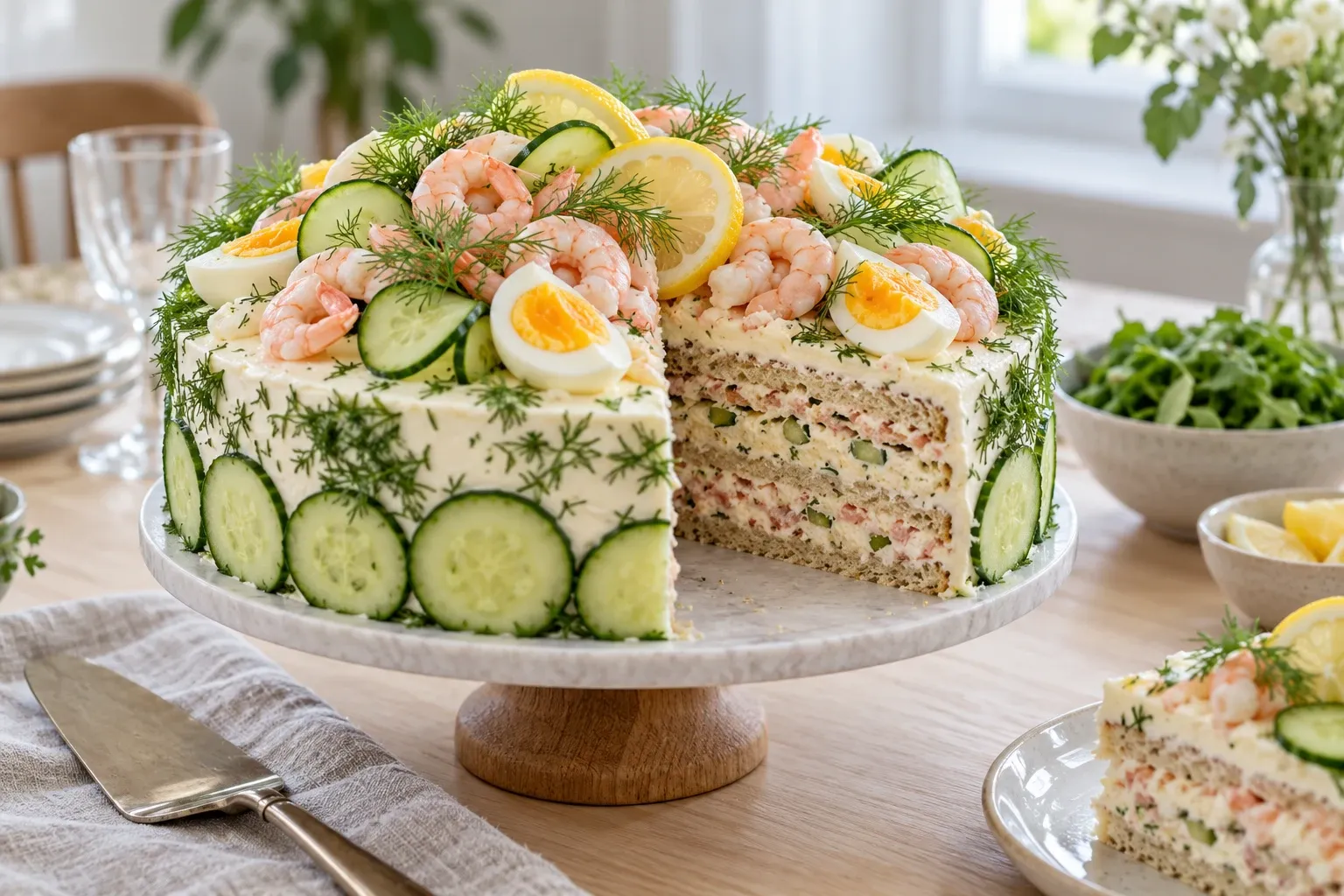
It looks like a cream cake, it’s cut like a cream cake, and it tastes of shrimp and mayonnaise. Here’s what it is, when you’ll be handed a slice, the real history, and what to know if you’re allergic or pregnant.
When you need this
You’ve been invited to a graduation open house, a 50th birthday, a christening or the reception after a funeral, and the invitation says nothing about food. Or a colleague has carried a decorated cake into the office and it turns out to be made of bread. Or you’re hosting in Sweden and want a hands-off, very Swedish centerpiece. In all three cases, the answer on the table is often a smörgåstårta.
What a sandwich cake is
A smörgåstårta (“sandwich cake”) is a sandwich built for a crowd. Layers of buttered bread, often alternating light and dark, are stacked with creamy fillings between them. The outside is spread with soft cheese, mayonnaise or crème fraîche and then heavily decorated, exactly like a gateau.
It’s served chilled as a dish in its own right, sometimes followed by something sweet, and it’s cut and handed round in slices. The shape varies: round from a bakery, often rectangular when made at home. Some bakeries also sell single slices, portionsbitar, so you can try one without a party.
The key thing for a guest: at a reception, the sandwich cake usually is the meal. It replaces hot food. Don’t treat the first slice as a starter and wait for dinner.
What goes in it
There’s no fixed recipe and no protected name, so every baker and household does it differently. These are the usual building blocks:
| Part | Typical ingredients |
|---|---|
| Bread | White or light rye, often alternating light and dark layers |
| Fillings | Shrimp or shrimp salad, smoked salmon, egg and mayonnaise, liver pâté, ham, cheese |
| Coating | Mjukost (soft spreadable cheese), mayonnaise or crème fraîche |
| Decoration | Shrimp or crayfish tails, rolled ham and cheese, sliced egg, cucumber, tomato, herbs |
One quirk Swedes rarely notice: meat and shellfish often share one cake. Ham next to shrimp next to salmon is a combination otherwise rare in modern Swedish food, surviving in only a handful of dishes.
Not every sandwich cake is fishy. Swedish cookbooks already had a lacto-vegetarian version in 1953, and vegan versions exist today. A few households even bake warm versions in the oven. If you’re served one, ask what’s inside rather than guessing from the top.
When Swedes serve it, and when they don’t
The sandwich cake solves a host’s problem: food that can be made or ordered in advance and stretches when nobody knows exactly how many guests will turn up. That’s why it belongs to personal milestones.
| You’ll likely meet it at | You’ll rarely meet it at |
|---|---|
| Graduation open houses in June | Christmas |
| Round-number birthdays | Easter |
| Engagements and weddings | Midsummer |
| Christenings and naming parties | |
| The reception after a funeral | |
| Office celebrations and company anniversaries |
The calendar feasts have their own buffets, and the sandwich cake isn’t on them. One newer exception: Swedish Wikipedia notes that eating sandwich cake on National Day, 6 June, has become a habit in many places. With it, people drink whatever suits the occasion: coffee, tea, beer, wine, soft drinks or mineral water.
It has its own theme day, Smörgåstårtans dag, on 13 November, started in 2012 by an enthusiasts’ group. It’s a social-media day, not a holiday.
Who invented it? Not who you’ve read
Most English pages tell the same story: a confectioner, Gunnar Sjödahl, invented the sandwich cake as an apprentice in 1965 and launched it in Östersund. Sjödahl has said so in many interviews. The theme day’s date, 13 November, is his birthday.
The printed record disagrees. The food historian Richard Tellström of Örebro University has said “there is no historical research that supports his claim”, and the dated sources back him:
| Year | Evidence |
|---|---|
| 1934 | The word smörgåstårta in a Swedish newspaper |
| 1940 | A cookbook gives a layered, decorated sandwichtårta |
| 1945 | Bakers advertise bread for making one |
| 1951 | A cookbook recipe for smörgåstårta, which Tellström calls “quite similar” |
| 1965 | Sjödahl’s claimed invention |
The dish evolved rather than being invented. It grew out of older open-sandwich dishes: a striped layered sandwich, the long decorated landgång that is still on café menus, and the small, elaborately decorated starter sandwiches of the 1920s and 1930s. It took off after the Second World War, when butter and cream were no longer rationed. Until the 1960s, sandwichtårta was the more common trade name.
What Sjödahl can fairly claim is popularising a commercial version. From there, caterers and bakeries made it a fixture of 1970s and 1980s parties. The dish also spread to Finland (voileipäkakku), Estonia (võileivatort) and Iceland (brauðterta).
One piece of trivia: a 510-metre sandwich cake made in Köping in 1985 became the story behind the book Tårtgeneralen (2009) and a film of the same name.
Allergies: five allergen groups on one slice
A typical sandwich cake contains crustaceans (shrimp, crayfish), fish (salmon, roe), eggs, milk and cereals containing gluten. All five are separate entries on the EU list of fourteen declarable allergens.
- Fillings are hidden. What’s on top doesn’t tell you what’s between the layers. Ask about the inside.
- You have the right to a straight answer. A shop, café or caterer must be able to tell you which declarable allergens an unpacked sandwich cake contains, not just which ones it doesn’t.
- Dairy is everywhere: butter on the bread, soft cheese or crème fraîche on the outside.
Our guides to eating out with food allergies and lactose-free Sweden cover how to ask.
Pregnant guests and listeria
This is the part recipe blogs skip. Listeria can grow at fridge temperature, especially in smoked and cured fish and sliced cold cuts that keep for weeks. Livsmedelsverket, the Swedish Food Agency, advises pregnant women and other risk groups (frail older people and anyone with weakened immunity) to:
- avoid cold packaged mixed salads, sandwiches and spreads that contain smoked or cured fish, mould or washed-rind cheese, or cold cuts
- avoid cold dishes with cold cuts or smoked or cured fish unless every ingredient is freshly packed
- eat bought smoked and cured fish within a week of its packing date
Livsmedelsverket doesn’t name the sandwich cake, but a salmon-and-ham one fits that description. In pregnancy, listeriosis can lead to miscarriage or a seriously ill baby. It kills 20–30% of the immunocompromised and frail elderly people who get it.
What you can do: ask the host or baker whether the cake was freshly made and the salmon freshly packed, or choose a version built on cooked shrimp and egg. Spreadable cheese in tubes or tubs and cream cheese are on Livsmedelsverket’s list of foods that are fine for risk groups.
Hosting: ordering and keeping it cold
Bakeries, supermarket delis and caterers take orders for whole sandwich cakes, sold by size or number of portions. Give the shop your guest count, and ask how far ahead you need to order: June graduation season and 6 June are busy weeks.
The cake is a chilled food, and Livsmedelsverket gives clear limits for how long chilled food should stand out:
| Room temperature | Maximum time out of the fridge |
|---|---|
| Up to 20 °C | 4 hours |
| Up to 25 °C | 3 hours |
| 26–30 °C | 2 hours |
Keep the fridge at 4 °C. On a warm June afternoon, serve the cake in portions and put the rest back between rounds rather than leaving it on the table all day.
Practical information
| Item | What to expect |
|---|---|
| Price of a whole cake or slice | Varies by size, filling, shop and town; ask for a quote by number of portions |
| VAT, whole cake taken away / slice eaten in | 6% / 12%, 1 April 2026 – 31 December 2027; some cafés price the two differently |
| Where to buy | Bakeries, supermarket delis and caterers; some bakeries sell single slices |
| Busy periods | June graduations and 6 June: order early |
| Theme day | Smörgåstårtans dag, 13 November; not a holiday |
| Safe standing time | 4 h up to 20 °C, 3 h up to 25 °C, 2 h at 26–30 °C |
| Typical allergens | Crustaceans, fish, eggs, milk, cereals containing gluten |
FAQ
What is a smörgåstårta?
A smörgåstårta, or sandwich cake, is a savoury dish built like a layer cake: buttered bread layers with creamy fillings between them, covered in soft cheese, mayonnaise or crème fraîche and decorated with toppings such as shrimp, salmon, egg, cucumber and herbs. It is served cold and cut into slices like a cake, usually as the main food at a reception.
What is in a Swedish sandwich cake?
There is no fixed recipe. Typical fillings are shrimp or shrimp salad, smoked salmon, egg and mayonnaise, liver pâté, ham, cheese and crème fraîche or soft cheese, with light or dark bread. Unusually for Swedish food, meat and shellfish often share one cake. Vegetarian and vegan versions exist, so ask the host or shop what is inside.
When do Swedes eat smörgåstårta?
At personal celebrations where food must be ready in advance and guest numbers are uncertain: graduations, round birthdays, engagements, weddings, christenings, the reception after a funeral, office parties and company anniversaries. It rarely appears at Christmas, Easter or Midsummer, which have their own buffets, though many people now eat it on National Day, 6 June.
Who invented the smörgåstårta?
Nobody can be named. The confectioner Gunnar Sjödahl says he created it in 1965 and launched it in Östersund, but the word appears in a newspaper in 1934, a 1940 cookbook has a layered sandwichtårta and a 1951 cookbook a smörgåstårta. The food historian Richard Tellström says the dish evolved from older open-sandwich dishes rather than being invented.
Can I eat sandwich cake when pregnant?
Be careful. Livsmedelsverket advises pregnant women to avoid cold packaged sandwiches and dishes containing smoked or cured fish or cold cuts, because listeria can grow in them in the fridge. A freshly made cake whose salmon was freshly packed is lower risk, and versions with cooked shrimp, egg and hard or spreadable cheese avoid the riskiest ingredients.
How long can a sandwich cake stand out?
Livsmedelsverket’s limit for chilled food is four hours at up to 20 °C, three hours at up to 25 °C and two hours at 26 to 30 °C. On a warm graduation day, take the cake out in portions and return the rest to a fridge set at 4 °C rather than leaving the whole cake on the table all afternoon.
Is smörgåstårta only Swedish?
It is Swedish in origin and closely tied to Sweden’s tradition of open sandwiches as a meal. The same dish is popular in Finland as voileipäkakku, in Estonia as võileivatort and in Iceland as brauðterta, and Swedish bakers abroad make it in Britain and the United States. You will find it most easily in Sweden and Finland.
Related guides
- Swedish birthdays — the round-number party where the sandwich cake comes out
- Studenten, the June graduation — the open house where you’re most likely to be served one
- Swedish cakes and pastries — the sweet cake that often follows
- Räksmörgås and Toast Skagen — the shrimp classics it borrows from
- Eating out with food allergies — how to ask about shellfish, fish, egg and milk
Facts verified 2026-10-14. Sources: Livsmedelsverket, Skatteverket, EU Regulation 1169/2011, The Local, VICE, and Swedish reference works citing dated newspapers and cookbooks for the history — full register in this topic’s source file. The 1965 invention claim is reported as disputed. No bakery names, prices or recipes are published here. Found something outdated? Tell us and we’ll fix it.