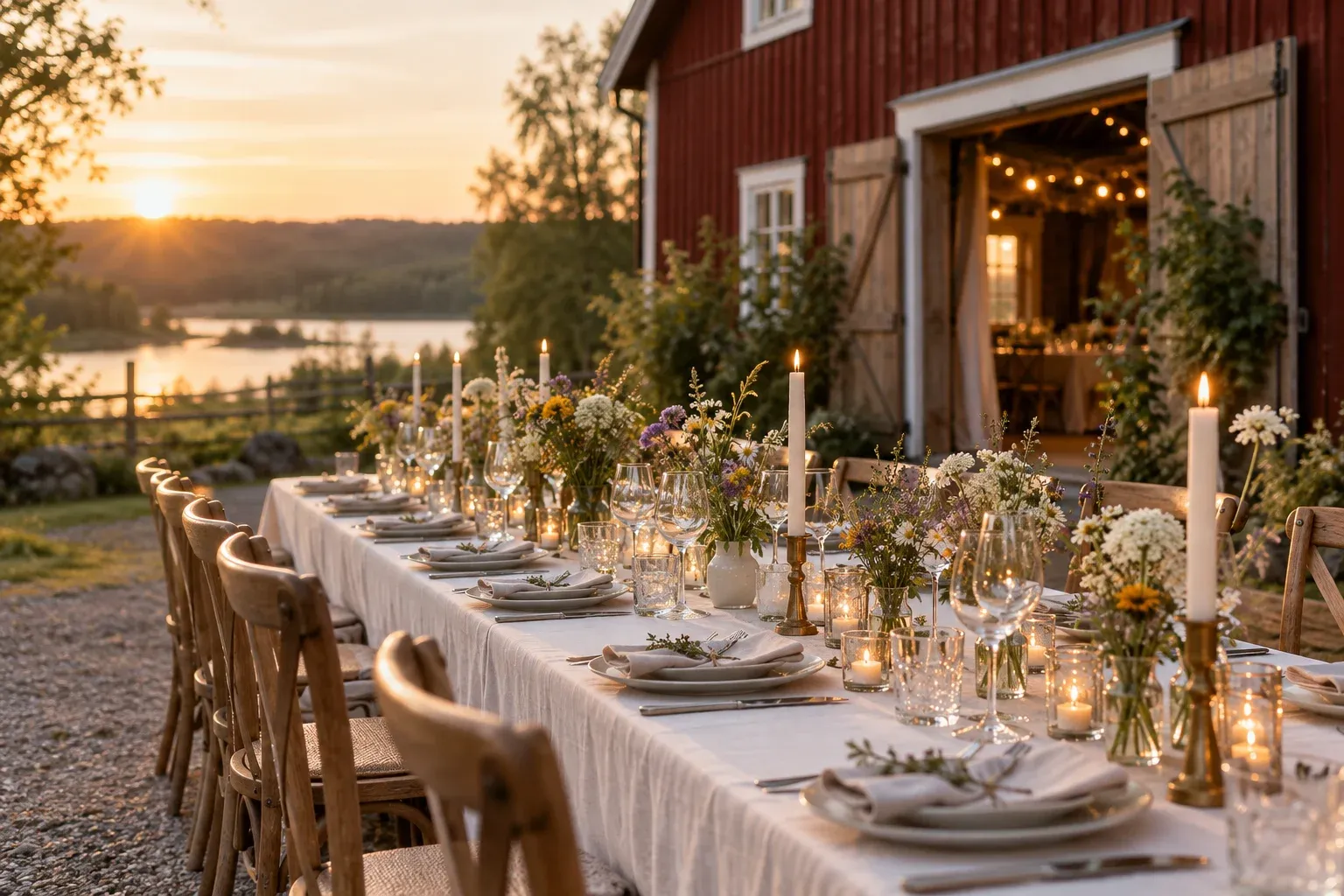
You have the invitation; here is what happens next. This guide walks a foreign guest through a Swedish wedding in order: the reply, the dress code, the ceremony, the long dinner with its speeches and games, the gift, and getting home.
When you need this
- You have been invited to a Swedish wedding and want to know what happens
- The invitation names a dress code you do not recognize
- You have been asked whether you want to give a speech
- You are choosing a gift and the couple mention a wish list or a Swish number
- You are traveling in from abroad and planning the day and the way home
Custom, not law, and not always a church
No law governs Swedish wedding customs. The Marriage Code (Äktenskapsbalken) requires only that the couple say yes before an authorized officiant “in the presence of relatives or other witnesses”. That is the one formal role you play as a guest: you are a witness. Everything else on this page is custom, and it varies by family and faith.
Two things have changed that older guides miss. First, the church is no longer the default venue: in 2025 only 26.6% of Swedish weddings, 12,135 couples, were held in the Church of Sweden. Many guests now attend a civil ceremony, a ceremony in another faith, or a short ceremony outdoors before the party. Second, the busiest month in 2025 was August, ahead of June and July, according to Statistics Sweden (SCB).
| Fact (SCB and Church of Sweden, 2025) | Figure |
|---|---|
| Couples married | 46,431 |
| Most popular month | August, then June, then July |
| Average age at first marriage | 35.1 (women), 37.1 (men) |
| Share of weddings in the Church of Sweden | 26.6% |
With first-time couples in their mid-thirties on average, the couple often already share a home, which shapes the gift customs further down.
The ceremony: the couple walk in together
In a Church of Sweden wedding the Swedish custom is that the couple walk up the aisle together, as a sign that they chose each other freely. A father leading the bride in and “giving her away” is described by parishes as a custom that came from abroad, largely through films. It is allowed, and some couples choose it, but it is not the Swedish default.
The other common belief, that Swedish weddings have “no bridal party”, is out of date. Expect one or two bridesmaids (brudtärnor) and groomsmen (marskalkar), often a best man who looks after the rings, and children in the procession called brudnäbbar. International couples sometimes have larger parties. The roles are old: peasant weddings had bridesmaids, groomsmen and a married woman, the tjocksan, who helped the bride all day.
As a guest in church:
- Arrive at least ten minutes early. Guests on the bride’s side traditionally sat on the left; parishes now ask everyone to fill from the front.
- Switch your phone off. Photography rules depend on the parish and the couple’s wishes; the program or the priest will say.
- Ask before throwing anything. Several parishes ban confetti, or plastic and metal confetti, and some ban petals indoors. Soap bubbles are a common substitute.
The bridal crown you may see is older than the white dress: crowns go back to the Middle Ages, while white wedding dresses became widespread in the early 1900s.
The dinner and the toastmaster
The dinner is where a Swedish wedding happens. It often opens with a brudskål, a toast to the couple, during a drink before everyone sits down. From then on the evening is run by a toastmaster (or toastmadame), usually a friend of the couple, who coordinates speeches, games, songs and films and keeps the timetable. Some parishes even suggest the toastmaster arrive early at the church to help guests to their seats.
Many couples leave a booklet at each place with notes on every guest, facts about the couple and song lyrics. Expect games that tease the couple; cheering counts as taking part. If the dinner is formal you will have a seating partner, your bordsdam or bordsherre, and the man toasts the woman on his right first.
Do not drink until the first skål. Wait for the welcome toast, raise your glass, say skål and look the people you toast in the eye. Any glass counts, alcohol-free included. The full toasting ritual is in our guide to Swedish drinking culture.
Speeches: book them with the toastmaster
Swedish wedding dinners have many speeches — eight to twelve is not unusual — from family, friends, and the stag and hen groups, who often show photos or films from the trips. Traditionally the father of the bride speaks first, although many couples change the order. The speeches are usually short and funny.
The rule a foreign guest needs: speeches are booked, not spontaneous. If you want to speak, tell the toastmaster beforehand. They keep a list and announce each speaker. Standing up unannounced disrupts a timed program. Nobody will ask a foreign guest to speak out of the blue; Systembolaget’s host guide even advises warning a planned speaker a day or so ahead.
| Situation | What to do |
|---|---|
| You want to give a speech | Tell the toastmaster in advance; keep it short and personal |
| You are asked to speak | You will normally be told ahead; you may decline |
| Guests tap their glasses | Usually a call for the couple to kiss, not for a speech |
| You have a surprise or a song | Clear it with the toastmaster, not the couple |
Reception customs: the kisses
Two playful customs surprise visitors. At many receptions, when the bride leaves the room, the women may go up and kiss the groom on the cheek, and when the groom leaves, the men may kiss the bride. And when guests tap their glasses, they usually want the couple to kiss.
These are reported by a wedding planner and language-school guides rather than any official body, and families differ. Follow the room; nobody is obliged to join in. You may have read about Swedish couples “kissing under the table”. We found no source that documents it as a Swedish custom, so we do not describe it.
Dress codes: read the invitation literally
The dress code (klädkod) on a Swedish invitation is an instruction, and it names a specific outfit. Systembolaget, the state alcohol retailer, publishes the standard definitions in its etiquette guide.
| Code | Men | Women |
|---|---|---|
| Kavaj | Suit or blazer in any color, with tie | Dress or skirt of any length, or trousers |
| Mörk kostym (most common) | Dark suit (navy, dark gray or black) with tie | Dress or skirt of any length |
| Smoking (black tie) | Dinner jacket, bow tie | Evening dress or elegant skirt or trousers |
| Frack (white tie) | Tailcoat, white waistcoat and bow tie, or uniform | Long ball gown |
Two exceptions matter at weddings. First, Systembolaget notes that at formal occasions such as weddings, even kavaj is often read as a dark suit. Second, folk dress (folkdräkt) is acceptable under every code, including white tie. The Local’s advice for foreign guests is that slightly overdressed beats underdressed, and not to wear sneakers with a dark suit. If in doubt, ask the couple; nobody expects a visitor to know the codes.
Gifts: the wish list and the Swish problem
Check the invitation or the couple’s wedding website first. Many couples share a wish list (önskelista) or ask for money towards a honeymoon, which makes sense when they already share a home. There is no expected amount. Set a budget you are comfortable with and add a personal card.
Money is often sent by Swish, Sweden’s mobile payment app — but Swish needs a Swedish bank account, BankID and a Swedish phone number. Most foreign guests have none of these. Ask the couple or the toastmaster for another way, or give a physical gift; our guide to Swish for tourists explains why there is no workaround.
If you bring wine or spirits as a gift, they must be bought at Systembolaget, which sells only to people aged 20 or over.
Getting home
The dinner runs late, and the toasts add up. Sweden’s drink-driving limit is 0.2 per mille in the blood, and after a long wedding evening you can still be over it the next morning. Book accommodation near the venue or arrange a ride before the day; see the drink-driving limit in Sweden.
Practical information
| Item | What to know |
|---|---|
| Reply | By the OSA (please reply) date on the invitation |
| Ceremony | Arrive at least 10 minutes early; phone off in church |
| Confetti and rice | Ask first; many parishes ban confetti |
| Speeches | Register with the toastmaster in advance |
| Dress code | Mörk kostym most common; kavaj at a wedding often means a dark suit; folk dress always accepted |
| Gift | Follow the wish list; no set amount; Swish needs a Swedish bank account and BankID |
| Cost of attending | Usually free; the hosts pay for the dinner |
| Alcohol gift | Systembolaget only, age 20+ |
| Driving | Limit 0.2 per mille; do not drive after the dinner |
FAQ
What should I wear to a Swedish wedding?
Follow the dress code on the invitation. The most common is mörk kostym: a dark suit and tie for men, a dress of any length for women. Systembolaget’s etiquette guide notes that at weddings even kavaj is often read as a dark suit. Smoking is black tie and frack white tie. Folk dress is acceptable under every code, and slightly overdressed beats underdressed.
Do I have to give a speech at a Swedish wedding?
No. Speeches are voluntary, but a Swedish wedding dinner often has eight to twelve of them, from family, friends and the stag and hen groups. If you want to speak, tell the toastmaster beforehand; they keep a list and announce each speaker. Keep it short and personal, and humor is welcome. Nobody will ask a foreign guest out of the blue.
What does the toastmaster do at a Swedish wedding?
The toastmaster, usually a friend of the couple, runs the dinner: announcing speakers from a list, introducing games, songs and films, and keeping the timetable. Some parishes also suggest the toastmaster or hosts arrive early at the church to help guests find their seats. Talk to the toastmaster, not the couple, about speeches or surprises.
Why do guests kiss the bride or groom at Swedish weddings?
It is a playful reception custom. At many weddings, when the bride leaves the room the women may go up and kiss the groom on the cheek, and when the groom leaves the men may kiss the bride. Tapping glasses usually asks the couple to kiss, not for a speech. Follow the room; joining in is never compulsory.
What gift do you give at a Swedish wedding?
Check the invitation or wedding website first. Many couples share a wish list or ask for money towards a honeymoon, since they often already share a home. There is no expected amount; set a budget you are comfortable with and add a personal card. Cash by Swish needs a Swedish bank account and BankID, so ask for another way if you lack one.
Does the father give the bride away in Sweden?
Traditionally not. In a Church of Sweden wedding the Swedish custom is that the couple walk up the aisle together, a sign that they chose each other freely. A parent leading the bride in has become more common through films and foreign weddings; parishes allow it but suggest the couple discuss its meaning with the priest first.
Related guides
- Getting married in Sweden — if you are the couple: the eligibility check, officiants and documents
- Swedish drinking culture — the skål, snaps songs and how to say no to a drink
- Dinner at a Swedish home — the welcome toast, table partners and the thank-you speech
- Swedish etiquette — the everyday customs behind the wedding ones
- Swish for tourists — why the couple’s Swish number probably won’t work for you
Facts verified 2026-10-14. Sources: Statistics Sweden (SCB), Church of Sweden parishes, Systembolaget, Institutet för språk och folkminnen, Information Sverige, Sveriges riksdag and The Local — full register in this topic’s source file. Reception customs vary by family. Found something outdated? Tell us and we’ll fix it.