If you are in Sweden on 6 June, you will see flags everywhere and not much else changing. Here is why the date was chosen, why the day is so quiet, and what it means for shops, sightseeing and your plans.
When you need this
You are in Sweden in early June and wonder whether 6 June will close things. You have seen Norway’s 17 May and expected something similar. You want to see the royal family in Stockholm. Or you are German or Dutch and are looking for the Whit Monday holiday you get at home. Each of these has a short answer, and none of them requires a change of plans.
Why 6 June?
Two events share the date. On 6 June 1523 Gustav Vasa was elected king, which ended the union with Denmark and began Sweden as an independent state. On 6 June 1809 a new Instrument of Government (regeringsform) was issued, laying down basic civil freedoms. Both are recorded in the government’s own bill on the holiday and by Riksarkivet, the National Archives.
The day then built up slowly:
| Year | What happened |
|---|---|
| 1523 | Gustav Vasa elected king on 6 June |
| 1809 | New Instrument of Government issued on 6 June |
| 1893 | Skansen in Stockholm starts its 6 June celebrations |
| 1916 | 6 June celebrated nationally as Swedish Flag Day |
| 1983 | 6 June becomes Sweden’s official national day |
| 2005 | 6 June becomes a public holiday; Whit Monday stops being one |
The flag-day ordinance still names it Sveriges nationaldag och svenska flaggans dag: Sweden’s National Day and Swedish Flag Day. For the flag side of the day, see our guide to Swedish flag days.
Why it feels low-key
Visitors from Norway, the US or France often expect a big patriotic day and find picnics instead. There are three plain reasons.
- There is nothing to be liberated from. Many national days celebrate independence or a revolution. Sweden’s marks a royal election 500 years ago and a constitution, chosen as symbols long after the events.
- It is young as an official day. It has been the national day only since 1983 and a day off only since 2005. When the government proposed the holiday in 2004, its bill noted that, unlike many other countries, Sweden did not have a public holiday on its national day.
- It cost Swedes a holiday. Parliament did not add a day off; it swapped Whit Monday for 6 June. The churches called Whit Monday the least bad church holiday to give up.
On top of that, Midsummer comes two to three weeks later and remains the bigger shared celebration of the Swedish summer. See our Midsummer guide.
What happens on the day
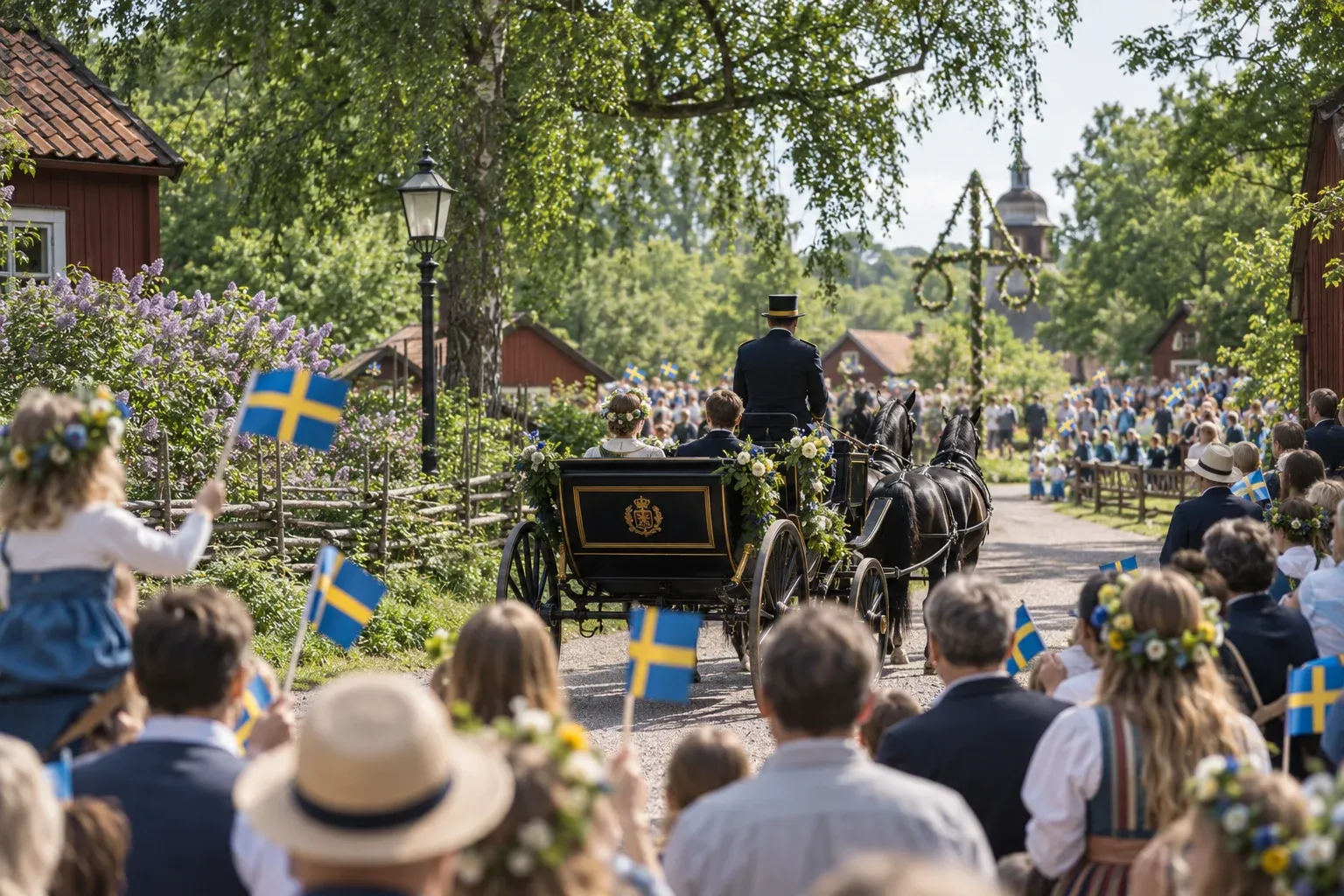
In Stockholm, the national ceremony is at Skansen, the open-air museum that has held 6 June celebrations since 1893. The royal family attends, with music, speeches and banner presentations, and the ceremony is televised. In 2026 the King and Queen rode by horse-drawn carriage from the Royal Palace to the Solliden stage, joined by the Crown Princess and Prince Daniel. Afterwards, government, Parliament and diplomats were invited to a reception at the palace.
Around the country, the royal couple usually spends part of the day somewhere else. On 6 June 2026 they started at Skokloster Castle in Uppsala County, with a stage programme from 10.20 and the King’s National Day speech. He said they had now celebrated National Day in all 21 counties.
Locally, look for your municipality’s celebration. Some are held at a hembygdsgård (heritage homestead), with speeches, music and flags. In recent years the Royal Palace’s outer courtyard has also opened to the public on the day, and Gärdet in Stockholm has hosted a National Day horse-racing event since 2013. Check the year’s programme before you go.
Skansen tip: the ceremony is inside a paid-admission museum and draws large crowds. Arrive early, or watch it on television for free.
What’s open
6 June is a statutory public holiday (allmän helgdag), but the holiday Act fixes the date only; it says nothing about opening hours. So shops decide for themselves:
- Shopping centres open, but on holiday hours. Farsta Centrum in Stockholm, for example, opened 11–17 on 6 June 2026.
- Supermarkets keep their own, usually longer, hours.
- Systembolaget, the state alcohol retailer, closes on Sundays and posts holiday hours per store. Buy what you need on 5 June.
- Most offices close for the day.
There is no substitute day: when 6 June falls on a Saturday or Sunday, nobody gets a weekday off, and employees have no automatic right to compensation. When it falls on a Tuesday or Thursday, the day in between becomes a klämdag (a squeezed working day), and offices run half-empty. For the full holiday calendar, see Swedish public holidays.
Citizenship ceremonies
Many Swedes first notice National Day through new neighbours. Since 2015 every municipality must hold a ceremony at least once a year for residents who became Swedish citizens other than by birth in the past 18 months. The law does not set a date, but most municipalities choose 6 June, often within the local National Day event. If you receive an invitation, attending is voluntary and free; your citizenship does not depend on it.
Mistakes to avoid
- Expecting a Norwegian-style 17 May. Look for local events in parks and heritage homesteads instead.
- Planning around Whit Monday. It has been a normal Swedish working day since 2005, unlike in Germany and the Netherlands.
- Confusing it with Midsummer. Midsummer Eve is the real shutdown; 6 June is a lighter holiday.
- Thinking it has always been a day off. Only since 2005.
- Calling it Independence Day. It marks a royal election and a constitution, chosen symbolically.
Practical information
| Item | Details |
|---|---|
| Date | 6 June every year |
| Status | Public holiday (since 2005) and official flag day |
| Next weekdays | 2027 Sunday · 2028 Tuesday (Monday 5 June is a klämdag) · 2029 Wednesday · 2030 Thursday (Friday 7 June is a klämdag) |
| Weekend National Day | No substitute day off |
| Shops | Holiday hours; check each shop’s avvikande öppettider |
| Systembolaget | Closed on Sundays; holiday hours per store, so buy on 5 June |
| National ceremony | Skansen, Stockholm, with the royal family; televised |
| Skansen admission | Ordinary ticket; price varies by season |
| Local events | Most municipalities; usually free |
| Citizenship ceremony | At least once a year per municipality, most often on 6 June |
FAQ
Why is Sweden’s National Day on June 6?
Two events share the date. On 6 June 1523 Gustav Vasa was elected king, ending the union with Denmark and starting Sweden as an independent state. On 6 June 1809 a new Instrument of Government was issued, laying down basic civil freedoms. The date was celebrated as Swedish Flag Day from 1916 and became the official national day in 1983.
Is June 6 a public holiday in Sweden?
Yes, since 2005. Parliament made National Day a public holiday from that year and removed Whit Monday at the same time, so the number of holidays did not grow. Shops can open but usually keep reduced hours, most offices close, and there is no substitute weekday when 6 June falls on a Saturday or Sunday.
Why does Swedish National Day feel so low-key?
Sweden has no liberation or independence date to celebrate: the day marks a 1523 royal election and the 1809 constitution, chosen symbolically long after the events. It has only been the official national day since 1983 and a day off since 2005, and Midsummer, a few weeks later, remains the bigger shared celebration.
How do Swedes celebrate National Day?
Mostly locally and calmly. Flags go up, municipalities hold events with speeches and music, sometimes at a local heritage homestead, and many welcome new citizens in a ceremony. In Stockholm the royal family attends the televised celebration at Skansen, which has hosted the day since 1893. Many families simply spend a free early-summer day outdoors.
Can I see the King on National Day?
Usually yes, in Stockholm. In 2026 the King and Queen rode by horse-drawn carriage from the Royal Palace to Solliden at Skansen for the televised ceremony, after visiting Skokloster Castle in the morning. Skansen charges ordinary admission and gets crowded, so arrive early or watch on television.
What are citizenship ceremonies on National Day?
Every Swedish municipality must hold a ceremony at least once a year for residents who became citizens other than by birth in the past 18 months. The law does not set a date, but most municipalities hold it on 6 June, often within the local National Day event. Attending is voluntary and costs nothing.
Is Whit Monday a holiday in Sweden?
No. Whit Monday stopped being a Swedish public holiday in 2005, when National Day on 6 June replaced it. The churches had called it the least bad church holiday to remove. This surprises German and Dutch visitors, for whom Whit Monday is still a day off; in Sweden it is a normal working Monday.
Related guides
- Swedish public holidays — the full list, and which days actually close shops
- Swedish flag days — 6 June as Flag Day, plus hoisting times and the pennant
- Skansen — tickets, transport and what else to see at the ceremony venue
- Midsummer in Sweden — the bigger celebration a few weeks later
- The Royal Palace in Stockholm — where the royal carriage sets out
Facts verified 2026-10-05. Sources: Sveriges riksdag (Holiday Act, Citizenship Act, flag-day ordinance, bills 2004/05:23 and 2013/14:143), Riksarkivet, Länsstyrelsen, Skansen — full register in this topic’s source file. Found something outdated? Tell us and we’ll fix it.