Swedish law doesn’t give you a clock time for silence. It gives you a standard, and your landlord, housing cooperative or campsite adds the clock time. Here’s how the two fit together, what happens after a complaint, and who to call.
When you need this
You’re in a rented flat, an Airbnb-style apartment or a holiday home with neighbours, and you’re planning a dinner, arriving late or doing laundry at night. Or you’re booking a campsite. Or a neighbour has just knocked — or you’re the one lying awake listening to a party upstairs.
No quiet-hours law: the real standard
There is no Swedish statute that says “quiet after 22:00”. We read the three laws that govern noise from homes, and none of them contains a clock time.
What the law does say is stricter in one way and looser in another. The Land Code (Jordabalken) requires a tenant to make sure neighbours are not exposed to disturbances so harmful to health, or so damaging to their living environment, that they “should not reasonably be tolerated” (inte skäligen bör tålas). The Cooperative Housing Act puts the same duty on flat-owners in a housing cooperative (bostadsrättsförening, or brf), who must also follow the association’s own rules. The Environmental Code adds that homes must be used so that no health nuisance arises.
| Law | Who it binds | The test |
|---|---|---|
| Land Code ch. 12 | Tenants | Disturbance neighbours should not reasonably have to tolerate |
| Cooperative Housing Act ch. 7 | Cooperative flat-owners | Same test, plus the association’s own rules |
| Environmental Code ch. 9 | Anyone using a home | No health nuisance (not minor or entirely temporary) |
The standard applies around the clock. Loud music all afternoon can be a disturbance too; the night just makes it easier to prove.
The public health agency, Folkhälsomyndigheten, publishes guideline values for noise indoors: 30 dBA as an average, 45 dBA as a maximum, and 25 dBA for music systems. These help the municipality judge a health nuisance. They are general advice, not a fine scale for neighbours.
22:00 and 23:00: where the times come from
The famous times are house rules (ordningsregler). They are not law, but they are written into the lease, the cooperative’s rules or the booking terms you accept.
- Apartment buildings: house rules commonly ask for extra consideration from 22:00 to 07:00. One large Stockholm housing cooperative puts it as avoiding activities that may disturb neighbours, “mainly between 22.00 and 07.00”.
- Campsites: booking terms commonly set night quiet (tystnad or nattro) from 23:00 to 07:00 — one municipal campsite’s 2026 terms say exactly that — but each site sets its own.
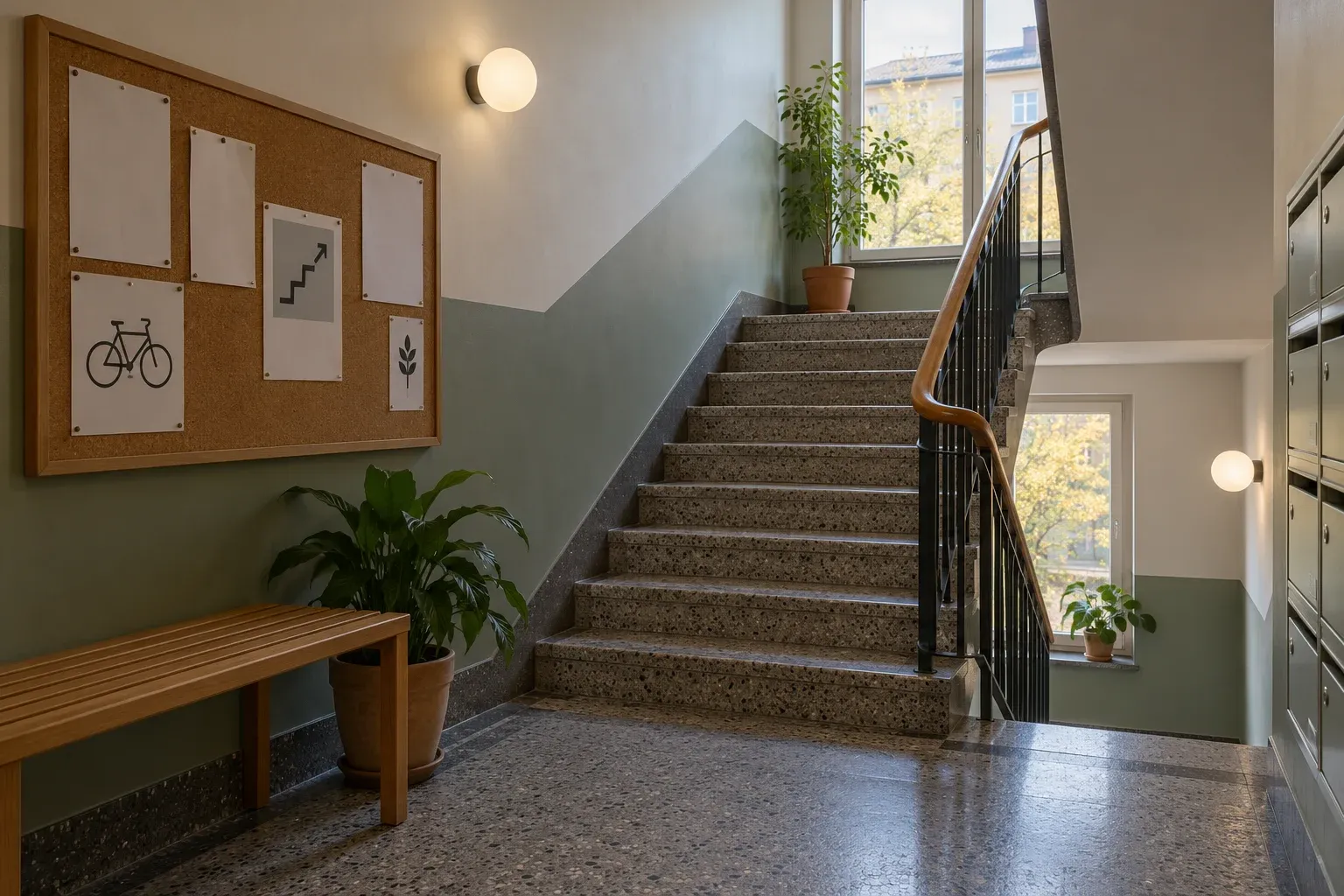
The same house rules usually cover laundry-room hours and renovation times, so read them on arrival. They’re on the stairwell notice board or in the rental listing.
What counts as disturbance
Not every sound. Housing operators’ guidance lists sounds you must accept in a block of flats: a colicky baby crying at night, children running and playing, a night-shift worker cooking and flushing at night, and music in the daytime.
What does count: loud music, parties, banging, barking and stairwell noise, especially late. And the assessment is objective — it doesn’t depend on how sensitive the person complaining is.
Common triggers in Swedish buildings:
- Outdoor shoes indoors — take them off
- Chairs scraping — felt pads help
- Dishwasher or washing machine late in the evening
- Slamming doors
- TV or speakers loud at night — headphones fix it
Planning a party? A note in the stairwell beforehand is the customary courtesy, and it makes one loud evening far easier to accept.
What happens after a complaint
Usually: a knock or a note. Apologise, turn it down, and it ends there — operators say most disturbance is simple thoughtlessness.
If it repeats, the neighbour goes to the landlord or the cooperative board, and the law sets the steps:
- The landlord or cooperative must tell the resident to stop (a tillsägelse, a formal warning) and notify the municipal social services.
- If the disturbance continues without being corrected, the lease or cooperative membership can be terminated.
- Particularly serious disturbance can lead to termination without a prior warning.
There’s no fine for noise inside a flat. The sanction is the home itself. And don’t retaliate by banging on the ceiling or posting angry notes — that can make you the reported party.
Your noise, your host’s problem
This is the part visitors miss. The tenant answers for everyone they let into the flat: household members, guests and anyone they have let stay. Cooperative flat-owners have the same supervision duty.
So in a sublet or short-term rental, the warnings go to your host — and so does the risk of losing the lease. A single loud evening won’t do that, but repeated complaints about guests are exactly the pattern landlords act on. If something goes wrong with a neighbour, tell your host rather than arguing in the stairwell.
At campsites the sanction is direct: terms can let the site send away guests who disturb others, without a refund.
If you’re the one kept awake
Boverket, the national housing agency, lays out the order:
- Talk to the neighbour — often they don’t know.
- Contact the landlord, property manager or cooperative board (in a rental, your host).
- Contact the municipal environmental office (miljöförvaltningen or miljökontoret), which assesses the noise and decides. You can appeal its decision.
If a problem repeats, keep a log — date, time, type and duration. Landlords ask for one before acting.
The police are for danger and public order: 112 only for threats, violence or other danger to life, property or environment; 114 14 for other police matters, around the clock.
Noise in public and fireworks
Outside the home, the Penal Code is direct: making noise in a public place (oljud på allmän plats) is disorderly conduct, punished by a fine. Shouting in the street after a party counts. Police can also remove a person who disturbs public order.
Municipalities add local public-order rules (lokala ordningsföreskrifter) for public places — typically requiring a police permit for noisy work such as pile-driving or rock-crushing, and for loudspeaker broadcasts. They don’t govern your flat.
Fireworks need a police permit wherever the time and place create a risk of injury or considerable nuisance. Many towns allow consumer fireworks without a permit in a set New Year window; the hours differ, so check the town’s ordinance. Our New Year’s Eve guide has the full rules.
Practical information
| Situation | Rule or typical time | Type |
|---|---|---|
| National quiet hours | None — reasonableness standard at all hours | Law |
| Apartment house rules | Commonly 22:00–07:00 | House rule |
| Campsite night quiet | Commonly 23:00–07:00; check the site | House rule |
| Noise inside a flat | No fine; warning, then possible termination | Law |
| Disturbing at a campsite | Can be sent away without refund (example terms) | House rule |
| Noise in a public place | Fine, set case by case | Law |
| Fireworks outside the local window | Police permit needed; otherwise a fine | Law |
| Emergency (danger, threats) | 112 | — |
| Other police matters | 114 14 | — |
| Ongoing noise problem | Neighbour → landlord/brf → municipal environmental office | Guidance |
FAQ
Is there a law about quiet hours in Sweden?
No. No Swedish statute sets a time when you must be quiet. The law says tenants and cooperative flat-owners must not expose neighbours to disturbances that should not reasonably be tolerated, at any hour. The familiar 22:00 to 07:00 comes from house rules in apartment buildings, which you agree to through your lease or rental, and courts weigh night noise more heavily.
What time do you have to be quiet in a Swedish apartment?
House rules usually ask for extra consideration from 22:00 to 07:00, and some buildings set their own times. Ordinary living sounds — children playing, a baby crying, someone coming home late — are not counted as disturbance. Loud music, parties and banging are, especially at night, and the duty to be considerate applies in the daytime too.
What are quiet hours at Swedish campsites?
Each campsite sets its own, in its booking terms or posted rules. A typical night quiet period runs from 23:00 to 07:00, but times vary by site. Terms can let the site send away guests who disturb others, without a refund. Pitches are close together, so voices carry. Check the posted rules at reception when you arrive.
What happens if my neighbours complain about noise?
Usually a knock or a note — apologise and turn it down. Repeated complaints go to the landlord or cooperative, which must tell the tenant to stop and inform social services; if it continues, the lease can be terminated. Very serious disturbance can lead to termination without a warning. If you’re a guest, your host carries that risk.
Can I call the police about noisy neighbours in Sweden?
Yes, but choose the right number. Call 112 only for danger to life, property or environment, such as threats or violence. Other police matters go to 114 14, open around the clock. For ordinary noise, the landlord, property manager or cooperative board is the first stop, then the municipal environmental office.
Can I have a party in a Swedish apartment?
Yes. Tell the neighbours in advance with a note in the stairwell, keep windows closed late, and bring the volume down in the evening — house rules typically ask for quiet from 22:00. A notified, occasional party is tolerated far more easily than repeated late nights, which can lead to warnings for whoever holds the lease.
Related guides
- Staying in a Swedish apartment — door codes, laundry rooms and trash rooms in the building you’re in
- Swedish campsites — chains, booking and the camping key
- Why Swedes are quiet with strangers — the social side of quiet, from buses to trains
- Renting a stuga — holiday cabins, neighbours and house rules
- New Year’s Eve in Sweden — fireworks age limits, permits and local windows
Facts verified 2026-10-05. Sources: Sveriges riksdag (Jordabalken, Bostadsrättslagen, Miljöbalken, Ordningslagen, Brottsbalken, Polislagen), Folkhälsomyndigheten, Boverket, Polisen, Södertälje kommun, Mullsjö kommun, SKB — full register in this topic’s source file. Found something outdated? Tell us and we’ll fix it.