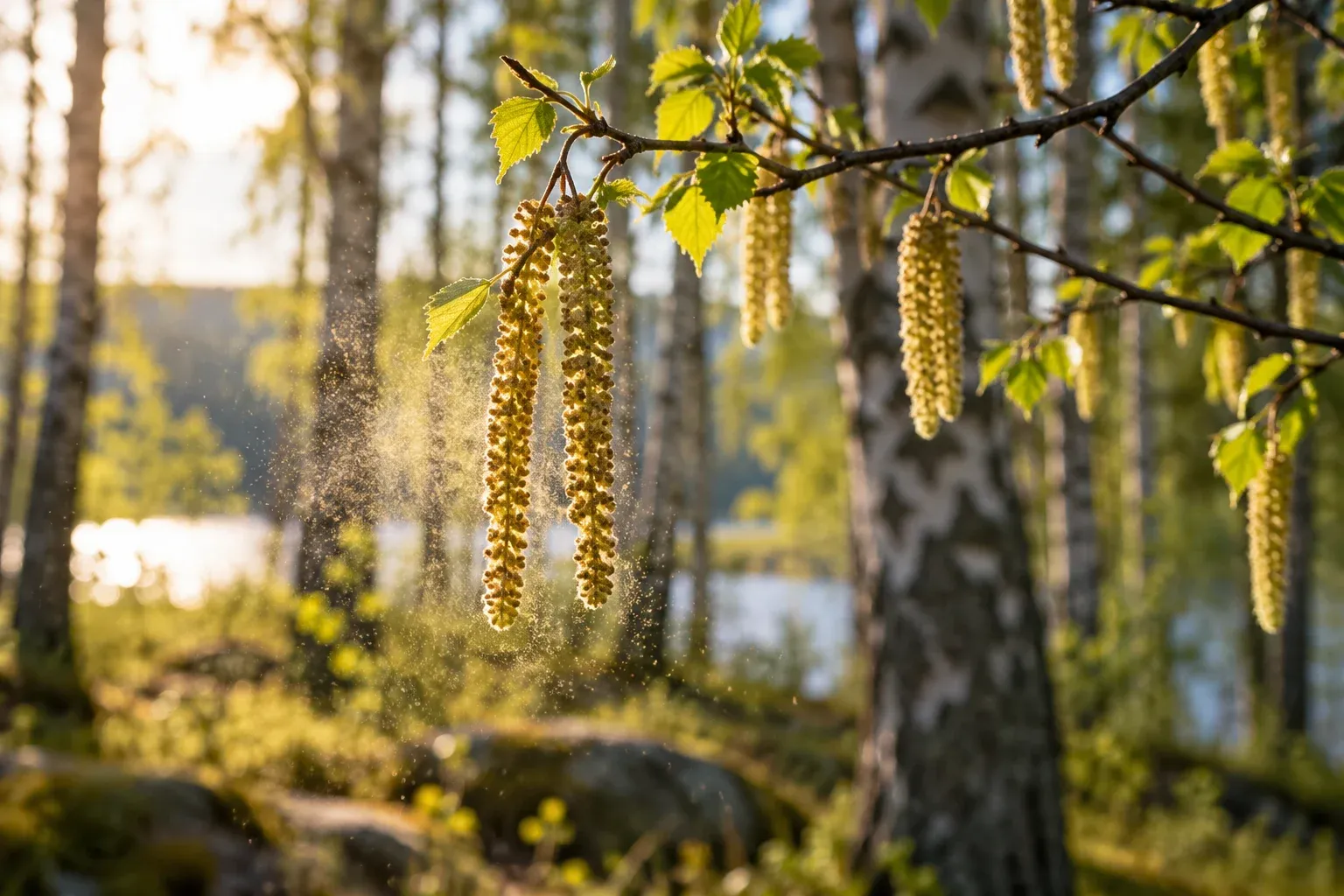
If you have hay fever, Sweden’s pollen year is long but predictable. This guide times it by plant and region, shows where the forecast lives now, lists the allergy medicines you can buy without a prescription, and sets out when an attack becomes a 112 call.
When you need this
- You have hay fever at home and are planning a trip between February and September
- You are sneezing in Sweden and don’t know which pollen is in the air today
- You want the Swedish equivalent of your usual antihistamine or nasal spray
- You are traveling with a child who has pollen allergy and need age limits
- You have asthma that flares in pollen season and want to know when it becomes an emergency
- You are hiking in the north and wondering whether birch season is over yet
- You eat a raw apple or a hazelnut and your mouth itches
The pollen calendar: when each pollen flies
Three pollens cause most of the trouble in Sweden: birch, grass and mugwort. About a quarter of Swedes get pollen symptoms in spring and summer, according to 1177, the regions’ joint health service. Hazel and alder fly earlier, and many people who react to birch react to them too.
| Pollen | Normal season (south first, north later) | What to know |
|---|---|---|
| Hazel (hassel) | From late February; often flowers February–April | Rarely high except locally |
| Alder (al) | From mid-March; ends mid-May | Can start in January–February after a mild winter; varies a lot by year |
| Birch (björk) | April–May in the south; ends around late June–early July in the far north | The worst allergen; can arrive in March on winds from central Europe |
| Grass (gräs) | Late May to August | Most intense around midsummer and the three weeks after |
| Mugwort (gråbo) | Late July to mid or late August | Symptoms can last into September |
| Ragweed (malörtsambrosia) | Turn of August–September | Rare and temporary in Sweden, unlike central Europe |
Two official sources differ slightly on birch. 1177 says birch starts in early April in southern Sweden; Naturhistoriska riksmuseet, which runs the national monitoring network, says it normally starts in the second half of April. Treat early April as the earliest likely start.
Weather moves the numbers day by day. Pollen levels are highest in dry, windy weather and low on cool, rainy days. Most of the pollen in Swedish air comes from spruce and pine, which is not allergenic.
South, central and north Sweden
Sweden is long, and spring travels north slowly. 1177 puts the gap between the south and the north at two to three weeks.
| Region | Birch | Mugwort |
|---|---|---|
| South (Skåne, the coast to Gothenburg) | Starts in April | High levels almost every season |
| Central (Stockholm, Mälardalen) | Starts mid to late April | Varies |
| North (Norrland, Lapland) | Later; ends around the turn of June–July in the northernmost towns | Mostly low |
So a June trip to Lapland can put you in birch season after it has ended in Skåne. In the mountains, dwarf birch grows mainly on the fells and in wetlands.
Where to check the pollen forecast
Sweden’s pollen forecasts come from the Palynological Laboratory at Naturhistoriska riksmuseet, the Swedish Museum of Natural History. In 2026 it measures at 23 stations, from Malmö to Kiruna, including Visby, Östersund, Umeå and Piteå.
The forecast’s home has moved. The old address pollenrapporten.se now redirects to a section of nrm.se, and links to the old site’s pages, still found in many guides, return errors. Start from the museum’s site instead. It has two kinds of forecast:
| Forecast | What it tells you |
|---|---|
| Local forecast | Expected levels over the next few days at each measuring town |
| National risk forecast | “Elevated” if the chance of high levels is at least 10%, “high” if over 50% |
Levels are given as low, moderate, high and very high, on different scales for trees and grass. For trees, over 100 pollen grains per cubic meter per day counts as high; for grass, over 30. SMHI, the weather agency, does not make pollen forecasts and refers people to the museum.
On a phone, the free Pollen app (Pollen+ on iOS) shows Swedish forecasts and works in English. It is made by an Austrian developer with the museum and university partners, not by the museum itself, and has a built-in symptom diary.
Allergy medicine without a prescription
The Swedish shelf is generous. Tablets, eye drops and nasal sprays for allergy are all sold without a prescription, each with its own age limit. Ask by active substance, using the Swedish spelling, which usually drops the final -e. Our guide to Swedish medicine names has the full translation list.
| Medicine | Substance (Swedish spelling) | Non-prescription from age |
|---|---|---|
| Antihistamine tablets | cetirizin, loratadin, desloratadin, ebastin, fexofenadin | 12 (cetirizine tablets from 6; some loratadine tablets per leaflet) |
| Antihistamine oral solution | desloratadin, loratadin | 6 |
| Antihistamine eye drops | levokabastin | No age limit |
| Antihistamine eye drops | ketotifen | 3 |
| Cromoglicate eye drops | natriumkromoglikat | No age limit |
| Antihistamine nasal spray | levokabastin | No age limit |
| Steroid nasal spray | budesonid (32 micrograms) | 6 |
| Steroid nasal spray | flutikason | 12 |
| Steroid nasal spray | mometason (Nasonex and generics) | 18 |
| Combination spray | azelastin + flutikason | 18 |
A doctor’s prescription can set lower age limits. For a blocked nose, 1177 says a steroid nasal spray usually helps most; for itchy eyes, antihistamine drops work quickly.
Pack size can change the status. Mometasone spray, the combination spray and levocabastine eye drops each exist as non-prescription and prescription-only packs of the same product. In each case the multi-packs are prescription-only.
Timing matters. 1177 advises starting one to two weeks before the season and continuing through it, because it can take two weeks for the medicine to work fully. A steroid spray takes days, not hours. The mometasone leaflet says to see a doctor if there is no effect within 14 days.
Pharmacy or supermarket. A pharmacy (apotek) stocks the full range and gives free advice. A supermarket may stock a smaller subset — a Swedish grocery chain sells mometasone spray, for example — but by law it may not sell medicine to anyone under 18. Our guide to buying OTC medicine explains the two channels.
Warning: Don’t use a cold decongestant spray (avsvällande nässpray) for hay fever. 1177 says these make symptoms worse if used more than ten days in a row.
If you are pregnant or breastfeeding, 1177 lists options you can use even where the leaflet does not recommend them: levocabastine, mometasone, fluticasone, budesonide or combination sprays; cromoglicate or levocabastine drops; and desloratadine or loratadine tablets, plus cetirizine while breastfeeding.
What you cannot buy here: your reliever inhaler
Asthma reliever inhalers are prescription-only in Sweden. The salbutamol inhaler we checked on FASS, the Swedish medicines reference, is prescription-only in every pack. If yours runs out, you need a doctor. Pack enough for the whole trip plus a spare. Our guide to bringing medicines to Sweden covers what you can carry in.
Don’t take more allergy tablets than the leaflet says. Läkemedelsverket, the Swedish Medical Products Agency, says to combine tablets with a spray or drops instead, and to contact healthcare if non-prescription treatment does not help.
When to get help, and when to call 112
Pollen can trigger asthma: a cough that won’t go away, breathlessness and wheezing, most often on high-pollen days or while exercising outdoors.
| Situation | What 1177 says to do |
|---|---|
| OTC medicine not helping, a small child with symptoms, or cough and breathing difficulty | Contact a vårdcentral (health center) |
| Sudden breathing difficulty and your asthma medicine isn’t helping | Contact a health center or out-of-hours clinic at once; if closed, an emergency department |
| Very difficult breathing despite using your medicine | Call 112 |
| A child with very difficult breathing, pale or bluish skin, or skin pulling in between the ribs | Call 112 |
For advice, call 1177. From a phone with a foreign number, 1177 publishes +46 771 11 77 00. Our guide to the 1177 advice line explains how the menu works.
Warning: Very difficult breathing despite your medicine is a 112 call, not a 1177 call. An asthma attack narrows the airways and can become life-threatening.
Cross-allergy is common. If you react to birch, raw apples, pears, raw carrots, stone fruit, hazelnuts, peanuts or soy can make your mouth itch, more so during the season. Cooking often destroys the trigger, but not in nuts. Severe reactions are rare. Our guide to food allergies in Sweden covers eating out.
Cutting your exposure on high days
1177’s advice for pollen days:
- Air the bedroom at night or early in the morning, when levels are low
- Keep windows shut during the day
- Dry clothes and bedding indoors
- Exercise outdoors early in the morning
- Avoid freshly cut lawns
- Don’t bring flowering plants indoors
- Rinse your nose with salt water; a sesame-oil spray helps a dry nose
At Easter, Swedes bring birch twigs (påskris) indoors. If your host does, the pollen can come with them. Our Easter guide covers this.
Practical information
| Item | Detail |
|---|---|
| Season | Late February to September; north about two to three weeks behind the south |
| Forecast | Naturhistoriska riksmuseet, nrm.se (the old pollenrapporten.se redirects there); free |
| App | Pollen / Pollen+, free, English available |
| Measuring stations | 23 in 2026, Malmö to Kiruna |
| OTC antihistamine tablets | Cetirizine, loratadine, desloratadine; also ebastine and fexofenadine from 12 |
| OTC steroid nasal sprays | Budesonide 32 µg from 6, fluticasone from 12, mometasone from 18 |
| Reliever inhaler | Prescription only — bring your own |
| Age limit in shops | 18 for any medicine sold outside a pharmacy |
| Medicine prices | Not published — they vary by retailer and pack |
| 1177 advice line | 1177; from a foreign phone +46 771 11 77 00 |
| Emergency | 112 |
FAQ
When is pollen season in Sweden?
From late February to September. Hazel starts in late February and alder in mid-March, birch from April into May, grass from late May with a peak around midsummer, and mugwort from late July through August. Northern Sweden runs about two to three weeks behind the south, and birch can last into early July in the far north.
When is birch pollen season in Sweden?
In southern Sweden birch usually starts in April — 1177 says early April, the national monitoring network says the second half of April — and stays in the air through May. Central Sweden follows in mid to late April, and the north later still, with the season ending around the turn of June and July in the northernmost towns.
Where can I check the pollen forecast in Sweden?
On the Swedish Museum of Natural History’s site, nrm.se, which now hosts Pollenrapporten; the old pollenrapporten.se address redirects there. It has local forecasts for 23 measuring towns and a national risk forecast. SMHI does not make pollen forecasts. On a phone, the free Pollen app shows Swedish forecasts and works in English.
Can I buy antihistamines without a prescription in Sweden?
Yes. Tablets with desloratadine, loratadine and cetirizine are non-prescription, and Läkemedelsverket also lists ebastine and fexofenadine tablets from age 12. Antihistamine eye drops and nasal sprays, cromoglicate eye drops and steroid nasal sprays are also sold without prescription. Pharmacies carry the full range; shops carry less and sell only to over-18s.
Is Nasonex or another steroid nasal spray sold over the counter in Sweden?
Yes. Mometasone spray, sold as Nasonex and generics, is non-prescription for adults from 18 in its smaller packs. Budesonide spray at 32 micrograms is non-prescription from age 6, and fluticasone sprays from 12. The leaflet says to contact a doctor if a mometasone spray has no effect within 14 days.
Can I buy an asthma inhaler without a prescription in Sweden?
No. Reliever inhalers such as salbutamol are prescription-only in Sweden, so bring enough for your whole trip plus a spare. If you run out, you need a doctor — a health center, or advice from 1177 on where to go. If breathing becomes very difficult despite your medicine, call 112.
When should I call 112 for an allergy or asthma attack?
1177’s rule is to call 112 immediately if breathing becomes very difficult despite using your medicine. For a child, call 112 if breathing is very difficult, the skin is pale or bluish, or the skin pulls in between the ribs and at the throat with each breath. For lesser breathing trouble, contact a health center or out-of-hours clinic urgently.
Why does my mouth itch when I eat apples in Sweden?
Probably cross-allergy to birch pollen, which 1177 calls the most common kind. Apples, pears, raw carrots, stone fruit, hazelnuts, peanuts and soy can cause mouth symptoms, which get worse during the pollen season. Cooking often destroys the trigger, except in nuts. Severe reactions are rare, but treat throat swelling or breathing trouble as an emergency.
Related guides
- Buying painkillers and OTC medicine in Sweden — where you can buy allergy medicine tonight, and the 18-year rule in shops
- Swedish medicine names decoded — turn your home antihistamine into the name on a Swedish box
- How Swedish pharmacies work — hours, free advice, and whether your foreign prescription works
- 1177: Sweden’s medical advice line — how to reach a nurse from a foreign phone
- Sweden in spring — the season that brings the birch pollen
Facts verified 2026-10-01. Sources: Naturhistoriska riksmuseet (Palynologiska laboratoriet), 1177, Läkemedelsverket, FASS, Sveriges Riksdag (lagen 2009:730) and SMHI — full register in this topic’s source file. Found something outdated? Tell us and we’ll fix it.