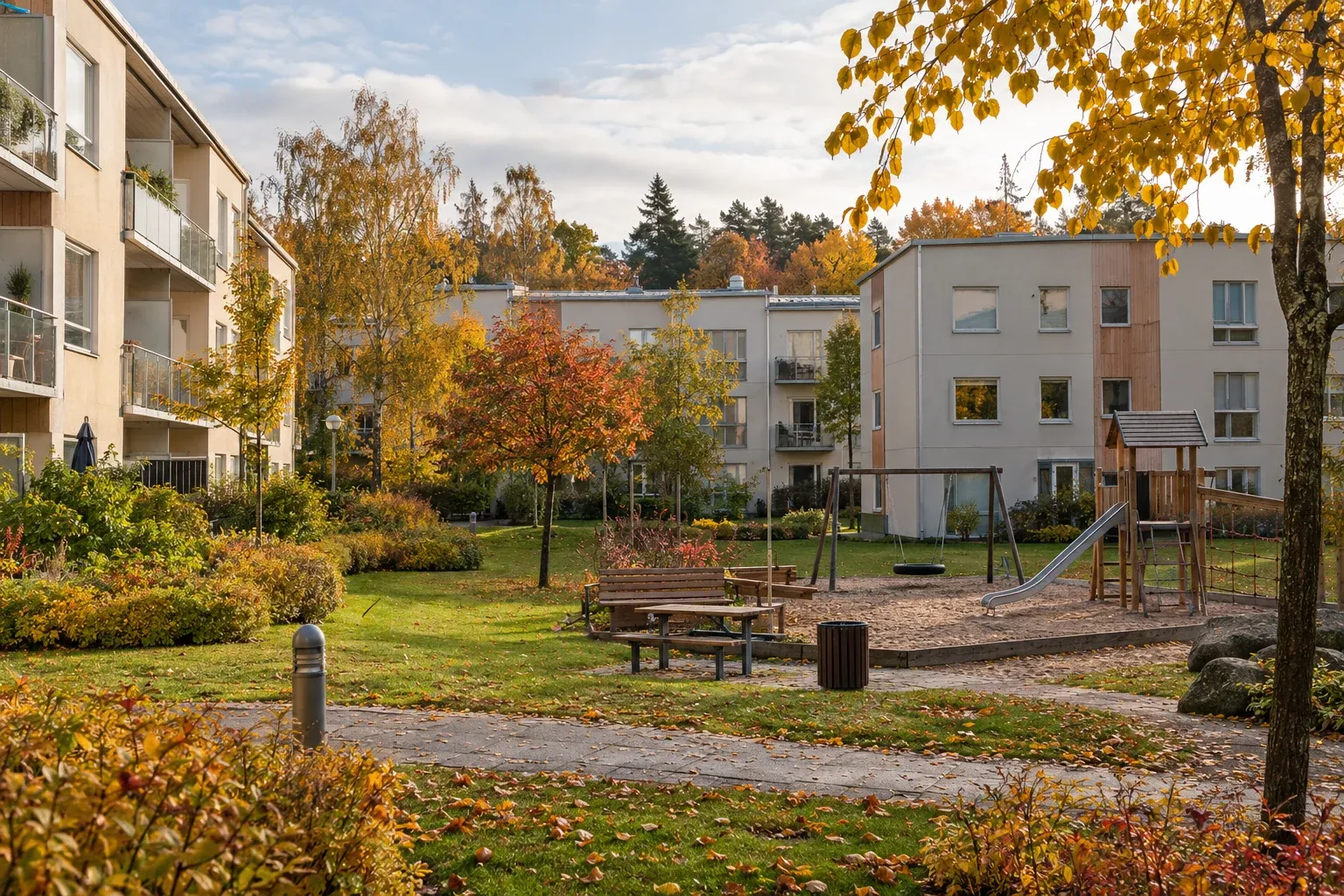
Ride any Swedish commuter train out of a city and you’ll pass the same blocks again and again. Here’s why they were built, why they look alike, and what the police label you read about in the news actually means.
When you need this
You’re taking the Stockholm metro out to Tensta for the station art. You’ve been offered a rental flat in a 1960s–70s suburb. You see rows of identical apartment blocks from the train and wonder why. Or you’ve read a headline about a “vulnerable area” and someone has told you to “avoid the suburbs” — and you want the official picture instead.
A million homes in ten years
Miljonprogrammet, the Million Programme, is the Swedish name for the decade from 1965 to 1974. According to Boverket, the National Board of Housing, Building and Planning, Sweden completed 1,005,578 homes in those years — every type of dwelling, all over the country. Together they make up nearly a fifth of Sweden’s housing stock today.
The reason was a housing shortage that had dominated politics since the war. Economic growth, urbanization, rising wages and rent-controlled housing pushed demand up, while building quotas held construction back in favor of other investments. By 1963 Sweden was already building 80,000 homes a year.
Here’s the surprise: Boverket says there was no real “programme”. There was no single law or plan. The name marked an explicit goal to build even faster, and to do it rationally and industrially. Almost all housing was built with state loans, so the Riksdag (parliament) steered production through the funds it granted.
Why the suburbs look alike
From 1966, the state’s advance loan decisions favored big projects: at least 1,000 flats, built to a uniform design with low labor and production costs. Long series, repeated floor plans and industrial methods gave the estates their family resemblance — blocks around car-free courtyards, with a shopping center and a transit stop at the heart.
| Area | City | What the sources say |
|---|---|---|
| Tensta, Rinkeby | Stockholm | Named by Boverket as results of the 1966 large-project loan rules |
| Råslätt | Jönköping | Same |
| Vivalla | Örebro | Same |
| Skäggetorp | Linköping | Same |
| Geneta | Södertälje | Same |
| Hammarkullen | Gothenburg | Homes built 1968–1969 (city housing company) |
| Rosengård, Kroksbäck | Malmö | About half the flats empty by the mid-1970s |
The tower-block image is only half true. The most common building type was the three-storey lamellhus (slab block), and a third of everything built was detached and terraced houses (småhus). High-rises of five floors or more did gain share after 1967, despite growing criticism. 1970 was the record year: 109,843 new homes, of which 75,226 were flats and 34,617 houses.
From shortage to empty flats
Then demand collapsed. In the early 1970s new flats became hard to let, and by the mid-1970s about half the flats in Rosengård and Kroksbäck in Malmö stood empty, and almost a third in Navestad in Norrköping. By the end of the decade flat building had fallen to around 15,000 a year.
Criticism came early: rents were too high, services and transport too poor, the design too monotonous, the outdoor spaces neglected. Boverket’s own verdict is that the price of building fast and cheap was decades of recurring social and physical interventions.
Today the buildings are fifty to sixty years old. Boverket describes the flats as often well planned and functional, but many need new pipes (stambyte), wiring and ventilation, and upgraded windows, balconies and facades, plus energy improvements. Municipal housing companies (allmännyttan) mostly want to fix the building envelope first, but do not always have the money.
What “vulnerable area” means
Some Million Programme estates appear on the Swedish Police’s list of utsatta områden — “vulnerable areas”. This is a policing classification, not a tourist warning:
| Category | Police definition (summarized) |
|---|---|
| Utsatt område (vulnerable area) | Low socioeconomic status plus criminal influence on local life; residents feel unsafe and report less crime |
| Särskilt utsatt område (particularly vulnerable) | All of the above, plus acute conditions such as parallel social structures, extremism, threats against witnesses or open drug trade |
| Riskområde (risk area) | Abolished in the 2025 assessment |
The police’s December 2025 assessment lists 65 areas: 46 vulnerable and 19 particularly vulnerable, in 29 municipalities, all in southern and central Sweden. If you’ve read “61” or “59” elsewhere, those are the 2021 and 2023 figures. The jump to 65 is mostly technical: large areas were split into smaller ones, one area was added and one removed.
The police describe the overall trend as weakly positive: 12 of 47 vulnerable areas improved since the year before, and 4 worsened. They also note that they can now work without problems in most areas and that riots and unrest are no longer a recurring feature.
Two things to keep straight. The police list is drawn from criminal influence, not building age — over a million homes were built, and 65 areas are listed. And Sweden has a second, separate concept: utanförskapsområden, a statistical classification from Statistics Sweden (SCB) and Boverket based on unemployment, school results, benefit dependency and voter turnout.
Visiting the suburbs
These are residential areas where tens of thousands of people live, shop and go to school. Rinkeby, Tensta, Hammarkullen and Rosengård all appear on the police’s 2025 map, and the police say shootings are geographically concentrated in such areas, though not confined to them. That is a reason for ordinary city sense, not for treating a whole suburb as off-limits. For the national crime picture sized to a visitor, read is Sweden safe.
What’s worth the trip:
- The metro. Tensta is one of the Blue line’s decorated cave stations, on line 10 toward Hjulsta — fit it into the Stockholm subway art route.
- Markets and food. The shopping centers at the heart of these suburbs are everyday places with groceries, cafés and international food shops; go in daytime.
- The architecture. Three-storey slab blocks, long high-rise slabs (skivhus) and low terraced houses side by side are the signature of the era.
If you’re renting here, ask what has been renovated — pipes, windows and ventilation are the big items in buildings of this age. The queue system is explained in renting in Stockholm and the housing queue, and everyday life in a block — door codes, laundry rooms, waste rooms — in living in a Swedish apartment block.
Mistakes to avoid
- “Sweden passed a law to build a million homes.” Boverket says there was no real programme — a goal and a way of building, funded by state loans.
- “It was all tower blocks.” Three-storey slab blocks were most common, and a third of the homes were houses.
- Saying “no-go zone” or “ghetto”. Neither is a police term, and residents find them stigmatizing. Use the area’s name or förort (suburb).
- Equating “Million Programme” with “vulnerable area”. The police list measures crime, not architecture.
- Quoting an old list. Anything with 61 or 59 areas, or riskområden as current, is out of date.
- Photographing residents as sights. These are homes.
Practical information
| Item | Detail |
|---|---|
| Million Programme years | 1965–1974 |
| Homes completed | 1,005,578 (all types, all Sweden) — nearly a fifth of today’s stock |
| Share that were houses | About a third |
| Record year | 1970: 109,843 homes |
| Police vulnerable areas (December 2025) | 65 in total: 46 vulnerable, 19 particularly vulnerable; riskområde abolished |
| Next police assessment | The national picture has come every two years since 2017 — check for a newer one before quoting |
| Getting there | A normal public-transport ticket; no fee to visit |
| Rents | Vary by landlord and renovation status — not published here |
FAQ
What was the Million Programme in Sweden?
It is the name for the years 1965–1974, when Sweden built 1,005,578 homes, nearly a fifth of today’s housing stock, to end a long postwar housing shortage. Boverket notes it was not one formal plan but a goal to build faster and more industrially, financed through state loans the Riksdag granted. Large uniform estates were favored from 1966.
Why do Swedish suburbs all look the same?
Because they were built quickly, in long series, with the same methods. From 1966 state loan rules favored projects of at least 1,000 flats with uniform design and low labor and production costs. The result was repeated three-storey slab blocks and high-rise slabs around courtyards. A third of the era’s homes, though, were ordinary detached and terraced houses.
Is it safe to visit Rinkeby, Tensta or Rosengård?
They are residential areas where people live, shop and go to school, and visitors go there for markets, food and metro art. They do appear on the police’s 2025 map of areas with criminal influence on residents, and shootings are concentrated in such areas. The map is a policing tool, not a visitor warning; use ordinary city sense.
What is an “utsatt område”?
It is the Swedish Police’s term for a residential area with low socioeconomic status where criminal actors influence local life, so residents feel unsafe and report less crime. A särskilt utsatt område adds acute conditions such as parallel structures or threats against witnesses. The December 2025 assessment lists 65 areas, 19 of them particularly vulnerable.
How many vulnerable areas are there in Sweden?
The police’s December 2025 assessment lists 65: 46 vulnerable and 19 particularly vulnerable areas, in 29 municipalities. The intermediate “risk area” category was removed. The rise from 59 in 2023 is mostly because large areas were split into smaller ones; only one area was added and one removed, and the police describe a weakly positive trend.
Are Million Programme buildings being renovated?
Many are, and many still need it. Boverket says the flats are often well planned but need new pipes, wiring and ventilation, and upgraded windows, balconies and facades, to avoid reaching the end of their technical life. Municipal housing companies mainly want to improve the building envelope, but do not always have the money to renovate as much as they wish.
Related guides
- Is Sweden safe? — the national crime figures, sized to a visitor
- Stockholm subway art — a route through the Blue line’s cave stations
- Renting in Stockholm and the housing queue — why flats are hard to get
- Living in a Swedish apartment block — door codes, laundry rooms and waste rooms
- Sommarstuga culture — the other side of 1960s Swedish housing
Facts verified 2026-10-06. Sources: Boverket, Polismyndigheten (Swedish Police Authority), Göteborgs stads bostadsaktiebolag, SL — full register in this topic’s source file. Found something outdated? Tell us and we’ll fix it.