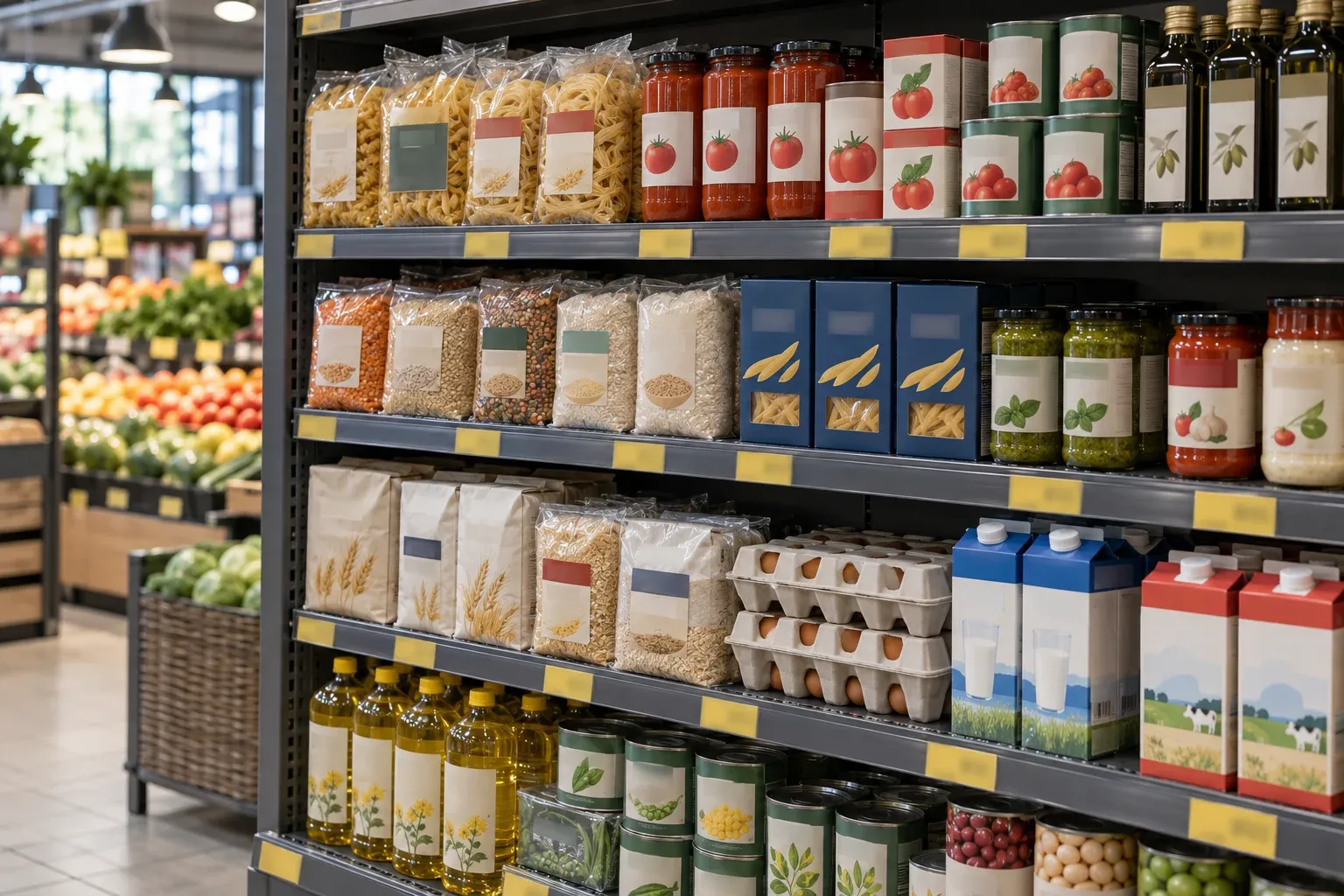
A Swedish shelf label packs a lot into a small space, and most of it is there because the law says so. Here’s which number to trust, what the red signs really mean, and what to do when the till disagrees.
When you need this
You’re in a Swedish supermarket comparing two sizes of coffee, yogurt or detergent, and the labels show more numbers than you expected. There’s a yellow box with “kr/kg” in it, a red sign with a lower price, maybe a line that says 30-dagarspris.
It also matters when the till charges more than the shelf said, when you’re weighing loose fruit or pick-and-mix, and when you wonder whether that bright offer price is actually meant for you.
The two prices on every label
Sweden’s Price Information Act, prisinformationslagen (SFS 2004:347), says goods must be shown with two prices: the price and the comparison price, jämförpris.
| Price | What it is | Where you see it |
|---|---|---|
| Pris (pack price) | What this pack costs, in kronor | The large number on the label or pack |
| Jämförpris (comparison price) | The price per kilo, litre, metre, piece or other standard unit | The smaller figure in the yellow box, with the unit written out |
Both are defined in the law as final prices including VAT and other taxes. You never add VAT in your head in a Swedish shop. The one common extra is pant, the deposit on cans and plastic bottles: the law says any added fee must be stated separately, so drink labels show ”+ pant”, and it appears as its own line on the receipt — see pant bottle deposit.
The detail is in Konsumentverket’s binding regulations, KOVFS 2012:1. They set the units — kr/kg, kr/l, kr/m, kr/m², kr/st (per piece), kr/100 st, and kr per recommended use such as kr/tvätt (per wash) or kr/disk (per dishwasher load). And they say the comparison price on shelf labels stands against a yellow background. That’s the yellow box you see in every chain.
How to read a label in 30 seconds
- Find the pack price. The big number, written with a comma or colon between kronor and öre — 24,95 or 24:95. “24:-” means a round 24 kronor.
- Read the yellow box. That’s the jämförpris, with its unit: kr/kg, kr/l, kr/st.
- Compare like with like. Only compare products in the same unit. For saft and other concentrates, the unit price is calculated per amount of ready-to-drink product. Multipacks of single portions use the same unit as one portion. Canned food in liquid is priced on the drained weight (avrunnen vikt).
- Check what kind of offer the red sign is — member price, multi-buy, or a real price cut (below).
- For loose goods, use the scale. Fruit, vegetables and pick-and-mix weighed in front of you need only a unit price, and the store must let you find out the cost before you pay.
- Watch the till screen. The till price is the one that applies.
Some products have no comparison price, lawfully: packs of 50 g or 50 ml or less, packs holding several different goods (ready meals), packs where the pack price already equals the unit price, cosmetics, and wallpaper on rolls. The law also drops it where a unit price would be meaningless or confusing.
Sale signs and the 30-day price
Since 1 September 2022, a product shown as reduced must also show the lowest price the store charged in the 30 days before the cut. This is the EU “Omnibus” rule, added to Swedish law as 7 a §. If the price was cut in steps, the reference is the price before the first cut.
On the label you’ll see one of these:
| Wording | Means |
|---|---|
| 30-dagarspris | Lowest price in the last 30 days |
| Lägsta pris 30 dagar | Same, spelled out |
| Tidigare lägsta pris | Previous lowest price |
| Ord. pris / ordinarie pris | “Regular price” — Konsumentverket asks stores not to use this for the 30-day reference, because it can mislead |
The exception matters in a food shop: goods that quickly deteriorate don’t need a 30-day price. Konsumentverket’s examples are plants, fresh food and drinks with a short shelf life. Frozen food, cans, dried pasta, flour, bottled water and soft drinks are not exempt. That’s why a short-date sticker can lawfully show only the new price — more in reduced-price food.
Member prices and multi-buy offers
Not every red sign is a price cut, and the difference changes what you pay.
| Sign says | What it is | Do you get it? |
|---|---|---|
| Medlemspris / Stammispris | Member price at Coop or ICA | Only if you show your membership at the till |
| 2 för 50 kr, 3 för 2 | Multi-buy offer | Only if you buy the full number |
| Extrapris with a 30-day price | A price cut | Yes, for everyone |
Member prices are a loyalty perk. ICA says Stammis members get special prices on selected items and must show their membership at checkout; registration uses mobile BankID or a one-time passcode from the store. Without it, you pay the normal price. How visitors can join is covered in Swedish supermarkets. If a member offer is presented as a price cut to everyone in a club anyone can join, Konsumentverket treats it as aimed at consumers generally, so the 30-day rule applies.
Multi-buy offers such as “2 för 50 kr” or “buy two for the price of one” don’t need a 30-day price, Konsumentverket says, because they don’t claim the item’s price was cut. Buy one and you pay the single price. Do the maths against the unit price before stocking up.
At the till
Konsumentverket is blunt: the price at the till is the one that applies. You can’t demand the shelf price or the advertised price. You can refuse to buy the item. Point out the difference — staff will often fix it — and if a store seems to misprice deliberately and systematically, report it to Konsumentverket.
Where groceries are priced only on the shelf, the regulations say you must be able to check easily that the till price matches. Ask staff, or use a price-check point if the store has one. At self-checkout you see each price as you scan.
Rounding: pay by card and the store may charge the exact amount or round to the nearest krona; pay in cash and the total is rounded — 1–49 öre down, 50–99 öre up. See cards in Sweden.
What is changing in 2026–2027
Two revisions are underway as of October 2026, and neither is final yet.
| Proposal | What it would do | Status |
|---|---|---|
| Konsumentverket’s new regulations, KOVFS 2026:X | Five permitted wordings for the 30-day price (including 30-dagarspris); a crossed-out price must be explained; the same unit for the same type of product; the yellow box online too | Proposed start 15 October 2026; adoption not confirmed when we checked |
| Finance Ministry memo Fi2026/00996 | The 30-day rule would cover goods only, not services | Proposed from 1 February 2027; no change for supermarket goods |
For shoppers, the direction is clearer labels. Konsumentverket’s guidance, updated 15 September 2026, still refers to the current KOVFS 2012:1.
Mistakes to avoid
- Comparing pack prices instead of the yellow jämförpris. A bigger pack isn’t always cheaper per kilo — see grocery prices in Sweden.
- Comparing across units. kr/kg against kr/st tells you nothing.
- Assuming the red price is yours when it says medlemspris or Stammispris.
- Reading a crossed-out price as the normal price. Look for the 30-day wording.
- Expecting the shelf price at the till when the two differ.
- Adding VAT in your head. Swedish consumer prices already include it.
Practical information
| Item | Detail |
|---|---|
| Governing law | Prisinformationslag (2004:347); Konsumentverket’s regulations KOVFS 2012:1 |
| Unit price | Required on goods; kr/kg, kr/l, kr/m, kr/m², kr/st, kr per use; yellow background on shelf labels |
| No unit price | Packs of 50 g / 50 ml or less, mixed packs, price = unit price, cosmetics |
| VAT | Always included in both prices |
| Sale signs | Lowest price of the previous 30 days, since 1 September 2022; not for quickly perishable goods |
| Multi-buy (“2 för 50 kr”) | No 30-day price required |
| Member price | Needs ICA Stammis or Coop membership shown at the till; membership is free |
| Till vs shelf | Till price applies; you may refuse to buy |
| Cash rounding | To the nearest krona; card may be exact |
| Grocery prices | Not published here — they change weekly; compare the jämförpris in store |
| Pending | New KOVFS proposed from 15 October 2026; 30-day rule limited to goods proposed from 1 February 2027 |
| Complaints | Konsumentverket (Swedish Consumer Agency) |
FAQ
What does jämförpris mean in Sweden?
Jämförpris means comparison price: the price per kilo, litre, metre, piece or other standard unit, including VAT. Swedish law requires it next to the pack price on almost all goods, and in stores it sits in a yellow box on the shelf label. It lets you compare different pack sizes and brands directly, without doing the maths yourself.
Do Swedish prices include VAT?
Yes. The Price Information Act defines both the price and the comparison price as final prices in kronor including VAT and other taxes, so the shelf price is what you pay. The one common addition is pant, the deposit on cans and plastic bottles, which must be shown separately and appears as its own line on the receipt.
What is a 30-dagarspris on a Swedish sale sign?
It is the lowest price the store charged for the product during the 30 days before the price cut. Since September 2022, Swedish law requires it whenever a price is shown as reduced, so you can judge the real discount. Goods that quickly spoil, such as fresh food and plants, are exempt, so short-date stickers may show only the new price.
Why was I charged more at the till than on the shelf?
In Sweden the price at the till is the one that applies, and you cannot demand the shelf price. You can, however, refuse to buy the item. Point out the difference to staff, who will often correct it. If a store seems to give wrong prices deliberately and systematically, you can report it to Konsumentverket, the Swedish Consumer Agency.
What do medlemspris and Stammispris mean?
They are member prices: discounts for people in Coop’s membership programme or ICA’s Stammis loyalty scheme. You must show your membership at the till, usually by card or app, or you pay the normal price. If such an offer is presented as a price cut to members of a club anyone can join, the 30-day price rule applies.
Does “2 för 50 kr” need a 30-day price?
No. Konsumentverket says multi-buy and conditional offers like “2 för 50 kr” or “buy two for the price of one” are not covered by the 30-day lowest-price requirement, because they don’t claim the item’s price was cut. Buy only one and you pay the single price, so compare the offer with the unit price before stocking up.
Related guides
- Swedish supermarkets — the chains, their member schemes and how a visitor can join.
- Grocery prices in Sweden — putting the unit price to work on your food budget.
- Reduced-price food — the short-date stickers exempt from the 30-day rule.
- Pant bottle deposit — the extra line on your receipt for every can and bottle.
- Sales seasons in Sweden — when the 30-day price matters most.
Facts verified 2026-10-06. Sources: Sveriges Riksdag (prisinformationslagen), Konsumentverket, Finansdepartementet, ICA — full register in this topic’s source file. Found something outdated? Tell us and we’ll fix it.