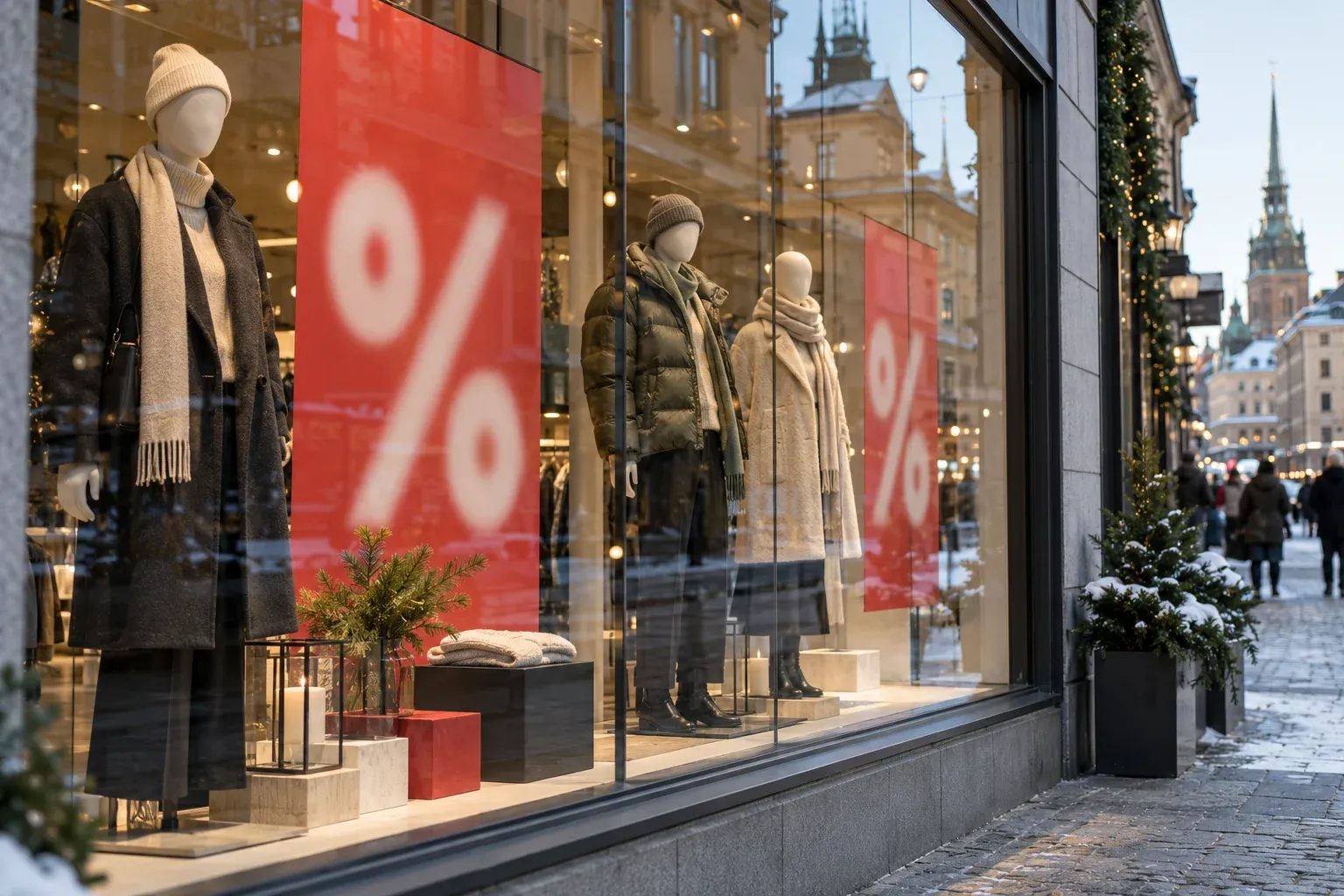
Sweden has three real sales peaks, and the one most guides lead with is no longer the biggest. Here is when each one happens, how to tell a genuine discount from an inflated one, and what a sale does to your returns and VAT refund.
When you need this
You’re in Sweden in late November and every window says “Black Week”. Or you’re visiting between Christmas and New Year and the shops are covered in mellandagsrea signs. Or it’s late June, and REA (sale) is painted across the glass.
It also matters when a tag shows two prices and you want to know which is real, when you want to return something bought on sale, or when you’re a non-EU visitor planning a VAT refund on discounted goods.
Sweden’s sales calendar
| Period | Name | What happens |
|---|---|---|
| Late November | Black Week, Black Friday, Cyber Monday | The biggest shopping week of the year; Black Friday 2026 is 27 November |
| Week before Christmas | Christmas shopping | Spending peaks again, with 23 December the second-biggest day of 2024 |
| 27–30 December | Mellandagsrea | Clearance of winter and Christmas stock between the holidays |
| January–February | Winter clearance | Some shops keep marking down after the mellandagsrea |
| Late June–July | Sommarrea | Summer stock marked down from around Midsummer |
Retailers choose their own dates. Sweden has no shop-hours law, so nothing fixes when a sale may start. What the law does limit is how long: Konsumentverket, the consumer agency, cites court rulings that sales running more than about two months a year are usually misleading.
Black Week and Black Friday
Black Friday is an American import that Swedish retailers stretched into a whole Black Week. It is now the single biggest day in the Swedish retail year. SCB, Statistics Sweden, tracks household spending through card and payment data, and its ranking is clear.
| Day | Household consumption |
|---|---|
| 29 November 2024 (Black Friday) | 11.1 billion kronor |
| 23 December 2024 | 10.9 billion kronor |
| 20 December 2024 (last Friday before Christmas) | 10.2 billion kronor |
| 28 November 2025 (Black Friday) | 11.4 billion kronor, highest day in SCB’s data since 2019 |
Over the last six years, households spent on average 7.2 billion kronor more during Black Week than in an ordinary week, mostly on non-food goods. SCB also sees Christmas shopping drifting from December into November.
For a visitor that means crowds, busy shopping centers and slower deliveries in late November. Spending rises all week and peaks on the Friday, so earlier in the week is calmer.
Mellandagsrea: the sale between Christmas and New Year
Mellandagarna (“the between days”) are the working days between Christmas and New Year. Christmas Day, Boxing Day (annandag jul, 26 December) and New Year’s Day are statutory public holidays, so the between days are 27–30 December. In 2026 that means Sunday 27 to Wednesday 30 December.
The mellandagsrea is the traditional clearance of winter and Christmas stock in those days. In practice many shops start right after Christmas, and webshops often earlier. It is still a fixture of the Swedish calendar, but by SCB’s measure it is no longer the year’s main bargain event: Black Friday is.
For what happens before the sale, and what is open over the holidays, see Swedish Christmas traditions and opening hours in Sweden.
Summer sales
The sommarrea clears summer stock from around Midsummer in late June, often in deeper rounds through July. It overlaps with industrisemester, the July weeks when much of Sweden is on holiday. As with every Swedish sale, the dates are each retailer’s choice.
How to read a Swedish sale tag
This is where Swedish law does the work for you. Since 1 September 2022, the price information act (prisinformationslagen, 7 a §) says that when a shop announces a price cut, it must also show the earlier price — and that earlier price must be the lowest it charged in the 30 days before the cut. If the price was cut gradually, it is the price before the first cut.
Konsumentverket applies this strictly:
- The sale price must be lower than the 30-day low, not equal to it.
- A “-30%” or “200 kr off” must be calculated from the 30-day low, not from any other price (the agency cites EU Court ruling C-330/23).
- The 30-day low must sit right next to the sale price, legibly, every time the price is shown.
- Extra reference prices, such as an “ordinary price”, are typically not allowed alongside it.
The word rea itself is protected by the marketing act (marknadsföringslagen, 17 §). A shop may call something a sale only if the product is part of its normal range, the sale is time-limited, and the price is substantially lower than normal. “Utförsäljning” or “slutförsäljning” (clearance) needs a real sell-off of all stock or a defined part of it. And a shop may not raise a price first in order to cut it and call it a sale.
| On the tag | What it means |
|---|---|
| Lägsta pris 30 dagar / tidigare lägsta pris | The legally required comparison price |
| Ord. pris / ordinarie pris with no 30-day low | A warning sign |
| Extrapris, kampanj, erbjudande | Also count as price-cut claims, so the 30-day rule applies |
This is enforced. After the Black Friday 2024 period, the Consumer Ombudsman (KO) issued injunctions backed by conditional fines totalling 22 million kronor against ten well-known retailers. In one case a jacket sold as “22% off” was actually 299 kr dearer than its 30-day low. In November 2025 KO added seven more companies, with fines totalling 8.6 million kronor.
One gap remains. The rule looks back only 30 days, so a price raised in October can still look like a discount in late November. If a big purchase matters, watch the price yourself for a few weeks. If you think a sale price is misleading, report it to Konsumentverket: a report does not settle your own case, but it feeds the agency’s supervision.
Exceptions: goods that spoil quickly — plants, fresh food, short-dated drinks — don’t need to show the earlier price.
Returns and complaints on sale goods
A sale does not touch your legal rights, but it can remove the shop’s voluntary ones. For the full picture see returns, öppet köp and ångerrätt.
| Situation | Sale goods |
|---|---|
| Faulty item | Three-year complaint right (reklamation); complain within two months of finding the fault |
| Bought online or by phone | 14-day withdrawal right (ångerrätt) still applies |
| Bought in a shop, not faulty | Öppet köp (money back) and bytesrätt (exchange) are store policy — and shops may exclude sale items |
Ask before you pay — “Gäller öppet köp på reavaror?” — and get the answer printed on the receipt. Pay-later and invoice options are pushed hard in sale season; read Klarna and invoice payments before using them.
VAT refunds on sale purchases
Non-EU residents can still reclaim VAT on discounted goods from shops that offer tax-free. The catch: the 200 kr minimum counts the price you actually paid, so a discount can push a purchase under it, and the refund shrinks with the price. Combine purchases in one shop if you’re near the line, ask for the tax-free form at the till even when it’s busy, and take the goods out of the EU by the end of the third month after the purchase month. Details in VAT refund in Sweden.
Mistakes to avoid
- Trusting the red percentage. Check it against the 30-day low beside it.
- Assuming the mellandagsrea is the biggest sale. Card data say Black Friday is.
- Expecting to return a non-faulty sale item in a shop. Store policy decides.
- Thinking an online sale purchase can’t be returned. The 14-day right still applies.
- Forgetting the tax-free form at a crowded till.
Practical information
| Item | Details |
|---|---|
| Black Friday 2026 | 27 November (Cyber Monday 30 November) |
| Mellandagar 2026 | 27–30 December |
| Required comparison price | Lowest price of the 30 days before the cut (since 1 September 2022) |
| Minimum discount | None in law; “substantially lower” judged case by case |
| Maximum sale length | No fixed limit; courts: more than about two months a year is usually misleading |
| VAT refund threshold (non-EU residents) | 200 kr per purchase, counted on the price paid |
| Complaint right for faulty goods | Three years |
| Online withdrawal right | 14 days |
| Where to report misleading prices | Konsumentverket |
FAQ
When are the big sales in Sweden?
Three peaks: Black Week in late November, ending on Black Friday; the mellandagsrea in the working days between Christmas and New Year, 27–30 December, often starting right after Christmas; and summer sales from around Midsummer in late June into July. Black Friday 2026 falls on 27 November. Smaller campaigns run all year, but sales may not last more than about two months a year.
What is mellandagsrea?
Mellandagsrea means “sale of the between days”: the shopping days between Christmas and New Year, when shops clear winter and Christmas stock. Boxing Day (26 December) and New Year’s Day are public holidays, so the between days are 27–30 December, though many shops and webshops start earlier. Retailers choose their own dates; there is no law on shop hours.
Is Black Friday big in Sweden?
Yes. Swedish retailers stretch it into Black Week, and SCB’s card data show Black Friday was the country’s single biggest consumption day in both 2024 and 2025, at 11.4 billion kronor on 28 November 2025. Over six years, households spent on average 7.2 billion kronor more during Black Week than in a normal week, mostly on non-food goods.
How do I know a Swedish sale price is real?
Look for the earlier price printed next to the sale price. By law it must be the lowest price the shop charged in the 30 days before the cut, and Konsumentverket says any percentage must be calculated from that 30-day low. A tag showing only an “ordinary price” comparison is a warning sign. Misleading prices can be reported to Konsumentverket.
Can I return items bought on sale in Sweden?
It depends where you bought them. In a shop, returns of non-faulty goods are voluntary store policy, and shops may exclude sale items, so check the receipt. Online, you have a 14-day withdrawal right for sale items too. A faulty item can always be complained about for three years, whatever you paid.
Can I get a VAT refund on sale items?
Yes, if you live outside the EU and the shop offers tax-free. The 200-kronor minimum counts the price you actually paid, so a discount can push a purchase below it, and the refund shrinks with the price. Ask for the tax-free form at the till and take the goods out of the EU by the end of the third month after purchase.
Related guides
- Shopping in Sweden — opening hours, card payment and the basic return rules.
- Returns, öppet köp and ångerrätt — exactly what you can and can’t send back.
- Jämförpris and Swedish price labels — reading the rest of the price tag.
- VAT refund in Sweden — how non-EU visitors claim back the VAT.
- Klarna and invoice payments — the pay-later options pushed in every sale.
Facts verified 2026-10-06. Sources: Sveriges Riksdag (prisinformationslagen, marknadsföringslagen, helgdagslagen, mervärdesskattelagen), Konsumentverket and the Consumer Ombudsman, SCB — full register in this topic’s source file. Found something outdated? Tell us and we’ll fix it.