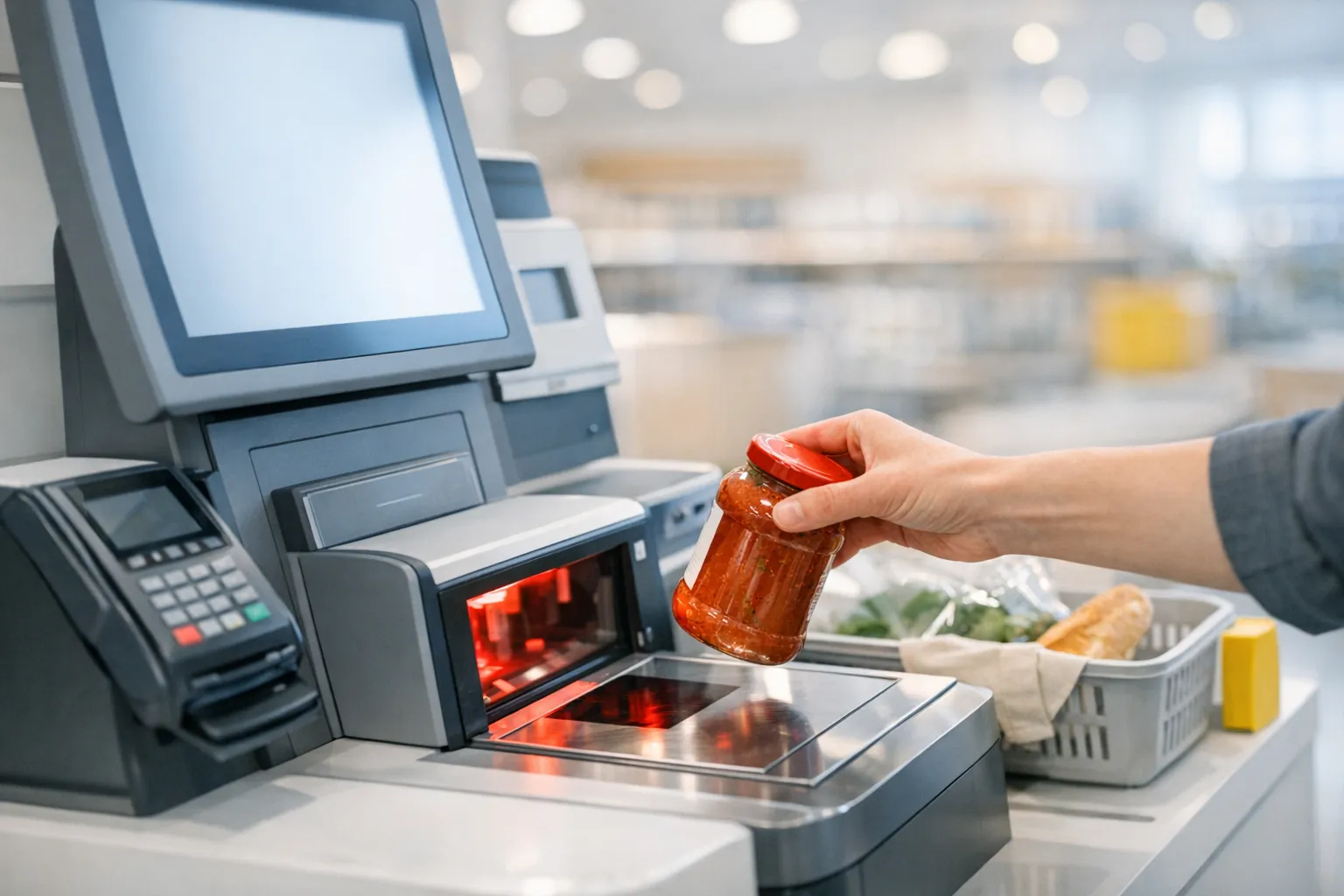
Checkout is the one piece of Sweden every visitor operates daily, and it’s more automated than almost anywhere else in Europe. Here’s how each lane works, what the random checks mean, and how not to look like a shoplifter by accident.
When you need this
You’re at the front of an ICA with a basket, three lane types, and pictograms instead of explanations. A light just came on over your kiosk and a staff member is approaching. Or the machine froze the moment you scanned a six-pack of folköl. All three are normal — and all three are covered below.
The three ways to check out
- Staffed till (bemannad kassa) — the shrinking minority lane. The only guaranteed option if you’re paying cash.
- Self-checkout kiosk (självutcheckning) — scan everything at the end. Open to everyone, no membership, English UI behind the flag button. Frequently card-only (endast kort).
- Self-scanning (självscanning) — scan items as you shop with a handheld scanner or the chain’s app, bag them straight into your own bags in the trolley, and pay at a fast lane without unloading anything.
The apps behind option three: Coop Scan & Pay (in the Coop app — you can start scanning without registering), ICA’s app scanning (built around its ICA/Stammis accounts, receipts by email for members), and Willys Scan & Go (inside the Willys app). Foreign phone numbers sometimes trip up the signup flows — if the app fights you, the kiosks never ask who you are.
How to use the kiosks, step by step
- Tap the English flag on the screen first.
- Scan each item. For loose produce, either weigh it at the kiosk scale and pick the item on screen — or, in chains that use it, weigh it back in the produce section, press the item’s picture there, and stick the printed label on the bag. Watch what locals do; both systems are common.
- Scan your bags too — bags are products in Sweden, taken from the rack and paid like anything else (a few kronor). Bringing your own is normal and saves the step.
- Pay by card or phone. Kiosks are often cash-free; if you’re carrying only kronor, head for the staffed till instead.
- Keep the receipt. Larger stores have exit gates that open when you scan the receipt’s QR code — and staff will wave you through if anything misbehaves.
Scan-as-you-shop: the chain apps
Self-scanning turns checkout into a formality: everything is already scanned and bagged by the time you reach the exit lane, so you just pay and go. It’s also the single best system ever invented for shopping with children — hand them the scanner and they’re employed for the whole trip.
Two things to know: the handheld-scanner racks in some chains release devices against a membership card, so as a visitor the app route (or the kiosks) may be easier. And if an app can’t finalize payment — a declined foreign card, a signup wall — you’ll need to rescan the lot at a kiosk, so don’t discover that with a full trolley at closing time.
Random checks: what avstämning means
Now and then, the system flags a self-scanning customer for a control: a staff member rescans a handful of items and compares against your total. It’s a lottery, not an accusation. Getting picked on your first visit means nothing; getting picked twice in a week means nothing. Stay friendly, hand over the basket, and it’s done in a minute or two. If a genuine mis-scan turns up it’s simply corrected — that’s what the check is for.
The one thing you must not do is treat scanning as negotiable: leaving with unscanned goods is theft under Swedish law however it happened, and stores prosecute readily. Scan everything, fix mistakes at the machine, and the system’s default assumption of honesty works entirely in your favor.
Age-restricted items at self-checkout
Scan a folköl, cigarettes, nicotine pouches, some medicines or a lottery ticket, and the kiosk pauses while a light summons staff to approve the sale. The statutory retail limit is 18 for folköl and tobacco, and chains instruct staff to ID anyone who looks under 25 — passports and EU ID cards work fine. Many stores also voluntarily enforce a 15-year limit on energy drinks, so a kiosk stop over a teenager’s drink is policy, not a malfunction. (Anything stronger than 3.5% beer isn’t in the supermarket at all — that’s Systembolaget.)
Mistakes to avoid
- Getting defensive at a random check — it reads worse than the mis-scan it might find.
- Skipping the produce scale in weigh-and-label stores — the honest mistake that looks dishonest.
- Forgetting to scan the bag, then panicking at the receipt gate.
- Assuming you need membership for kiosks — never; only the app flows want accounts.
- “I’ll sort it at the end” bagging of unscanned items — see the theft paragraph above.
Good to know
- Queues before Midsummer and Christmas Eve are biblical; self-scanning is the fast lane those days (and the control-scan rate rises to match).
- Rural stores keep more staffed tills; big-city stores may have none open off-peak.
- Staying two weeks and shopping one chain? The app pays for its download in member offers even if you skip full signup.
- The pant machines by the entrance are the other half of Swedish supermarket ritual — feed them first, and the voucher pays part of your groceries.
Practical information
| Item | Cost |
|---|---|
| Self-checkout / self-scanning | Free — no surcharge anywhere |
| Shopping bags | A few kronor each, scanned like any item |
Everything else about the store visit — chains, prices, opening hours — lives in Swedish supermarkets explained, grocery prices and opening hours in Sweden.
FAQ
Do I need to be a member to use self-checkout in Sweden?
No — the self-checkout kiosks are open to everyone with no account, in every chain. Membership only enters the picture with app-based self-scanning: Coop’s Scan & Pay starts scanning without registration, while ICA’s and Willys’s app flows are built around their account ecosystems. If an app won’t accept your foreign details, just use the kiosks.
What happens during a random check at self-scanning?
The system randomly selects some customers for an avstämning: a staff member rescans a handful of your items and compares against your total. It’s triggered by lottery, not suspicion, and takes a minute or two. Cooperate cheerfully, and if a genuine scanning miss turns up, it’s corrected on the spot — that’s the point of the check.
Can I pay cash at Swedish self-checkouts?
Usually not — most kiosks are card-and-phone only, and the sign to look for is endast kort (card only). Some larger stores keep one or two cash-accepting kiosks, but the dependable cash route is a staffed till. Card acceptance, by contrast, is universal, including foreign cards and phone wallets.
How do I buy beer or tobacco at a self-checkout?
Scan it like anything else — the kiosk then pauses and signals a staff member, who checks your age and approves the sale on the machine. The statutory limit is 18 for folköl and tobacco, and chains instruct staff to ID anyone who looks under 25. Have physical ID ready; foreign passports and EU ID cards work fine.
How do I buy fruit and vegetables at self-checkout?
Two systems exist. In many stores you weigh produce at the checkout scale and select the item on screen. In others you weigh at a scale in the produce section, press the item’s picture or code, and stick the printed label on the bag — the kiosk then just scans that label. Watch what locals do, or ask; mixing up the systems is the most common tourist fumble.
Why did the gate not open when I tried to leave?
Many larger stores have exit gates that release when you scan the QR code on your receipt. If you tossed the receipt or paid in a companion’s app, wave to staff — they open it manually. It’s an anti-walkout measure, not an alarm, and needing help with it is routine.
Related guides
- Swedish supermarkets explained: ICA, Coop, Willys and more — which store you’re actually standing in
- Can you pay with cash in Sweden? — why the kiosk shrugged at your kronor
- Pant: how the bottle deposit works — the machines by the entrance
- The milk shelf trap — before you scan the wrong carton
- Folköl: the beer supermarkets can sell — why the age light came on
Facts verified 2026-07-25. Sources: chain systems as documented by ICA, Coop and Willys (operators) and Swedish age-limit legislation — full register in this topic’s source file. Store-level details vary; we describe the systems as chains run them. Found something outdated? Tell us and we’ll fix it.